
Judge finds fault with fixies
Posted by Jonathan Maus (Editor) on July 28th, 2006 at 8:28 am
Yesterday at the Multnomah County Courthouse the law came down against fixed gear bicycles.
On June 1, 2006 Portland bike messenger Ayla Holland was given a ticket for allegedly violating Oregon Revised Statute (ORS) 815.280(2)(a) which states,
A bicycle must be equipped with a brake that enables the operator to make the braked wheels skid on dry, level, clean pavement. strong enough to skid tire.
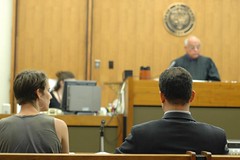
At issue was whether Holland’s fixed gear bicycle met this requirement. She and her lawyer Mark Ginsberg thought it did, but Officer Barnum of the Portland Police Bureau thought otherwise so they brought the matter in front of a traffic court Judge.
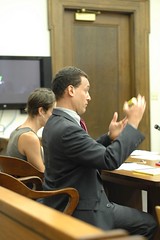
According to Officer Barnum, he stopped Holland at SW First and Jefferson and told her that she was in violation of the law and that she must put a front brake on her fixie to avoid a ticket. Holland disagreed. She and Ginsberg claim that Oregon statute does not clearly define what a brake is and that as long as a bicycle can perform a “skid on dry, level clean pavement” it does not need to have a separate, traditional braking device.
At the start of the trial it was clear that neither the Judge nor the Officer understood just what a fixed-gear bicycle was. To help them visualize, Ginsberg likened a fixie to a child’s Big Wheel. Once everyone was clear and the cop was finished with his opening testimony, Ginsberg began his cross-examination:
Ginsberg (to Officer Barnum):
“When you approached the rider did she stop?”
Officer Barnum:
“Yes.”
Ginsberg:
“How’d she stop the bike?”
Officer Barnum:
“I don’t know.”
Ginsberg:
“The gear itself stopped the bike.”
Officer Barnum:
“But the gear is not a brake.”
From the outset, the judge seemed to agree with the cop and it was up to Ginsberg to change his mind. The trial began to hinge on the definition of brake. Ginsberg continued to ask questions of the cop.
Ginsberg:
“What is a brake?”
Officer Barnum:
“A lever, a caliper or a coaster brake hub.”
Ginsberg:
“Can you show the court where in the vehicle code a brake is defined as such?”
Officer Barnum:
“No.”
Ginsberg:
“Did you at any time during the traffic stop ask my client if she could skid (thus meeting the performance requirement of the statute)?”
Officer Barnum:
“No.”
At this point the judge seemed increasingly exasperated with Ginsberg’s direction and pointed out that “brake” was a commonly accepted term. To end this line of questioning, Ginsberg offered to demonstrate to the court that Holland could easily bring her fixed-gear bike to a skid on dry, level pavement. The judge declined his offer.
Now it was time for Officer Barnum to ask questions. He asked Holland,
“What would you do if your chain broke?”

Holland:
“I would use my feet.”
Officer Barnum:
“What if your leg muscles had a spasm?”
Holland:
“I’m not sure…these are emergency situations.”
Ginsberg interjected with a question for Holland:
“Did any of these situations happen on the day you were stopped?”
Holland:
“No.”
Now it was time for Officer Barnum to submit his closing testimony. He continued to argue that nowhere in the statute does it say gears can be utilized as brakes (it doesn’t say they can’t either). He also said that “motorists and the public deserve to have these bikes be properly equipped,” and that a “skid is not as good or safe as a stop.” “The requirement,” he said, “has not been met.”
Now it was Ginsberg’s turn. He said,
“The state is overreaching in seeking to define a brake as a lever and a caliper. The question remains; is the fixed gear the brake? The statutes are clear that the answer is yes.”
To solidify his point, he took out a huge Webster’s dictionary and opened it to the word “brake.” The definition stated that a brake is a “device to arrest the motion of a vehicle.” It did not stipulate anything about a distinct lever or caliper. In his last few comments he proclaimed that the current statute is not well-written and that it is “frightening to require only a front brake.”
With both sides at rest, it was time for the Judge’s final opinion. His contention was that the main source of braking power on a fixed gear are the muscles of the rider, not the gear itself. To this end, he questioned how messengers—whom he’s seen riding “much too fast”—could stop safely.
In the Judge’s opinion, gearing itself and/or leg muscles are not a sufficient source of braking power. He said,
“The brake must be a device separate from the musclulature of the rider. Take me for instance. I don’t have leg muscles as strong as a messenger…how would I stop safely?”
He then turned directly to Ginsberg and said,
“If your client had a stick she could rub against her tire, you’d have a case. I don’t believe the defense has convinced me to broaden the definition of a brake. I find the defendant guilty.”
So now Holland has 30 days to either attach a hand brake to her bike and pay a $73 fine, or appeal the decision. In talking with her outside the courtroom it seemed like she did not think the Judge’s opinion was fair and I wouldn’t be surprised if she and Ginsberg decide to continue the fight.
This decision by the Judge raises some concerns and questions. Will the cops now feel emboldened to go out and ticket everyone on a fixed-gear? Are fixed-gears now essentially illegal? Are fixed-gears truly a public safety hazard?
Fixed gears have become a huge trend across the country and with hundreds if not thousands of them in Portland, I don’t think we’ve heard the end of this issue.
Email This Post
Possibly related posts


July 28th, 2006 08:45
Hate to say it, but I'm with the judge. You can indeed stop without a (conventional) brake on a fixed gear bike (I ride one too, with brakes), but anyone who claims they can stop as quickly without a brake as they could with one is ignoring the simple physics involved. To reverse the situation, there's a reason you aren't allowed a brake at the velodrome - you'd suddenly be able to stop far faster than the other riders, and could cause a nasty crash.
July 28th, 2006 08:49
Lots of people (including me) have a brake on our fixed gears, and I think it's a very good idea to run a front brake for use in emergencies at least - not to mention hills... A skidding rear tire (or tires) is one of the least efficient ways for a vehicle to stop...
That said, riding brakeless FG is legal according to this statute, it should remain legal, and the judge and cop are both nincompoops.
July 28th, 2006 08:57
The judge clearly ignored the intent of the law, which is that bicycles must have a safe means to slow and stop. When you pull a brake lever aren't you using you muscles to stop the bike? This guy is a real brainiac.
It is worth noting that modern hybrids and electric cars are being designed to use their generators as brakes . . . no levers or calipers there. The naroow lever/caliper paradigm betrays a lack of intelectual rigor too. Not surprised to see a cop having a hard time getting his head around it, but a judge? Sad. Appeal.
July 28th, 2006 09:05
FYI - OBRA now requires brakes on fixies in races outside the velodrome.
July 28th, 2006 09:09
From what I know of conventional bicycle physics wisdom, the front wheel is far superior in its braking ability. This can be easily tested on any bike with good working brakes on both front and rear. The rear wheel will lock and skid with a fraction of the effort and braking effect. Further, when the rear wheel skids it looses all its tracking ability - in effect, it is not a wheel when it is skidding. The bike is nearly out of control if either wheel is skidding. It is, however, nearly impossible to lock up the front wheel. Unless one is braking hard in a turn, it is better to use the front brake. If one had to choose only one wheel for braking it would be the front wheel.
July 28th, 2006 09:13
Perhaps I do not understand the reluctance to have a brake on a bike, even it used for only emergency circumstances. Can someone explain? There are bigger issues to fight when it comes to traffic laws and the relationship between motorists and cyclists.
Take the $73 and buy a brake and beer and move on.
July 28th, 2006 09:14
But hybrids do not have ONLY their generators available to stop with. The question is not can you stop, or even stop safely, it's can you make a safe and expeditious emergency stop. Without a front brake (mechanism doesn't matter) on a two-wheeled vehicle, you simply cannot stop as quickly. Would you feel safe riding a geared bike with a broken front brake in downtown traffic?
Cruiser bikes with coaster brakes are an interesting counter argument, but they are rarely ridden at speeds comparable to a fixed or road bike, and put much more rider weight over the rear wheel.
Judges frequently rule on the intent of the law rather than the narrow wording. This was obviously the case here: he felt that a fixed rear wheel did not allow for sufficient braking alone to meet the intent of the statutory requirement.
July 28th, 2006 09:15
I also have a front brake, but from the physics standpoint, I wouldn't want to skid it. What if the cop's legs had a spasm, while he was driving?
regardless, the judge is wrong. If you can make the rear wheel skid, you have a brake. how else did it skid? the question is not how good the brake is.
July 28th, 2006 09:22
Skidding is a red herring. The point of the skid is to establish that braking pressure (regardless of the source) can be applied that exceeds the amount needed to overcome the friction between the tire and the road. The most efficient and safest stop is one where the braking force barely equals the friction between tire and road, slowing the vehicle at the maximum rate. This principle applies equally to both cars and bicycles. If you can apply enough pressure to skid, then you can apply enough pressure to brake.
That being said, hand-activated brakes will be more effective than coaster brakes or fixed-gear pedalling back-pressure, because the reaction time is less - nerve impulses travel quicker to the actuating muscles for the hands in your forearms than they do to the actuating muscles in your upper and lower legs. At high speeds the reaction distance can be as much as 3 times the braking distance. (note that this paragraph does not reflect on the law, only on safety)
The biggest argument for mechanical brakes over human leg power is maximum force. If there is enough friction to support large braking forces, the maximum force that can be applied by a rider on an upright bike is the rider's weight. (On a recumbant, it is the strength of the bicycle seat - most cyclists can leg press at least 1.5 times their own weight) The maximum braking force of a mechanical brake is limited by hand grip strength, but is typically much more than the weight of the rider.
Anyway, the point is, if you can skid, you can apply enough force to safely stop, and you've met the legal and practical definition of "braking". Obviously, Mr. Ginsberg is aware of this and the Multnomah County judge in question disagrees. It's simple physics, but physics is not intuitive for many people, judges included.
July 28th, 2006 09:27
While my fixie has brakes I believe the officers reasoning to be faulty. Your hand uses muscles to pull a lever and the logic of a chain breaking can also be applied to the brake cable snapping, or the caliper snapping. The logic could also be used in a car, what would you do if your master cylinder failed....
At least on a bike you could use your feet, doesn't really work in a car.
I would appeal
July 28th, 2006 09:28
I ride fixed with two caliper brakes. I'm not going to take sides here, but I think the skid is vastly underestimated in braking effectiveness...it seems that some folks consider braking to cease or something when skidding, but wow...dragging a locked-motion rear wheel, rubber frictioning against the pavement...it's slowing the bike, right? It's like "throwing an anchor out."
July 28th, 2006 09:33
Is it a weight issue, or an issue of "style points"? Let me guess, style points and nothing more. One can have that brake and save it for emergencies only.
I love my one speed, but I do have a brake, all $11 worth at City Bike. The extra weight is not a burdon at all, and as for style points, the bike is still cool.
Show me a quick stop on a no brake fixie on a steep fast downhill, and I will change my mind.
Ride safe, ride fast, stop fast...Safety first on shared roads, do what you want at the track or free ride park.
Tankagnolo Bob
July 28th, 2006 09:34
1) Shouldn't the cops also stop everyone with a 50 year old wornout coaster brake or who have oily, dirty rims and brake pads that won't stop the bike?
2) Skidding isn't as effective as a non-skidding rapid slow down, since the coefficient of kinetic friction is lower than than the coefficient of static friction.
3) I don't care if you're Major Taylor -- put a friction brake on your bike. Just about everyone eventually realizes that death by intersection isn't as cool as it sounds. However, it probably shouldn't be a legal requirement.
July 28th, 2006 09:34
This is ridiculous for a simple reason:
One, coaster brake, on the rear wheel of a bicycle, is legal.
A brakeless fixie cannot stop as fast as a bike with a brake on the front. But it can stop as fast as a coaster brake can.
If the law wants to say, "Bicycles must have a brake on the front wheel," that's one thing. But that's not where we're at.
---
FWIW, I have front AND rear caliper brakes on my fixie...
July 28th, 2006 09:36
Show me a hybrid car with no foot brake, silly analagy !!! One can downshift with a conventional four speed car too, but damn, there is that foot brake again !!! Give me a brake!!
Tankagnolo Bob
July 28th, 2006 09:38
"Will the cops now feel emboldened to go out and ticket everyone on a fixed-gear?"
well, i just got a $97 ticket yesterday for not having any brakes, so i guess so. the cop mentioned that they are cracking down on this now and that it was first brought to his attention at critical mass.
July 28th, 2006 09:39
I have a fixie in my stable. I practice with it. Braking with it is not as effective as with hand brakes. Think it is? Skid the tire immediately with the cranks in the 6 and 12 o'clock positions. Also, think about other people and not just yourself. If you were the only person on the road, or with other fixies that would be fine... but outside of the 'drome, that's not the case. I understand the desire to ride without traditional brakes on the road but in the end it isn't as safe.
July 28th, 2006 09:49
"This decision by the Judge raises some concerns and questions. Will the cops now feel emboldened to go out and ticket everyone on a fixed-gear? Are fixed-gears now essentially illegal? Are fixed-gears truly a public safety hazard?
Fixed gears have become a huge trend across the country and with hundreds if not thousands of them in Portland, I don’t think we’ve heard the end of this issue."
Re-read your own report ... the judge found the rider guilty for riding a fixed-gear without a brake; he didn't rule fixed-gears "illegal" ... just because you put a brake on the thing doesn't mean you actually have to use it.
July 28th, 2006 09:55
Why on earth would you not put at least a front brake on your fixed gear street rider? That is just absurd. There is no good reason for it at all.
Worried about weight? Take a crap before you ride. Jeez....
July 28th, 2006 09:59
Absolutely Ludicris.
Sad that cops and judges can't spend some time on more signficant safety issues. We all know there are bigger fish to fry.
July 28th, 2006 10:01
Seems like people are answering two questions:
first, does it make sense to have a hand brake?
second, does the law require it?
I think that Mark's right about the law. If he was using Webster's Third New International, which I think is the standard dictionary for lawyers, and no where else in the vehicle code is brake defined, the court is simply wrong.
The judge's reasoning is bogus. Brake separate from musculature? For hand brakes, that's a part of the bike; for fixies, that's the gear, part of the bike.
There's another interesting question: why did the officer ticket the messenger? Dangerous riding? In fact, the messenger was able to stop, which was the purported reason for the ticket: inability to stop.
We'll see what we can do to get the police to stop giving out these tickets, and to focus on true traffic safety problems.
July 28th, 2006 10:06
The bigger question is why are we allowing a handful of non-experts push definitions of law without doing their homework to educate themselves into making sound decisions based in scientific evidence?
What I see is that your opinions do not matter. Now take your ruling and your brake and go home.
July 28th, 2006 10:07
Does anyone else think this might open up precendence for the standardization of what is "street legal" for bicycles? I know there are already laws about reflectors and lights, but do we need to start regulating transmission and braking systems?
"Yes Officer, my bicycle is cleared by the BTA."
I personally don't feel like I have enough braking control on a fixie and would feel reluctant to ride around town without at least one handbrake. This is MY choice. However, I don't think people who ride the fixies go "much too fast" or don't have the control.
What the hell is this "much too fast" shit? Bicycles still can't contend with the speeds of any motorized vehicle and can rarely exceed the speed limit of any regular traffic. So even at top speeds, aren't we still safer than cars and motorcycles and scooters?
Fight this ticket! Fight!
I'm a little irritable today...
July 28th, 2006 10:15
I was in court yesterday and witnessed another biker who has been ticked for "biking while fixed".
I dont want to tell people how to live or how to ride. I dont care if someone is riding a freewheel and rely only on their 'sole brakes' to stop. If track bikes aren't causing us to be less safe why should anyone care? (note: cars are the number one killer of people under the age of 38)
This is more about whether we choose to force others to live by our standards. total bullshit. People are dying, and cars are the reason. The cop is pathetic.
July 28th, 2006 10:20
I commute (and race) a fixie with a front brake. I sometimes just use legs to stop and sometimes I use the front brake and sometimes (most times) I use both.
I think this is a bogus ruling because Ayla was able to stop (without 'brakes'), however I think that there actually is a safety issue out there.
Not everyone is as skilled as the brakeless messengers riding around. A few days ago I watched a girl semi skid through the intersection coming off the broadway bridge going into town. She would have been creamed by a car making a legal green lighted right hand turn if she hadn't skidded, turned, and almost put her bike down (furthermore, she almost crashed into me). A foot or two more into the roadway and she would have been creamed.
So I guess what I am saying, is that the police are justified in ticketing bikes for not being able to stop (regardless of the type of bike). If the rider can stop using his or her legs, more power to them. Frankly, though I fear for those that are emulating the messengers and can't stop very well, but are riding brakeless (for the cool factor).
I feel bad for the messengers, as they are the ones that are going to feel the heat (and they are the ones most likely to be able to stop)
BTW: Another 'scary' trend I is the 'fake fixie'. ie a Single Speed road bike- with a freewheel and only a front brake. This is a recipe for disaster.
July 28th, 2006 10:20
I'm curious: can a fixie without hand brakes stop as quickly as an automobile going the same speed?
Does anyone know if there has been any data collected on this?
July 28th, 2006 10:20
Stop flaming the persons' personal preference for braking methods. The fact is you can brake on a fixed gear bike. the rider stopped when asked to. efficiency or lunacy, is not in question.
July 28th, 2006 10:26
Sorry, I'm with the judge an the officer on this one. I ride a fixie on the streets and yes, it has real brakes. Why in the world would you not outfit your bike with a brake?
Brakeless bikes are for the track, not the street.
If you want a track-legal fixie, get a _second_ fixie and don't bother putting a brake on that one.
July 28th, 2006 10:40
skateboards don't have brakes and they can legally operate in the downtown streets.
July 28th, 2006 10:51
The Segway doesn't have "brakes", does it?
July 28th, 2006 11:03
What about a unicycle? Does this mean I can no longer go around town on my Uni? That's technically a fixie too, isn't it?
UNICYCLISTS UNTIE!
July 28th, 2006 11:21
As far as legal definitions, this seems pretty easy to defend:
A. A brake is "a restraint used to slow or stop a vehicle".
B. The State already condsiders engines as brakes as demostrated by road signs "No Engine Braking Allowed". Legs are the bicycle's engine. The engine can be used as a brake.
Simple no?
Mr. Ginsberg?
John Boyd
July 28th, 2006 11:25
The Oregonian has picked up this story. It's already on their blog and should be in the paper tomorrow.
July 28th, 2006 11:35
As far as I know, skateboards aren't considered vehicles under Oregon state law; bicycles are. That's the legal difference. As for unicycles...?
July 28th, 2006 11:40
First off, any experienced fixed gear rider, like a messenger can stop a brakeless fix at least as well as a BMX bike with a rear handbrake will stop. I have read the law, and if the requirement is that you must be able to lock up the wheel, than skidding on a fixed meets that requirement. I hear you "But there is no brake." Yes there is, it is the fixed hub. You resist the forward motion with your legs and the bike stops. That sounds like a braking action to me.
The other thing about this law is that a freewheel singlespeed with just a front brake does not satisfy the law, even though applying the braking force on the front wheel will stop a bike quicker than anything, it will not make the wheel skid, cuz your weight transfers toward the front of the bike when you brake.
The law needs to be re-written by someone who understands how bikes work and what a rider's capabilities are.
July 28th, 2006 11:44
It's a faulty argument to make the case that engine braking in a truck is equivalent to leg braking on a fixie: every single one of those trucks has mechanical brakes and is required by law to have operational mechanical brakes. Sure, the engine can be used as a brake, but it is not their sole method of braking.
July 28th, 2006 11:52
Its been said several times, but maybe we need to go over it again. There are TWO questions:
1. Is riding a brakeless fixie safe?
2. Is riding a brakeless fixie legal?
I guess we can argue about whether or not it's safe, or whether it SHOULD be legal, but hose are beside the point of this court case.
To me this case is about whether cops can ticket you for riding something they don't think is safe, even if it is completely legal. If you think about it, riding in a car is safer than riding on a bike--so what would keep a cop from ticketing ALL bike riders now, just because he thinks its not safe?
It's not about safety, it's about whether cops can make up the rules as they go along. This sets an awful precedent and all cyclists and all citizens should be alarmed.
July 28th, 2006 11:53
Some other points:
The first "safety bicycles" were fixed gear without caliper brakes. The coaster brake camealong later. So, if you go far enough back in history, the "traditional" way of stopping a bike is by resisting the forward motion of the pedals.
If the chain broke or derailed on a coaster brake bike, you would also be left with no brakes. I had my chain come off my fixed on Broadway, going downhill. I stopped by rubbing my foot against the side if my tire.
July 28th, 2006 11:55
The point is that "brake" isn't defined by the law. It's fine & dandy that the judge says that "brake" is a common term, but a parking brake meets the common term definition of "brake" and yet doesn't meet the restrictions of the law.
July 28th, 2006 11:55
While I think a front brake is a good idea, by no means should it be required if the rider can come to a quick controlled stop. Whether it's a stick, feet, or 8" disc brakes.
As far as the skateboard having no brakes point? I got a ticket the other day for doing powerslides going down a hill. A powerslide is by far the quickest and safest way to stop on a skateboard if done properly. The officer called them crashes. I got a ticket for "improper position in the roadway." He also lied to me, and said several time, "skateboards are not allowed on any street in portland, maybe you should read up on your law."
I see some parallels here...
July 28th, 2006 12:00
“The brake must be a device separate from the musclulature of the rider. Take me for instance. I don’t have leg muscles as strong as a messenger…how would I stop safely?”
Um.... don't pedal as fast in the first place? This is a good example of a poor judgement by the justice in question. If you are unable to cause the wheel to skid at any speed, don't ride a fixie. If you can cause it to skid, but not if you're going 20 mph, then SLOW DOWN. Riding / driving too fast for conditions is a whole 'nother issue, and involves a completely different statute.
July 28th, 2006 12:02
We can "what if?" all day. For instance, what if the cable snapped on your freewheel-equipped bike? "What if you went to squeeze the lever and had a sudden attack of carpel tunnel syndrome.
Also you can "skip stop" a fixed bike too. A skip stop is when you lift the rear wheel and set it down while resisting the forward motion of the pedals. Do this 3 times and you are at a complete stop.
Sorry for the multiple posts but this subject hits on about 18 of my pet peeves about peoples perceptions of what is safe on a bicycle.
July 28th, 2006 12:04
Interesting discussion. How could the officer possibly know that it isn't a coaster brake? What if the chain on my 1970's Schwin Cruiser breaks? Same problem.
But as a fixed gear rider for several years, I have absolutely no doubt that a fixie with a front brake can stop faster than without. And if the rider is tired, it can make stopping even more difficult. Sheldon Brown, whom I consider the preeminent authority on the matter, agrees: http://www.sheldonbrown.com/fixed.html
And another thing...it is bad form to lock your elbows!
July 28th, 2006 12:07
I don't like the precedent that this decision sets. The judge seems to have made a call based on what he believes is safe - while not even understanding the terminology/mechanics. Not based on the reading of the law.
Was the 'anti-bike cop coalition' sitting around in the donut shop at their monthly meeting when one of them came across the legal definition and had a eureka moment?
I hope this is appealed...
July 28th, 2006 12:09
If this is the case can somebody please ticket the meth-heads that come screaming into an intersection with no brakes and their feet dragging trying unsuccessfully to slow themselves down?
July 28th, 2006 12:16
maybe the cops should carry around brakes like they did with lights and give them away for free
July 28th, 2006 12:17
1. When I was 10 I took all the brakes off my BMX bike and used to stop by mashing my shoe against the rear tyre. My mum used to get so mad, I went through shoes pretty quickly.
2. I want to know how much dinero Ayla is paying Ginsberg. So far a $73. fine and a brake seem like they would be cheaper than fighting the legal battle. Mark must be doing this pro bono.
3. Come on we all know what the heck the law means. The judge may be an nincompoop but he wouldn't be forced to use nincompoop thinking if we (cyclists) weren't trying to make such a ridiculous argument.
4. I used to ride without a helmet when I was a kid- gasp!!!!
July 28th, 2006 12:20
I guess I'll have to send my newly restored Penny-Farthing bicycle to the dumpster.
July 28th, 2006 12:22
Exactly Chris--this is only a notable case because the cop and judge use their own idea of what is safe on a bike, rather than any reasonable reading of the law itself.
It doesn't matter what the law should be--take that up with your congressman. It does matter what the law is. Brakeless fixies are legal, which is qute a different question from whether they should be legal.
July 28th, 2006 12:28
Good point Adam. But there is the rub, and the reason we have more lawyers than social workers, you see the letter, not the spirit of the law.
July 28th, 2006 12:31
Well, there's a lot of room to disagree on the spirit of the law. Some people think fixies are safe, some don't.
I just don't want a cop ticketing me for his idea of the spirit of the law.
July 28th, 2006 12:46
This is not a matter of opinion. A bike equipped with brakes can stop faster and safer (no skidding) than a bike with no brakes.
July 28th, 2006 12:49
It seems that any way you look at this case was a bad decision.
Interpreting the law literally no caliper fixed gear bikes are legal.
Interpreting the law more liberally fixed gears stop as quick as or quicker than old coaster brake equipped bikes or caliper/steel wheel bikes in the rain. Unless the police want to use this decision as precedence to pull over any bicyclist on a crappy department store bike, it should be appealed.
That said, I have a front brake on my fixie. It’s a nice option when you are tired.
July 28th, 2006 12:54
And a bike limited to very very low gears (say, 39/21) can stop faster than bikes with several gears. There is a whole range of possible designs yielding a range of stopping distances, and the usual two-brake freewheel is by no means the fastest-stopping design.
There are obviously design considerations besides stopping distance at work here. The law puts a clear minimum on braking ability, and brakeless fixies meet that limit. All else is a matter of taste.
July 28th, 2006 12:55
well, we'll see if cops hand out tickets tonight won't we. CM usually has some fixed there and an assload of cops soooo....only time (a few hours) will tell
July 28th, 2006 13:10
a couple things I'm not sure were mentioned:
someone riding a fixed gear cannot accelerate beyond what their ratio will allow, they can't coast to reach higher speads. Ride too fast? maybe, but not as likely.
also, what if someone who rides with a coaster brake has their chain pop off? It's an identical scenario.
July 28th, 2006 13:11
im sure who ever wrote the law had no idea that there were bikes out there that didn't "coast".
and thanks Joe, I forgot that today was CM day.
July 28th, 2006 13:16
True, depending on the brake and the rider, but it doesn't matter since the law doesn't concern itself with "faster" or "safer," instead it sets a defined standard.
How could the judge conscientiously decline a demonstration of how the bike could stop legally?
July 28th, 2006 13:36
Stupid. "what if you had a cramp, what if your chain broke?"
really? what if your brake cable slipped/broke, what if you ride a walmart bike and your brakes (even in good working order) cant stop you
"In the Judge’s opinion, gearing itself and/or leg muscles are not a sufficient source of braking power."
Well in this case I am glad we don't rely on hand muscles to use hand brakes!
July 28th, 2006 14:00
The intent of the law is to keep you and other people alive. It is idiotic to ride a fixed gear bike without at least a front brake on public roads. I'm out every day commuting 40 miles on a fixie, the front brake has saved me more times than I can count.
July 28th, 2006 14:15
Here is the statute as it pertains in it's entirety, quote:
(a) A bicycle must be equipped with a brake
that enables the operator to make the braked
wheels skid on dry, level, clean pavement.
John
July 28th, 2006 14:29
Here's what the statute says:
A bicycle must be equipped with a brake that enables the operator to make the braked wheels skid on dry, level, clean pavement.
This has always been a topic that was open to interpretation, like many things in law. Brakeless fixie riders, and folks in this thread, interpret the "brake" here as being the fixed hub. That's a plausible interpretation.
The problem, though, is that the statute says that a bike must have (1) a BRAKE that (2) can cause a SKID. According to the (sometimes contradictory) rule of statutory interpretation, another very plausible interpretation is that the statute requires not just the ability to skid, but also a brake mechanism.
I ride a fixie, so I know the operation of fixies. I doubt that an appellate court is likely to reverse this ruling. The reason is that a reversal would force the the appellate court to interpret the statute to mean that a brake is NOT required by the statute, just the ability to skid the bike. Not only does this jdgment seem to fly in the face of the plain language of the statute, but there is little social benefit to stretching the interpretation.
July 28th, 2006 14:34
When you brake a rear wheel, your interia propels you forward, lifting your rear wheel. The wheel loses traction and thus grazes the road surface in a skid with a stopping force approaching zero. People can skid their fixies for several hundred feet because their weight is over the front wheel and the rear wheel has virtually no contact with the road.
The worst part of the law is that the brake simply must be able to skid a wheel. A front brake can stop you more than twice as quickly as a rear brake...(.67g versus.30g) but it can not skid a wheel!! You will be thrown over your bars before you skid the front wheel; at which point you have reached the terminal braking ability for that bike's geometry (or at least exceeded its practicle braking force).
The law is an inversion of what is actually safest. And putting a front brake on will not help her conform to the law any more than she already does.
Other states require that the bikcycle be able to stop at a given speed within a given distance.
Jobst Brandt says:
http://draco.acs.uci.edu/rbfaq/FAQ/9.17.html
July 28th, 2006 14:43
Hey Pooh and all you other folks who are using the "I think you're an idiot" arguement.
That is THE SAME arguement that the anti-bike folks use to justify telling us to get off the road. Just read "Dean's" comments on the whole 95.5 madness.
I ride a fixie and I use a front brake. I recommend a front brake. But the issue at hand is not personal preference. It is whether personal preference and ignorance should trump the rule of law, which is what I would say the judge and cop are guilty of. The law is simple if somewhat vague. It mandates a "skid" which a fixie can provide.
Ironically the cop stated that a front brake needed to be present. Good luck trying to get a front wheel to skid on clean level pavement. 99% of the time you won't be able to do it and therefore you would NOT meet the standard set forth by the law.
Another example of laws being applied to bikes by people who do NOT ride. Messengers riding to fast?? What the heck does that have to do with anything??
Most of the good arguments have been made. Whether a chain brakes could be asked about the cable. Leg spasm? Are you kidding? blah, blah, blah.
I can't wait til all the heretofore "unbraked" fixies put on a rear brake and a lever on their seatpost. "Hey cop, I've got my brake."
July 28th, 2006 14:44
[...] More on the court case here, and some lively debate in the comments section. [...]
July 28th, 2006 14:48
So according to the judge, any vehicle that uses regrenerative brakes would also be illegal.
http://en.wikipedia.org/wiki/Regenerative_braking
July 28th, 2006 14:55
The law was obviously written in the 50s or 60s when coaster brakes were the brake of choice on most bikes sold in American.
What really irks me is how the cops seem to be spending all their time and effort busting fixie riders, critical massers, zoobombers and bike commuters on bicycle boulevards, as if any of these activities is an outstanding threat to public safety, instead of focusing their efforts on motor vehicle operators, who are the real safety threat on our roads.
July 28th, 2006 15:00
maybe i'm missing the point...but if this is a safety issue i feel that there are other things that a focus should be put on (i'm personally more concerned with p.o.s. cars on the road, horrible drivers, debris on road ways, etc., than folks on fixies w/o a *brake*)
i was given the same ticket last february after critical mass (fixie, no brakes). we had just crossed the hawthorne bridge. i was tired, indian food had spilled in my bag. the ride turned right, i continued straight towards home. so at this point i wasn't even a participant in the ride any longer. there were three or four motorcycle cops sitting in a parking lot just west of 7th on hawthorne. the light at the intersection i just mentioned was red. i stopped. as i'm sitting there at the light i just stopped at, two cops on motorcycles pull up behind me with their lights on. they said to pull over, which was really funny since we were all sitting completely still. i asked where. they said to walk over to the sidewalk. we bickered about brakes and safety and skidding and broken chains and all that crap. the cop went back and forth and for a few minutes i thought he'd be cool and understand how ridiculous the situation was (i was at a red light that i safely stopped at...right in front of him!). alas, he gave me a ticket. i told him thanks for tackling the real issues that plague our city streets (satisfying!)
i went to court, he didn't show, ticket was dropped.
July 28th, 2006 15:15
Portland judge: Brakeless fixie is bad...
A Multnomah County judge has ruled that the ability to skid with a brakeless fixed gear bicycle does not meet the Oregon statutory requirement for a bicycle....
July 28th, 2006 15:41
I have been a part of this wizzing contest for time three here, I now ask the question, HAVE ANY TESTS BEEN DONE TO COMPAR?. IN THE CAR WORLD, I AM SURE THERE ARE MIMIMUM STOPPING STANDARDS FOR BRAKING. HONDA CAN NOT JUST COME OUT WITH A CAR THAT TAKES THREE MILES TO STOP.
HAVE TESTS BEEN DONE TO SHOW A FIXIE CAN STOP IN THE SAME DISTANCE AS A GOOD FRONT, OR COASTER BRAKE. LETS BE SCIENTIFIC HERE, IF A FIXIE WITH AN UNSKILLED RIDER CAN STOP AS FAST AS A COASTER WITH AN UNSKILLED RIDER, THEN LET THE UNBRAKED FIXIE ROLL, IF NOT, KEEP IT ON THE TRACK. - TANKAGNOLO BOB X 3
July 28th, 2006 15:44
You can ride faster with a brake than without because you don't have to maintain such large buffers. Why not ride closer to your limits?
That given, I can see why one would want the extra thrill of not having brakes. I'm one of those dorks with front and rear and fixed and have at times used all three brakes in panic situations.
But I do believe that riding without calipers, that is only with the legs and chain, counts as brakes under the law. Seattle Police recently said as much in the local newspaper. Sorry, your Portlanders.
Oh yes, cars stop faster than bicycles from the same speeds. Cars don't have to balance while stopping after all, and can skid or ABS all four wheels. Strangely, semi trucks stop much more quickly when they are fully loaded.
But back to the case, the judge didn't allow evidence of actually seeing cyclist brake. I wonder if that evidence can be added on appeal.
July 28th, 2006 15:49
I have had some experience dealing with statutory construction, and my gut tells me that any appeal by Holland would fail (I certainly wouldn't take it on). I don't have the time right now to review the legislative history to figure out exactly when the current language re: brakes was enacted (the statute containing that provision was enacted in 1983, but has been amended a number of times since then), but it doesn't really matter because the appellate courts only look to legislative history when the language is ambiguous and my guess is that in this case the court would not find any ambiguity. For some fun bedtime reading, may I suggest the case of PGE v. Bureau of Labor and Industries, 317 Or 606 (1993), which sets out the approved methodology for statutory construction in Oregon. In a nutshell, PGE v. BOLI holds that when construing a statute, the appellate courts look first to the text of the statute in context. If the statute does not define a term, the court looks for its plain and ordinary meaning, usually using Webster's 3rd International, but not always. The court will not look to the legislative history unless it finds that the statute is ambiguous. Interestingly, this has led to cases where the legislative history has indicated one thing but the court has found that the statute's text unambiguously said something else. In one such case the court even said something like "that may be what the legislature intended to do, but that's not what it did."
Anyway, the rule of construction that is important here is that the court must give effect to all provisions of the statute. In this case, as has been pointed out, the statute requires not just that the rider be able to skid the braked wheels on dry, level, clean pavement but that the rider do so by means of "a brake." Because the statute does not define "brake," the court would turn to the dictionary and most likely adopt the definition noted in earlier posts.
July 28th, 2006 15:59
"If your client had a stick she could rub against her tire, you’d have a case."
What? Maybe she should have argued that since she could have stuck her messenger bag, or her arm, or a squirrel into her spokes.
July 28th, 2006 16:16
Perhaps "the stick" will become the new rage in hipster bike schwag...
eg. "Damn. Is that the new Merckx hand-turned ash brake stick? I should get one of those. I just broke my maple Cinelli and four spokes. I was looking into these Japanese bamboo brake sticks online, but I can't find an importer..."
July 28th, 2006 16:20
I didnt have time to read all the comments, so I dont know if this has been covered, but if the law will say that you need a front brake, does that mean that bikes with just coaster brakes are against the law?
Peter
July 28th, 2006 16:27
I was just thinking about something.....
This is pretty ridiculous. Is it the judge's job to interpret the law or to uphold the laws? (I don't know the answer)
How COULD the judge refuse the demostration? Anyway, if the appeal takes money to pay the attonery, I'll poney up the first $20.00.
There I said it...... anyone else?
July 28th, 2006 17:02
Statutes are interpreted according to their plain meaning. The lawyer's argument was a losing one, demonstartion or no. The judge's job in that court was both fact finder & interpreter of the law. The plain wording of the statute was sufficient to render his verdict, not withstanding the absence of a definition within the staute itself. Oregon Vehicle Code does indeed define the word "brake", and had the judge chosen to write an opinion he would have used it. But this is traffic court...
That said, I don't like the idea of getting a icket for riding my track bike on the street.
July 28th, 2006 21:40
Brad said: "Strangely, semi trucks stop much more quickly when they are fully loaded."
Actually, almost every vehicle stops better fully loaded, due to increased friction with the ground. It's the same reason why front brakes work so much better than rear brakes - when the bike's CG shifts over the front wheel, there is more weight over the wheel and therefore, more friction, allowing a quicker stop without skidding. In the case of the front wheel, the wheel is so far forward of the normal Center of Gravity that it's effectively impossible to skid - greater forces shift the weight further forward and increase ground pressure and friction under the forces involved exceed the weight of the bike and rider - at that point, you get catapulted over the handlebars.
The same thing happens with cars, trucks, trains, busses, etc, though the forces don't exceed the weight of the vehicle in most cases, so the vehicles tend not to flip.
July 28th, 2006 21:45
I ride fixed, but always with a brake. In my opinion, it is very foolish to not have a brake and ride in traffic. I don't care if you can "Skid" or whatever (yes, I can). It is inherently less safe to ride without a brake, regardless of wether you lose style points.
This is just a case of a growing group (cyclists) finally being asked to have a safety standard. Hopefully this kind of thing can eventually lead to the acceptance of cycling as a viable transportation alternative by the population at large.
July 28th, 2006 21:53
Here's wehre I take issues with the judge and the cop's reasoning. They qualify a brake as
"A lever, a caliper or a coaster brake hub.”
All well and good. However, when the defendant made the case that she was able to make the rear wheel skid using soley her fixed rear hub, the officer replied with a "what if" emergency scenario involving a broken chain, in a (presumably successful) attempt to discredit the stopping abilities of a fixed gear rider in an emergency situation.
Now the double standard that the officer is operating under should be obvious. What happens if the chain brakes on a bike equiped soley with a coaster brake rear hub? You're equally as S.O.L. on such a bike as you would be on a fixie. Does this mean that officer has the discretion to target coaster brake riders as well? Will he target them? Or is he just being discriminatory to fixed gear riders, presumably due to some preconcieved notion of their "counter-culture" status?
That's the biggest part that bugs me I think. I'm still not going to put my brake on for the same reason that I never ran a front liscense plate on my car. If I get popped for a ticket, I'll throw a brake on, take a picture of it and take it into court where the photo will show that I am now in compliance with the law.
July 28th, 2006 22:08
In a pinch you can also stop a fixed by (very carefully) rubbing a gloved hand on the top of the front tire. Was she wearing gloves?
If anyone wants to know how to convert a coaster brake to fixed gear to fool the cops let me know.
I think if you had a hub with a fat middle like a Phil Wood you could take out the left side spacer and put a coaster brake anchor arm in there and clamp it to the frame. "No sir, Officer, it's not a fixed.See,it's a coaster brake!"
Once again I will state that if you know what you are doing, select a fairly low gear, and pay attention to the road, a brakeless fixed is plenty safe. If I want to ride at my limit I flip my wheel over and use the 15 tooth sprocket at the Alpenrose Velodrome. If I want to hit some hills I ride my fixed road bike which has center-pull brake at both ends. I can't put brakes on my track bike, it does not have brake mounting holes.
July 28th, 2006 22:12
Ok - some notes on what's been commented so far:
Under the ruling, unicycles are illegal for street use. Unicycles are considered bicycles under the definition given in ORS 801.150. Segways *are* legal - they are exempt from braking requirements under ORS 815.135(3)(d).
ORS 815.125 stipulates that brakes must be adequate to control the vehicle and must be in good working order. It describes the type of brake required for MOTORIZED vehicles, but not for unmotorized ones.
I am not a lawyer, but the judge is probably correct for the following reason:
ORS 815.820(2)(a) A bicycle must be equipped with a brake that enables the operator to make the braked wheels skid on dry, level, clean pavement.
The key word is: equipped. It's going to be really difficult to argue that a human being is bicycle EQUIPMENT. One could argue that equipped means affixed or attached. There's some room for debate there, but I'm starting to think that the definition of "brake" isn't going to be as important as the definition of "equipped".
Websters says "equip" means "to furnish or provide with whatever is needed for use", so maybe that's not actually an issue.
Hmm... Food for thought, anyway
July 28th, 2006 22:31
Sorry, the hub is the drive when you pedal forward and the brake when you resist (the forward motion of the pedals). Just like a coasterbrake brake or even a lever operated brake you have to act on it for it to work.
July 29th, 2006 01:16
Why would a cop bother to stop someone because they stop their bike using leg power and a chain instead of hand power and a cable, or instead of leg power and a hub? Why did it happen to the woman in this story?
It is frustrating to think that our tax dollars are being spent to harass cyclists when there are such dangerous things happening with cars. I drive a car as well as ride a bike. Driving a car in the metro area (actually anywhere in the USA) is dangerous and scary. Almost every time I get in my small car I end up with a monster truck, SUV, or some type of vehicle riding my ass endangering my life and the lives of any passengers I might have. I am not a slow driver. This is a form of road rage. This is illegal behavior, it is very dangerous, and it happens constantly at all speeds, but I'll bet few tickets are given out for it. Are the cops afraid of road-ragers? Apparently.
I'm in a local burb, and out here we are plagued by cars with illegal exhausts. Small, meaningless subhumans (runts) modify them so they whine loudly. I call them "runt-mobiles." It is clearly illegal, yet they seem to run the streets with no fear of the cops. Are the cops afraid of the runts driving runt-mobiles? Apparently.
I guess it is safer to stop a person on a bicycle than to actually do real police work.
We need to take away their cop cars. I mean ALL COP CARS. Put them in small unmarked cars. Honda Civics, Geo Metros, Toyota Tercels, etc. Use standard license plates so they are not marked as cop cars. Put lights in the grill or use magnetic mount lights on a cord that the cop can attach in a second to the roof. Put EVERY cop in those small unmarked cars on the strets and freeways and have them to write road-rage and illegal-equipment tickets by the THOUSANDS EVERY SINGLE DAY. In a few months there would be a difference. But as long as the cops are being pussies, harassing cyclists, and hiding in marked cop cars (so the criminals know to straighten up cause there's a cop car nearby) nothing will change.
After a few months and after literally hundreds of thousands of tickets were written here in the metro area, the roads would be safer for motorists. This place would have a reputation that you drive courteously or you're getting a ticket! Would the streets be unsafe because the cops had not been harassing cyclists for those months? Not one bit.
July 29th, 2006 01:49
regarding post #44 by the other chris: i think the cops hang at starbucks these days.
also one thing i'm not sure that has been addressed is risk compensation (for all y'all who think it's crazy/foolish/stupid/shouldn't be done, riding fixies minus brakes). i think having brakes encourages you to ride faster, that front brake gives you false security and confidence.
i usually ride one of my two brake-less fixies (down interstate, both geared 45x15 and i have no problems stopping at the light at greeley if it's red). i cruise at a pretty good clip on my way to work, but on days when i ride my touring/road bike to work i absolutely fly. i haul ass. i know i've got the brakes to jam on if need be. i have fun but i bet overall i'm *safer* on my fixies (cuz not having those brakes really makes me think about every car i'm trailing and every light i'm approaching). that's just me maybe...
July 29th, 2006 01:49
Sounds like the cops in Portland don't have enough real work to do these days, on the upside I guess that means you all have a really nice city!
I'm glad so many people here care enough about the safety of their fellow riders to encourage or pressure us all to rock a brake or two.
But why not extend the scope of safety from beyond the road and into the home. I for one wear a helmet every morning in the shower, you just never know if you're gonna slip. Even experienced bathers should consider reducing the risk.
And while we are at it, how about a manditory seatbelt law for every city bus with a strictly enforced no standees rule. Enforced, that law could be even more lucrative for the city than just fares alone. But mostly, it's about safety.
yep, good ole public $aftey! cha-ching.
I'm also concerned about those cirque du soleil acrobats, maybe they shouldn't go spinning around so high up on those bolts of fabric or balance themselves on tiny poles in the air.
I myself would never do that.
Whether it's got brakes or no brakes, 1 wheeled 2 wheeled or 3 wheeled i don't care. i just really love bikes, I love them almost as much as I love freedom. I kinda think the two go together quite well.
July 29th, 2006 05:43
Here's the Oregonian's story on this case.
July 29th, 2006 07:54
I agree with the judge, and with the statute (though perhaps the language could be made clearer and much more specific).
A brake is a brake. Bikes need brakes to better guarantee the rider will be able to stop safely. I've told my customers this for years and I haven't changed my mind yet.
The shop where I work will not sell a fixed gear bike without affixing a brake to it. Slug Velo won't allow brakeless bikes of any kind on the rides. Now I;m told that OBRA is requiring fixies at the velodrome to be outfitted with at least one working brake.
There's a reason for all that, and it's not discriminatory, it's for the sake of everyone's safety. Period.
Ride safely, folks. --Beth
July 29th, 2006 09:37
how canyou try to be, in good conscience, negating what anyone said by simply trying to call them stupid--in one of the more facetious statements here. That's just plain ignorant.
Force messengers to use brakes on fizies, sorry if it destroys your image, but it's safer for everyone. I see many people on fixies stopping very dangerously without brakes everyday zig zaggin all over the road, you call that safe? Keep track bikes on the damned track!
And yes you can equate the safety of riding a bike through a stop sign as being just as dangerous as if a car or motorcycle did the same; however, the end results would bode far worse for the cyclist.
for shits sake people the police aren't trying to terrorize anyone, they're just trying to protect the welfare of everyone. give them a break. or would that ruin yoru image too?
July 29th, 2006 09:45
we do ride safe
July 29th, 2006 10:11
I too ride fixie, both at Alpenrose on the track and on the street. However, for the last 4 years I've been riding my street fixie, geared 53X15 for flat or 53X19 for hills I have also had a front brake to supplement the control and braking that my rear wheel backpressure gives me, as, even with my big legs on the 53X19 on the flat I can't come to a stop fast enough to avoid the likely idiot car turning in front of me! I don't like to see anyone forced to do something they don't want to, albeit it be for "style point reasons" or for any other reason, but my interpretation of the law, regarding the word in the ORS "equipped" seems pretty clear. Also, I'm not the only fixie-rider that rides tall gearing and and can go 25MPH+ on the street and all it would take is a bad fixie bike accident without at least one "court-recognized brake" to allow the PPB to come down even harder with their own double-standard interpretations of the laws . Remember about 2 years ago when the Motorcycle Cop in charge of the CM detail threatened most of a Critical Mass on 23rd at sunset with ticketing/arrest if they did not have a battery-powered rear red light, as "a reflector is not safe enough? Those that got tickets, of course, got dismissals in court as the related ORS states "reflector or light"....
July 29th, 2006 11:00
my best friend and I were just talking about this. the judge said that "I don't have the leg musciles as strong as a messenger....how would I stop safely" well I think that expercience is key. for example someone that's a new driver that doesn't have experiance isn't going to go out and drive a stick shift that doesn't know how to drive it right? they're going to keep to an automatic. Messengers ride fixies cause of the experiance and muscle they have. why would he try and ride something that he just said he would be incapable of doing when there's other options out there for him. the fixies are the "manuals of the bikes" while unfixed ones are the automatics.
July 29th, 2006 12:07
just because there is a brake on our fixies doesn't mean we need to use it......we are still riding our fixed gear. i don't want some jackass judge who has no idea what he is talking about telling me what i can and can't do. if the judge would accept evidence of the ability to skid to a stop.....whatever, i'm gonna go ride.
July 29th, 2006 12:37
Bikes don't stop people. People stop people.
Change the law. All riders must demonstrate at least a .6-g stop, regardless of unholy contraption. You will find most of the brakeless messengers passing the test and a large number of the general population banned from their bicycles, well equipped with handbrakes though they may be.
Robert
July 29th, 2006 12:52
I have many,many things to say about this issue.
I will be adressing them this weekend, on our site, http://www.portlandmessenger.org/.
The main comment I have to say here, today, is this:
The comments here seem to reflect the thoughts of the police, the judge, and others in control.
I believe Bill Murray said it best in "Caddyshack".
"We mock what we do not understand"
For these same reasons, for example, we are barely allowed to play bike polo in city parks.
We are not allowed to sit on a piece of city sidewalk for any length of time.
We are not allowed many things in our world, simply for the fact that they are misunderstood, and those in charge refuse to take a "proper" look at things that are considered an "unknown entity".
This is another fine example of ignorance corrupting the ways and means by which we survive.
I would also like to touch on another comment or two, made by the Slug Velo poster, Beth H.
First off, the highly erroneous statement that the OBRA will be requiring front brakes on the velodrome is ludicrous, at best.
The use of a front brake on the track is not only sacriligous, but a huge violation. You would not be allowed to set foot on the track, in a sanctioned track event, with a mechanical brake on your bike. This fact is easily backed up by the fact that, in a heated, or even unheated track race, you are shoulder to shoulder at times with others. Your handlebars may even be inside of the arms of the person riding next to you. Having a "mechanical" brake, with cable and lever attached, is only something else to hook another on, to cause a huge wreck, which will cause bodily damage, even death.
I challenge you to try to go race at the velodrome with a mechanical front brake on your bike. In fact I will take you there, pay your entry fee, and film you as you are turned away.
Also, I have seen postings and flyers for the Slug Velo events, where as it seeems, everyone is invited, the ride pace is slow, if not even backwards at times.
It would seem to me that a group that encourages slow, meandering rides, with no pace whatsoever, would embrace the fact that someone is riding a fixed gear, at a manageable for everyone and their sister rate, where quick stopping is not an issue, and will not be.
Instead , you state here that these fixed gears without a dangerous "mechanical" front brake, are not allowed on your rides.... This is as confusing to me as the courts ruling in Ayla's case.
You may wonder why I stated just now that mechanical front brakes on fixed gears are dangerous.
Well, There is a nice gymnastic move, that, when done, is so simple, yet so smooth, that it is beautiful and effortless.
It is called a cartwheel.
This is also the same move, yet with much less graceful, and much less beauty, that occurs when a emergency braking situation is applied, on a bicycle, that has only one front "mechanical" brake.......Can you say broken collarbone? I knew you could...
July 29th, 2006 15:10
Thanks Dabby for providing another experienced perspective on this thread.
It is not suprising to me that the majority of posts about the saftey of riding caliper brakeless are coming from people who feel the need to start their posts with 'I ride with brakes and...etc.
What seems dangerous at first is not always so.
I recently was given a high end road bike by a client of mine. I have been riding track bikes on the road for over 10 years now exclusively.
In the past I rode a road bike.
The other day I went for a ride on this freewheeled dura ace caliper equipped racing machine and it scared me shitless. I was horrifyed at the speeds I could reach on the highway, the feeling of being propelled along the road without the ability to slow the bike with my legs left me feeling vulnerable and the ultra quick response from the brakes felt very dangerous to me. Of course I know I could get used to all the different variables and be perfectly safe on that bike, I used to do just fine and obviously other people can control them, but I really prefer riding my track bike, and have developed many techniques for stoping and slowing that really work. I have broken a chain, skipped a chain at high speed, been cut off numerous times, had to make sudden stops and had many close calls. Each time I was able to respond as immediatley as I ever could back when I used to ride a regular road bike. After riding that road bike I can understand why people with caliper brakes are wary of riding caliper brakeless track bikes. If I imagined riding a track bike were anything like my experience on that road bike I would want at least two brake on my track bike, but it's not the same. For me and others like me, riding a track bike in the city is perfectly safe. To disagree with me is to disregard my experience as irrelevent, and that's just rude.
When I look at recumbant bikes I shake my head,
to me that looks VERY dangerous, ironic huh? but since I know from years of experience that riding a track bike on the road can be safe (though apparently this is contrary to popular opinion), I remind myself that recumbant riders have the experience that allows them to be comfortable and safe riding their chosen bike. It works for them and I respect their choice.
July 29th, 2006 16:13
Ann Ony Muss : I will ride my track bike on the street if I want to. I have the skill to ride it safely. Just because you don't think you could do it doesn't mean that I can't. Also the "zig-zagging" you speak of is called slaloming, it slows you down just like it would on skis. Another fixed gear specific skill, like trackstanding and skipping, that you don't have and don't understand.
July 29th, 2006 16:28
Dear "Ann Ony Muss",
Your ignorance is astonishing. I think we should FORCE you to start thinking and not try to rationalize about things you obviously have no idea about.
If you've ever ridden a fixed-gear (not a "Fizie") you would understand that we are in more control of our bicycles than you are in your car. You feel the rythim of the bike, thinking at least 2 intersection in front of your while still concentrating on the cars around you.
Messengers of all people are more experienced cyclist than most commuters, do you know why? because we ride our bikes, fixed or not, from 8-5 5 days a week. WE KNOW WHAT WE:RE DOING.
Your comments on the police are so fucking ignorant also. Never ridden in critical mass before and watched a friend tackeled just for not having a light?
i don't know what office your cooped up in all say but you should go experience the world and quit judging from your fucking tower.
-NeRf
and for S#!t sake get enough courage to at least write an alias if your going to Troll around on a message board. nerf isn't my real name but people know me.
July 29th, 2006 16:44
I can't believe I'm saying this, but Dabby makes a point. Brakes do not necessarily make a bike safer, in fact there are occasions where it might actually be less safe.
The major point, to my eyes, about this law being big news is that it affords the police another selectively enforceable law, which will be used to harass cyclists, especially those who draw the police officer's ire. This law does nothing more to make the cycling population safe than does a law requiring cyclists to wear helmets. Sure, it's a good idea, but that doesn't mean it should be required. I don't have brakes on my bike. That may make me look stupid in your eyes, but it doesn't necessarily make me unsafe. And there is no law against being stupid, as long as it doesn't hurt anyone. At least, there shouldn't be...
July 29th, 2006 16:44
Ummm.... technically, aren't ALL bikes sold in Oregon in violation of this law?
The law requires 'braked WHEELS' to skid.... that includes the front.
Put the cop on a freewheel equipped bike and let him demonstrate his technique for skidding the front wheel on clean, dry, level pavement.
July 29th, 2006 16:51
this is typical for the police.
too busy nitpicking cyclists and especilly messengers than to do real law enforcement( what about dall those times that people blaze through red lightrs, since the topic is about properly stopping ) i can see that the layman could be confounded about the whole fixed gear issue. however, the cop said she stopped. on her own. the wole issue is that.
July 29th, 2006 17:30
I am not going to pretend messenger are angels any more than I will pretend Zoobombers don't break the law. If cops want to pull people over, pull them over when they actually make a moving violation. Anything less than that is flat out harassment.
July 29th, 2006 17:33
I agree fully with Bldzr, as he selected one of my other great fears involving this case as the basis for his comment.
Selective law enforcement has plauged messengers, and cycling in general in this town since I can remember, and certainly before.
I recall a meeting, in the auditorium of the Portland Building, in th 1990's.
In attendance were the police, the mayor, the owners and operators of almost all the messenger companies in town, and damn near all the messengers themselves.
The topic was mainly, if I remember correctly, riding on the sidewalk.
We were told that we would be allowed to ride on the sidewalk, it was not a problem. We needed to do so in order to affectively do the job they rely on us to do.
But, if we rode on the sidewalk, they would just decide whether to give us a ticket, their discretion. No parameters were involved, just officer discretion.
I recall making some noise right after that happened, standing up, and laying it out for them in my own terms.
I also recall the bicycling community, MY bicycling community as I thought, sushing me, attempting (unsucessfully)to get me to clam up, and take it, knowing full well that it was wrong, both legally, and morally. I beleive I had to leave the event early...as you could imagine they were not happy with me....for being right.
Is this what is going on now?
Is the cycling community and the legal system letting us, the core, down again?
I think so.
As the eloquent Bldzr has pointed out, this is only the start.
Once the law against stupid is passed, we are all screwed. Even you.
July 29th, 2006 22:11
Mayor potter's web page gives his email address, mayorpotter@ci.portland.or.us. I wrote him a letter:
Dear Mayor Potter,
I see on the bikeportland.org blog, http://bikeportland.org/2006/07/28/judge-finds-fault-with-fixies/, and in the Oregonian, http://www.oregonlive.com/news/oregonian/index.ssf?/base/news/1154141722159250.xml&coll=7, that Portland Police now have enough time on their hands to go after the fixed gear bicycle menace.
This is good news, indeed. It must mean that all the other problems, that might be more pressing, have been solved, including:
* drunk drivers on the roads. Remember about 2 years ago that a drunk driver, Lindsey Llaneza, killed 2 bicyclists? He had been driving without a license for nearly 17 years, from what I remember reading at the time. I'm sure that he was not the drunk behind the wheel without a license at the time. I'm glad to see that all the others like him have been removed from our community's streets.
* the Sellwood bridge has been replaced, with a new bridge that has an adequate weight limit and that has adequate bike lane facilities.
* the mess that was the intersection of Beaverton-Hillsdale, Oleson, and Scholls Ferry Roads has been rationalized. this intersection, strictly speaking, is a few blocks west of the Portland City limits. But on bad days westbound traffic did start backing up before it left the City.
* missing links in the bike lane network have been filled in, especially on the bridges on Barbur Blvd.
* blackberry vines have been trimmed back along the City's bike lanes.
* broken glass, and other debris, on those bike lanes has been swept up.
Seriously, though, there are more important things for the Portland Police to be doing. I have not heard of one accident caused by the legs of a rider of a fixed gear bike failing to be able to stop the bike. This is a non-problem.
Sincerely,
....
July 30th, 2006 07:39
In response to Dabby (post # 95):
Slug Velo requires bikes with brakes for the same reasons that we require all participants to wear helmets, and to sign waivers that agree to individual responsibility on the part of each rider. We want people to be as safe as possible. We recognize that our ride draws mostly less-experienced cyclists who want to ride in an atmosphere that encourages safe, responsible, *predictable* riding.
The nasty part of the truth is that we also want to avoid lawsuits. There are lawyers, and lawsuits, and a society filled with righteously-angered parties ready to file a suit at the drop of a hat.
I stand by my eariler opinion that brakeless bikes are a bad idea in traffic, and anyone who wants to think that this makes me a scaredy-rider, old fart or (insert your insult here) is free to do so.
It won't make me ride a bike without brakes, nor will it change the Slug Velo policy against riders on brakeless bikes.
Pedal on -- Beth
July 30th, 2006 08:43
then non of us are going to ride slug velo. it's thst simple. back to the topic at hand, beth, this isn't about brakes, it's about ignorance. the people that are in charge are ignorant of what they talk about, the laws they make, and what laws they CHOOSE TO ENFORCE! even if you think all bikes need breaks, do you think OUR system has the right to selectively enforce these laws that are not clearly defined or are as old as time. you know, you may think "it's got nothing to do with me so i don't give a shit". when they start coming after you for something that you don't think is right, come cryin to us and see what happens. i can see it now, "slug velo riders ticketed for going to slow". our bike community might be just huge as all hell but it so fucking divided it's disgusting. whatever, my rant is done. and i'm going to go RIDE MY BIKE!! with breaks, without breaks(of my own need, not some states 'laws'), i don't give a shit, i'm gonna ride it no matter what
July 30th, 2006 08:45
nothing against you or you ride beth
July 30th, 2006 10:29
stopping your bike is SO uncool. only car-toppers have brakes.
July 30th, 2006 11:20
Group rides are a different story. If you are in a group ride, and the majority of the bikes are freewheel, they tend to slow down to a stop a lot later than a fixed would when approaching an intersection. When you ride fixed especially brakeless, you start to slow down sooner than you would if you were on a bike with conventional brakes.
Most of you people who are mouthing off about how unsafe it is to ride fixed have never swumg your leg over one, or are too inexperienced on one to make any sort of judgements about how safe or unsafe they may be without brakes. If any of you do start to ride fixed, I suggest you put some brakes on while you are learning, like all of us brakeless fixed riders did while we were learning, and then proceed to learn how to control a fixed gear without using the brake.
July 30th, 2006 11:21
i rode no brakes for years until a couple months ago when i also got a ticket. so i put a front brake on, showed the judge the receipt, and he dropped the ticket. no problems for me and i can always take the brake off if i want. it's funny though... with the brake i find that i can ride much more aggressively through traffic.
July 30th, 2006 11:33
I don't think anybody is arguing whether or not having brakes is a god idea or not. Of course it is. But it's not the kind of thing that should be legislated. Beth, you have your own ride and are responsible for it, therefore you are perfectly within reason to set guidelines for how people may participate in it. Unfortunately, the legal landscape is not that simple. The law should keep "the public" safe from harm inflicted upon it by individuals, but protective law like this one walks the slippery slope that descends into a police state.
The question is whether you view the law as being a protective father, keeping you from bringing harm to yourself, or as a jail warden, looking to control you and keep you in line.
I think that if you have had a run-in with Portland Police on your bicycle, you know which one is the case.
July 30th, 2006 11:38
Thanks to those of you who posted here, and to the three angry cyclists who found my email address through the slug velo site and sent me angry rants there. You're free to be angry with me if you want, although you should really be writing letters to the judge in this case if you want to effect any change.
1. I HAVE been on a fixed gear bike (equipped with brakes) several times. Not my own, and not for any distance of more than about four miles. But I wouldn't make any statement about a bike I've never tried; that would be silly. My observations about fixies are based on 12 years in bicycle retail and four years as a bicycle safety instructor, along with 35 years of bicycling ranging from racing to commuting and touring. I am not new to bicycling by any means.
2. Slug Velo is not ashamed of attracting a and novice and/or older -- even occasionally geriatric -- cyclist who is either unable to keep up without all those additional gears, or who cannot simply and "gracefully" fall off a bike into a cartwheel position in an emergency as Dabby eloquently describes above.
By all means have your fixies (and for your own sake be careful out there) and be free to make your own choices as long as you can accept the risks and consequences.
Youngsters: please remember that someday that older, slower cyclist is going to be you. I hope the next generation of young, strong and daring cyclists will treat you with the respect the current crop of older and/or novice cyclists so richly deserves.
Peace -- B
July 30th, 2006 11:46
well beth, i told my girlfriend about your ride and she seems excited to do a slow paced non heavy traffic ride.
July 30th, 2006 12:58
I wish I had the time to read all of the responses before mine, but in lieu of that, I'm glad this case has brought up a great discussion/debate. I love seeing 100+ responses to one of Jonathan's articles and, regardless the opinions, it makes me feel like a tiny cog in a larger cycling community. Thanks!
I have never been on a fixie, but seeing them fly by me, or ogling one locked to a post, I have dreamed of the day I own one. A beautiful fixed gear is the simple equivalent of bicycle porn, and I don't want my kinks tampered with. However, if only for the sake of a clearly misunderstood law, I say: appeal.
July 31st, 2006 08:36
I like the assumption that everyone on a brakeless fixed is young. I'm 40 next month!
July 31st, 2006 08:50
I am tired of bicyclists in this city having a holier than thou attitude. Not only are they smug jerks, they often break the law. I see numerous bikes every day on the way to work blow red lights. Above the law? I am on a motorcycle, yet I cannot split lanes (even though if I passed a car, I would be out of his way, not like a bike that is always in the way) What would happen to me if I decided I wanted to blow lights? Oh, and the law says that I wear a helmet. It's the liberal bicycle types that always want to pass some sort of law, protecting people even if they don't want the protection. The helmet law is such a law. So, if there's a law requiring breaks, you should embrace that law. I wear my helmet, and would always wear it even if it were legal not to do so. Put a break on your bike, what's the big deal?
Some people argue that many have the ability on a fixie to break properly. Well, I am a very skilled driveer, and I have the ability to go 100 miles per hour safely. So, I know the speed limit is only 65, but for me it should be 100.
Stay in your bike lanes. Don't blow lights. Don't be confrontational; remember how much a car outweighs you. And put a brake on your bike! What, will it ruin your image? Quit whining. It’s these attitudes you all have that are beginning to backfire. You are not a majority, and you are starting to piss a lot of people off.
July 31st, 2006 09:00
Troll.
July 31st, 2006 09:02
"Quit whining."
"I am tired of bicyclists in this city having a holier than thou attitude. Not only are they smug jerks, they often break the law."
Sounds like whining to me.
July 31st, 2006 09:41
Its nice to finally hear some voices of experience in these comments. At this junction, we should be listening to and respecting the opinions of the seasoned messengers who are posting on here, rather than turning away and disregarding them. Too many of the opinions stated on here are based on a loose understanding and ignorant interpretation. More often than not they seem to be peppered with other biases regarding messengers or fixed gears in general that have little to do with the issue at hand. I too, ride my bike all day for work. I respect the sage advice that many of these guys have to offer. Most of us will never log the amount of saddle time that these guys have. Do not be so quick to dismiss their opinions. Even if they are not the most eloquent speakers or couth people, they are the ones who we should be talking to and listening to at this point.
By dividing against ourselves we are only hurting ourselves as a whole. When cyclists start to attack and berate each other, we become weak and open ourselves up for other restrictions on our safety and freedom. Ride how you will, no matter if you are on an upright commuter wearing an orange safety vest or a brakeless fixie wearing dirty jeans, and allow others the same right, even if you don't agree.
M