
This guest article was written by Keith Daellenbach and edited by Adrienne So.
On April 6, the City of Portland announced an innovative $20 million electric bike rebate program for qualified residents. Stated goals include reducing carbon emissions, lowering economic barriers for low- and moderate-income citizens, and making Portland more resilient to climate change.
All of these are admirable, and as a citizen who regularly bikes 17 miles one-way across town to work in Beaverton and over 3,000 commuting miles annually, I am a fan of getting as many people as possible on bicycles and out of cars.
But there’s no way to avoid it. E-bikes consume electricity, which is generated from sources like natural gas, coal, wind, and solar panels. E-bikes have an operational carbon footprint and corresponding environmental impact. Conventional, human-powered bicycles consume no electricity and generate zero carbon emissions. And even more salient, an entry- or mid-level bike costs roughly a third the price of a comparable e-bike and offers lower maintenance costs. All stated program goals are satisfactorily met with conventional bicycles, yet they are given short shrift.

This is a program blind spot. I published a letter to the editor in The Oregonian on this matter on April 12, 2026.
Why is the city intentionally and unnecessarily restricting rebates to e-bikes? Does the city think low- and moderate-income citizens are unable to ride conventional bicycles? Why miss expanding the quantity of bicycles by casting the net wider to include cost-effective conventional bikes? With the program’s three-year time horizon, it should be updated now to include bicycles without motors.
I emailed my letter to the editor to Mayor Keith Wilson, all 12 city councilors, the Portland Clean Energy Fund (PCEF), and the Bureau of Planning and Sustainability (BPS), which operates the rebate program. I quickly heard positive feedback from the offices of Mayor Wilson, Councilor Steve Novick, Councilor Tiffany Koyama Lane, and Councilor Candace Avalos, all indicating that my advocacy would receive further review.
Why is the city intentionally and unnecessarily restricting rebates to e-bikes?
– Keith Daellenbach
On Tuesday 14 April, I attended the Portland Bicycle Advisory Committee’s (BAC) April 2026 meeting. During the public comment period, I again advocated for an expansion of the PCEF bicycle rebate program to include conventional bicycles and again got what I would consider to be a general positive response.
If you are interested in also advocating for an expansion of the rebate program to include conventional bicycles, please consider sharing your input directly with Mayor Wilson, all nine city councilors, PCEF, and BPS leadership. Let’s make even more progress towards achieving the lofty goals of the rebate program by expanding it to include conventional bicycles and apply the $20 million rebate money as efficiently as possible over the next three years.


Thanks for reading.
BikePortland has served this community with independent community journalism since 2005. We rely on subscriptions from readers like you to survive. Your financial support is vital in keeping this valuable resource alive and well.
Please subscribe today to strengthen and expand our work.
While I agree that rebates for e-bikes but not bikes feels silly on its face, I don’t think the electricity/carbon footprint of required to power an e-bike is worth mentioning. Here in Portland, that power almost certainly comes from hydro (which has its own issues).
https://portlandgeneral.com/about/who-we-are/how-we-generate-energy/energy-sources
PGE’s mix is over 50% emitting. 40% of that is natural gas and 6% is coal.
I don’t know about the specific mix for Portland, but on a national scale, e-bikes actually beat out traditional bikes on the carbon footprint. The energy expended by the bike is less carbon-intensive than the energy output by a human on the average American diet.
Which may be more of an argument for the vegan diet than against traditional bicycles, but good luck selling the average American on maybe trying to reduce their beef consumption.
You need to cite a source on this claim, friend. eBike riders also eat food, so, like, what? You’re saying eBike rider’s electricity + food consumption is somehow less than traditional bike rider’s food consumption? Hard to believe.
PCEF does fund non-electric bikes, they just don’t use the rebate program to administer it. My bike buddy got one entirely for free along with credit at local bike shops to appropriately accessorize the bike. It’s a nice bike! It’s a wonderful program and I assume the rebate vs. non-rebate question is more administrative in nature, not about bias for/against electricity.
There are already places you can get acoustic bicycles for free or low cost. A social worker I had literally told me that she has been able to help get several of her clients bikes at Bikes 4 Humanity for free through her job in the past. She worked at Outside In. Bikes 4 Humanity also sells their bikes discounted on a sliding scale. You also can get free and low cost acoustic bicycles at a bike shop in Washington county. Before the e-bike rebate program, there was no program that had anything that was legitimately affordable for low income residents that needed/wanted an e-bike. Many of us had to only rely on BIKETOWN for many years if we wanted to ride an e-bike. Many of us that have applied for the e-bike rebate are students and working class and/or have disabilities where riding e-bikes are a better fit compared to acoustic bikes. And let’s be real, even if you don’t have a disability, I don’t know a single person that enjoys coming to work soaked from sweat from riding an acoustic bicycle to work. E-bikes make it easier to commute places and to continue your job at work without burning your body out. No one is trying to take away acoustic bikes. Times are changing to accommodate more bike riders needs, and that is not a bad thing.
I like soaking in sweat. I’m not the only one. We exist
Actually, you do.
I am fairly certain that there have been some studies showing that operational carbon emissions of e-bikes can be lower than acoustic bikes especially for folks who are not vegan. Saying that an acoustic bike produces no emissions is not accurate and e-bike emissions are very low.
Do you eat more on days when you ride your bike in moderation than when you don’t? I sure don’t.
Whenever I go on a really long bike ride I use that as an excuse to pile on 2nds and 3rds at dinner. I don’t think that’s what Bjorn is talking about though.
Someone else made this claim. Hard to believe. Cite a source, please
You ride 17 miles to work, which is very impressive. Because of that, I think that you might be missing the impact that an e-bike can have for people who are not physically fit. Yes, you can ride more and get in shape, but the first time showing up to work a sweaty, huffing mess is enough to put lots of people off of using a bike for utility.
As others have mentioned – you can already get regular bikes free or nearly free. The thing about regular bikes is that cost is not the barrier. For e-bikes, cost is the barrier. FWIW, I think the city has done a good job setting parameters for what bikes they will help pay for. You have to get one that is for utility/commuting, not an e-mountain bike ill suited to city riding or some Surron e-moto.
I think that your energy would better be spent on factors that do get people on bikes (of all types) – denser housing closer to jobs & commerce, and safer streets.
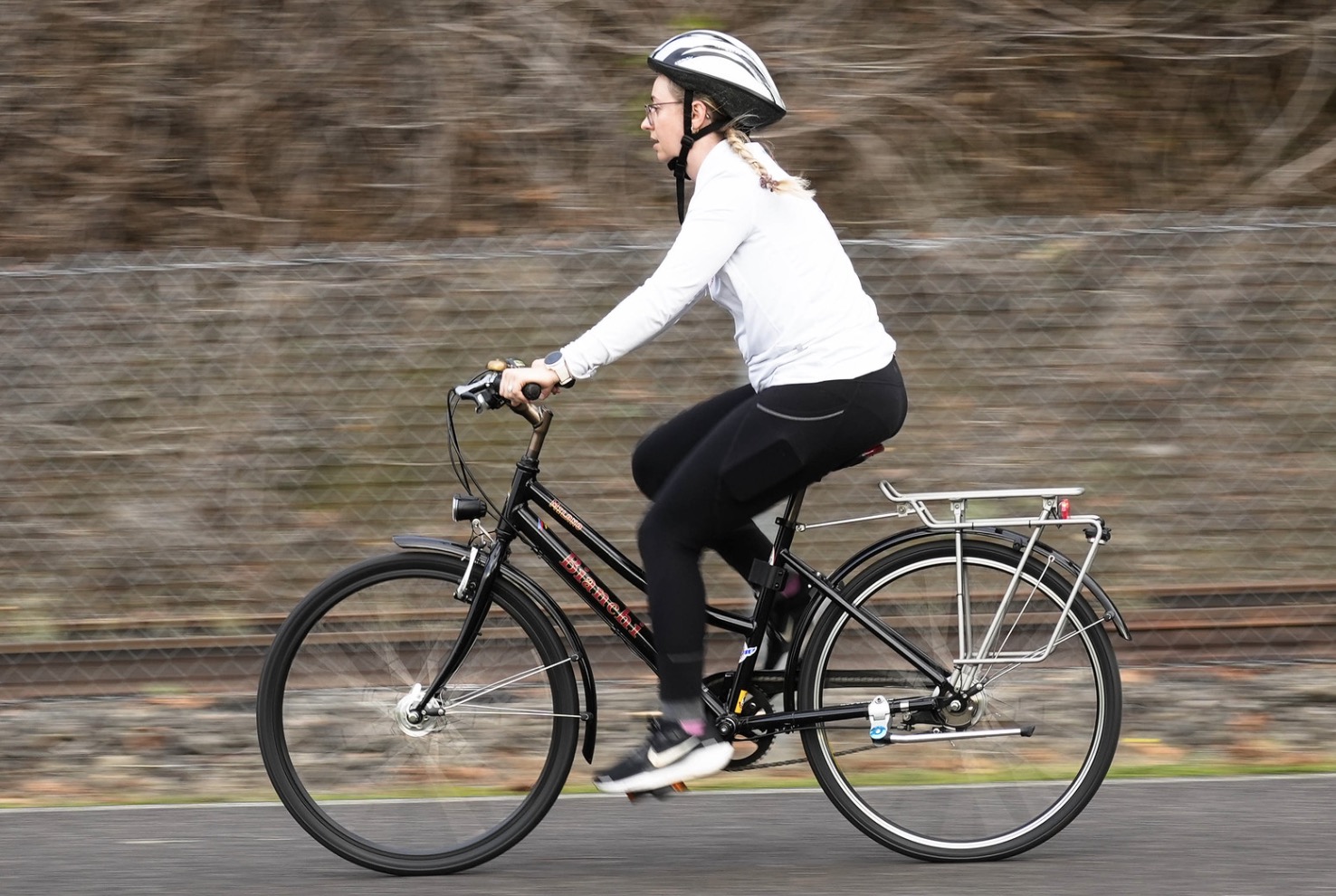
Also that person in the picture (with a very cool bike) needs to wear their helmet properly. It should go over your forehead to just above your eyebrows.
The money should be returned.
Some of you rich tech bros seem to forget that us lower income people do this thing called manual labor, much different than sitting all day in a fancy air conditioned office typing on a computer. While you may feel the need to exercise more to make up for sitting down all day, we are on our feet moving, lifting, running orders to customers, cooking in a hot kitchen, ect… No one wants to be exhausted before starting an 8-12 hour shift of physical labor. And lets not forget, riding home uphill and against the east wind on a winter night is no fun, I would never consider doing it without my ebike.
You wouldn’t be exhausted *before* your shift if you rode to work. exercise doesn’t work like that. You don’t fall asleep immediately after exercising
I’m sorry, do you have a different word for hot, sweaty, tired, and uncomfortable? I’ve ridden my old Rockhopper to work plenty of times when my other bikes are down for repair and I know how my body feels more than you do.
Hello, I run The eBike Store, and have an obvious vested interest in the eBike rebate.
Do you remember back before City Bikes were electric? They saw very little use. Once the original bikes were replaced with electric city bikes, the usage shot through the roof.
The data is clear. Electric bikes are ridden further (340%) and more often (number vary, but 2-3x is the range I have seen).
On a logical level: the last time you drilled a hole, did you use an electric drill or a bit and brace?
Your “logical” example is a logical fallacy.
When I drill a hole, all I care about is making the hole. When I ride a bike, I’m getting from point A to point B but I also want exercise. And it’s nice not to have to worry about maintaining a battery and associated electronics, too.
Claims made without evidence. Where are you getting these numbers?
Including Regular bikes makes perfect sense. The money would go much farther with cheaper bikes included. Not sure why the MOTOR ONLY crowd is so opposed to being inclusive. Require fenders on all subsidized bikes so they are more practical and can be ridden year round.
Anecdote: My family has two bikes through the PCEF e-bike program: standard and cargo. We also have a bunch of acoustic bikes (cruiser, carbon fiber racing bike, folding, family cargo). None are really great for picking up groceries or commuting, so they don’t get as much use. Now… I have barely touched my car this summer because I have both the energy and means to get to work from Gateway to Milwaukie on 205/Springwater (20 mi roundtrip). I can tote my 12 year old daughter from Gateway to Kerns for gymnastics or down to Clackamas Town Center for a mall outing. I think having the funding to get low-mid income folks like my family on ebikes is the right move. We can ride acoustic bikes just fine, but we’re grateful for something more accommodating and meets the objective of getting folks out of cars.
Please don’t make assumptions about my financial situation, just take this at face value; we were vetted by PCEF and didn’t lie about anything.
Everything manufactured or created, including humans, has a carbon footprint.
I ride both an ebike and regular bikes. If I am not driving my car as much because of my ebike, then I am using less carbon. I’m all for PCEF funds going to regular bikes as well, but after over 10 years of owning an ebike, and being a bike commuter for over 46 years, I can definitely say that I drive a lot less since owning an ebike.
Solar charges my ebike, fyi.
Wow people seem to get really butthurt from this. Regardless of whether or not e-bikes leave a bigger carbon footprint, the simple overall message is regular bikes should be afforded a rebate along with e-bikes. It’s really that simple. Some people DO prefer commuting on regular bikes rather than e-bikes. I myself like both depending on the circumstances.