

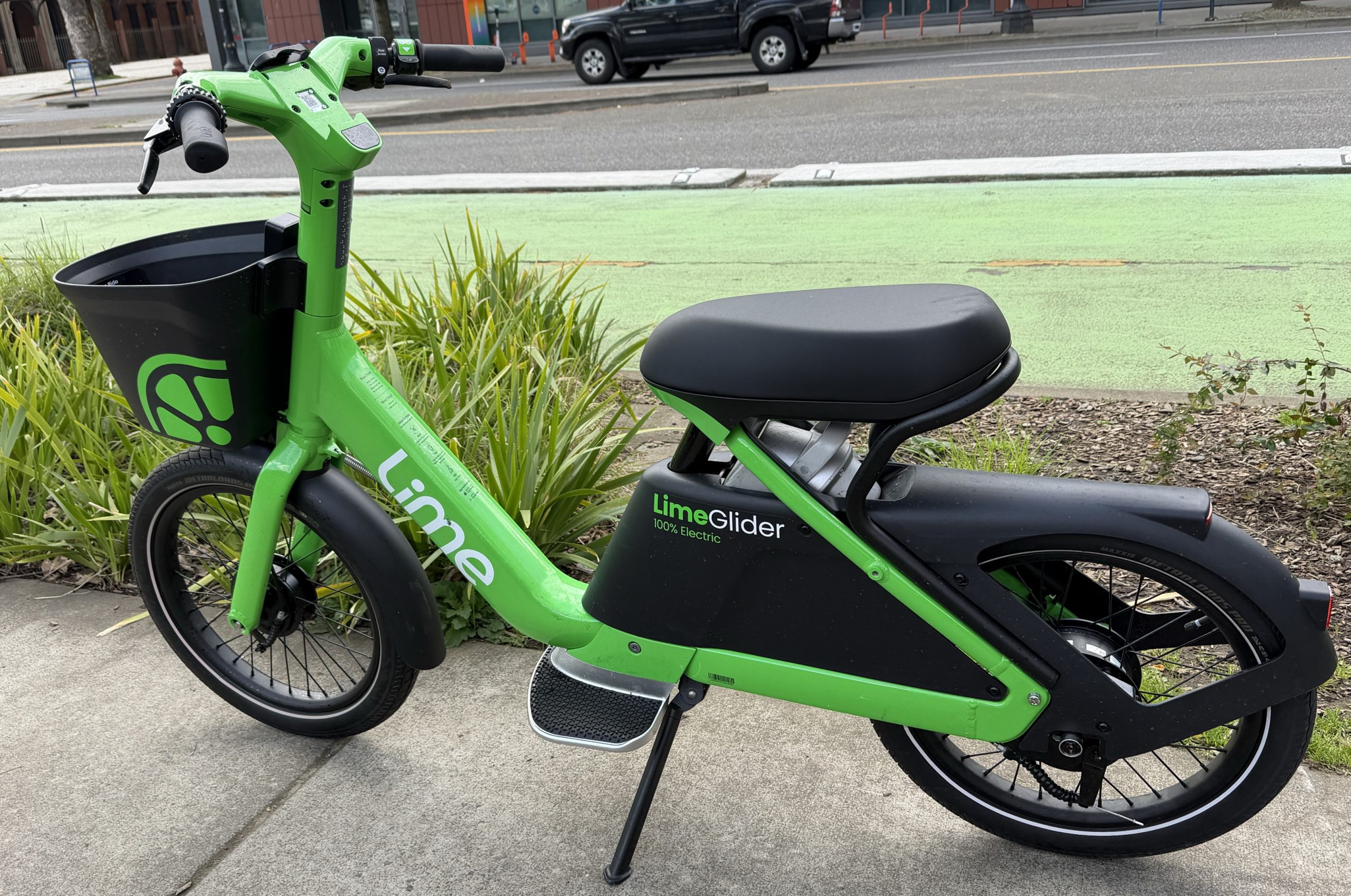
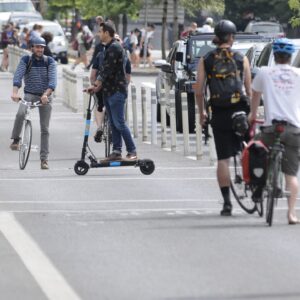
Move over e-bikes and e-scooters, there’s something new in Portland’s bike lanes. Last week Lime added a new type of shared electric vehicle to their local offerings with the launch of 250 LimeGliders. These new mobility devices are billed as “the next generation of seated e-scooter” by Lime and the local media, but upon closer inspection they aren’t scooters. And they definitely aren’t bikes.
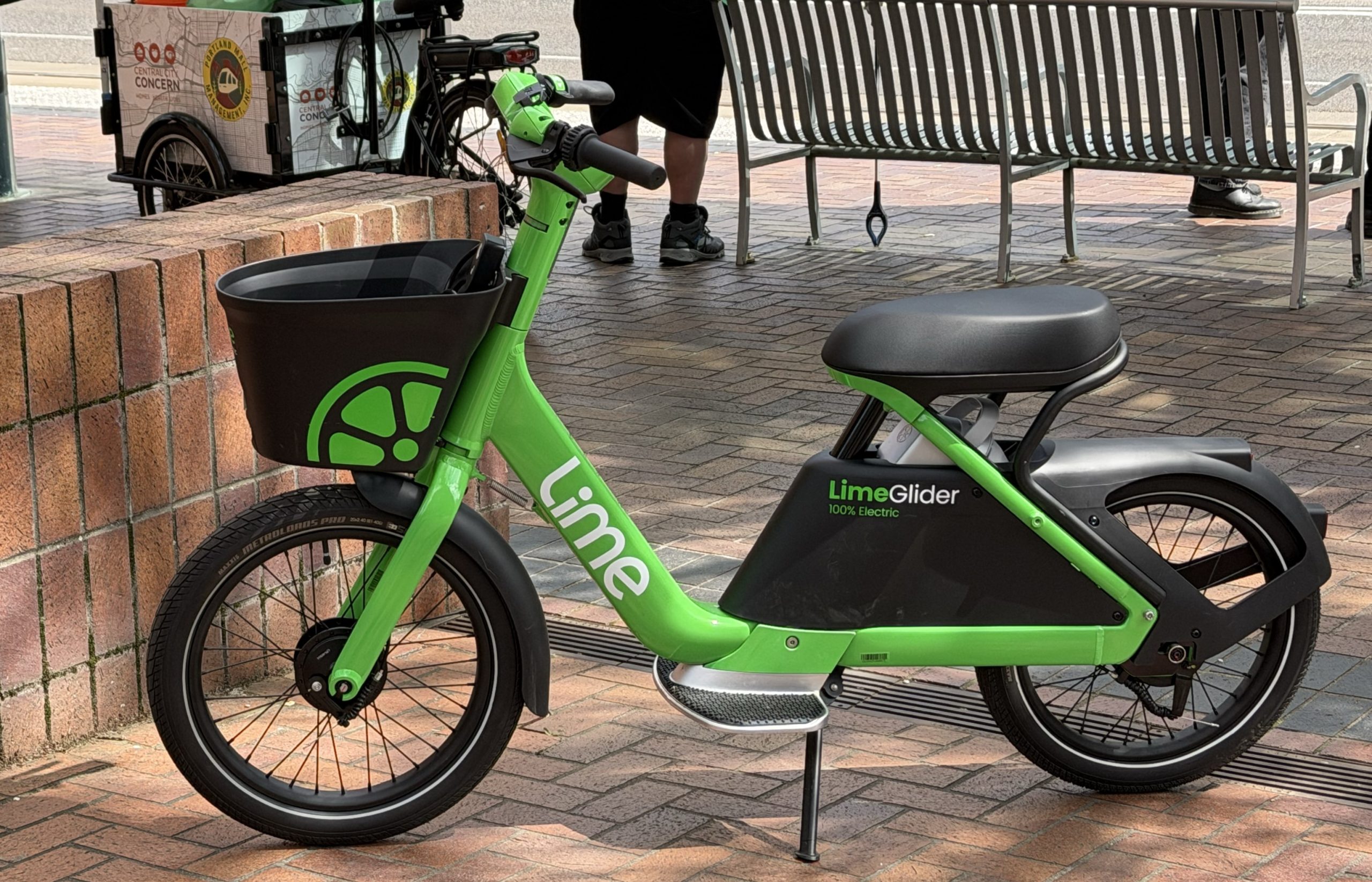
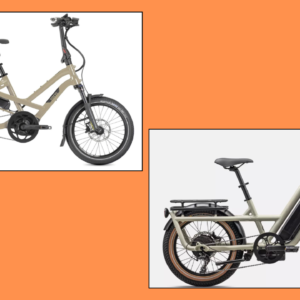
The Glider does have a big, cushy seat, which makes its riding position similar to a bike. But it doesn’t have pedals, so it’s not a bike. And its 20-inch wheels are twice the size of Lime’s e-scooter wheels and are the same size as their e-bikes. Lime had deployed a limited number of seated e-scooters since 2019, but these new vehicles are much different.
Here’s what Lime said about them in a press release:

“The Glider is designed as an inclusive and accessible option for all riders, as well as those looking to replace car trips with a more comfortable, two-wheeled option combining seated comfort with the effortlessness of a scooter. The innovative design includes foot rests instead of pedals, allowing riders to simply get on and go. The larger padded seat is unique in Lime’s fleet and is positioned closer to the ground to provide a lower center of gravity for riders.
Lime repositioned the battery and updated wheels on the new vehicles to achieve a lower center of gravity, improving stability and maneuverability, especially for smaller-statured riders. This is particularly useful when riders move the vehicle off the curb to start a ride or when walking them onto the curb to a parking spot when ending a ride. These features cater to feedback from groups traditionally underrepresented in Lime’s active riders, including women and older riders.”
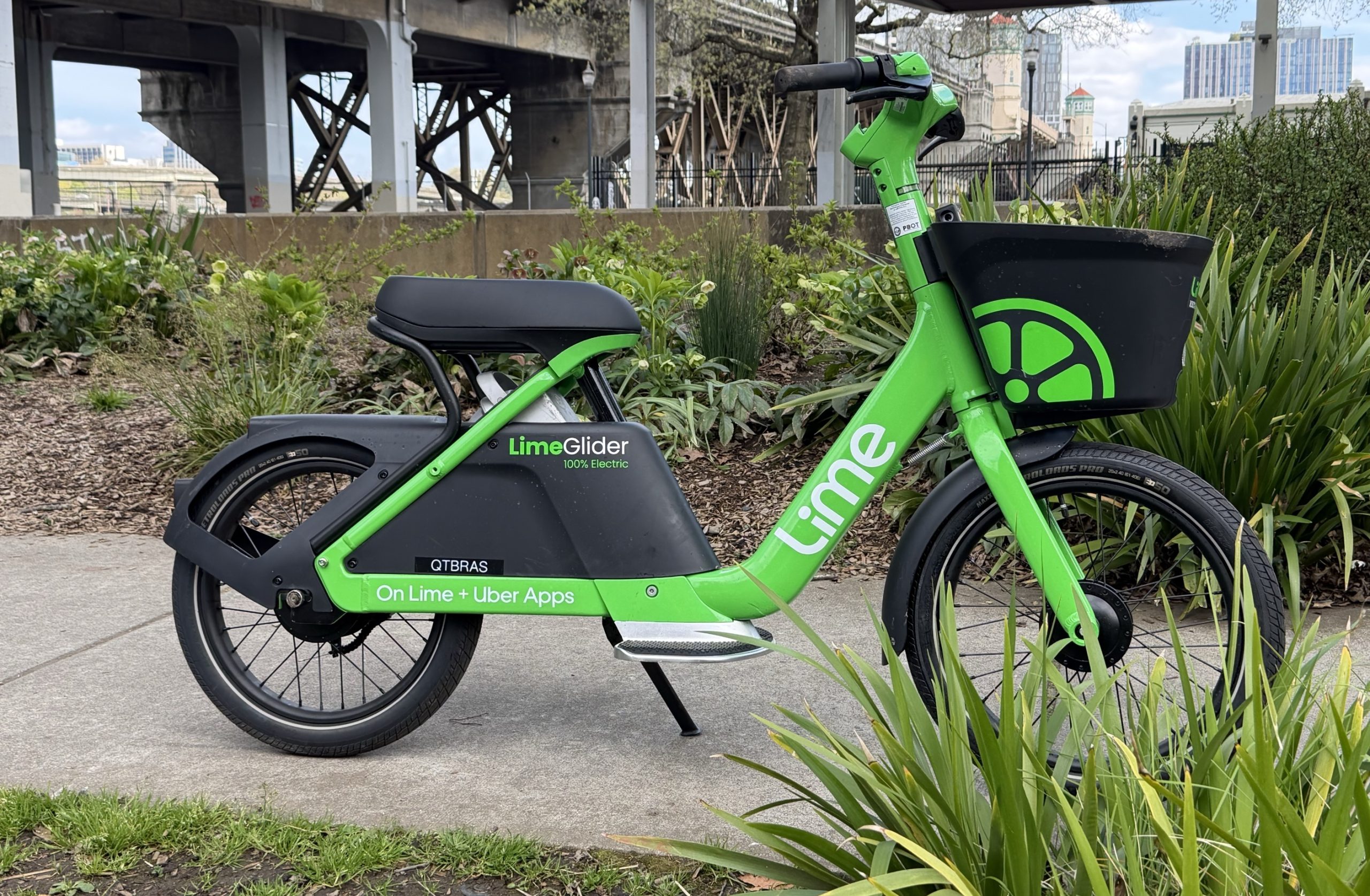
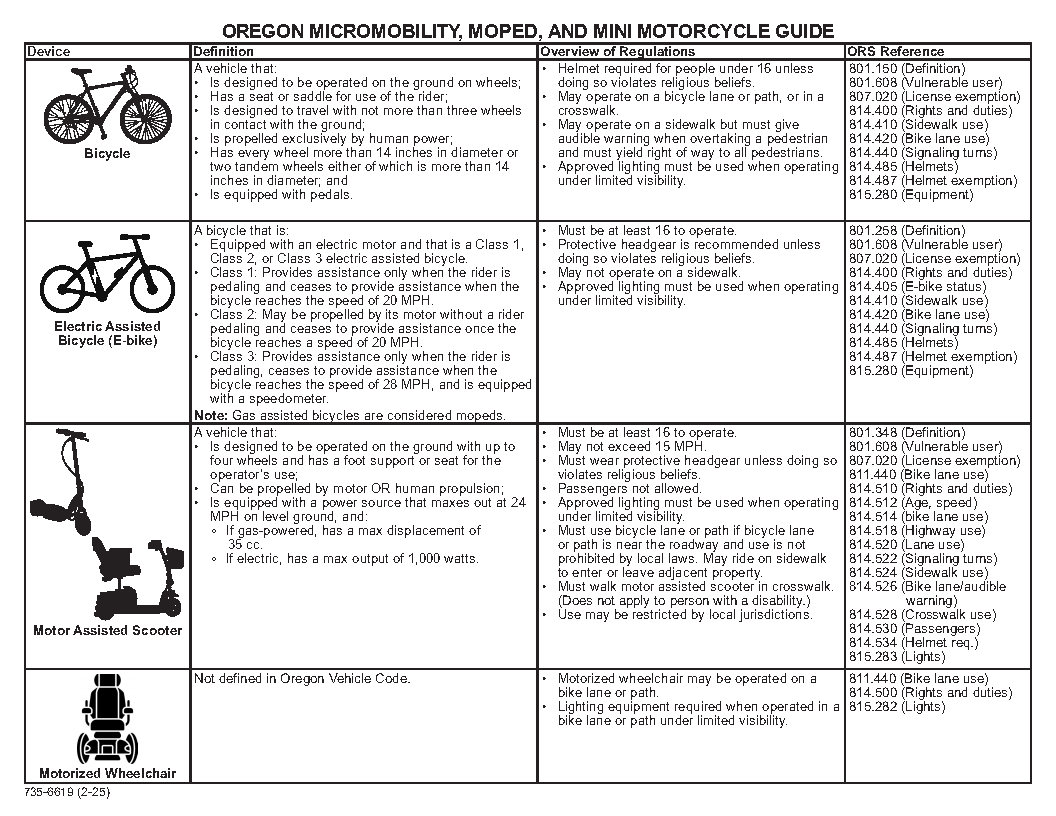
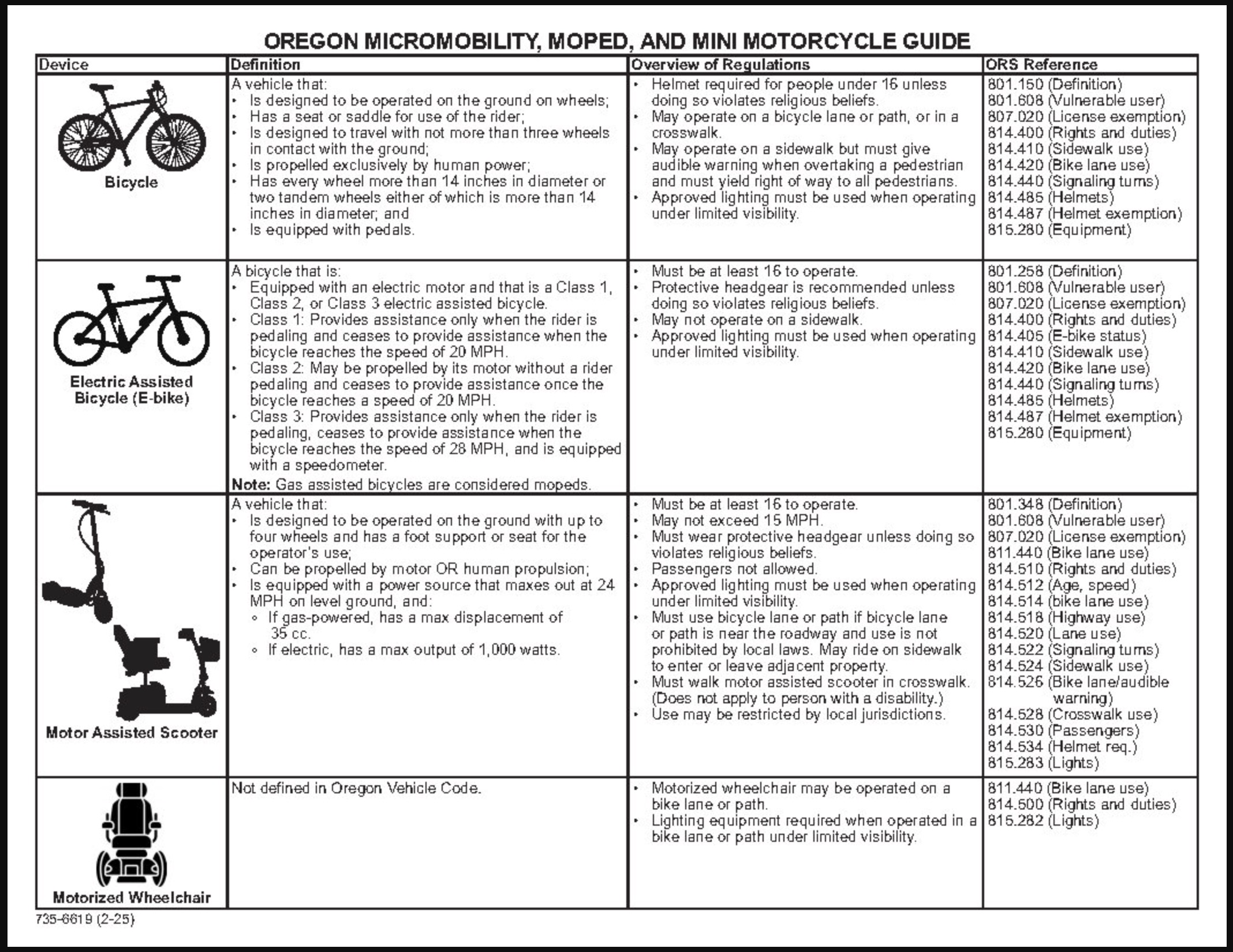
The Gliders utilize a hub motor and have a top speed of about 15 mph. According to Oregon law, the vehicle would be considered a “motor assisted scooter.”
Lime already holds a permit with Portland Bureau of Transportation for e-scooters and they’ve worked closely with PBOT on the Glider rollout. The currently have about 2,000 e-scooters on the streets, compared to just 250 LimeGliders. PBOT endorsed these new vehicles as a way to make the system even more accessible to a wider variety of users.
Lime has operated in Portland since 2018 when the launched their dockless LimeBikes. In 2024, Lime was one of two companies (along with Biketown operator Lyft) authorized to take part in Portland’s micromobility program.
I’ll hop on one of these soon. In the meantime, I’d love to hear from someone who’s ridden one. How did it work for you?

Thanks for reading.
BikePortland has served this community with independent community journalism since 2005. We rely on subscriptions from readers like you to survive. Your financial support is vital in keeping this valuable resource alive and well.
Please subscribe today to strengthen and expand our work.
It is a motor scooter.
As is my Honda Metropolitan.
It should be licensed and insured
I’m going to assume that Lime/Uber have a license to operate and probably also carry insurance.
One thing these have over your scooter is they don’t spew noise and particulate matter everywhere. They’re also speed-limited to 15mph and weigh about a quarter of your personal CO2 production plant. So there’s that.
What you mean is “I don’t like these; I have no thoughtful critique and therefore the only solution is micromanaging riders”
I think it’s better to see it as a Class 2 e-bike with the pedals removed and the max assist speed decreased to 15 mph.
A Lime Glide is a ‘motor assisted scooter’ (based on ORS definitions) … but appears a Honda Metropolitan is actually a motorcycle, not even a ‘moped’, as it has a top speed is 42 MPH it looks like (which exceeds the moped definition limit of 30 MPH).
I thought the Lime Glide was a moped, until I read the ORS definitions and caught the “other than” exclusion in the moped definition. Note the link in the article (and Jonathan’s response to a comment below) is missing a second page of a helpful ODOT PDF that is referenced and shown.
801.345 “Moped.” “Moped” means a vehicle, including any bicycle equipped with a power source, other than an electric assisted bicycle as defined in ORS 801.258 or a motor assisted scooter as defined in ORS 801.348, that complies with all of the following:
(1) It is designed to be operated on the ground upon wheels.
(2) It has a seat or saddle for use of the rider.
(3) It is designed to travel with not more than three wheels in contact with the ground.
(4) It is equipped with an independent power source that:
(a) Is capable of propelling the vehicle, unassisted, at a speed of not more than 30 miles per hour on a level road surface; and
(b) If the power source is a combustion engine, has a piston or rotor displacement of 35.01 to 50 cubic centimeters regardless of the number of chambers in the power source.
(5) It is equipped with a power drive system that functions directly or automatically only and does not require clutching or shifting by the operator after the system is engaged. [1983 c.338 §59; 1985 c.16 §19; 1997 c.400 §5; 2001 c.749 §25]
801.348 “Motor assisted scooter.” “Motor assisted scooter” means a vehicle that:
(1) Is designed to be operated on the ground with not more than four wheels;
(2) Has a foot support or seat for the operator’s use;
(3) Can be propelled by motor or human propulsion; and
(4) Is equipped with a power source that is incapable of propelling the vehicle at a speed of greater than 24 miles per hour on level ground and:
(a) If the power source is a combustion engine, has a piston or rotor displacement of 35 cubic centimeters or less regardless of the number of chambers in the power source; or
(b) If the power source is electric, has a power output of not more than 1,000 watts. [2001 c.749 §2; 2018 c.3 §1]
Oh cool, they reinvented the moped, but worse.
Not a “mo-ped” [motorized – pedal cycle]: no pedals, so really seated scooter… All the speed and none of the old noise and less pollution.
BUT for existing e-scooter riders it should have safer traffic safety outcomes overtime (more stable, larger wheels, package basket, bigger brakes, ASSUMING if top speeds are kept manageable (15 mph) within the “50cc” threshold.)
A noped.
A slo-ped : )
these gliders look like mopeds and other motorcycles, but they are not gasoline powered and they have a 15mph speed limit.
https://www.youtube.com/watch?v=P2LlYtuwYrQ
This dude hits at least 22mph on a downhill
indeed he does! https://youtu.be/P2LlYtuwYrQ?t=230
They are all over Seattle, where I have tried one. I wasn’t the biggest fan, but I do see the appeal. I’ve got a lot of thoughts, so, big comment incoming.
The biggest benefit of these is that they are more stable. It’s kind of shocking to me that anyone would want to ride an electric scooter given how terrible the pavement is on many of our streets. Feels like asking for a broken wrist. For that reason, I always prefer the stability of a bike. I guess the ‘gliders’ have a wheel in both worlds being basically an e-scooters with bigger wheels. They’re also more practical with the basket on the front. Always good to be able to take your backpack off your back or grab a bag of groceries.
My main gripe with these, as well as scooters and Biketown bikes, is that they are dockless. I understand that’s part of the appeal, but there’s just so many problems. People truly do park them in the absolute worst places on a regular basis. I guess you could go around reporting all the improperly parked bikes and scooters but that is a futile effort because more will spring up in their place within a day. I also don’t think that relying on me to tattle on my neighbors is a good way to do rule enforcement.
Of course there’s the pricing, too. If I remember correctly, the ‘gliders’ in Seattle cost more than the bikes & scooters – which are already very expensive! I would like to see the city do something to provide more affordable shared bikes (perhaps regular bikes as an option like Citibike has?) and make pricing more predictable. The by-time instead of by-distance can make a 2-mile trip vary wildly in price. 35 cents a minute is crazy. I also think it incentivizes risky behavior like running stoplights. Most of the time, it’s cheaper for a friend and I to take an uber than for us to use biketown.
I get that poor people get special discounts and free biketown, but while I don’t qualify for food stamps I’m not exactly made of money. It’s just not reasonable to use it but once a month when I end up in a spot where the buses aren’t running late enough.
I do like the idea of ‘shared micro-mobility’ I guess, but I don’t think the current regime is really doing much to make it a convenient option for, really, anyone. Low-income folks get free rides but the bikes/scooters aren’t consistently available, and the math doesn’t work out for middle-income people to use them. The incentive structure isn’t really there for shared bikes & scooters to replace car trips.
You think 35c per minute is crazy? How does 50c per minute sound? (which is what these cost)
That’s how much people are willing to pay not to ride TriMet (because I don’t believe for a second that these are displacing driving in most cases… except, perhaps an Uber on the margin).
50 cents a minute!!!
I think it’s overly cynical to say that people are paying that to avoid riding TriMet, Mostly I suspect people are using it to fill in gaps in transit service. Maybe we’re saying the same thing in a different tone here though.
Cynical, yes. Overly? Not sure about that. I see plenty of people riding them in places and during hours that transit is running fine. It would be an easy theory to test using existing data — to what extent do Lime trips overlap bus service?
There are a lot of people who just don’t see transit as an option. After returning from a recent trip (to a US city where I happily used transit), I boarded an empty Red Line car at the airport, and it still reeked of body odor from a previous rider. TriMet can be viscerally unpleasant in ways I’ve never experienced elsewhere.
Given the choice, I might opt for the e-bike sans pedals as well.
Maybe not in the category of “overly” cynical for your baseline lol I take TriMet all over town several times and week and don’t have many unpleasant experiences. I think the worst in recent memory was a guy asking everyone on the train for money. As far as the relation to other US cities – last time I went to NYC a guy was full on smoking out of a 2-foot bong on the subway. I also saw another dude pee in the corner of the train car. To me a somewhat stinky train car isn’t that big of a deal compared to genuinely unsafe or antisocial behavior.
We do have to acknowledge that TriMet could do better though, despite the recent improvements. We deserve clean and calm public spaces.
By ‘gaps in transit service’ I mean places where frequency and/or transfers add a huge time tax to a trip. The last time I used biketown it was becuase I barely missed a transfer to 20-minute service bus and the bike ride was only 15 minutes.
I think this is a worthwhile question to answer. There’s gotta be research on this, if not for Portland specifically. My gut agrees with your assessment that bike/scooter share probably doesn’t displace many car solo car trips. They probably replace more transit or walking trips than anything. I do still think that bikeshare is worth investing in, and that if done right it can both complement transit and offer an alternative to car trips. I guess I’ll have to spend some time reading before I really form an opinion though.
If you have one bad experience per month, that might be enough to get you thinking about alternatives (and if the experience is bad enough…)
A light but regular user might take 10 trips per week, so we’re talking one bad experience per 40 rides.
Of course it depends on the nature of the experience, the level of vulnerability you feel, what your alternatives are, etc.
Of course it isn’t. But it is gross nonetheless. Some people don’t like gross.
If we want more people to use transit as an alternative to driving, it can’t be gross, and there can’t be situations like the one you described where you get stranded because of a missed connection.*
I think we can fix gross (other places have, though maybe not NYC), but I don’t see a practical way to fix the service problems like missed connections that are inherent in the model.
I agree that bikeshare is a good thing; it’s just too expensive for me except in emergencies.
*And absolutely no shooting blowgun darts through the lungs of other riders!
Or how much one is forced to pay because TriMet assumes everyone is home and in bed by midnight. And yes, I speak from experience as this is literally my only use case for these things, but one I am extremely grateful for once or twice a month.
The Lime glider is priced the same as the other Lime scooters with the income qualified lower price: $.5 unlock and $.07/minute.
“Most of the time, it’s cheaper for a friend and I to take an uber than for us to use biketown.”
Don’t worry the clowns on our City Council are striving to make our ride share (Uber/Lyft) the most expensive in the country and even potentially cause the demise of ride share here. Death by a thousand cuts in current day Portland as the doom loop is being turbocharged by the Peacocks.
“Portland’s leading institutions, including the Blazers, Timbers, and the Oregon Symphony and Ballet,” oppose the measure.”
https://www.opb.org/article/2026/04/07/uber-lyft-portland-proposal-change-ride-share-hailing-services/
Waymos will be the demise of ride share. Until then, yes, uber drivers should get paid more.
I’m here for it. Make Uber more expensive.
It’s an e-bike with the vestigial parts removed, like toes on a whale.
Throw them in the Willamette
Please don’t be a polluter, it’s not cool.
I get the sentiment but hate the idea. Why not push them into an intersection so they can functions as diverters for a few hours?
More equipment owned by irresponsible corporations to be left in all kinds of inappropriate locations – blocking sidewalks, driveways, dumped in the Willamette, and so on.
When will the “City That Works” actually put reqquire these corporations to take a modicum of responsibility for their equipment and where it is literally “dumped” daily by users?
When you vote in Councilors who aren’t corporate stooges?
crazy that a) you know how E goodfriend voted in the previous election and b) they’re solely responsible for the electoral outcome.
Pardon me for typing “you” instead of “we”. No personal attack meant.
What’s your answer to the poster’s question?
My answer is that it all needs to be docked. E-bike/scooter racks would make great tools for intersection daylighting – a stated goal of PBOT. The knock on effect is that I don’t have to dodge abandoned scooters in the SE Powell/railroad underpass.
It’d be a big improvement for sure. I didn’t notice if they’re still having ICE vehicles running around charging them , but I assume so.
The batteries are swappable. They do still have people in vans going around to swap the batteries and take bikes/scooters that need service. IMO those vans should be electric but ideally there would be docks that include charging somehow.
I partially retract my previous comment – this morning I saw a Biketown branded cargo bike full of batteries that an employee was swapping out of bikes. So I guess at least part of it is (somewhat?) decarbonized.
That’s pretty neat and a pleasantly thorough business model which I hope that they can maintain. Thank you for the update, it is a pleasant ray of positive news.
So it’s an electric motorcycle (or an electric scooter kinda like the 49cc motorcycles Honda had in the 60s and 70s?)
I saw one on Sunday on NW Thurman, parked almost in the travel lane.
We passed a law regulating the use of gas powered lead blowers. It’s now illegal for a property owner to use, or cause to be used, a gas powered leaf blower from January through September. The prohibition becomes year round after two years.
We could pass a law making it illegal for a person to park a scooter anyplace but attached to a scooter rack or within the bounds of marked scooter parking. It would be sticky to figure out how this would affect the fleet operator but if there is a constituency regularly pushing the narrow issue of parking it will get the city’s attention.
They need to just have physical docks ala Citibike, Bixi, or dozens of other shared bike/scooter schemes. It is already against the rules to leave scooters/bikes anywhere. Similar to curbing fast driving on overly wide streets, enforcement is a futile and fruitless effort.
I really dislike scooters (and bikeshare bikes) parked blocking sidewalks. There’s never a need to park them in the middle of a sidewalk, and I move those regularly. Having scooter racks or designated parking areas makes sense in areas where they’re regularly used. What about everywhere else?
Maybe it would make sense to allow them to park in bike racks (public and private) perhaps followed up with bike parking regulation changes that addresses them?
Off that subject, I love the leaf blower law. Weirdly, the business near me that’s been the most disruptive leaf blower is also the worst for clogging their sidewalks with scooters and bikeshare bikes.
So these aren’t legal in bike lanes, on multi-use paths or through car diverters right? They’re definitely not allowed on sidewalks like other e-micromobility vehicles. They don’t have pedals and they’re fully powered by a throttle. It’s a low powered electric motorcycle.
What are the odds anyone will abide by or enforce that? Can’t wait for the new wave of idiots passing me too closely in all of those places.
To be honest I think you’re catastrophizing here. I do see some pretty shocking behavior on the scooters – especially downtown on weekend nights – but most people are just trying to get from A to B safely. Frankly I don’t think it’s productive to dismiss an entire category of micromobility just because you have had some bad experiences. If I had a nickel for every time some drop-bar carbon bike spandex mafia guy was aggressive with me while commuting, I could buy a whole new carbon bike to ride. It is frustrating, but I recognize that the social harm caused by mean lycra guys (or escooter riders) is several orders of magnitude smaller than our biggest killer; SUVs and trucks.
I’m catastrophizing at all. These aren’t even on the same level as a “carbon bike spandex mafia guy”. For one they weigh significantly more. I’d rather be hit by a carbon bike then this 60lb monstrosity. They’re also frequently used illegally and the companies operating them offer no way to reign in this behavior. Underage people use them all the time, they’re abandoned completely blocking bike lanes, they go way over the “speed limit”, and they’re ridden where they’re not supposed to be.
Just because SUVs are worse doesn’t mean we should allow Lime to just shit all over our infrastructure and not expect them to do anything about reigning in their users. Stop making excuses for shitty companies because they green/disability-wash their terrible behavior.
Legally these are “Motor Assisted Scooters” and can use bike lanes. They are also specifically allowed to use sidewalks “to enter or leave adjacent property.”
Source: https://www.oregon.gov/odot/forms/dmv/6619.pdf
But I also think it’s reasonable to think of them as Class 2 e-bikes that have had the pedals removed and the max assist speed decreased to 15 mph.
This is motor assisted scooter, by oregon vehicle definition, correct?
Yes. Legally it fits that definition
I think that I will hold off for a little while longer. If Lime can develop a four wheeled enclosed vehicle that runs on electricity and can go well over 50 mph, then I’m in!
Design wise – the new LimeGlider looks to use ~>95% of the parts that their pedal bike uses, more than I had initially guessed. This helps for maintenance. I had assumed that the LimeGlider would have had a shorter wheelbase etc. than the current Lime bike model to allow even more efficient loading into Sprinter/ Transit rebalancing vans. The loss of pedals does help in this aspect. [I am surprised they did not adopt an even smaller rear wheel while keeping the larger front wheel.]
This seems like an improvement over the scooters- safer, more useful for more people. My biggest gripe with the system is the a-holes that drive around pick them up. There was someone flying down out narrow residential street with a truck full of scooters last Thursday morning and I nearly got creamed by a biketown sprinter rolling out of a parking lot across the Naito bike lanes without stopping or looking! I agree with previous commenters that mandatory docking needs to be implemented.
I’ve seen these around and they seem so much safer than the traditional stand up scooters. I’m glad Lime deployed them!
I rode one the other day and really enjoyed it. I commute mostly downtown and in the pearl and use the standing scooters regularly, but this was a nice change especially carrying a bag in the basket rather than on my back. It does fill in the distance for me to get to the max station, so I did use it exactly how they intend. I was able to ride it to the max station from my house quickly rather than walk, and then get on the train since I was in a time crunch. It is for sure a light electric moped or something similar. Reminded me more of riding around in the streets Saigon or Rome than when I use the standing scooters, which feel clunky.
It’s a scooter, but with bigger spoked wheels. The motorized equivalent would be a Kymco People.
The People can go 30mph, and almost that fast uphill, gliders can barely go 8mph uphill. Not the same at all.
I am referring to the large spoked wheels and step-through DESIGN. Obviously.
To me, this primarily shows that there is an unappreciated latent demand for diverse transportation options and the safe space to operate them.
I rode one in Seattle for an afternoon, probably 10 miles around greenlake and u district shopping and having tea! It was awesome!