

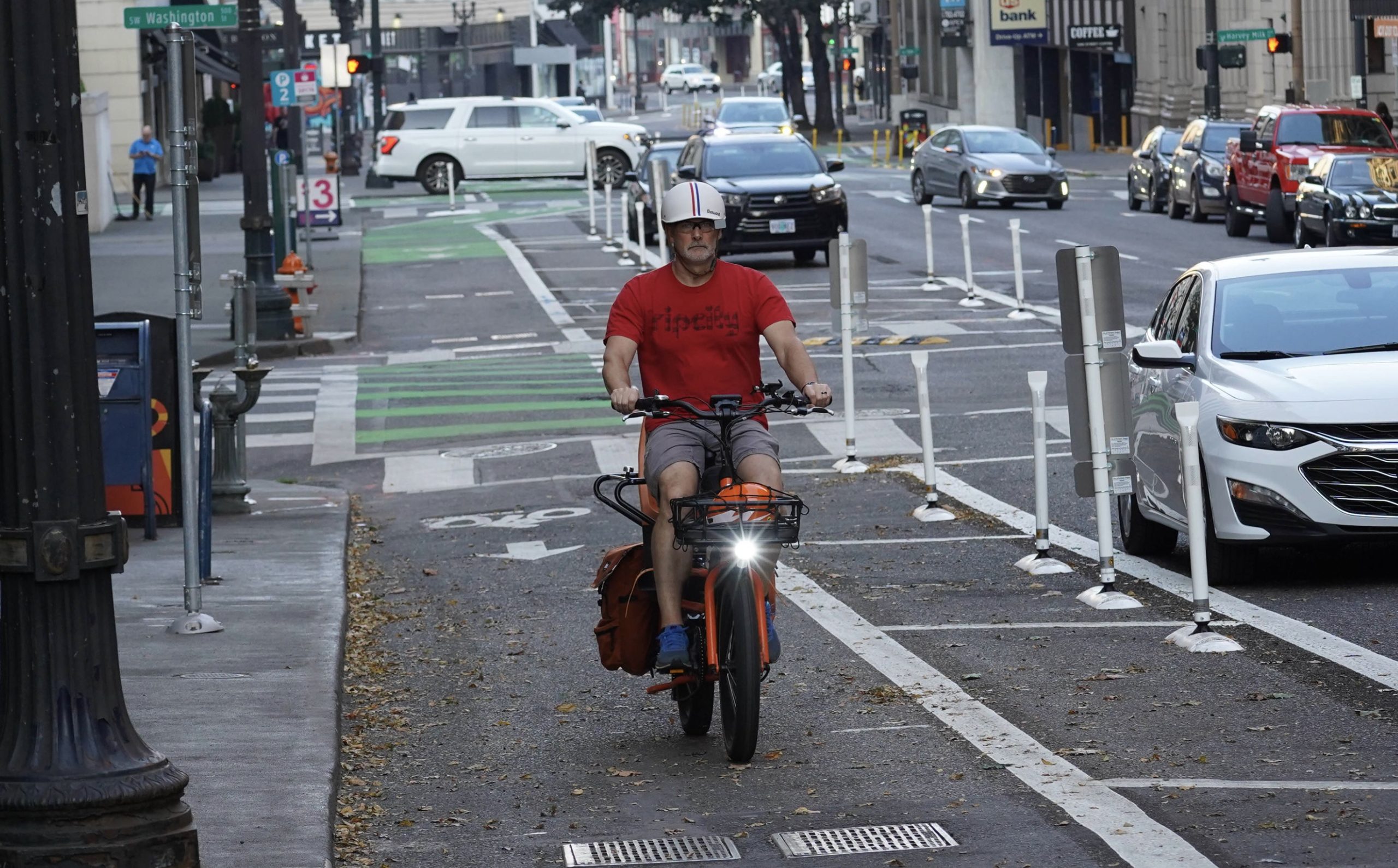
The last three years have been a roller coaster for the bikeway on Broadway that runs through Old Town and Southwest Portland. In September 2023 we learned the city hatched a secret plan to remove the bike lane protection and revert the design to an older version. Three days later, after widespread community outcry, those plans changed and the bike lane was ultimately saved.
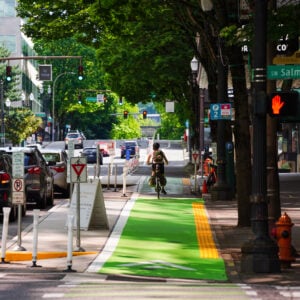
In 2024, the Portland Bureau of Transportation completed upgrades to SW Broadway that included better signals and loading platforms. And then yesterday, PBOT announced even more upgrades they say will make Broadway safer to use and to nicer to look at (see design below).
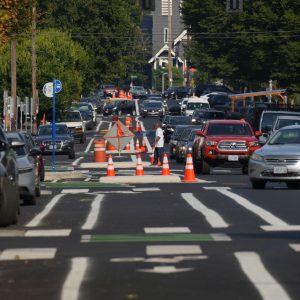
Starting tomorrow, PBOT crews will install dozens of planters and concrete traffic separators (a.k.a. curbs) in the buffer zone between the existing bike lane and car parking spaces. According to a statement from PBOT, “The improvements will reduce ongoing maintenance and improve aesthetics on the highly visible downtown corridor.”

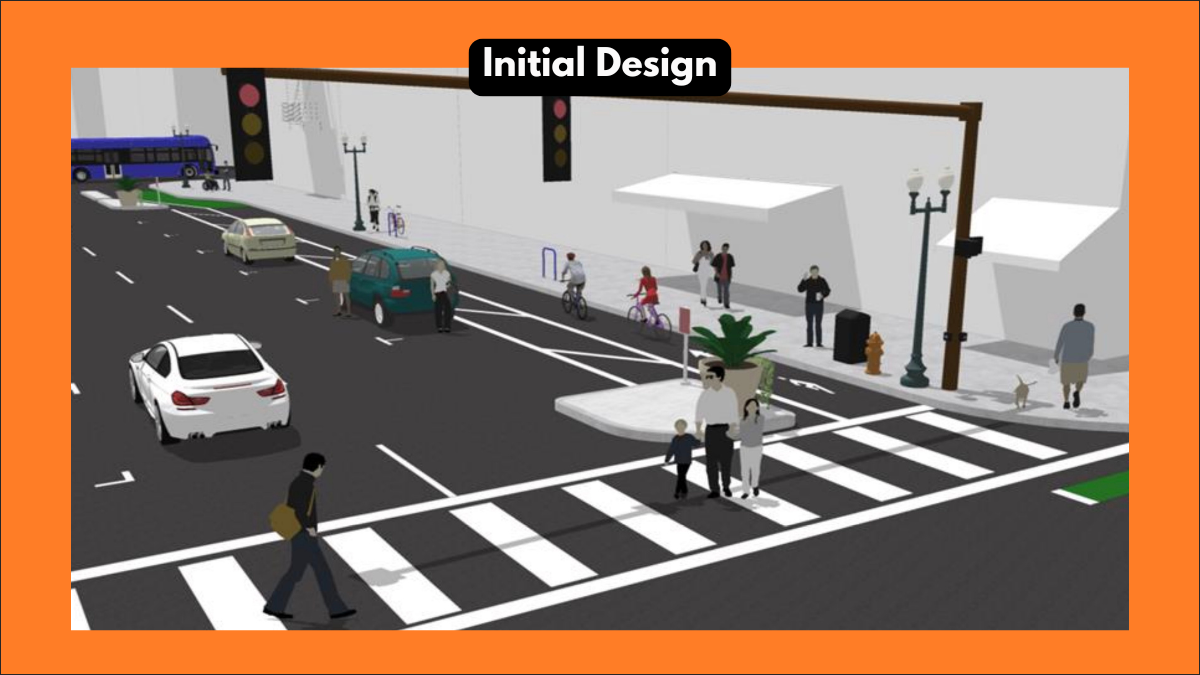
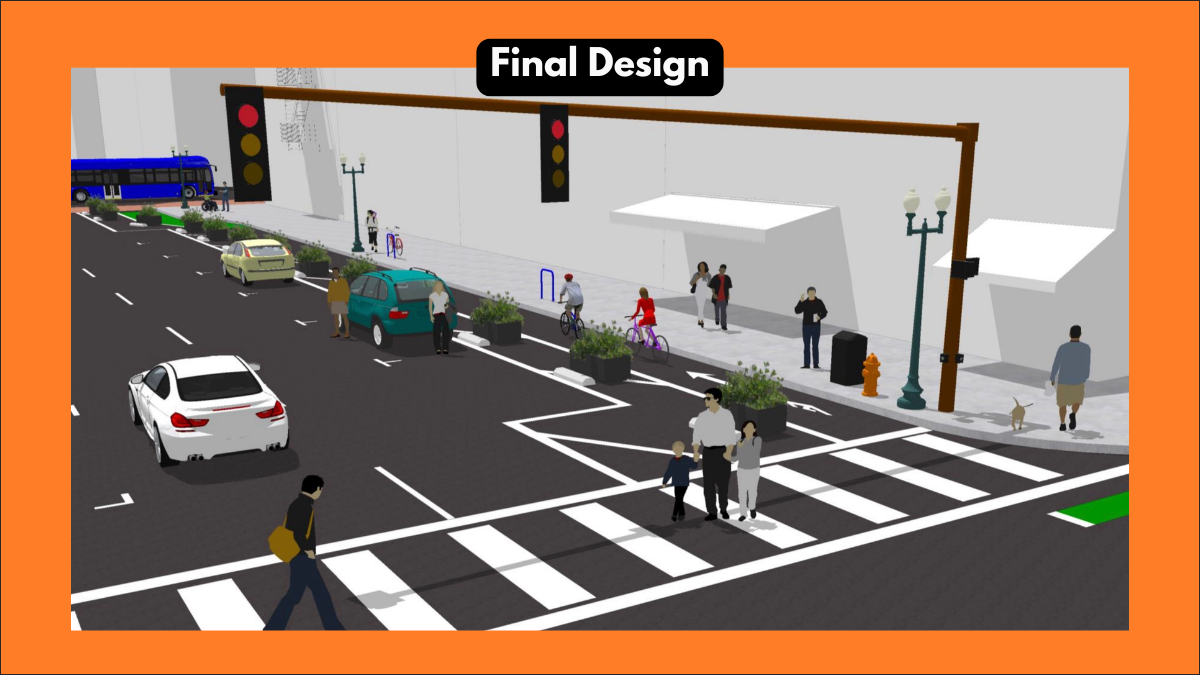
The first phase of work will will focus on SW Broadway between Oak and Yamhill. PBOT wants to get this section done by mid-May so the street can be part of the 2026 Bloom Tour, an annual event where creative flower displays take over the central city (think of it like the Winter Light Festival, but flowers instead of lights). Later this year, the new planters and curbs will extend north from Burnside to NW Glisan and south from Yamhill to SW Clay.
When PBOT first shared the plans for this project, it looked a bit different (see comparison of initial and final design above). Initially they were going to install one larger median “end cap” at the beginning and end of each block. The end caps would have one planter each and there would be nothing added to the buffer zone along the bike lane — even the existing plastic wands would be removed (likely because they look terrible). The final design cancels the end caps and replaces them with short concrete curbs and planters lining the entire length of the bike lane.
When PBOT brought this project to the Bicycle Advisory Committee last month, one member scoffed at the planters and relatively small curbs, saying drivers hit and push them out of place (the large planters on NE Multnomah are regularly hit and moved around by incompetent, reckless drivers). PBOT staff said their engineers are confident the planters will stay put thanks to input form Maintenance Operations staff who said each one will be installed with a concrete curb right next to it.
I reached out to PBOT to better understand their decision to switch from the larger end caps to the planter/curb design.
PBOT Communications Director Hannah Schafer explained that they opted for the curbs/planters option for a few reasons. First, members of the Central City in Motion Working Group expressed concern that the initial design would have no protection in the buffer zone. PBOT also heard from “stakeholders on the corridor” (which I always hear as “business owners”) that planters would be considered an upgrade from an aesthetic standpoint and that, in general, folks wanted to see more planters in general. Schafer also added that if they had a larger budget for the $550,000 project (which is being paid for with General Transportation Revenue made up of state Highway Fund and local parking , they’d keep the larger concrete end caps and do the planters and curbs.
Other than these changes to the bike lane and a small change in parking availability between NW Glisan and Burnside (which will move from a “No Parking” zone from 6:00 to 9:00 am to all-day parking) this project won’t impact the way the street operates.
For more on this project, visit PBOT’s website.
Thanks for reading.
BikePortland has served this community with independent community journalism since 2005. We rely on subscriptions from readers like you to survive. Your financial support is vital in keeping this valuable resource alive and well.
Please subscribe today to strengthen and expand our work.
Amazing! Well done PBOT! Time to start expanding this across the river on Hawthorne and NE Broadway.
Will these be pre-fab curbs which are bolted down? Or will they be poured in place with rebar down into the asphalt? Or just set on top of the asphalt?
Will the planters be bolted down or just held by their own weight?
Will certain hotel and business owners, plus certain business associations, complain again? Will PBOT have to move planters and prefab curbs several times at taxpayer expense due to these complaints?
If they’re prefab I hope they dont put them in backwards like they did on NE Broadway
Those were not pre-fab. PBOT doesn’t really use pre-fab curbs. They are cast in place like any other concrete curbs. The ones on Broadway were backwards because the crews just put in the forms backwards, likely not understanding the idea behind the asymmetrical design.
Good to know, TY
PBOT typically does “cast in place” poured concrete with rebar, rather than pre-fab curbs, because the pre-fab ones are easier to knock out of place or damage.. Planters are usually just very heavy.
Sounds great but.. can we get a protected lane that extends past 7th to Williams and the Broadway bridge? This is the sort of incomplete upgrade or installation people talk about when it comes to the question “what should we be spending limited funds on?”
That’s a totally different area, across the river from this project the article is about, and it would require removal of a travel lane and complexity around dealing with a freeway interchange. This is a lot easier and cheaper to upgrade an existing parking-protected bike lane downtown. Also, there is a partially funded project already underway to do the Broadway Bridge to 7th Ave section, with design phase starting soon.
There was a plan to do just that, which was going to be paid for by a federal grant that the Trump admin rescinded because it was too woke.
Unfortunately yeah, oof. But they did find the money for design. Just need to dig a little deeper to get the same treatment they used here on N/NE Broadway. Bring on the planters.
Sounds very nice but will the plants actually be cared for and the planters not just left to be weed containers and canvases for graffiti? It’s hard to have nice things in current day Portland.
https://www.wweek.com/news/2023/08/09/trees-planted-by-the-city-in-east-portland-two-years-ago-are-dead-because-the-city-didnt-water-them/
This is great question- in the past, PBOT has explicitly walked away from their landscape obligations citing a shortage of maintenance money (see NE 102nd/Weilder, for example:https://maps.app.goo.gl/Q7cGeXCPrZU3PAHY9). I love plants and welcome more beauty to the streetscape. However, I am surprised to see PBOT take on something that requires so much maintenance. These small planters will need to watered 1-3 times weekly from June through September and be weeded, trimmed and replanted occasionally. Plants installed in the ground can become established and required little/no water, but these containers are way too small. PBOT also does not allow irrigation in the R/W, but maybe they are maying an exception here? I have a lost of questions- hopefully we will get some great news that PBOT has a plan for taking care of these. At a minimum, it looks they will preclude the Benson from using the buffer as a temporary parking space for sports cars!
There are a lot of planters downtown that seem to manage fine. I suspect the Clean & safe crew (or whoever is watering the sidewalk planters) may be able to help with the bike lane foliage.
I’m not saying it is impossible, but it does cost quite bit. This is an expensive choice for PBOT and I question their commitment. Maybe they got the Downtown businesses to chip in? I would like to know more about their plan to maintain these and what the budget it. It might be worth it, but I would still like to know
Wow, I wonder if planters and trees are different things? I guess your irrefutable evidence of Portland’s dysfunction, a WW article from 2.5 years ago, will just have to stand as proof that we shouldn’t bother putting planters down.
Can’t even be bothered to reference the planter protected bikeway on Multnomah? I recall them being fine, but occasionally damaged or moved into the bike lane. Seems more relevant than yet another article just sort of vaguely referencing poorly run programs as evidence that we can’t do anything and shouldn’t try.
Fixed it for you:
Minor annoyance: the watering trucks tend to water during peak commute hours and always block the bike lane.
Blumdrew logic: ‘It happened before, so it’s irrelevant.’ Meanwhile, lessons from past mistakes are apparently optionaL
It’s not a barmy take, Angus. Blumdrew got you bang to rights on your whinging, yet it’s important not to be all piss and wind – to learn from the past, as you say, but just cuz it didn’t work once don’t mean it can’t ever work. Cheers, mate.
Please point me to the place in my comment where I say we shouldn’t learn from past mistakes. I’m saying past mistakes are not evidence that we should never do anything, which is what you are saying.
And for whatever it’s worth, this is a different city department during a different political administration. None of the people responsible for all those dead trees will be responsible for these planters. I’d consider your example to be essentially irrelevant and entirely annoying.
Yet another article announcing yet another nice thing being done in Portland, responded to with yet another comment that we can’t have nice things in Portland.
Sometimes reality is hard to face qqq.
More limited funding being spent on cosmetic improvements to an already established and safe bike lane instead of addressing hundreds of miles of disconnected and dangerous bike facilities. Urbanists and their real estate speculator friends love the “placemaking”* (⬆⬆⬆real estate valuations), however.
*”activation”
While I tend to sympathize with your general sentiment of prioritizing important connections to NW/SW Broadway, I’m not sure I would describe this project as “cosmetic.”
Upgrading plastic wands to planters and concrete separators is generally a result of PBOT’s year long endeavor originating from the hardening memo to remove things like plastic delineators, which require frequent maintenance/replacement. This might be aesthetic/marketing in part, but the upgrade is well worth the $500k.
Quick-build protected bike lane on Sandy or a bunch of projects that make oh-so-not-controversial business-friendly (FIRE $$$) improvements to already quite safe infra?
If the goal is to create infrastructure that is ready for the next recession (likely cause of 2009-2015 bike boomlet in PDX) or oil crisis (80s boomlet) then it might be a good idea to prioritize a useful network.
I’m with your general point – that expanding the network is generally more important than improving specific bike infra that is already *IN* the network.
But if you were around for The Great Broadway Bike Lane Fiasco of 2023 (I think it was ’23), when Director Williams had signed the order to rip out the lane at Councilor Mapps’s behest, you might agree that making the lane harder to rip out is REALLY important. Maybe I’m naive in thinking that planters and concrete will make ripping out less likely, but if it does then I’m all for it.
Before a few years ago I might have agreed. But it’s been pretty clear any amount of money on any amount of concrete can be torn out given enough bikelash. There are numerous examples but one of the more egregious ones happened just recently in Encinitas where the city spent 4 million dollars to install PBLs, and will spend 3 million to tear it out and rebuild it. People like to hate on Portland/PBOT, but man this is some epic MF bullshit.
It also seems like PBOT might be more insulated in the new form of govt, so the whole Mapps situation might be less likely. This is just a knee-jerk impression so feel free to oppose.
You could be right, but I guess that so far PBOT has been restrained from ripping out established bike infra, so I tend to project that behavior into the future – which isn’t to say it will always hold. I suppose we must be ever vigilant.
Maybe. See NE 7th.
– It looks like the poured concrete curbs/islands shown in the initial design have been removed in the final design, and movable planters and short curbs are added. I like the physical blocking off of the bike lane mid-block, but am concerned that less permanent structures are being used.
– And maintenance IS an issue. – I can think of many examples of serious lack of vegetation and tree maintenance all over town with different types of transportation infrastructure projects that started out good. Maybe the adjacent property owner should be responsible for this, as is the case with park strips. They are getting what could be a really lovely addition of planters to embellish their front entrance, so they can keep them planted, watered and weeded.
– One other thought/question – especially because this is in a very high pedestrian traffic area in front of a hotel and restaurants: What ideas could be incorporated to remind people on foot not to stand around in the bike lane or cross it without looking for bikes coming? I experienced that conflict there just this past Saturday night, and have experienced it in a very similar treatment in Seattle. Ideas or examples to remedy?
Betsy great points. Based on the hardening memo, this stretch had both maintenance and protection needs. Because of the enormous discrepancy between the cost of poured concrete and planters (likely more than double the cost), I think this is a great sign that PBOT is being flexible in using cheaper materials that are both long-lasting AND functional (i.e., effective at physical separation). This also means that the lane can be expanded easily given a higher demand. Signs like this might be helpful, although I think it takes time for people to adjust culturally. NYC has put up delineators/fencing to limit pedestrians from using the bike lane in places with high ped traffic.
earwriste,
The memo you linked to does not inspire any confidence. It discusses the aesthetic shortcomings of plastic wans and the on-going maintenance costs, but it does not mention the ongoing maintenance costs of planters. Even self-watering planters will need their reservoirs filled weekly during the hottest months. These will need to be watered (crew of 2 people, typically) weekly using a large water truck during hot dry weather. This typically includes a week or 2 in May, a week or 2 in June, all of July, August and September and a week or 2 in October. That’s 15 weeks of 10-15 minutes/planter. On top of this, planters need regular trimming, weeding, and plant replacement; ideally, this is done monthly year-round. Finally, planters are MUCH easier to mess with than plastic wands, so a replacement budget is still needed.
To be clear- I don’t think this is insurmountable, and I DO believe this is valuable. I would like to see some evidence that PBOT knows what they are doing and that they are committed to doing it well. Planters can be a lovely addition toa streetscape, but if the plants are dead the planters are used as ashtrays, I would rather have plastic wands!
I would love to see some follow-up questions asked of PBOT and added to the story if possible. I suspect their may be a partnership with Downtown Clean and Safe, but that funding is dependent on Downtown businesses, so they may choose to take care of certain planters and ignore others.
Anyway, I agree with earwriste’s support for PBOT…”being flexible in using cheaper materials that are both long-lasting AND functional”…but I am skeptical that using planters is a realistic way for PBOT to acheive this.
All good points maxD. I’m not sure there is a clear answer (citywide) yet, and BES is likely not a part of this. Pointing to the Multnomah planters is a little depressing, but at least some of them have remained there for a decade (were they the same ones used in the 80s downtown???), and they might be cared for by the Lloyd Eco dist (someone correct me if I’m mistaken).
I don’t think we can rely on the 20th diverter neighborhood good-will vibe entirely, but that can’t be underestimated (and 20th is a special much-loved case). But really, worst-ish case scenario we have some dead plants, but its stills work functionally.
Agree with all your points and concerns about the planters and as much as I want world peace, I too want when you mention that “I would like to see some evidence that PBOT knows what they are doing and that they are committed to doing it well.”
I am concerned though that both ideals will not come to fruition anytime soon.
Great points, Betsy. And it’s not just people standing in the bike lane – cars will often *park* in the lane, esp up at that new-ish hotel near PSU. Making it impossible to drive a car into the lane seems like a big priority.
Why here? This already feels like the lowest-stress part of my commute down Vancouver across Broadway into SW.
A more permanent installation makes it less likely that the lane will be ripped out at the behest of some downtown power player.
YES Gary, Vancouver/N Bway should be PBOT’s top priority. You may not remember, but the mayor had a fancy but a propo, uncomfortable moment during an interview with Jonathan while avoiding death by semi on Vancouver. I’m sure this is not all that uncommon.
Nice tradeoff! I liked the prior endcap designs, but the less expensive curb protected planter boxes should improve delineation of the shared space. I hope the maintenance works out. I look forward to riding throughout a successful installation!
I think that within a year, the cost of the concrete endcap will be cheaper than the planters. The planters need consistent, regular maintenance. If you miss a week during the wrong month, you have to start over. If PBOT is struggling to maintain wands, they have no business investing in planters and plants
what I’d really like to see here is a way for them to prevent drivers from right hooking cyclists at every corner – this is my biggest issue here with parked cars on the left blocking sight lines
I know how: station a cop to write tickets for drivers’ failure to yield. I’m not even kidding about this. PPB should have one guy that would just go around doing bike lane and crosswalk education & enforcement. PBOT can do all the green paint, vision clearance, signal separation, etc they want but at the end of the day if SUV drivers are glued to their phones it won’t matter. The law is to yield to cyclist and pedestrians when turning; yet a shocking number of drivers don’t know or don’t care.
Or are unaware the cyclist is there because they’re riding in an unexpected place, hidden away behind some parked cars.
Not an excuse, but an explanation, and the cyclist goes down either way.
The single biggest “aesthetic upgrade” to this or any city street would be to radically lower the number of cars and trucks on it.
Bonus: It’s also the single biggest safety upgrade, the single biggest air-quality upgrade AND the single biggest noise-pollution upgrade.
Well, you got your wish! Until 5-ish years ago, this section of Broadway was three travel lanes for motor vehicles, and now it’s just two lanes.
Seems like the landscaping for the planters could be financed pretty easily with a hedge fund.
“hedge” fund, you say? legit lol.
Between Two Ferns LLC?
some grad student should go back and study the past 25 years of the 15 blocks of bike lane on Broadway. It would be funny to see how much portland has spent to get a run of the mill bike lane. it is hard to fathom how wasteful and inept city government is there.
All these upgrades, yet PBOT STILL doesn’t think sight-impaired people being dropped off at the Heathman or Schnitzer Concert Hall deserve to know when they’re entering a bike lane, and bike riders don’t deserve a bike lane that isn’t going to have those same people entering it while they’re biking through because PBOT didn’t bother to provide detectable warnings on the curb side of the bike lane.
I told PBOT about this and they said there’s no reason to provide them, even though PBOT DOES provide them at almost every island bus stop in Portland that I’ve ever seen.
https://maps.app.goo.gl/my9ZQBXmkphk5s5Z8
Aha! Not knowing any sight-impaired folks, I have never fully understood the use of those yellow plastic treatments that my walker-dependent acquaintances call a bit dramatically “the bumps of death” for how difficult they are to navigate compared to smooth concrete sidewalks. Tricky to balance the needs of all the differently-abled people who might use a city street!