

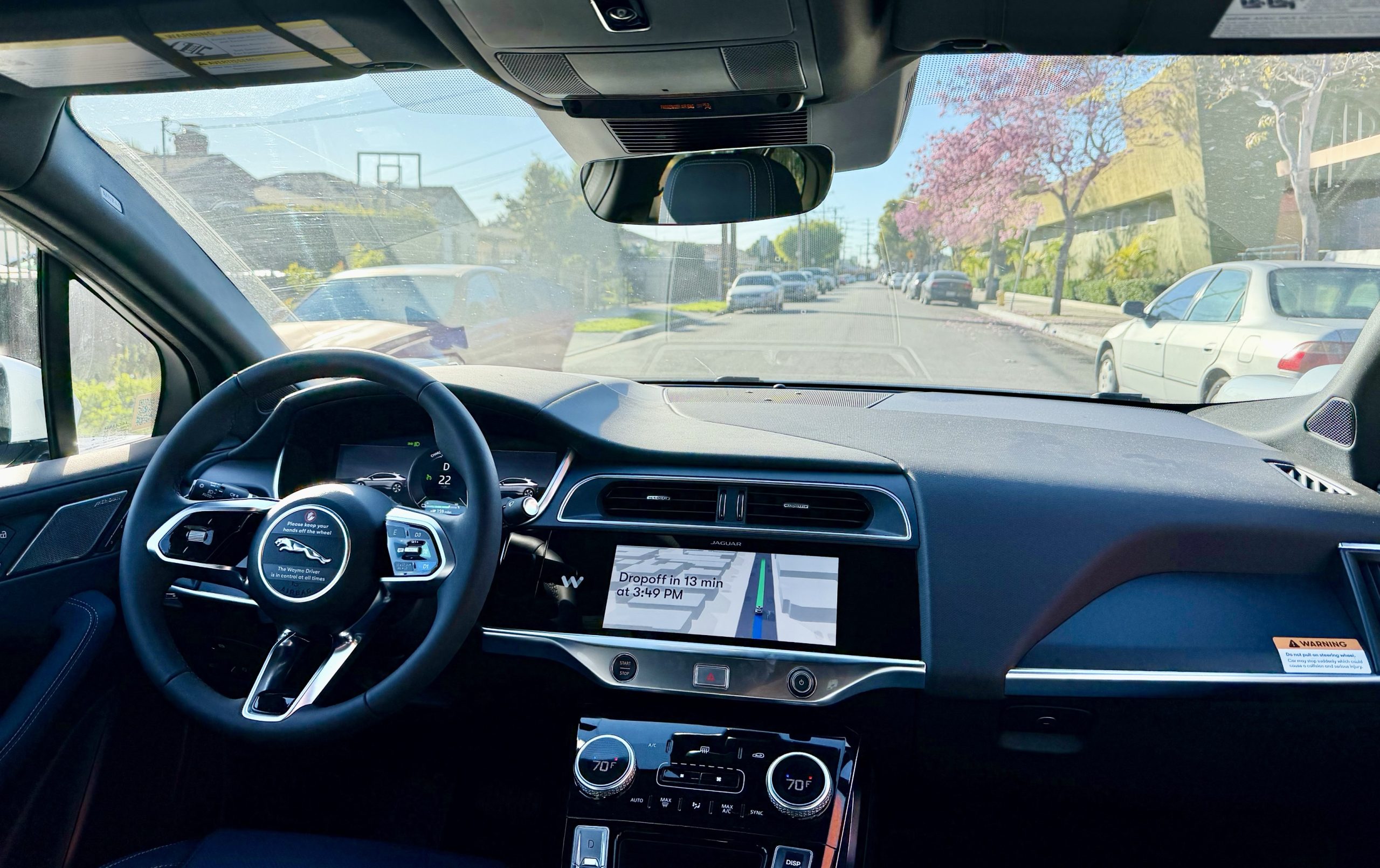
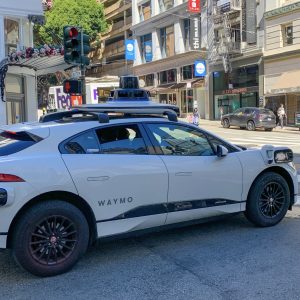
The Portland Bureau of Transportation wants to be ready for Waymo and the potential onslaught of autonomous vehicles. After the Google-owned company approached city officials last fall to share their desire to operate on our streets, PBOT realized it was time to update their administrative rules that govern the new form of transportation.
PBOT last dug into AVs in 2017 with the passage of their Smart Autonomous Vehicle Initiative, but a lot has changed in the industry since then. And with Waymo’s aggressive expansion plans — they recently raised $16 billion in venture capital and want to launch in 20 more cities this year — PBOT officials want strong local regulations that balance innovation with public safety. And simmering under all these conversations are Portlanders with strong feelings about AVs and city council members who are skeptical to say the least.
PBOT Mobility Innovations Section Manager Jacob Sherman (formerly the city’s e-scooter program manager) stopped by the Bicycle Advisory Committee last night to share the city’s stance on Waymo and hear from members what they think of AVs in general. He was joined by PBOT Transportation Planner Hannah Morrison.
“We see automated vehicles as just the next evolution of this broader industry [of rideshare companies like Uber and Lyft], and we think that we need to get ready for it and have a conversation about what it could mean for Portland,” Sherman shared at the BAC meeting last night. Sherman said he was relieved a state bill that would have preempted local control of AVs died in the state legislature last month.
“We think these [AVs] should be regulated as for-hire vehicles — just like taxis and just like Uber and Lyft. And we need to maintain our local control to be able to do that,” Sherman said.
Like students getting ready for a big test, PBOT has been studying-up on AVs. In the past few months, PBOT officials have talked to over a dozen other cities to better understand the pros and cons that come with robotaxi services like Waymo. “We took pieces from other cities and tried to do this in a Portland way,” said Morrison, when explaining PBOT’s new draft rules.
Sherman describe the “Portland way” as, “Trying to propose a thoughtful, collaborative approach that could let companies come to market, but also do so in a way that kind of protects the broader public good.”
To be clear, PBOT isn’t anti-AVs. The benefits they see include: safety, more efficient traffic flow, a good option for folks who can’t drive themselves, and the fact that AVs give riders more time to themselves. But the perils loom large as well. PBOT is concerned about: how robotaxis will interact with other road users, the impacts on the job market, increased congestion (in California, about 40% of AV miles are without a passenger), who has access to the videos and photos the cars take, how AVs could induce sprawl, and so on.
To stay in the driver’s seat when it comes to regulating AVs, Portland’s plan is to set a strong set of ground rules before any testing or operations begin. Here’s a general outline of the draft rule PBOT is seeking comment on (taken from a PBOT presentation to the BAC last night).
To understand companies’ intended operations, they must provide a description of the conditions they will operate under, including: time of day; environmental conditions (e.g. weather); and a description of restrictions on operations, including: speed of travel, roadway type, and a map of their intended operating area.
To ensure that the City permits safe companies and not possible bad actors, companies must: provide a statement of testing or deployment experience, comply with robust insurance and liability requirements, comply with all state and local laws (including traffic laws and parking regulations).
To ensure widespread access, AV companies must: provide reasonable accommodations to passengers with disabilities and host at least two public outreach events annually.
To ensure companies are supporting the City’s Vision Zero goal, they must: provide a Passenger Safety Plan; provide a First Responder Interaction and Disengagement Plan and host at least one in-person training annually; provide PBOT with copies of NHTSA collision reports; comply with all federal, state and local laws (including traffic laws and parking regulations); do not pick-up or drop-off passengers in a vehicle or bicycle lane; comply with federal AV requirements; submit documentation on annual vehicle inspections.
To ensure that companies are committed to data privacy and data sharing, they must: share trip level data with the City (like taxis, Uber and Lyft, BIKETOWN, e-scooters, and car-share); comply with the Oregon Consumer Privacy Act; submit a privacy policy showing how they will safeguard passengers’ information. AV companies should also work with the city to integrate our data about street closures, school zones, work zones, and first responder conflicts.
To ensure that AVs contribute to the City’s decarbonization goals: all AVs must be fully battery electric vehicles.
Standard private for-hire permit and per-trip fees will apply to for-hire AVs, just like taxis, Uber and Lyft. These fees support administration and maintenance and operations of transportation system.
Addition of a for-hire AV permit. To receive a permit for commercial operations, AV companies must either:
- A) Start with a Portland AV Testing Permit and complete at least 500,000 automated miles across their fleet without their permit being suspended or revoked OR
- B) Have tested/deployed in at least 5 other U.S. cities, have completed at least 500,000 automated miles, and have no permit suspensions or terminations in the U.S. in the last three years
Permits can limit fleet size. Permits can be suspended or revoked for noncompliance.
The response from BAC members was mixed. One member, Alon Raab expressed serious concerns — both about basic things like safety (he doesn’t like that you can’t look robotaxi drivers in the eye when negotiating an intersection) and deeper societal issues the vehicles represent. “I find this technology alarming,” Raab said. “Six companies own the market. I don’t feel comfortable in a world where six companies own a market. It’s a philosophical issue.”
“This is a big question of what kind of world we want,” Raab continued. “And I don’t feel comfortable with this world where machines drive and don’t have any responsibility and where a few people make all the decisions.”
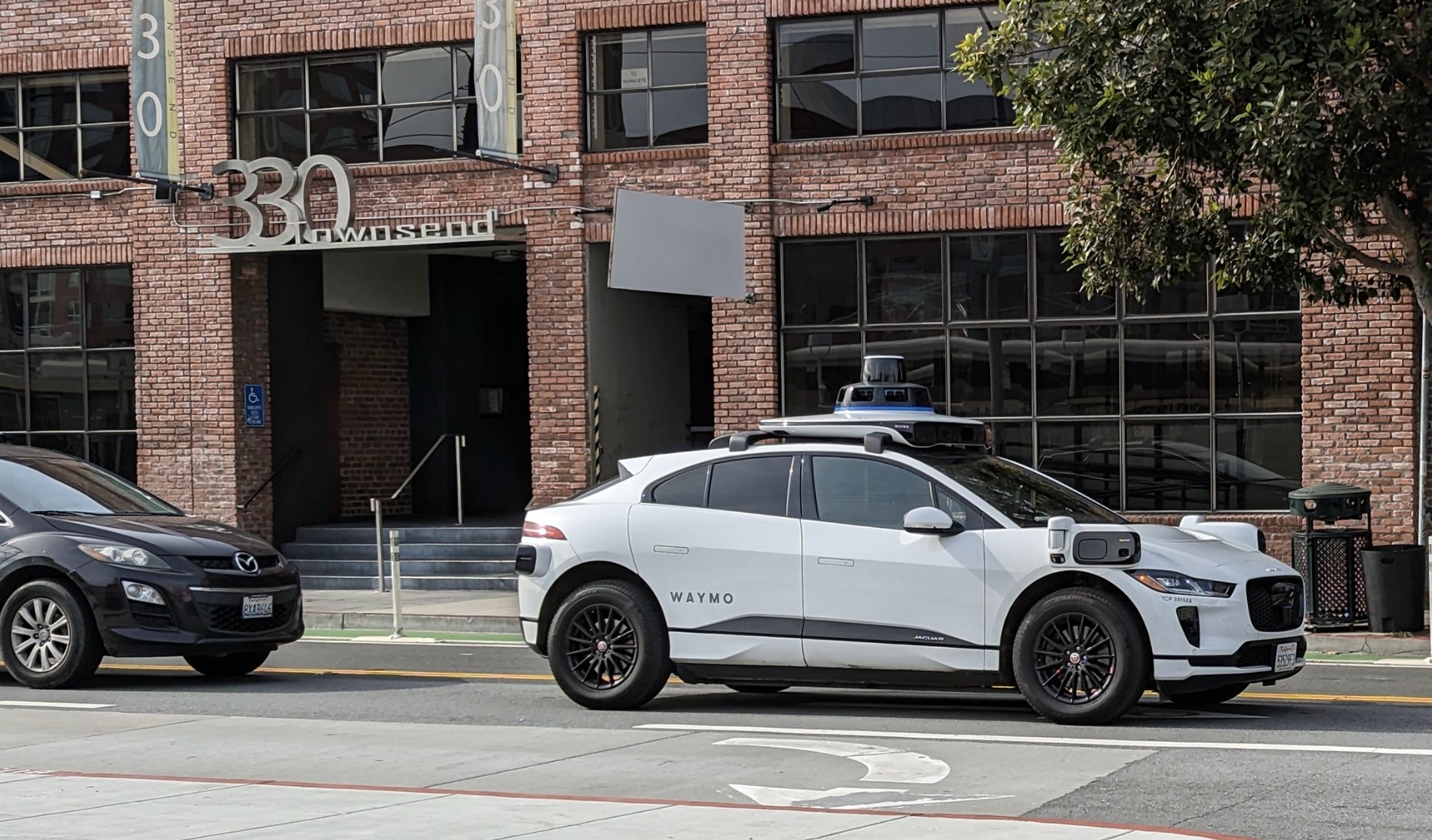
BAC member Sabrina Freewynn had a much different take. “I am a total supporter of autonomous vehicles. Absolutely love them,” she said. Freewynn, who’s ridden in a Waymo in Phoenix, said people need to get more familiar with them, “So I like that idea of having them tested in Portland.”
The issue of traffic law enforcement came up several times during the meeting. If a police officer wanted to issue a citation to an AV, how would that even work since there’s no driver to cite? Sherman with PBOT said, “Oregon law doesn’t answer that question right now. That’s a piece of law that needs to be clarified at some point.”
There remain many questions surrounding the future of AVs in Portland. That’s why you should pay attention and consider sharing your comments with PBOT. The comment period will be open through April 4th and there’s a public hearing today (Weds, March 11th) from 6:00 to 7:30 pm at the Portland Building downtown (Zoom also available). Learn more about the draft rule change and opportunities for feedback on PBOT’s website.

Thanks for reading.
BikePortland has served this community with independent community journalism since 2005. We rely on subscriptions from readers like you to survive. Your financial support is vital in keeping this valuable resource alive and well.
Please subscribe today to strengthen and expand our work.
That seems like a red herring concern.
If that is a real concern, at least consider that it means folks are choosing to take AVs to come back into the City to work and/or play.
Making it easy, which usually means prioritizing, people who come in and out of the city to work and play is sprawl. It wastes resources and destroys the destination. It is one of the main reasons downtown Portland is in the desperate situation that it is now.
Yes, you’re hitting the nail on the head. One of the major contributing factors to why downtown Portland utterly sucks right now is the ring of people outside the city with more money than people in the city, but want to experience the humiliation ritual of spending $300 per person for 15 bites of food because the NYT said they needed to, and wouldn’t mind taking an AV to get there.
Its definitely not the druggies or rampant vehicle related crime.
I was thinking more about how Portland, like a lot of US cities, over invested in car-commuter infrastructure, turning their downtowns into car-sewers, office buildings and glorified malls, often destroying residential. Now, the suburbs have grown to the extent that they can support their own malls, and people don’t need to commute to the office. Keeping downtown a car sewer to accommodate circling empty AVs would be a bad idea. Especially, since city hall and many planners/ investors have finally realized that more residential with associated services is the best path to revitalizing downtown, and making it a destination again.
I get this take, honestly, but it is completely revisionist history. After 50 years of the office buildings in Portland being the most productive real estate from a taxation perspective, in the entire state, now they were a bad idea because leadership made unilateral decisions that anyone with a modicum of understanding in markets would realize were very detrimental to the economy six years ago? Add in the Portland voter’s suicidal empathy of measure 110, and its the revolving door of people not thinking there are ever negative repercussions to their decisions and the economic status quo just marches on waiting for the next tax to be applied to the activity.
I do agree that city hall planners have definitely realized residential is the way forward, unfortunately for them, that requires actual market participants, i.e. investors, and contrary to your comment above, they are not investing in Portland. It’s like super weird, you can make the title “developer” a pejorative and they will still build, but when you make it clear you actually don’t understand how the world works and they lose money on a couple deals here, they will not be back to put millions of dollars at risk for a long time.
So, yeah, maybe AV’s are great, who knows, but more people downtown should be the focus regardless of how they get there, but in the Portland way, there are just people climbing over each other to project their moral superiority while everything gets worse.
Does it really, though?
I’ve considered it, and I don’t like it.
We’ve done this all before (sprawl, white flight, etc). I guess it’s okay now because the vehicles are electric.
Are AVs the result of white flight or do you fear they will be a trigger for white flight?
This is just my two cents, but I can’t see how using a taxi-like service, only this time without a human driver, will magically encourage people to move outside the urban growth boundary.
Uber and Lyft and Radiocab and Broadway Cab…etc have been around long enough that if hailing a car from your phone was going to cause you to leave the city (where you’d be even more dependent on their services?), it would have happened already.
The robotaxis won’t be much of a factor, but self-driving personal vehicles absolutely will. Once you can “work on your commute” and your vehicle doesn’t use expensive gas, suddenly a one hour each way commute isn’t a big deal.
Again, this is about “automated vehicles”, not just taxis.
I’m not convinced this technology will be commercialized to private vehicle owners beyond people rich enough to already have their own drivers (or close to it).
Setting aside Elon Musk’s hubris and vanity, all of the serious players in this space are developing commerical cars.
Spending this much money on an asset and then having it sit idle 22 hours a day isn’t why folks are making these.
But let’s assume that they do, and eventually people living in Portland will be able to ride down to Dick Hannah, get a Level IV Honda CRV, and then throw their bike in the trash before they nap on their way home.
That’s a completely orthogonal issue to whether Waymo is allowed to commercially operate in within the City of Portland.
It’s going to be a while before Waymo will take you out of the urban core, even if you ask nicely. Those other services will do so today.
Unless Waymo is using shell companies to hide ownership of their vehicles, there doesn’t seem to be a problem assigning liability if the photo enforcement guide is any clue. Since there is no driver, straight to Waymo. Same as if an officer issued a citation although, has that ever happened?
“Oregon Law authorizes the citation issued to your business or public agency to be dismissed if you complete the Affidavit of Non-Liability identifying the driver. However, if you do not fill out the Affidavit of Non-Liability with accurate and complete driver information, the citation will not be dismissed and your business will be responsible for the citation.”
I would take a totally different approach — rather than issue individual fines/tickets, I would lodge the incident with the appropriate regulator who can investigate and ensure that the appropriate company updates their software or, if they won’t/can’t/don’t, the regulator can impose an appropriate corporate sanction, including large fine or withdrawal of operating license.
Obviously there needs to be a mechanism in place for this, but the concept of “tickets” doesn’t really make sense in the context of AVs.
It doesn’t make sense at all, I agree. I guess my thinking was that we don’t really need to expend a lot of time or resources trying to invent a system for Waymo when there are systems working just fine in 10 cities. I was just trying to show there are plenty of regulations that apply to Waymo already codified under Oregon law and at most would just need a little tweaking. If there was ever a time to just cut and paste from what the other cities are doing with Waymo, this would be it.
It seems from some of the reactions in the article that people believe we need a unique solution to AVs that are no longer unique and are now operating smoothly in 10 varied cities.
Imagine how the driver ‘black points’ system – for a jurisdiction with such – for moving violations would work for a robo car…points are issued, but then the corporation [‘whom’ now has human citizen level lobbying rights, thank you very much SCoTUS!] says of that “driver” ticketed does not work here anymore. [That robot was “SAE Level 4, ‘OS: Prune Dust’ ” but it is now…”SAE Level 5 ‘Wet Prune’ “…etc. etc.]
This has made my day so much better. “OS: Prune Dust.” Black metal band? Borzoi puppy? Next workout fad? AIs dont have to always get all the best names.
How about in the sense that if their vehicles make illegal movements, they pay fines for each incident until they sort out the problem? Why should a regulator have a role in figuring out if they are addressing the problem? If my psychopathy leads me to speed or run stops, does the city analyze me? No, but they can write me tickets. If I’m in a company car, the company can eat the tickets or turn me in.
If that turns out to be the best way to improve the system, then sure. I think a more holistic and collaborative approach might yield better results for everyone, but I’m open to ideas about how to achieve the best performing, safest system we can.
Your post makes me think you’re more interested in inflicting pain than solving problems, but maybe I’m wrong.
A corporation doesn’t feel pain. A fine is a direct communication with a corporation. It shouldn’t be up to regulators to suss out the issue, that’s the job of the company. If they don’t see fit to make a change, the fine isn’t big enough.
Regulatory capture is a real thing. If the function of regulation is more or less internal to the company it will be their interests that are addressed and not the public interest.
There can be multiple strategies towards yielding a desired result. Not all work equally well.
If an antagonistic approach is most likely to work, then we should use that one.
What benefits?
Safety: Waymo does better, but Teslas self driving is very much more crash prone that humans: https://futurism.com/advanced-transport/tesla-robotaxis-crashing-more-human-drivers
Efficient Traffic Flow: robotaxis increase VMT: https://usa.streetsblog.org/2026/03/05/study-academics-agree-avs-will-super-charge-vmt-driving-car-dependence-autonomous-vehicles-waymo
Option for folks who can’t drive themselves: willing to give them this one
More time to themselves: We probably have enough time to ourselves in our metal boxes https://www.theguardian.com/us-news/2024/dec/29/extreme-car-dependency-unhappiness-americans
Truly disabled people will be harmed in a robotaxi future. If these displace transit trips or clog up roads, slowing down bus lines, how do wheelchair users or anyone needing assistance get around? This is great for people who “can’t drive” but can still walk, or prefer not to drive, but this is not good for the disabled community.
“Truly disabled people will be harmed in a robotaxi future.”
Leaving aside what constitutes “truly disabled”, that future could be entirely avoided with regulations requiring vehicles be accessible, which I believe the rules Portland laid out address. Waymo has wheelchair accessible vehicles.
I see a much greater upside than downside with AVs for people with difficulty getting around if we make the right policy choices.
And based on the past, we won’t when it comes to new technology.
Now we have a chance to get it right. That’s much more likely to occur with constructive engagement rather than unreasoning objection, which will likely translate into “leave it to PBOT.”
The “More time to themselves” stood out to me also. More time compared to what? Transit riders are not by themselves, but most are listening/looking at their phones the whole ride anyway so that doesn’t seem very different. Folks driving cars are by themselves but are (only technically) supposed to be watching the road. If I’m walking or biking or something similar, I’m by myself. Does it take more or less time to travel by these other means, and how does that relate to “more”? Is this just a coded way of saying, “People prefer to take an AV where they don’t have to interact with or see any other humans, not even a person driving the Uber and especially not those stinky homeless people on transit”? I can believe people would state that as an immediate personal benefit, but I think it’s very short sighted and poor for society at large, and don’t think we as a City should invite Waymo to operate here to deliver on that “benefit.”
Maybe talk to a woman about this one.
I talked to two women about the supposed benefit of more alone time. Neither sees an AV ride as a viable solution. Do all the women in your life think this is something great about drverless vehicles as compared to other ways of getting around?
“Do all the women in your life think this is something great about drverless vehicles”
No. But then I didn’t know any who take Uber either, so I’m hanging with the wrong demographic.
So, you believe it is better for society at large to grant a monopoly on anti-social behavior to a few people and force everyone else to just deal with it, or do we need to just make a few people sad and allow public spaces to actually be enjoyable?
How do AV’s navigate pick-up and drop-odd locations? Uber/Lyft are very comfortable using bike lanes or stopping in-lane. Will AV’s do that if requested? That seems like something the City could preemptively address.
There are certain parameters that can be set/changed, but generally there’s no discretion.
Probably.
I had the same question. If a rider summons an AV and the rider is standing next to a bike lane, does the AV somehow wave the rider around the corner to a safe-stopping place? Maybe the permit should designate EVERY SINGLE pick-up and drop-off (Russian chauffeur?) location and AVs are not allowed to stop anywhere else. That seems like a manageable programming task.
Oh so maybe there could be designated AV ‘stops’ kinda like…wait for it…bus stops??? Maybe we could just stick with buses then!
We all know that they are going to stop in the bike lanes or in the travel lanes, put on flashers, and wait until the rider gets in. Hopefully these are more predictable to ride around compared to Uber drivers, but they are going to clog up traffic flow and block cyclists.
Vancouver, BC has designated 5-minute rideshare/taxi loading zones on commercial streets that seemed to work really well. I didn’t see any ubers just sitting in traffic or in a bike lane while I was there last summer. I’ve been dying for some of those on Williams every Thursday evening. Have to assume they would work for AVs pretty well also, assuming there are enough spaces sprinkled along streets.
The City/State is failing if they are not addressing pick-up/drop-off regulation
What about a simple question of “Will the operation of these vehicles likely increase overall the number of motor vehicles on our streets, which will thus increase pollution, traffic, and other public health problems?” If yes, do not approve.
I agree with Lois. And would add, to what extent will the adoption of AVs crowd out other, desperately needed transportation upgrades?
This already happened with predatory venture capital TNCs* (e.g. Uber/Lyft) and many car-free cycling advocates celebrated the freedom of being “car free” while being able to call up an underpaid Uber “contractor” (never employee) to chauffeur them around town.
*whose corporate revenue strategy explicitly relied on undermining public transit
PBOT can’t afford to pave the potholes let alone put up a wall around the city. I’m afraid cars are going to continue to come into the city, robotic or not.
That sounds like a problem that should be addressed.
2% of the population: “problem” should be addressed
75% of the population: add more lanes to address traffic congestion
I’d love to apply this criteria to motorized bikes, scooters, and other formerly human powered vehicles.
The purity of human power is less of an issue than the operating space required and the proportionate use of resources. A single bike plus motor and battery weighs about 50 pounds. An e-cargo bike with passenger capacity, perhaps a hundred. That’s less than four percent of a light car.
The road space required for a light e-vehicle is little more than a strictly human powered one. Scooters, arguably less. I don’t excuse rude behavior by anyone, but I’m able to park and ride my e-bike in the same space it took before it was converted.
Why would a person doing a rational analysis choose to exclude a choice of vehicles that reduces resource use by 96% compared to what we call a car*, without first banning one of the greatest categories of resource hogging on the planet?
The concerns of a person operating an e-vehicle that weighs less than its rider are almost identical to the concerns of a person riding a conventional bike in the present situation where combined they are less than ten percent of road users.
*while providing much of its functionality
I am continually amazed at the level of “motor capture” of the bicycling community.
Beyond that, I don’t really understand your comment.
I’d be happy to reach understanding. Bikes are sweet, I’ve enjoyed riding bikes, without motors, for decades and the more I ride the more I like it.
What I have trouble understanding is a need to banish or over regulate modestly boosted e-bikes from a street environment that already includes vehicles weighing tons with power output over 100,000 watts.
If anyone had asked me I would have capped e-bike power output at 250-350 watts but of course they didn’t. People riding e-bikes are commonly rude and thoughtless, but a lot of the problems we see are a result of pushing everything that is not an automobile into the same narrow space and saying “problem solved”.
I don’t want to banish “boosted bikes” at all — I think they should be treated equally with other more-than-human-powered vehicles. For example, no riding on the sidewalk (which is already the rule), and prohibiting children from riding them.
I absolutely agree that we should not push everything that is not a car into the same space. Sufficiently powerful e-bikes should probably not be on MUPs. I have no idea what “sufficient” means in this context, but if the motorized nature of a particular vehicle is so modest as to be indistinguishable from a normal bike, then treat it as such.
I don’t know what the right regulatory framework is, but I do feel pretty comfortable saying that motorized bicycles are fundamentally different than non-motorized bicycles. While I understand the desire for e-bike advocates to try to blur the line, I think that blurring does a disservice to people getting around on their own, without motors.
All the more reason for congestion pricing and/or Vehicle Miles Travelled-fees
At this point, my understanding is that a Waymo ride costs about the same as an Uber/Lyft ride. So it will continue to be the case that a minority of people can afford to frequently travel this way. The only ones who will save money will be those who give generous tips to human drivers–and those people can afford to travel that way regardless. So the number of motor vehicles on the streets will likely remain steady in the short term, with Waymo cars replacing some taxis and Uber/Lyft drivers.
However, if Waymo gets AV competitors in the future, prices could come down. The company is currently pocketing the (relatively meager) portion of the fare that would go to a human driver with Uber/Lyft. That means that competition would drive prices down and potentially increase the number of cars on the streets. This is why it’s important to get the regulations right.
Two relevant Portland Transportation System Plan Policies:
New mobility priorities and outcomes: Facilitate new mobility vehicles and services with the lowest climate and congestion impacts and greatest equity benefits; with priority to vehicles that are fleet/shared ownership, fully automated, electric and, for passenger vehicles, shared by multiple passengers (known by the acronym FAVES). Develop and implement strategies for each following topic. (COMPREHENSIVE PLAN Policy 9.68)
a: Ensure that all new mobility vehicles and services and levels of automated vehicles advance Vision Zero by operating safely for all users, especially for vulnerable road users. Require adequate insurance coverage for operators, customers, and the public at-large by providers of new mobility vehicles and services. (COMPREHENSIVE PLAN Policy 9.68.a)
b. Ensure that new mobility vehicles and services improve active transportation and shared ride travel time reliability and system efficiency by:
c. Cut vehicle carbon pollution by reducing low occupancy “empty miles” traveled by passenger vehicles with zero or one passengers. Prioritize vehicles and services with the least climate pollution, and electric and other zero direct emission vehicles operated by fleets and carrying multiple passengers. (COMPREHENSIVE PLAN Policy 9.68.c)
d. Make the benefits of new mobility available on an equitable basis to all segments of the community while ensuring traditionally disadvantaged communities are not disproportionately hurt by new mobility vehicles and services. This includes people with disabilities, as well as communities of color, women, and geographically underserved communities. (COMPREHENSIVE PLAN Policy 9.68.d)
e Identify, prevent, and mitigate potential adverse impacts from new mobility vehicles and services. (COMPREHENSIVE PLAN Policy 9.68.e)
New Mobility tools: Use a full range of tools to ensure that new mobility vehicles and services and private data communications devices installed in the City right-of-way contribute to achieving Comprehensive Plan and Transportation System Plan goals and policies. (COMPREHENSIVE PLAN Policy 9.69)
a: Maintain City authority to identify and develop appropriate data sharing requirements to inform and support safe, efficient, and effective management of the transportation system. Ensure that when new mobility vehicles and services use City rights-of-way or when vehicles connect with smart infrastructure within the City they share information including, but not limited to, vehicle type, occupancy, speed, travel routes, and travel times, crashes and citations, with appropriate privacy controls. Ensure that private data communications devices installed in the City right-of-way are required to share anonymized transportation data. (COMPREHENSIVE PLAN Policy 9.69.a)
b: Design and manage the mobility zone, Curb/flex Zone, and traffic control devices to limit speeds to increase safety, to minimize cut-through traffic, evaluate future demand for pick-up and drop-off zones, and to prioritize automated electric vehicles carrying more passengers in congested times and locations. (COMPREHENSIVE PLAN Policy 9.69.b)
c: Evaluate the public cost and benefit of investments in wayside communication systems serving new mobility vehicles and services. (COMPREHENSIVE PLAN Policy 9.69.c)
d. Develop sustainable user-pays funding mechanisms to support new mobility vehicle infrastructure and service investments, transportation system maintenance, and efficient system management.(COMPREHENSIVE PLAN Policy 9.69.d)
e. Ensure that new mobility vehicles and services that connect to smart city infrastructure, and private data communications devices installed in the City right-ofway, help pay for infrastructure and service investments, and support system reliability and efficiency. Develop a tiered pricing structure that reflects vehicle and service impacts on the transportation system, including factors such as congestion level, carbon footprint, vehicle miles traveled, vehicle occupancy, and vehicle energy efficiency. (COMPREHENSIVE PLAN Policy9.69.e)
I’d like to see a requirement of the permit be that every vehicle is equipped with a GPS tracker that uploads data to the city. This would allow the city to independently determine things like are these vehicles obeying the speed limit, are they getting stuck and clogging up the street in places, are they stopping to pick up drop off in places that don’t have parking spots etc.
Like they do with city vehicles? That still park in bike lanes. That still speed. That still act like people are driving them?
I’m pretty sure Waymo knows where all its cars are at all times. Meanwhile, the city can’t enforce rules and regularions on the city vehicles it already tracks. How would the city adapt to handling all the data you would want Waymo to share them?
To be fair, the issue of data analysis bandwidth is evaporating quickly with the improvements in machine learning programs. They are uniquely well suited to making sense out of mountains of data and cost a fraction of what a human does to operate.
The city wouldn’t have to pay at all honestly. This town has lots of curious folks with computer skills, think about the transit appliance project where just by making the data available people built and installed coming arrival reader boards for Trimet for free. If the city publishes the data the analysis will happen.
Yeah, but then someone has to review and validate the analysis before you can use it for any source of policy or regulatory action. Ideally that someone is both trained in statistics and can review the source written in Python, R, javascript, whatever…
But because some nerd ::looks in mirror:: publishes a graph or map on their blog, doesn’t mean you can run with it uncritically.
Data analysis is the easy part. the rule of thumb is that any “data analysis” task is 80% data preparation, 10% complaining about data preparation, and 10% actual analysis. Knowing which statistics will be meaningful and rigorously interpreting them to inform real-world actions and decisions is the hard part.
Waymo has been criticized for its lack of transparency in other cities. They can and will make the case that this is proprietary or a costly regulatory burden. Get ready to hear on loop “The cost of a waymo ride is so expensive because of people riding bicycles and a nosy city government.”
The linked post doesn’t seem to say that the bill died in committee. Or am I missing something?
The time ran out. It didn’t get the work session it needed in time.
“(in California, about 40% of AV miles are without a passenger)”
This is the biggest issue to me. I was recently in Phoenix and used public transit while there. The frequent-service transit corridors I rode (bus and light rail) were teeming with empty Waymo cars. I saw dozens of them, but only noticed passengers in them a couple times. As you noted, zero-occupancy vehicles increase traffic congestion even further than single-occupancy vehicles! One thing you didn’t mention: More vehicle miles also increases the wear and tear on our streets–something Portland cannot afford to see right now.
(It was interesting that Waymo had so many cars on corridors already well served by transit–by American standards at least. I rode a couple non-frequent bus lines also, but didn’t notice Waymo cars along those streets.)
AVs in general probably will result in safer streets over time (I was gratified to see that the empty Waymos were moving at or below the speed limit, while the human-powered cars were zooming past them). But I think they need to pay for road usage by the mile, and they should not be allowed to “cruise” when traffic is heavy.
Now transit riders can complain about ‘all those very empty robotaxis’…just like the empty seats in SOVs more common in our cities before Waymo. 🙂
Can we get some “No Occupancy Vehicle Lanes?”
So what? If I drive myself somewhere, 50% of the time is spent going there and 50% is spent going back. With a ride service, it is 60% of the time with a rider, so about 20% of the time (10% of 50%), they can find a new ride before they have to drive the distance of the ride before. That is a massive increase in efficiency from self driving.
Where’s the efficiency? In your example, self-driving has a passenger both ways. If the car is a four-seater, that’s 25% efficient. Moving the vehicle without a passenger or other cargo is 100% inefficient.
My wife and I have one car, I need to run an errand, then she does when I return. My errand is 10 miles away, so I drive myself 10 miles there (50%) and then I drive myself home (50%). My wife does the same and the ratios are the same. The driver as occupant is irrelevant, the car has to go somehow. However, if my wife starts walking when I leave and by the time I am on my way back, I pick her up at 4 miles from home, we just made that trip 20% more efficient. That is exactly what the data of the ride services is showing. Their dispatching software and number of drivers in most areas is adequate enough that they can get a driver to you in less miles than the trip you are going to take or they just provided.
Not necessarily an apples to apples comparison, but if the analysis in the article is carrying weight, and is seen as some metric of gross inefficiency, I’d love to see how inefficient transit is. Does MAX ever hit 40% full on average, how many bus lines operate at 40% full?
You are comparing a round trip driving yourself with a one-way trip in a Waymo. If you do the round trip in a Waymo, it would generate an average of 40% more VMT than a round trip in your car. If you left your car parked and walked to the bus stop, the VMT would be divided among all the people on the bus.
Your math isn’t mathing. If I have to go someplace in a normal, privately owned and operated car that is ten miles away, I drive ten miles there and ten miles home, for a round trip of twenty miles. If I do it in an av, the av drives (on average) four miles to pick me up, then ten miles to my destination. That’s a total trip of fourteen miles. Then I want to go home. For the return trip, the av does a ten mile trip with me in the car plus 40% deadheading. All said and done, the av has driven 28 miles to take me twenty miles. You have to factor that same average inefficiency into every trip the av takes. That is not improving trip efficiency.
“(in California, about 40% of AV miles are without a passenger)”
This is a pretty wild statistic – are they just driving around aimlessly while waiting for a passenger customer? They can’t just stop and wait it out?
Easier/cheaper to drive around than to find parking sometimes. This is literally the Trash Future that people have been warning us about with AVs.
“They can’t just stop and wait it out?”
They do exactly this.
They probably wait somewhere in some cases–if they can find parking. But even if they park, the next request may be several miles away from the car’s current location, which would contribute to the 40%. (I’m sure Uber/Lyft and taxis log similar percentages of their mileage without paying passengers.) That said, I saw dozens of empty Waymos driving around on major corridors on a recent trip to Phoenix–in areas where it would have been easy and free to park. I can’t imagine that all those cars happened to be on the way to pick someone up.
In denser urban environments it may make more sense (from Waymo’s perspective) to “circle the block,” as it were, than pay for metered parking or piss off other people who might want a scarce parking space. From a regulatory perspective, it seems to me that all taxi services (including Uber/Lyft) should pay for road usage by the mile, should not be allowed to “cruise” when traffic is heavy, and should be required to pay for parking in metered spaces even if they’re there for 30 seconds (the latter could be enforced by GPS and onboard cameras).
Maybe we should go back to parking meters that require a human to stick coins in a slot and turn a knob, haha! Let’s see if Waymo can invent a robot to do that!
Endlessly circling the block would run the vehicle’s batteries down, requiring it to go find a place to charge, taking time away from the business of carrying paying customers.
You’re right. Makes more sense to just stop in the travel lane and throw on the hazards.
I assume Waymo cars have big enough batteries to cover at least 6-8 hours of city driving, meaning they can easily cover the busiest times of day even if they cruise a lot.
They have a range of about 250 miles.
Good point. We should just park them in the middle of travel lanes to improve efficiency.
This so much. AIs have handily beaten the Turing Test a while ago. But the dishwasher test is still years away.
I have a computer operated dishwashing robot in my kitchen. You’ve probably seen them — they’re pretty cool.
I’m glad to see this discussion start to separate the concept of autonomous vehicle technology from the corporate implementation of this technology. The latter is much more important, but seems to be missed by a large number of people that are distracted by the novelty of AVs and whether they “like” them or not.
I too am glad that the difference between AV tech and corporate implementation is being acknowledged.
It will make it easier for people to not have to grasp at fantastical reasons to object to AVs and simply say……
“I don’t like the AV tech because of reason ABC and don’t want them here” or the more likely “I don’t like corporations that I don’t like” and don’t want them here.
Maybe each Waymo car can have a bumper sticker:
ONE MORE CAR ON THE ROAD
I’m currently in SF this week and have been using Waymo exclusively to get around. I’m sold. They offer a far safer ride than any Uber or Lyft driver I’ve ever had. They have dealt with unpredictable behaviors from other road users with care and caution. They maintain a safe following distance and religiously never exceed the speed limit. Can’t wait for Waymo to come to Portland!
Fun for visitors doesn’t necessarily translate to good for residents. Waymo has already begun to make their cars drive more aggressively. How far will alphabet shareholders want them to push the limits? I also preferred using waymo when I was in SF to uber or lyft, because the human drivers were pretty miserable and took more emotional and mental bandwidth to interact with, however, it was also clear that waymos were making congestion worse and they have reportedly not been good partners with the city.
The bigger picture experience of SF is that there are way too many cars and their roads are ridiculously built for speeding cars over people.
You raise an interesting question: should AVs drive “properly” or should they drive “colloquially”, conforming to the expectations of other drivers, improving the flow of traffic and predictability (and therefore safety)?
As always, the answer is probably somewhere in the middle. Waymo seems to be trying to find the proper balance; their vehicles are often criticized for being too timid, and yet some people criticize Waymo for trying address that complaint.
My personal feeling is that they should conform to local norms so long as safety isn’t compromised, and perhaps that can be gradually dialed back as time passes, which could have a calming effect on vehicles around them.
Local norms in Portland include rolling through crosswalks at stopsigns, speeding, and speeding up for yellow lights, but maybe that’s not what you mean. The “calming effect” would be a good outcome but how likely is it that a loose AV operation would be gradually tightened? The comments praising Waymo all said the safe operation they experienced was a definite feature right now.
“how likely is it that a loose AV operation would be gradually tightened?”
That really depends on the regulatory framework.
Realistically, the companies are going to err on the conservative side, so we’re not going to see any of them adopt my idea.
Did you just wake up from a multi-decade long nap?
Local norms in the 2020s include buzzing pedestrians near/in a crosswalk, blowing through stale red lights, reckless passing (including on the right in a bike lane), screaming threats/epithets at people walking/biking etc.
I can be over-generous to humanity at times. I can’t prove it but it seems like people act out when a rain storm is coming in.
SD, do you have a citation(s) about programming the vehicles more aggressively? This is a fundamental concern I have: today they are safe, tomorrow a programmer changes a couple lines of code and they are significantly more dangerous. How we regulate that will be critical and I’m curious if you have some reporting about it as you alluded to
The day after, they get sued or regulators shut them down.
Suits take years. Regulation is not enforced.
If you want regulations to be enforced, talk to your elected officials.
There are regulators? Are they in the room with us right now?
here’s one article about it. They call the slippery slope being “confidently assertive”
https://www.electrive.com/2025/12/09/waymos-driving-style-takes-a-turn-towards-more-aggressive/
Also see Tesla Mad Max mode. Also reported on pretty extensively.
Tesla and Waymo are utterly separate.
Yes, Tesla and Waymo are seperate. And? You think only one company will get to operate here?
Only one company is capable of it for the foreseeable future.
Waymo is doing just fine in all the other places it’s operating. It’s still safe, slow and calms traffic around it.
Cars of new Portlanders are coming into town everyday and the Democratic Corporatists at the state and local level have done their best to destroy our public transportation. Saying that these same incumbents will suddenly build out a safe, clean and comprehensive public network when they haven’t for over 20 years is laughable. Since our elected officials have so clearly failed us then it’s time to give the private market a try. I don’t like that, but it is what it is.
Stop voting corporatists into office and maybe our public transportation will improve in a decade or two.
The primaries are coming up.
One problem that has already begun emerging is the opacity of coding in litigation, particularly for AI. An employee might be able to point to a source code, but not know why an AI has made certain decisions. Lawyers/judges have little to no understanding of coding so they must defer to computer engineers who also may have little to no understanding the reasons for a particular behavior. This will only become more a factor as decision making for AIs begin to become more complex and AIs themselves begin to edit their own code.
Hi eawriste,
This is an interesting discussion, and it’s true that judges need to stay up-to-date on scientific, technical, and statistical issues. The difficulty with AI is knowing how the application determined network weights from the data sets it was trained on. AI is not an “expert system” of rules. Rather it, at much expense, creates matrices of weighted nodes through training on huge data sets. The difficulty is in tracing back how the weights of nodes were determined, and how those weights led to an action. Everybody has trouble determining that, not just judges.
That problem may lessen when the lawyers and judges are AI themselves.
“Lawyers/judges have little to no understanding of coding”
Lawyers and judges aren’t idiots, and detail with complex issues all the time. We don’t need to understand exactly which code commit caused Waymo to drive in the sidewalk, we just need to know that Waymo did drive on the sidewalk and must suffer some sanctions as a result.
There are lots of complex issues here, but assigning liability for bad outcomes is not one of them. We’ve been doing that for millennia.
I think this is the POV that causes the city of Portland to cave and completely legalize AVs with few, if any, regulations (see Novick’s feckless cave in to Uber/Lyft for example; vote him out please).
If we only focus narrowly on the fact that individual AVs are safer than human drivers we might not see all the other negative externalities of further entrenching a car-centric transportation system. Take a step back and consider the increase in VMT, the increase in vehicles on the road, the disruption of public transit, the increase in the cause of all crash injuries and death – KE.
Have a lot of people been killed by AVs? What will be causing the crash injuries and death? Other drivers plowing into Waymo cars?
It looks like Waymo has between 300-700 cars (as has been pointed out they are not big on transparency) in San Francisco so far compared to about 12,600 registered ride share drivers in Portland. I know that registered does not mean actively on the streets, but I was surprised at how many there are. Will we even notice an increase in traffic with such a small infusion of Waymo vehicles? Are you concerned they will surge thousands of cars into downtown?
You keep focusing on Waymo. It will not be only Waymo operating here.
Yes, lots of people have been lilled by Teslas FSD.
Tesla does not have AVs nor will it have for years. Yo paring people killed by Teslas to what Waymo AVs are doing in the real world right now is not even comparable. As I said, they are utterly separate.
However, if you just want to throw misinformation and falsehoods about AV ability then I suppose conflating Waymo with Tesla will work for you. It is simply not grounded in reality though. Waymo has proven AV cars and Tesla does not have AV cars.
To say that Tesla does not have AVs while people in Tesla throw on FSD and stop paying attention makes no sense. Its irrelevant to how we define AVs when a company allows people to let the computer drive their car. If you can hit a buttong and allow the computer to drive for you, you have an AV.
Not at all. I don’t think you understand what an AV is and what Waymo cars do.
Tesla does have Robotaxis that are in the working trial stage which is an actual AV. With vision only sensors I wouldn’t trust being in it or around it and as the article states it exceeded the speed limit to match traffic. Note, the article is written by car heads so take some of their opinions for what it’s worth.
https://www.motortrend.com/features/tesla-robotaxi-vs-waymo-one-autonomous-taxi-service-comparison-test
“To say that Tesla does not have AVs”
Teslas with FSD are not autonomous vehicles. It’s a simple, correct factual statement, unless you are using a different definition than the rest of the world.
Tesla is testing actual autonomous vehicles, but they have not yet been deployed without a safety driver.
https://www.tesla.com/support/robotaxi#availability
Those Tesla Robotaxis all come with a human in the passenger seat mentioned in the article provided to Sky so they are definitely not autonomous.
I think the term “autonomous” refers to driving, not sitting gin the passenger seat. Waymo has remote operators in the Philippines or something, and they are still considered autonomous.
Waymo does not have remote operators anywhere.
They do have folks in the Philippines (and possibly elsewhere) that help the cars get “unstuck” when they hit a difficult situation, but they do not actually operate the cars. More like indicate the general direction they should head out, but they’re never steering or applying the accelerator.
Yes. Similar to the paid passengers in the Tesla not driving the Tesla. It is a bit torturous at this point, but the thread is about how far along Tesla robotaxis are, which they claim are autonomous. And the likelihood of other companies being ready to deploy AV taxis in Portland.
No. You are wrong. I dislike being so blunt, but you refuse to listen to other ideas or educate yourself about how AVs work so I doubt you actually know what parameters Waymo needs to have enforced on it. You’re not discussing how to establish regulations for them, all you are doing is spreading misinformation (and that’s the politest word I could think of).
Tesla Robotaxis have a passenger controller so they can operate the car if/when it goes wrong hence they are not autonomous.
Waymo has years of safely operating without a controller in the car in 10 cities. It is fully autonomous.
Just saying you don’t want Waymo in town “because they’re owned by a corporation “ is a quick way to be ignored in any discussion on how to regulate them.
What misinformation? You can argue about what autonomous means, but you would be arguing with how Tesla refers to their robotaxis, and what most people think of as an autonomous vehicle. Sorry you have a hard time understanding my perspective, keep trying.
There are definitely negative externalities with AVs, but increasing crashes and deaths isn’t one of them.
The question is do AVs increase or reduce externalities? By sharply reducing crashes and relying on electric motors, I believe they greatly reduce external costs.
You know whats even safer than AV’s?
Public transit and bikes, and theu dont clog up the roads.
And considering that we are in an economic downturn, eliminating more jobs os a terrible idea. Sendong even more wealth to Silicon Valley is a terrible idea.
That’s entertaining. I thought traffic enforcement in Portland was racist, ableist, sexist, anti-democratic and a Trumpian ideal to be “de -emphasized” at all cost.
Yeah it’s hard to relinquish your tight grip on that narrative huh?
Jonathan, that’s a bit rich coming from the bloke whose site has been running the same droning narrative about cars and enforcement for years.
For ages the line around Portland was that traffic enforcement was racist, unfair, and should be dialed way back. Now suddenly everyone’s worried about how enforcement works with robotaxis. Pointing out that flip isn’t “clinging to a narrative.” It’s just noticing what’s right in front of us.
And honestly, AVs probably make enforcement easier, not harder. A robotaxi can’t argue, can’t speed off, and logs everything it does. If it breaks a rule, you know exactly who owns it and exactly what happened.
Feels like instead of going around the same loop about cars being the problem, maybe we just see if the tech actually makes the streets safer. Pretty straightforward, really.
AVs aren’t people, and they have no phenotype and behavior that human enforcers can boil down to “race” on which to selectively enforce the law. Sure, those human enforcers can develop other biases that apply to AVs, but you and Tropical Jo don’t appear serious when you can’t acknowledge that those who have opposed various enforcement approaches for various reasons might not have any reason to oppose enforcement of regulations on AVs and the companies that own and operate them. Overlooking that possibility is what made TJ look like they were gripping a narrative.
PBOT says they’re writing these rules ‘the Portland Way’ — thoughtful and collaborative. But if recent history is any guide, the Portland Way means layering on permits, fees, taxes, outreach meetings, equity plans, and data requirements until only the biggest companies can afford to play. All while the city funds endless programs that don’t fix homelessness, treats police like the problem, and watches businesses and commercial real estate values flee. In Portland, ‘the Portland Way’ often feels less like thoughtful governance and more like regulating, taxing, and debating a city while it slowly falls apart.
One possible positive from AVs is to move away from a blame based paradigm of safety to a systems based paradigm. Now we often think about which driver is responsible for an accident instead of looking at the whole system: driver, vehicle, roadway, etc. Now, the driver often gets a slap on the wrist because they genuinely don’t have that much responsibility for the accident and everyone ignores the other factors. In aviation or healthcare the response is to pull apart the whole system and only punish for intentional or willfully negligent actions. Reducing harm by fixing procedures, training, equipment, work environment are more important than assigning blame.
This could also be one of the biggest negatives. Waymo just pushed for legislation that it could not be treated differently from other “ride share” companies that are already operating. Based on this, waymo could routinely park in the bike lane and break numerous traffic laws and simply absorb the minor costs of any fines by passing them onto the consumer. Having a human driver associated with each vehicle allows for a system of deterrence that will not exist with the driverless “system” that you mention.
It is wild to suggest that waymo or competing AV corp would build their system to maximize safety and good behavior rather than maximizing profit. Aviation and healthcare are much more tightly regulated than car traffic. For healthcare, the for-profit system is constantly pushing against that regulation to put profit over outcomes. US healthcare is evidence of the failure of regulation in many instances. Also, there is no FAA for AV companies, and they have fought against regulation. AV companies will only have more leverage as they establish a presence in cities.
If we instituted appropriate regulation of human drivers and vehicles, the predicted margin of safety that AVs offer could possibly offer would significantly shrink to a margin that may not outweigh all of the other negatives.
“It is wild to suggest that waymo or competing AV corp would build their system to maximize safety and good behavior rather than maximizing profit”
Who in the world is going to pay for a harrowing, dangerous ride? That an AV is safer and calmer than a rideshare or taxi is precisely the draw.
“If we instituted appropriate regulation of human drivers and vehicles, the predicted margin of safety that AVs offer could possibly offer would significantly shrink to a margin that may not outweigh all of the other negatives.”
We have done that for decades. It has not worked. There is no enforcement, there is no social pressure and there is no improvement. Worse, people on this very site argue against human and camera enforcement of the laws that would make us all safer if only they were actually followed.
The people outside of the Waymo are not paying for the ride. The people paying often would be happy with the waymo prioritizing the speed of getting to a destination over the comfort or safety of people outside of the vehicle.
There are many ways that vehicles can make transportation more dangerous without smashing into people. Clogging bike lanes, blocking cross walks and sight lines, opposing the overall reduction in cars as a mode of transportation.
If Waymo vehicles start going wild, fine the company, or rescind their license to operate. We have plenty of existing mechanisms to handle stuff like this.
There are more than enough contemporary examples of the failure of existing mechanisms to handle stuff like this.
“There are more than enough contemporary examples of the failure of existing mechanisms to handle stuff like this.”
Perhaps, but that’s not really an AV problem.
If we are going to allow AV’s into our cities, NOW is the time to identify conflicts and attempt to prevent them. It seems likely that AVS will use bike lanes, bus stops, streetcar stops etc as places that are convenient for them and their users to make pick-ups and drops offs at the expense of the efficiency and safety of people riding bikes or using transit. It also seems likely that AV companies will continue their creep toward more aggressive/selfish (confidently assertive) driving, again at the expense of people walking and riding bikes. This seems fairly easy to anticipate, but I am not sure if it is being addressed by City and State leadership
I don’t think Cody is saying that he believes the AV companies will prioritize safety over profit in the current policy environment. He’s just saying the opportunity is there for it as soon as many vehicles are operating under a consistent, specified rule set.
I also disagree that we could be successful in in regulating drivers and vehicles into being more safe. For one thing, we (the US) is politically unwilling to do this, we’ve shown it over and over. The other is that even with better regulation, leaving humans in control of vehicles will always, inherently maintain a level of randomness/error that computer programs are less prone to by orders of magnitude.
I’m not saying that the technology or policy is necessarily there today but I do fully believe that the technology has the potential to make the roads much, much safer if we can get the policy right. That alone should be a powerful motivator to find appropriate ways to move forward here.
I also don’t think we will soon be successful in regulating human drivers, not because we can’t, but because of political will, like you mention. However, that political will is also absent in regulating deep-pocketed corporations that can buy council or legislator seats, or sue cities into compliance with their desires. That is my point. Most AV proponents always add the caveat “with proper regulation,” but we have extensive experience and evidence that durable appropriate regulation is very difficult. We have failed to regulate cars, why would we be successful in regulating AV corporations.
The technology does have potential to work out well, but it also has the potential to completely suck the life out of cities. The same arguments were made for cars, which were met with resistance. Then car companies captured policy makers and destroyed cities and transit, biking and walking.
Cars and AVs are fundamentally different despite looking similar (though the newest designs may change that). They’re more like airplanes or trains or taxis (in that they’re controlled centrally and are not piloted by random individuals), all of which we have successfully regulated, despite our experience with cars.
Autonomous Vehicles are not centrally controlled. They run autonomously, hence the name. Unlike trains and airplanes, AVs have no onboard human operator. This may solve operational issues with unreliable humans, but it does introduce unique problems that rely on a fully functional communications network for any remote intervention.
I meant they are centrally controlled from a corporate responsibility standpoint.
I agree that technology is close to being very useful. But the corporate control without adequate oversight is what scares me. AV’s COULD be a boon to street safety, but tech companies have not demonstrated any concern for public accountability.
Everybody knows ‘the tech companies’ will screw us over. And it’s evident that our government is severely undermatched to the task of effective regulation. I’m not anti-tech, but I predict the adoption of AVs will be a disaster.
How is that “system of deterrence” working out with FedEx and Amazon vehicles?
Exactly. Without the threat of meaningful fines, it will be even worse. And it is not just parking in bike lanes. It could be every finable nuisance driving behavior, including behaviors that make traveling more dangerous for people outside of cars.
Even better, if dangerous behavior is identified, it can be corrected and applied to the whole fleet. Try that with your typical Amazon driver.
Who is going to correct behavior, the tooth fairy, santa claus? The incentives are not there. So much uncritical tech-optimism coupled with belief in benevolent tech bros. ughh
Is Waymo simply waiting to unleash its NASCAR mode until they have infiltrated all the cities they want and playing nice until then?
If this behavior you are dreading was going to happen I would think it would have shown up by now. Do you really believe there is a board room of people smoking 100 dollar bills while plotting the right time to order the Waymo fleet to speed recklessly, run over cyclists and block crosswalks?
Very serious question that you’ve dodged so far, what is the incentive for Waymo to make their product less safe by causing it to speed and ignore traffic laws? You can get a rideshare to do that. The appeal of Waymo is that it will be safe by obeying laws so the person riding can relax which is not possible when driving or using public transportation.
competition with Tesla or another company? greed? If driving faster attracts more customers, they will might do that. If they could charge a premium for faster service, they might do that. I appreciate that safety and predictability appeal to you, but there are plenty of people who value efficiency and immediacy more. Unless they are forced to prioritize safety, I would expect the corporations to value profit. If speed and aggression becomes profitable, then I would expect them to choose that.
“Who is going to correct behavior?”
Lawmakers? Regulators?
We elect people to do this. If they’re not doing a good job, we need to elect someone else.
If all else fails, send in the lawyers.
The issue is hardly new, and the solutions are well known.
I hate to break it to you, they are not doing a good job, and the strategy of just elect a different one is also failing. This would particularly be the case with AVs in our car dependent culture.
The issues brought by AVs are new, primarily because of their scale and the power of technology today to create monopolies and concentrate power. Alphabet will have deeper pockets and better lawyers.
This is why strong preemptive regulation now is crucial, but may be reversible.
I’ll admit that change is awfully hard when no one is willing to vote for different candidates.
What specific issues do you think AVs add to the city that we aren’t already dealing with with Uber/Lyft/Amazon/FedEx, or that aren’t already well understood by the courts, such as liability?
And I’m not arguing against regulation, not at all, especially if it is well considered and not fear based.
“What specific issues do you think AVs add to the city that we aren’t already dealing with with Uber/Lyft/Amazon/FedEx, or that aren’t already well understood by the courts, such as liability?”
I don’t see many truly novel issues with AVs, but I don’t think the current system is doing a good job with supervised vehicles, and AVs might be significantly cheaper to run and hence more numerous.
Superficially, this safe systems narrative is possible, but in practice it’s extremely unlikely. Just like AVs are safer than the average driver, we tend to think of the potential for system-wide change while looking only at a narrow range of specific variables.
The stakeholders in our current transportation system are dispersed, i.e., a lot of people who generally have a diffused power and overlapping interests. We tend to not blame drivers for “accidents” because our culture uses cars as default for the vast majority of transportation. So an outsider who is harmed by those “accidents” might idolize any transportation mode that has the potential for improved safety without consideration of the vast array of other variables.
When we introduce corporate stakeholders into our transportation system, we press the scales inexorably in favor of their interests. Safety, for example, is a least common denominator in their interests. You might say, “We can just fine them when they break the law.” There are a few current examples that can show us what future corporate decisions re our transportation system might look like in the future when AV companies hold a large portion of stakeholders.
Amazon, for example, has increasingly become a stakeholder in street space where they essentially rent our streets for free. They can do this while racking up enormous amounts of fees, and then simply ignore the fees. When you are a 2 trillion dollar company with enormous political contributions and market share you can do that. So who owns the street space when a corporation can use it without accountability for specific behaviors? Will corporations rent or purchase parts of streets?
The same approach will happen with general AV behavior and safety. Street space can be appropriated, but what about street design, use, purpose? A pedestrianized street is not profitable to an AV company, nor are protected bike lanes. In the eyes of AV companies, the best roads are the ones that allow AVs to travel quickly and unhindered.
AV corporations use their political/economic weight to change laws when possible, ignore when necessary, and market their success when believable. Rarely will these decision be favorable for a streetscape geared toward humans existing in that space.
The acceptable amount of road deaths is ~$40, largely without AVs. It may be less with AVs, but the potential harm isn’t in road deaths or even in comparison to average drivers. It is in transferring the current dispersed power of public space ownership to corporate interests.
All other details aside, if we allow them in our city we better make sure to tax Waymo accordingly so we can feed that money back into infrastructure and jobs for people displaced by robo taxis.
Contrary to popular belief local governments do not need to compete for tech companies business. Don’t make the same mistake data centers have in waiving taxes for the ‘opportunity’ to have them in our city.
Our local and State government can’t wait to give hundred of millions of tax and PCEF money to a billionare and waive tax receipts for the forseeable future from the players and anyone associated with the Blazers for the opportunity that they remain in Portland. Enthuastic give aways to billionares by the DSA council was definitely not on my bingo card. I really thought their rhetoric would be backed up by their actions.
As horrible a mistake as bringing data centers into Oregon, the State politicians and many local governments don’t seem to think its any problem and are eager for them to pollute our waters and increase the cost of electricity.
I share your belief that Waymo should be taxed in line with Uber, Lyft and the remaining taxi companies and it is more of an opportunity for Waymo then it is for us. I also feel that Waymo can provide something tangible that others can not.
My main point that is that “we” have no control over this except to stop voting these pro-corporate people into office where they have the power to make such horrible choices for us.
I totally agree; this also applies to professional sports teams.
Any taxes applied to Waymo will be passed directly on to Portlanders. We already pay enough taxes (especially car free families), the city needs to spend our money more effectively and efficiently.
Nah, we need to get the middle class to pay for it all. I’m one of those and when I’m paying those extra local taxes for childcare and homeless that just means that much less money I can spend at local businesses.
I wonder if anyone’s done a study on how many people have lost their jobs to those extra taxes we pay.
And those utility fees the City Council can’t wait to get their hands on and spend on their pet projects. That just means even less spending cash for me to use at the local coffee shop or restaurant. Not looking good for those low paid employees out there.
Their pricing would still need to remain competitive with other forms of transportation. If we waive their taxes they will still charge whatever the market will tolerate and we get nothing in return. Taxes incentivize behavior, or disincentivize I guess.
This conversation isn’t about general government spending. I don’t necessarily disagree with you. But this is about robo taxis and their impact on our city.
They could also run at a loss until they dominate the market, and then start raising prices.
Can a portion of that $16 billion in venture capital funding be used to provide radar reflectors for Portland’s urban cyclists? Having an AV tailing me while I’m on my bike makes me nervous as I’m probably invisible to the driverless car.
Actually, you’re almost certainly more visible to the driverless car, which has LIDAR and a 360 degree camera view, than to a human driver that has only their eyes and is easily distracted and gets impatient.
That said, it might make sense for future bikes to have reflectors built in, just as a lot of ski equipment now has reflectors built in to make it easier to locate people in an avalanche.
It’s not expensive.
Your bike frame is already a radar reflector and at any rate, the clanker cars use LiDAR (of which your entire being is a reflector of)
Hard to say how it knows not to run you over now, but it isn’t a bad idea to wrap yourself in aluminum foil before riding once they are on the streets.
Been lining my hat with tin foil for years to keep the government from reading my thoughts; glad to know it will keep the robo cars from reading my thoughts too.
I share Alon Raab’s concern that “you can’t look robotaxi drivers in the eye when negotiating an intersection.” It is a problem with human drivers behind dark tinted glass, too. I think it would be easy to require a robotaxi to have an indicator light on the side to acknowledge when it recognizes an oncoming cyclist. It would alleviate the anxiety of not knowing if you are being seen.
And also drivers with untinted glass at night or when glare from the sun is bad.
Just look into the tech a tiny bit, it becomes very evident, particularly with Waymo’s, they know you’re there before you know it is there. Of course, it still has to grapple with physics, just like a lot of people here in the comments, but that’s reality.
Like a puma?
I really like this idea.
The question that people should be asking is “A couple years after fleets of corporate AV taxis are operating in Portland and nationwide, how much will it cost to persuade a few elected officials to rip out the Broadway bike lane? How much would it cost to get rid of all the protected bike lanes downtown? How much would it cost to convince the right people to convert the transit only lanes to AV lanes, or just back to car lanes?”
Usually buying the support of an elected official isn’t that great. A few thousand to their re-election campaign. Offers of do-nothing jobs after they leave office also help.
So less than one percent of their lobbying budget from a couple of years ago. https://www.opensecrets.org/industries/contrib?cycle=2024&ind=T2100
Thank you Jonathan for presenting this important issue.
Instead of the city trying just to regulate the cars, why not have a serious discussion about their potential impact and the kind of city we want?
Additional concerns I expressed at the BAC meeting include humans losing jobs and livelihoods and the large demand on data centers that the vehicles will create,
https://mitechnews.com/internet-of-things/self-driving-vehicles-could-overwhelm-current-data-center-capacity/
with data centers having very negative impacts on the environment and on the communities by them, requiring gigantic amounts of water and land
https://www.eesi.org/articles/view/data-centers-and-water-consumption
https://www.lincolninst.edu/publications/land-lines-magazine/articles/land-water-impacts-data-centers/
This study offers additional points to consider
* Cyclists and Autonomous Vehicles At Odds :Can the Transport Oppression Cycle be Broken in the Era of Artificial Intelligence? https://pmc.ncbi.nlm.nih.gov/articles/PMC9294810/
This article https://www.bicycling.com/culture/a42111006/are-cyclists-safe-around-self-driving-cars/ raises the point that ‘Could autonomous vehicles make cycling safer? Maybe we’re asking the wrong question. What if, in our search for ways to make cycling safer, we ask how to make cities cleaner, greener, and more pleasant places to live? Then the answer that emerges might not be to make better cars. Maybe the answer is to make fewer of them, and more of everything else.’*
A good afternoon,
Alon
*Not sure what the writer meant by ’more of everything else.’
my read is “more cycling, walking, buses, trains, scooters, rollerblades…”
I have lots more confidence that AV’s will abide by speed limits on my neighborhood streets than I do that my neighbors will abide by speed limits. I estimate that my neighbors have about a 5 percent compliance today.
I look forward to AV’s helping me slow down my neighbors by abiding by the speed limits by driving 20 like I do.
Me too. I also have lots more confidence that we will be further locked into a car-centric transportation system and car choked streets
Some of what PBOT said is reassuring. However, I can’t help but think of my experience with PBOT involving Car2Go, the new-tech car-sharing idea of a few years ago.
Car2Go was doing some illegal things with storing cars overnight in City parks, etc. I called PBOT, assuming the bureau that oversaw Car2Go would agree to tell it to reign in its illegal behavior. Dylan Rivera responded (after acknowledging the behavior was probably illegal if I said it was) by giving me Car2Go’s phone number and telling me the most efficient thing would be for me and Car2Go to work something out on our own.
We did, but it was an incredible show of irresponsibility on PBOT’s part. If I hadn’t stepped in as a citizen, the illegal activity would have continued. Similar things have gone on with the City overseeing other new things, such as short-term rentals–not just hiccups due to things being new, but longer-term shoddy oversight. So I’m not confident the City will do better with AVs.
As a car free family of over 15 years we took advantage of car share services like car2go for those rare occasional trips that required a car. These companies leaving Portland was a major burden for families like mine and has made conversations about buying a car a closer possibility (cringe)
A telling instance of how a city is trying to correct course with Waymo and locked in a court battle is Santa Monica. They tried to limit the noise from a 24/7 charging center that was driving people crazy, and Waymo is suing them to keep it operating. A waste of city resources to keep Waymo under control. https://www.foxla.com/news/santa-monica-waymo-public-nuisance-lawsuit
Recent Waymo experience in San Francisco – pedestrian and cycling
I was recently in San Francisco with my bike and had direct personal experience with the many, many Waymo taxis driving around. They are everywhere.
The Waymo taxis were literally 10x safer around me on my bike compared to the average driver I experience weekly on the roads of Portland. Example: my wife and I were riding through a residential neighborhood two abreast. A Waymo came up behind us slowly. As we shifted to single file and moved right, the Waymo remained behind us and did not try to pass or get near us. When we reached a stop sign and shifted to the curb to allow it to pass, it slowly pulled parallel to us, stopped at the stop sign and waited to see if we would proceed. When we did not it rolled on. When I compare that experience to riding the streets of Portland watching the many drivers run stop signs, speed past me and ignore pedestrians it is a no brainer. Our experience as pedestrians was similar. The Waymos were far more polite and safe compared to the human drivers.
Our friends who live in San Francisco told us many people prefer the Waymos over Uber and Lyft. One does not have worry about the quality or safety of the Uber or Lyft driver. They have had multiple experiences with less than ideal drivers.
I would encourage anyone who is interested and able to visit San Francisco and see for themselves how the Waymos operate. I went there as a skeptic. But as a cyclist and pedestrian I came home impressed. I would feel far safer cycling in Portland if a large percentage of vehicles on the road operated like the Waymos in San Francisco.
You know whats even safer than AV’s?
Less cars wand more public transit. To move away from car-centricity, we must also move away from cars and towards public transit and bikes.
Uber/Lyft did not reduce the number of cars on the road. AV’s will not reduce the number of cars on the road. People are not going to get rid of their personal vehicle that they don’t need to wait for it to arrive just because AV’s are around.
I agree with Sky. We don’t need another kind of car. We need a robust transportation system that gives people choices. Yes. 1000x yes. AV’s are or have the potential to be safer than human drivers. There is a lot more to the story
At least in Portland, Trimet is an utter failure and people can’t ever rely on it. How do you propose that changes? I have some starter ideas:
Those are just off the top of my head.
What about your ideas to improve the system, not just blame others?
So you’re saying that your dislike of Waymo has nothing to do with AVs and the potential they bring. You just want less cars and that’s causing you and others to not even consider any positives that the technology might bring. I am reading a lot of foot stomping about “cars bad” on this post and not many coherent arguments against AVs.
What’s stopping us, besides the fact that people obviously don’t want this?
I mean I agree, but maybe people would respond better to our public transit system if it was truly functional like in NYC, Tokyo, or the UK. That said, as a car free cyclist, pedestrian, and transit user, sometimes ride share user, I am 100% in favor of AV taxis from a safe streets perspective
Absolutely. I’m liking the positive vibes here. A little, “At Waymo, safety is our highest priority.” And a skootch of “being in a car with a poor or working class person is much less pleasant than a nice sterile environment where you get to dial in the right amount of ethnicity with AI music that energizes your day.” Great use of impersonal testimony… Mr. skeptic… wink, wink.
You certainly have a way with words, but let’s see if we can broaden the message to reach consumers that are more reluctant to like and subscribe. If bikey people in Portland visit San Francisco and bike around the city with this comment in mind, they will probably be very disappointed, because there are way too many cars without enough bike infrastructure. Bikey people who have already lived and biked in SF or had to walk and take transit around the city for work know that it kinda sucks. For many, this friendly encouragement won’t pass the smelly test.
The standard selling point that rapey uber drivers will be replaced with friendly robots is good, but people may soon realize that AVs are just additional cars on the road. More informed readers will know that AV taxis increase overall VMT, and replacing humans won’t happen for a while, unfortunately. The bad drivers will still be there demanding more room for moar carz. And since this is a bike website, they might say, “Hey, wait a minute, a protected bike network would be much better than AV taxis, And, bikes will ultimately have to compete with AV taxi corporations for limited road space.”
Instead, let’s focus on the bright future that alphabet promises; a controlling stake in all transportation. After all, would alphabet invest this much resources just to run a taxi service? Wouldn’t it be great if everyone’s transportation needs were met by one company that had complete vertical integration of vehicles, mapping network and infrastructure. We could pick up where uber left off and put the final nail in the transit coffin. No one will need to bike or walk again, so we can dedicate all of that wasted sidewalk and bike lane space to transportation subscribers. Of course, we could make sure that there is a premium experience for those who deserve it.
So, try this message, instead. “Dear humans of Portland, moving from one place to another is hard, it is a struggle. You may have to experience different temperatures or feel your body doing stuff. You may have to change from waiting to moving to waiting again. You may have to interact with another human that is unfamiliar to you, yikes. Wouldn’t it be better if you never experienced this uncomfortable thing we call transportation, or the things in between home and your destination? Instead, you could concentrate on your personal entertainment environment, yummm? Even better, join the happy inevitability of hashtag AV life by investing your life savings in GOOGL.”
If you have time I highly recommend the novel, Sentenced To Prism, by Alan Dean Foster.
It describes a society where people wear mechanical suits all the time and what happens when a troubleshooter ends up on an alien planet with his suit (of course) damaged and he has to survive for the first time without it. The synopses focus on the silicon planet, but the underlying story is of a person relearning how to live on their own without a suit (car).
https://en.wikipedia.org/wiki/Sentenced_to_Prism
I’ll believe they’re safer now, but I’m wary of pressure from customers to go faster, be more aggressive, for the AV to drive more like they drive.
We’ve seen this over and over with tech companies – introduce a legitimately good product and then gradually enshitify it after strong-arming regulatory acceptance and driving competitors out of the market.
As someone who rides and skates all around Portland. I would feel MUCH safer riding next to a Waymo than a human driver. Human drivers are often distracted and willfully break traffic laws, endangering everyone around them. Tesla FSD is only level 2 but even Teslas give me much more room when passing than a typical human driver.
But the real advantage I see for autonomous ride share is to break the car ownership model. Many people own a car for only a few trips per week. Since they have to pay all of the car ownership expenses regardless of how much they drive, the car becomes a sunk cost, which results in more trips by car even when bike/walk/transit would make more sense. If these same people know that they can use a ride share service at a lower cost than car ownership, it breaks that cycle.
The city could retain control over ride-sharing to make sure that fleets obey laws and don’t clog our streets. There is currently no way to manage traffic in this way.
Despite the many concerns with this technology, I feel that the advantages could outweigh the disadvantages.
Exactly. The technology provides the opportunity to break up the status quo in a way that hasn’t been possible for over a century. Whether we’ll do it is a different question, but the possibility is coming into existence.