

Welcome to the week.
Everything has changed in America with the killing of Alex Pretti by U.S. Border Patrol officer. Pretti was the second person to be fatally shot as part of the Trump Administration’s occupation of Minneapolis. Now the line is crystal clear that Trump is the leader of a fascist government and to make matters worse, his top officers and spokespeople have doubled-down on blatant lies and propaganda. While cycling and transportation news feels less important against this backdrop, let’s remember that what we do here (in a broad, general sense beyond this blog), has never been just about news and information. It’s about building bonds between each other — one event, one ride, one story, one comment, one person at a time.
On that note, I look forward to seeing you at Bike Happy Hour this week. We’ll have a special open mic where I’ll ask folks to introduce themselves and share what they need from our community and/or what they can share with our community. Together we can process what’s going on and we can help each other respond. See you Wednesday from 3:00 to 6:00 pm at Migration Brewing on North Williams Avenue. (Yummy snacks on me at 4:00 pm!)
And now, a few notable stories that came across my inbox in the past week…
Industry reacts to Alex Pretti killing: Pretti was a bicycle rider and customer of a bike shop in Minneapolis. His death has shaken that state’s bike industry to the core. (Bicycle Retailer)
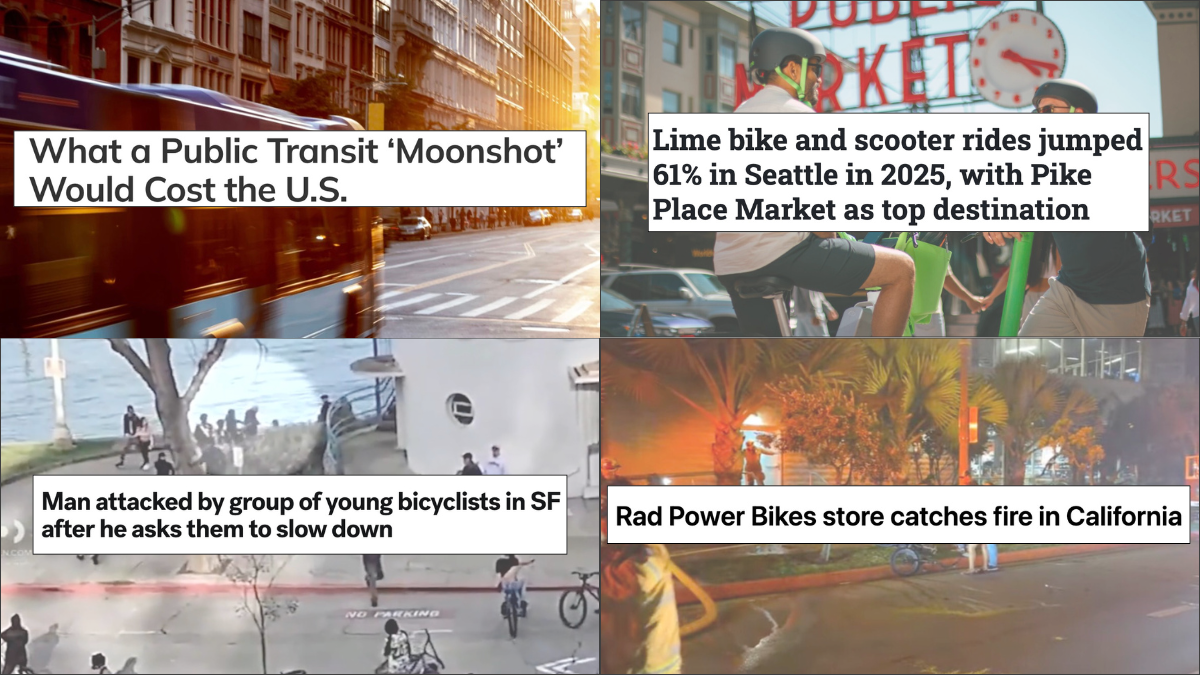
“Thermal incident”: A Rad Power Bikes retail store in southern California caught fire. The company confirmed it was a “thermal incident” and given the recent battery recall and other problems with the once mega-brand, this will stoke concerns and speculations. (Seattle Bike Blog)
Delay on trail vote: A key vote that would strip the Yamhelas Westsider Trail from the Yamhill County Transportation System Plan has been postponed until January 29th due to a high volume of testimony. Advocates should see this as a win and commissioners should see this as a sign that a lot of folks care about this trail! (Newberg Graphic)
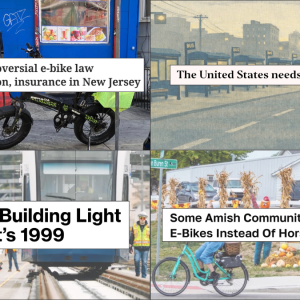
That’s clever: A company in New York City has adapted their technology to provide swappable e-bike batteries to food cart owners in bid to replace loud and toxic gas and diesel generators. (Electrek)

Transit cheaper than highways: How much would it cost to build world-class transit in the U.S.? “It’s not as much as a skeptic might assume, and it’s substantially less than what the country already spends on maintaining its highways, according to a new report. (Governing)
A good sign: Bike and scooter share is alive and well in Seattle as new numbers from Lime report a 61% (!) jump in 2025, with rides to Pike Place Market becoming a top destination. (Geek Wire)
Kids these days: Amid growing popularity of young people riding together in large groups, a man in San Francisco was attacked and beaten by riders after he told them to slow down. (ABC SF)
Thanks to everyone who sent in links this week. The Monday Roundup is a community effort, so please feel free to send us any great stories you come across.
Thanks for reading.
BikePortland has served this community with independent community journalism since 2005. We rely on subscriptions from readers like you to survive. Your financial support is vital in keeping this valuable resource alive and well.
Please subscribe today to strengthen and expand our work.
I wonder how much Seattle closing Pike Place Market to vehicles last spring/summer contributed to the uptick in trips there on lime. It’d be cool if they released more granular data for the time it was closed to non-essential vehicles.
I’d guess not much, given that the number of spaces removed wasn’t huge (40-60 I read), that the Market has its own large (800 space) parking garage adjacent, and that lots of market users are people who are going to other places downtown also, so either were parking elsewhere or not even driving.
However, perception matters, so I could see reading about the closure influencing some people to use lime instead of driving. I agree it would be interesting to see the data for spaces-vs-no-spaces times.
Last time I went to Seattle I was so pleasantly surprised by Pike Place being car-free. I had usually avoided it because I’ve had some really bad interactions with raging SUV drivers. They need to keep it that way permanently.
I would be very surprised if there was any measurable effect. The main effect will be to prevent hapless tourists from turning into the market, a driving mistake that will cost at least 10 minutes. Hopefully driving to the market remains miserable enough to deter car trips. I’ve regretted the choice every time I’ve taken my car there.
Transit cheaper than highways: My main issue with stories like these it that it would require all members of Congress and all 50 states’ legislatures to end their addictions to highway funding. Most Democratic politicians are just as addicted to highway funding as Republicans, both nationally and locally, be it in California, Texas, Florida, or NY. It basically ain’t gonna happen – you’ll have an easier sell getting legislators to defund the $9 Billion ICE program.
Not only that, but highway funding is seen as benefitting rural communities (or suburban communities that like to cosplay as rural) but transit is seen as a mostly urbanite concern. Highway funding = good, honest down-to-earth blue collar rural folks. Transit funding = expensive trains for degenerate yuppies and criminals.
Truth.
There’s a growing constituency for plucking that $9B turkey, if that’s the actual number.
One outtake from the story of our recent experiments in government is that our military has been very pliable in this business of adventurism (if not outright piracy). It’s not soon to look at the resources being consumed and what we get for that. I’m still waiting for my peace dividend check.
I did some envelope math before. The billion dollars that ODOT likes us to ante up for a given freeway would crisscross Oregon with MUP. I’d give the roads people a lean budget and tell them they could either keep the current roads together or look for jobs, and meanwhile figure out what it would cost to build what we need for the future and get busy financing that.
Maybe to just nitpick a little . . . it’s not the highway funding that the politicians love. It’s that construction companies love that funding, and we know very well that large campaign donations (above and below the table) are made to the politicians. That’s what the politicians adore, more and more campaign money so they can stay in power.
That report evaluated the raw numbers of transit vehicles. Once again ignoring the existing residential patterns (ie. density but also zoning).
In North Clackistan, (an area with 150,000 people) the nearest commercial establishment is often 1 or 2 miles away.
It takes 2 buses and over an hour to get to Sellwood or 10 minutes to go the 5 miles in the car,
–an extra bus will fix this how?
In Lents, the area is twice as dense, restaurants, shops, and bars are mere blocks away. One can just barely get around on foot/bus but I’m one of the few who do so. And I yearn for the days when I felt safe riding a bike. At my age, breaking a bone/joint and entering years of medicalization is just not worth the risk.
What a Public Transit ‘Moonshot’ Would Cost the U.S.:
This is the most important paragraph in the whole article.
IMO the best thing the federal government could do for transit would be to focus on inter-city transit. There’s lots of rail corridors that could be upgraded to be as faster or faster than driving for a hell of a lot cheaper than high-speed-rail. Those corridors should have curves straightened, grade crossings eliminated or mitigated, and be electrified. Tracks should also be upgraded to facilitate more frequent trains. Our own Cascades line comes to mind, of course, but there’s dozens of similar situations all around the country where trains are already getting good ridership and upgrading them would be a net benefit to the communities they connect.
If the feds are taking the lead on the infrastructure upgrades, the FRRA/DOT or whoever could have a whole team of engineers and project managers on staff who are really good at upgrading rail corridors. They could bop around the country making incremental upgrades, gaining experience and expertise along the way.
In places where rail service doesn’t make sense, good, frequent, intercity express bus service should be provided, with comfortable, centrally-located bus stations.
I think giving people a way to get between cities without a car or expensive plane ticket (not to mention; sans emission if electrified) would be a great catalyst for local transit systems and land use patterns to improve.
I strongly agree. I’ll also add that any serious higher speed rail project will involve a passenger-dedicated double track electrified railway, and there will basically always be excess capacity for regional and suburban trains in addition to intercity service. More passengers use the Northeast Corridor on the combination of NJT, Metro-North, MBTA, SEPTA, and MARC services than they do on Amtrak by a huge margin – I think NJT’s NEC line alone gets more ridership than Acela and the Regionals combined.
There would be huge transit benefits if the skeleton of local services that parallel Cascades from Eugene to Seattle (and up to Bellingham) could be replaced with hourly local trains originating at the major regional hubs. Intercity services often skip places like Canby and Woodburn, but if you’ve ever ridden the 99X you know people do want to get to the Portland area from those places. Having better integration and frequency would go a long way to supporting the folks living the valley who have limited car access or who just don’t want to drive.
Seems like this needs to happen no matter what type of project it is. If the only way the transit projects are competitive is to overhaul how the system works, then we should conduct the highway vs transit project comparison entirely in that universe.
In other words, if did all of those things to reduce the time and costs associated with large transportation-related projects, then that would benefit highway construction as well.
IT would be great if somebody could organize a big bike ride/protest/memorial for Pretti this weekend in PDX
Honest Question: what’s stopping you?
Here it is:
https://www.shift2bikes.org/calendar/event-23231
Regarding youth with e-motorcycles and “gang” like activities: Honolulu has struggled with this a lot as it ignored the sales of e-motorcycles as e-bikes too long and then when they attempted regulation many police officers were not prepared at the push back: see link for one of many large such events https://www.hawaiinewsnow.com/video/2025/03/24/hundreds-e-bike-riders-swarm-an-ewa-beach-neighborhood/?utm_source=chatgpt.com
Jonathan — the shooting is tragic and needs accountability, but statements like “everything has changed” and calling the entire government “fascist” feels over the top. BikePortland is most effective when it focuses on facts, community, and real change — that’s how outrage becomes something that actually helps people.
Hi,
I disagree.
Thanks for the feedback.
The fascism is a real fact (which is obvious to everybody who’s not brainwashed by Faux News).
Jonathan, not that this shooting shouldn’t be fully investigated and consequences for wrongdoing but was it wise for Pretti to conceal carry ad Sig Sauer 9 mm pistiol to a protest in which one would likely be interacting with armed federal law enforcement? The NRA seems thinks it was a wonderful idea…..https://www.politico.com/news/2026/01/27/gun-rights-groups-blast-trump-over-minnesota-response-00748217
Horribly bad take. Carrying a firearm is protected by the 2nd amendment AND he had all the proper licensing from Minnesota to carry concealed. Having a firearm (which he never touched) is 100% legally and morally allowed.
You might need to look at the over riding reason why the 2nd amendment is second only to freedom of speech/religion. Hint, it’s not about hunting.
Having a firearm is NOT a reason to be shot and killed by the federal government.
The right to have the firearm is absolute, agree on that 100%. How to behave with the firearm is where the nuance comes in and is not a binary scenario, unfortunately.
The coursework he took to get his permit would have discussed extensively the concept that in a volatile situation, the discovery of the carrying individual’s firearm may be the spark that creates an immediately uncontrollable event for that individual. It would require minimal to no diligence to know that the environment surrounding ICE conducting federal law enforcement actions is a volatile environment. If he were following the education supporting the approval of his permit by the book, he would have never determined it was a good idea to carry into that space due to the aforementioned likelihood that the identification of the firearm, in the context of behavior preceding that identification, can generate unintended consequences that are immediately life or death.
It is possible in this specific situation the ultimate tragedy may be that the firearm he carried is one that has a reputation of unintentional discharge and the officer removing his weapon (it is not clear if it was with the holster or not) caused the unintentional discharge the other officers mistook for Pretti firing a round.
In short, carrying the gun is not a death sentence, how one behaves with it could be.
You mean after they violate his 4th Amendment rights, something could go wrong?
Great take on this execution.
“In short, carrying the gun is not a death sentence, how one behaves with it could be“
In searching for an off ramp for the government, you seek to link behavior to a fundamental constitutional right.
Simply substitute “speaking freely” for “carrying a gun” and ask yourself how your argument sounds.
He did nothing with the gun. He did not brandish it, he did not reach for it, it was simply there. By all accounts he was tackled while trying to render aid to another protester.
If one fears for one’s life being taken by the government for exercising a core right then we are not free citizens, we are subjects.
My argument sounds fine because I am not a strict constructionist, I know rights aren’t absolute. The court has opined on this countless times.
Do you the mean the highly moral Supreme Court that can do no wrong and only concerns itself on what is the proper application of law in a completely neutral fashion? Is that the court you’re referring to?
I am curious what some restrictions you feel the government places on your right to freedom of speech. Do you have some examples of things the government will charge you for saying?
You mean the Supreme Court whose entire existence is formed in the document you’re continuing to pretend to know so much about?
Put it in AI, you’ll get a whole list of things you can’t say…
So no examples of your finite 1st amendment rights?
Blaming the victim. Nice
Was it wise for him to go there at all, with or without a gun? Is it wise for anyone to be in a protest in which one would likely be interacting with armed federal law enforcement?
Of all questions anyone could ask about Pretti’s killing, yours really misses the mark in my opinion.
And what’s your point about the NRA response? This time, the NRA and other gun rights advocates are right–legally carrying a gun is, well, legal.
Seriously? The only reason the gun has entered the public conversation is the specious and unhinged statements by the fascists and their propaganda mouthpieces in the media (“domestic terrorist”, “you don’t take a gun to a protest”, etc). Masked government enforcers executed a citizen to suppress dissent. ICE and CBP are openly operating beyond the law with the full support of federal government. That’s the scary reality that our country is facing right now. And you want to bring up the Pretti’s gun? I don’t like that we live in an armed society, either, but folks are carrying guns all over the place. Get a grip.
It’s a bit wild to see progressives suddenly okay with packing heat—did I miss the memo where we switched from “defund the police” to “mask up and bring your Sig Sauer 9mm to the protest”? I mean, the shooting definitely raises serious questions about excessive and illegal
use of force, but if Pretti had just left his very cool 9mm at home, very likely he’d still be around to talk about it. Think about it. Would you recommend bringing a weapon to a protest?
Why not just leave your right to speak freely at home while you’re at it? You know, don’t speak up so you avoid offending the government? Maybe you don’t understand what a constitutional right is or what “…shall not be infringed” means? It means citizens have an inalienable right to speak freely AND be armed and neither is justification to be gunned down by a poorly trained, trigger happy mob.
Always some nimrod here defending goons…
1) I don’t consider myself a progressive.
2) I’m not “okay” with people carrying guns, but I understand that folks are going to do so. I grew up in Idaho and have been around guns and gun culture all my life. I’ve always thought the 2nd amendment was bullshit, but it’s in the constitution.
3) You know what else is in the constitution? The 1st amendment, which says we get to assemble and speak against the government.
4) Conservatives frequently and gleefully carry guns at protests (often to ‘pro-life’ events!). Bit wild to focus on the gun that was lawfully carried and not fired when a violent gang of government thugs illegally and fatally shot homeboy 10(!) times.
5) The protestors in Minneapolis are inspiring patriots, and we should all stand in solidarity with them, especially given the deadly state violence they are bravely facing.
6) These poorly trained racist incels are not the police. They are hired to enforce civil laws and have no business carrying pepper spray let alone loaded firearms on duty. So “defund the police” is the wrong slogan for the moment. The correct one is ‘abolish ICE’, and it can’t happen soon enough. (OK, CBP, but the sentiment stands.)
Not to mention that Pretti didn’t even have a gun when he was shot in the back face down on the pavement.
The problem with “Abolish ICE” is that someone needs to be managing the border, so what we need is a more a nuanced solution than another self-defeating slogan.
I’d vote for “Prosecute ICE”, but no one cares what I think.
We have a Border patrol which is an entire different organization than ICE.
They are currently doing the job at our borders.
You do know that, right?
ICE is a rogue agency, Abolish ICE is not Defund the police even though conservatives like to think that.
You’re right about Border Patrol, but this is still not a problem that can be solved with sloganeering.
It’s not sloganeering, the next congress can simply abolish ICE as a government agency. Public opinion polls are nearing 50% support for it and that number will grow as long as Trump continues making ICE a Federal Gestopo.
It’s a Real loser issue for the GOP, not just a slogan.
They can, if they can overcome Trump’s veto and find a way for someone else to do the work that ICE is supposed to be doing, and find a way to revoke the huge pot of money ICE has access to.
That’s more than a slogan — it will take a lot of political and policy work to make it happen. And it won’t be simple.
If I’m not mistaken (could very well be), ICE is part of DHS, which was created during the post 9-11 islamophobic panic. The whole department could go IMO. Maybe was can find a professional wrestler to oversee the dismantling as clownland security secretary. We had a border before 9-11 (and plenty of racist immigration law, too). I agree it’s unlikely, and I’d settle for some sane leadership there.
I’m not objecting, I’m pointing out the fact that it will be anything but simple.
The sooner DHS is done away with and the Coast Guard sent back to the Department of Defense the better. 20+ years of airport security kabuki theater, intrusive government meddling with the ability to freely travel and having to listen to the United States being creepily described as “The Homeland”. Shutter it, send the Border Patrol back to the border and perhaps local jurisdictions would help uphold federal law.
What government agencies handled the border before ICE was created in 2002?
So yes, abolish ICE. The agency that was managing the border before then will do just fine.
The Immigration and Naturalization Service. INS. Instead of saying BAN ICE you used to say FUCK THE INS. I had that sticker on a bike! We can call ICE something else but there’s always going to be some agency handling immigration and border issues.
I bet if one of the SissyBoys (aka Proud Boys) was killed during a one of their temper tantrums and found to be carrying a pistol I bet many here would be applauding.
Hypocrisy is everywhere.
“She wouldnt have been raped if she wasnt wearing such a short skirt”
Thats what you and everyone else sounds like when you claim Pretti was shot for having a holstered hand gun tnay was concealed and that he didnt even touch.
Instead of blaming the victim, blame the maniacs that our government are paying to terrorize us.
Strange choice of gender assumption, especially here in Portland.
It can be true that Pretti both 1) did nothing wrong, acting completely within his rights; and 2) did something that contributed or even led to his fate.
There are lots of things he could have done to avoid getting shot, including staying away from the protest. That doesn’t mean that what happened was, in any way, his fault.
People here have such a complex about victim blaming.
WTF are you talking about?
Both siding every issue is so ridiculous.
You just CANNOT help yourself.
The “Sage” of bike Portland…. You are so precious.
Someone’s feeling a bit victim blamed by my post!
There is a reason the famous quote, “An armed society is a polite society” exists. There is a reason that the majority of people find it perfectly acceptable to give a monopoly on violence to the police, be they local, state or federal. The most people with the most guns win in most situations. So, regardless of your determination on the political leanings of those saying it, what was the plan with the gun? Did he think he was going to fire off three clips into six guys that your propaganda arm says are, untrained and inexperienced, yet are carrying two guns each and more rounds than him? Was he going to get into a shootout with ICE supporters? Are we not allowed to ask because the 2nd amendment exists?
If you understand the Bill of Rights and what it means to be free citizen you would understand that no one needs a plan to exercise their rights.
And if someone else exercises their rights to not be dead more then you exercise your rights to not be dead because free men don’t have plans, does it matter that you’re a strict constructionist?
I honestly don’t understand this.
“Did he think he was going to fire off three clips into six guys that your propaganda arm says are, untrained and inexperienced, yet are carrying two guns each and more rounds than him? Was he going to get into a shootout with ICE supporters?”
No, he was simply legally carrying his firearm, in his own neighborhood, as he did every other day, same as millions of other American citizens do every single day in this country.
“There is a reason that the majority of people find it perfectly acceptable to give a monopoly on violence to the police, be they local, state or federal.”
I’m skeptical such a majority exists. The whole point of the 2nd amendment is to prevent a state monopoly on violence lest our country be susceptible to tyranny. As Angus has been squealing about, I hold generally anti-gun views. But if there was a time when one could see the 2A logic, this seems like it.
And if being armed leads to politeness, why do all these immigration pigs act like such jackasses even though they have big boy guns?
Micah, I love how you’re an anti-gun liberal… except when it’s suddenly “totally fine” for someone to pack a Sig Sauer 9mm to a protest. That’s a hot take so convenient it deserves its own zip code.
Look, the federal agents clearly botched everything—no argument there. But let’s be real: if Pretti had left his legally owned, very cool firearm at home, he’d almost certainly still be alive. No gun = living Pretti. It’s not rocket science, it’s just the brutal arithmetic of high-pressure situations.
So yes, protest, resist, call out federal overreach—but maybe the first rule of protest club should be: optional accessories do not include “anything that goes bang,” even if your moral compass does a little gymnastics that day.
I don’t have any confidence at all that Pretti would not have been shot to death if he hadn’t had the gun. What got him killed was his decision to stand up to the bullies. The gun had already been taken by the CBP thugs when they shot Pretti. The only role the gun played in the situation is that it is the strongest available basis (of a very weak set) for right wing whataboutism and reflexive defense of completely horrific and indefensible government action. Based on Renne Good’s execution should we make the rule that you shouldn’t bring cars to protests?
The presence of the gun almost certainly heightened emotions. That justifies nothing, but we all know that when the adrenalin kicks in, bad things sometimes happen.
The presence of an extrajudicial paramilitary force sent to pacify Minneapolis also certainly heightened emotions. Which one do you think is more consequential? “He shouldn’t have brought his gun to the protest” is equivalent to “She shouldn’t have worn such a short skirt.” Both offer plausible causal explanations that are morally irrelevant.
He would also be alive had they just not dragged and tackled and beat the shit out of him first after he held his hands up in front of them!!!
WTF is wrong with you people?
BB, mate, take a breath before your blood pressure files a missing persons report. No one here is auditioning for Cops: Federal Overreach Edition. Yes—dragging, tackling, and beat-down theatrics by armed agents is cooked. Completely stuffed. If “hands up” means “rugby tackle” now, the rulebook’s gone walkabout.
My point isn’t “yay cops,” it’s “boo to every factor that turns a tense standoff into a lethal mess.” High-stress agents + protests + weapons = a recipe that ends with candles and hashtags. You can acknowledge the thuggery and admit that adding a firearm to the mix is like pouring petrol on a barbie during a total fire ban.
So yeah, the agents botched it. Badly. But pretending the presence of a gun is irrelevant is a bit like saying the croc didn’t matter because the river was already dangerous. Multiple things can be bloody wrong at once.
Now let’s all unclench before someone brings a chainsaw to the next protest and we have to pretend that’s unrelated too.
No this, is a bad take, and you would defend Kyle Rightenhouse and say “but he didn’t resist bro”
Jaycee, that’s a bad shortcut. Pointing out that weapons escalate already volatile situations is not the same thing as defending cops, the state, or Rittenhouse-style “he didn’t resist” logic. No one is saying the killing was justified or excusable.
It’s possible to hold multiple things true at once: Pretti was brutalized, CBP acted irresponsibly, and the presence of a gun increased the likelihood that an already reckless and chaotic response would turn lethal. That’s a structural reality, not a moral endorsement.
Dragging in Rittenhouse just sidesteps the actual argument. If every discussion about escalation gets flattened into “you’re defending murder,” then we’re not debating actions or systems anymore, we’re just throwing labels and shutting the conversation down.
The gun was only found after they illegally grabbed him, dragged him to the ground and began beating him.
They had no idea he even had a gun until that point.
Your defense of shooting someone in the back 10 times is noted.
The sickness of the MAGA crowd is mind boggling.
So if Pretti having a gun is why he go shot, then what lead to Renee Good being shot? Where was her gun?
She was driving her weapon. Cars are lethal weapons as we all know.
There is ambiguity on whether she meant to hit that fed or how hard she hit him, but there is no doubt her wife yelled at her to “drive, baby, drive” and she did. Should the fed not have been in front of the car? Should she have stepped out of the car when ordered? Did the fed actually need to fire his weapon? Ambiguity. There is little to no ambiguity with Pretti’s death. He was gunned down for no reason. Having a firearm is not an excuse, no matter how badly trained or caffeined up or scared the feds were.
Ban All Guns
Start with the government first!
I don’t really understand what that means
Fair enough, it means take away the government’s guns and the police guns. Take away the tools of totalitarianism before taking the citizens guns away. Why should we be unarmed when ICE, BP and local PPB have all the guns they want?
Then after the government guns are gone and all the citizens guns are gone and we’ve been invaded by all the numerous countries that hate us, what do you do when you get hungry after the electric grid collapses and you can’t catch a rabbit or don’t know how to plant veggies?
We’re both living in a fantasy world but I think I’m less delusional. There are countries now, today, where you can walk around and be quite certain you won’t be the victim of gun crime regardless of who is holding the gun. I’ve been to some! As an American it is absolutely something that does at some point cross your mind. (Same goes for auto use. “Man, I bet no one here drove…I bet very few here even own a car!”) To the best of my knowledge there is no country that has no armed agency at all. Be that police or some sort of armed services.
So after reading that I’m honestly curious what you meant by “Ban all guns”. Did you not mean all guns?
“Ban All Guns“
LOL. Mr Trump, what are you doing posting on Bike Portland?