

When I experienced the bike path through the Rijksmuseum in Amsterdam for the first time in 2013, I was awe-struck. I called it (along with the Hovenring bike bridge in nearby Eindhoven) one of the two “wonders of the bicycle world” and it remains one of the coolest pieces of bike infrastructure I’ve ever seen.
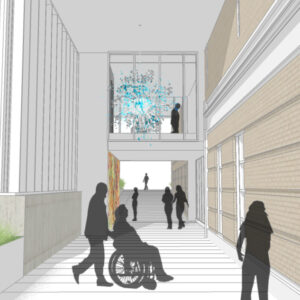
I would have never expected to have something similar here in my own city; but with the opening of the Portland Art Museum’s (PAM) new Rothko Pavilion Thursday, the unexpected has become reality. Portland has added an amazing piece of civic architecture-slash-transportation infrastructure to the Central City that belongs right up there with Pioneer Square, the Aerial Tram, and the Tilikum Bridge. Officially named the Pat and Trudy Ritz Passageway, the tunnel pierces a new glass pavilion that connects two museum buildings and allows walkers and rollers to move freely between SW Park and SW 10th avenues. The design also allows passersby to peer into museum galleries, while visitors inside can watch tunnel traffic as they walk across the skybridge between the two buildings.
The tunnel is a triumph and stands as a powerful demonstration of Portland’s commitment to walking and biking. But what’s most remarkable (and mostly forgotten) is that it almost never happened and was not part of the initial plans.
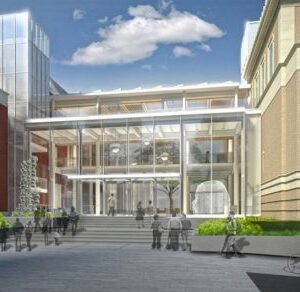
When PAM first shared designs of the Rothko Pavilion expansion in 2016, there was no tunnel through it. As word spread, local residents and biking and walking advocates voiced concerns about how the pavilion would cut off access across the former plaza. In early 2017, I began to report on those concerns and opposition to PAM’s plans grew. Museum leaders incorrectly assumed that Portlanders would happily trade public plaza access for a major upgrade to this important institution. They were wrong. Local residents, advocates, and even City of Portland planning commissioners, attached great value to the permeability of that plaza and PAM’s attempt to change the public easement through the property that had existed since 1968 was met with stiff resistance. Once plans to close access to the plaza became widely known, the city’s bicycle and pedestrian advisory committees came out in opposition against it and pushback at its first city council hearing was so stiff, a decision on the design was delayed.
In response, PAM came up with a new plan in November of 2017 they hoped would quell resistance. PAM Director Brian Ferriso even attended a PBOT Bicycle Advisory Committee meeting to ask for support from cycling advocates. Unfortunately for PAM, the proposal didn’t go far enough because it still closed off the plaza and would only allow people to walk bikes through an enclosed pavilion structure.
Ferriso tried to convince BAC members that the tradeoff would be worth it: Yes, folks would have to walk through the museum to get across the block, he explained; but in exchange they’d get a major investment into the museum. But biking and walking advocates weren’t having it. Former BAC member Chris Achterman told Ferriso, “If this is a door, that’s not going to work. I hope that as you approach this project you see it as Portland’s version of the Rijksmuseum.”
Nearly one year after that BAC meeting, PAM and Ferriso finally relented, the tunnel proposal emerged, the advocates were satisfied, and Portland got its version of the Rijksmuseum tunnel.
I got chills Thursday as the gentle downhill grade pushed me and my bike into the glass gallery. Nodding and smiling at others who seemed similarly smitten with this novel passageway, I recalled the effort it took and the people who spoke up to make it a reality.
As I stopped to prep for another ride through, Portland Mayor Keith Wilson walked by. He wasn’t aware of the tunnel’s history, but he knew it was cool. “I’m so glad we have it,” he said as he walked through it with the excited urgency you’d expect from a mayor who’d just cut the ribbon on something that will help his efforts to revitalize downtown. “It’s extraordinary. This is what you talk about as far as urban living — where you bring the active transportation into the actual cityscape. It’s what makes a community a community. You look to to your right and you’re actually in a museum while you’re going down a city street. It’s brilliant.”
By “city street” Wilson was referring to SW Madison, which was closed off at SW Park in 1968 to build the museum. That closure came with a condition that the museum would maintain a public easement through the plaza. It was that easement PAM officials initially wanted to change, and that the new tunnel keeps constant.
In addition to the new passageway, there’s a new bike parking area on the SW Park side that has four stainless steel staple racks. When I noticed a very proud and well-dressed woman taking photos in front of a plaque nearby that read, “Barbara Bours Brady Bike Bay,” I figured she was likely the donor. Sure enough, it was Brady. Turns out Brady is an avid cyclist who’s logged over 130,000 miles as a member of the Portland Bicycling Club since the 1980s.
“I’ve cycled for many, many years and I wanted people to have a place to park their bikes so they didn’t have to drive their cars in downtown Portland, including myself!” Brady, a long time museum donor and resident of downtown, told me Thurdsay. “I have to get some dressy black pants so I can bike up here and if I get a little grease on them it won’t matter!” she added.
Judging by the crowded racks on Thursday, she won’t be the only one. The new pavilion — and the tunnel that runs through it — appear to be an instant hit.
— Go check out this fantastic addition to the museum and bike and/or walk through a tunnel a few times. Access to the museum is free through Sunday, November 23rd. See PAM’s website for more info.
Thanks for reading.
BikePortland has served this community with independent community journalism since 2005. We rely on subscriptions from readers like you to survive. Your financial support is vital in keeping this valuable resource alive and well.
Please subscribe today to strengthen and expand our work.
What a great conclusion! Thanks for following this story from the initial design to completion. I too was out there Thursday for an afternoon walk during my lunch break and the first thing I did was walk through the tunnel and around the building. Very grateful that the city pushed for this outcome in response to citizen advocates.
“Portland has added an amazing piece of civic architecture-slash-transportation infrastructure to the Central City that belongs right up there with Pioneer Square, the Aerial Tram, and the Tilikum Bridge.”
“But what’s most remarkable (and mostly forgotten) is that it almost never happened and was not part of the initial plans.”
“I recalled the effort it took and the people who spoke up to make it a reality.”
Never doubt that a small group of thoughtful, committed citizens can change the world; indeed, it’s the only thing that ever has.
Margaret Mead
Heartfelt thanks to everyone who can now walk or bike through this passageway and say to themselves, “I had a hand in this.”
Barbara, my queen, have you heard the good word about chain waxing?
Came here to make the same joke
Or belt drive
Knowing her, she probably has heard about it.
Or a chain guard
Great write-up! PAM is offering free admission 11/20-11/23
https://portlandartmuseum.org/event/grand-opening-free-days/
I rode through the passage about 2 weeks ago. It is great to have, but in the middle of the passage it felt dark and not so welcoming. Perhaps they have ceiling lights that weren’t yet functioning?
Congrats to all who advocated for public access to the plaza. We’ve ended up with a very cool urban space.
Really nice video, especially with Brady’s fortuitous cameo.
The Portland Art Museum is less civic- and community-minded than it wants to promote itself as being, so I’m glad that pushes from actual civic- ad community-minded folks, including BikePortland, have resulted in this outcome (… which knowing PAM they will now take credit for).
I *especially* love getting to know Barbara Bours Brady through this video. Yes, a museum goer of a certain age might arrive in heels and charming chapeau, but that don’t mean she doesn’t bike with the rest of us! So important for people to see the breadth of bicyclists in this town. And this bike parking appears much better than the awkward arrangement PAM previously offered cyclists.
Also worth noting that in Jonathan’s footage we can see a someone rolling through the passage in a wheelchair, a visual reminder that we designing best when we design for all. (Accessibility has been an issue with PAM in the past, both within their buildings and in terms of getting into the buildings.)
I think the passageway forced the museum to make some architectural choices that made the interior space more interesting.
Thanks to BikePortland and everyone else who made this happen!
Obviously it’s better for people biking and walking than the original closed-off scheme. And I always appreciate routes that are only available to people who aren’t driving–like public stairs, Tilikum Crossing, etc.
I hope the museum will find that the passage makes the museum better. It’s certainly already getting a lot of positive, obviously-in-Portland attention for the museum.
I stopped my museum membership when the original controversy arose. I guess I can resume it again.
So are you attempting to say your embrace of cancel culture was effective? LOL. 🙂
Look cool! I wonder how long it will take to be vandalized with graffiti like other iconic bike infrastructure like the Ned Flanders Crossing, Blumenaeur Bridge and the Bob Stacey (Gideon) overcrossing? Sadly, one can’t have nice things in current day Portland.
You just listed several nice things that we have.
A comment section without threadjacking Debbie Downers is one nice thing you are destroying, Jose.
I’m not trying to doom-post, but let’s be honest: Portland has plenty of ‘everything’s fine!’ viewpoints that ignore obvious problems. I’d still love to see this project stay in good shape.
Is the Bob Stacy crossing “nice”? Call me crazy but I don’t consider feces on the floor, broken elevators and graffiti covered walls “nice” Do you qqqq?
https://bikeportland.org/2025/05/29/unreliable-bob-stacey-overcrossing-elevators-spur-website-with-timely-updates-394653
When I said you just listed several nice things, I didn’t mean everything you listed was always in good condition. Of course the things you described about the one crossing are not “nice”.
But I’d certainly call the art museum addition, its tunnel, the Blumenauer Bridge, the Flanders Crossing “nice things”, along with literally hundreds of bike facilities, parks, and other public facilities in Portland, and also hundreds or thousands of private facilities here that are open to the public.
Of course you can find problems all over Portland. Of course people are aware the tunnel could be vandalized or otherwise compromised, as can any public facility. But your, “Sadly, one can’t have nice things in current day Portland” is histrionic, especially as a response to this tunnel and museum addition
And nobody in the article or comments here has said anything I’d describe as ” ‘everything’s fine!’ viewpoints that ignore obvious problems”.
And maybe you’re “not trying to doom-post” but that’s exactly what you did.
I think everyone would agree that 1) Portland does have some “nice things”; and 2) Many of Portland’s “nice things” are abused in way that makes them less nice.
The phrase “can’t have nice things” is a reference to the second point, not the first. Why is this even a conversation?
Nice!
On a related note, does anyone know the long term plan for the small street/plaza on SW Main, in between SW Broadway and SW Park Ave? It’s currently blocked, but opening it back up would extend a premier bikeway up into downtown from the river.
PBOT made my commute a million times better when it closed off one lane of SW Main years ago: it turned a car-crowded, stressful climb up from the Hawthorne Bridge into what must be the nicest bike lane in the City.
The only problem is that the road is literally blocked by a gate, at SW Broadway, between the Schnitz and the Newmarket Theater. That operable gate existed previously: during events at the two P5 buildings, SW Main would be closed to car traffic. When the City created the large bike lane lower down, it closed this gate. I haven’t seen the gate opened up since then.
There’s no way to ride a bike through the gate, so unfortunately, while SW Main is a real excellent, low stress bikeway, continuing up the hill past the Schnitz requires one to ride up the brick sidewalk. That’s technically illegal!
I don’t know there’s any existing plan for this, or if it’s just a loose end that didn’t fit into the cheap, quick, and effective changes that made the lower stretch of SW Main so great.
It’s one of those little things about biking around the City: I will continue to ride up the sidewalk (luckily, the northern side of the street is a ramp, not stairs), but having to slowly squeeze by pedestrians to just keep going on the road is a real drag.
I started past the museum today about 3pm. Huge crowd outside. (It seemed the farmers market should be over by then.) I was about to ride through the tunnel when an employee said I couldn’t; a fire alarm had gone off in the museum, and that explained the crowd.
Hope there was little or no damage.
Shout out to Doug Klotz who, as a member of the Pedestrian Advisory Council, immediately recognized the access issue of the original design and brought a well-evidenced and persistent argument in favor of a design that would better serve the community.
Good job on this win!