

The Rails-to-Trails Conservancy is shifting their efforts into high gear with the planned October 20th release of their new report, Active Transportation for America: The Case for Increased Federal Investment in Bicycling and Walking.
The report will try to make it clear to policy makers, advocates, the media and the public that an increased federal investment in bicycling and walking is long overdue in America.
Since March of 2007, the RTC has been working with cities across the U.S. to help them prepare individual “case statements” to coordinate with the national launch of the report.
The goal is to heighten the profile of walking and biking as a cost-effective solution to many problems facing our country and to ultimately persuade Congress to expand the Non-motorized Transportation Pilot Project (funded in 2005) to include more money and more cities. Initial estimates are that they’ll ask for $2 billion in funding for 40 cities (the initial pilot project gave four cities $25 million each).

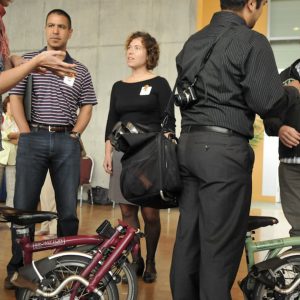
a meeting at the 2008 National Bike
Summit. Metro President David Bragdon
and PDOT’s Roger Geller are sitting
on the right.
(Photo
Jonathan Maus (Publisher/Editor)
BikePortland founder. Father of three. North Portlander. Basketball lover. If you have questions or feedback about this site or my work, contact me via email at maus.jonathan@gmail.com, or phone/text at 503-706-8804. Also, if you read and appreciate this site, please become a paying subscriber.


Thanks for reading.
BikePortland has served this community with independent community journalism since 2005. We rely on subscriptions from readers like you to survive. Your financial support is vital in keeping this valuable resource alive and well.
Please subscribe today to strengthen and expand our work.
How about “Rails AND Trails” I wouldn’t mind sharing the RR’s ROW with a freight train every now and again if it ment that I could ride alongside (at a safe distance) the rails and not have to play dodge car.
Just My $0.02
RTC has “Rails with Trails” projects as well. npGREENWAY envisions portions of the North Willamette Greenway Trail to be alongside an ‘active’ rail line.
In fact, there is a critical opportunity right now in the lifetime of this project. It is very important that everyone support Portland Parks Bureau’s request to fund an updated planning study of the North Willamette Greenway. The study would be funded with federal dollars as part of the regional flexible fund allocation of the Metropolitan Transportation Improvement Program.
Please go to the Metro website and express your support for this vital transportation link between North Portland and the region:
http://tinyurl.com/support-npGREENWAY
Stay tuned for more information to come from http://www.npgreenway.org
I heard James Howard Kunstler talk about Rails-to-Trails and he mentioned the ROW stuff – potentially ‘Rails AND Trails’. It’s on one of his podcasts. Was interesting.
Basically, he was suggesting we needed rail back in a big way, so if nothing else, the rails-to-trails projects would preserves those rights of way until such time that we could convince the powers that be to fund rail again.
And, as K’Tech says, maybe we can have both.
With the changing face of american transportation, I wonder if we ever see “trails to rails”? Think of the the springwater coridor converted back to rail for the street car or Max. It would be the cheapest, most obvious way to install a new line.
penny for a pound
Suburbanism is dying. In the year 2000 a report was released within the real estate industry that showed that 20% of suburban homes would be abandoned by 2025. Now it seems that the situation is more dire.
Since the ’90s we have seen a shift from car-drivable only suburban sprawl toward bike and pedestrian friendly dense, urban living. We should be willing to recognize that the first criterion for bike travel is proximity: few people will be willing to bike more than 4 miles to work on a daily basis.
Providing bike-friendly routes will only do so much. The larger problem is addressing the mounting problem of housing shortages and high rental prices in desirable, walkable areas. The government must immediately put an end to new, fringe development in Gresham, Hillsboro and other “edge cities” in favor of dense, mixed use spaces and redevelopment of languishing areas close to the city center.
A good book that deals with the problem of transitioning away from the failed suburban experiment to a sustainable, urban model is The Option of Urbanism by C. Leinberger