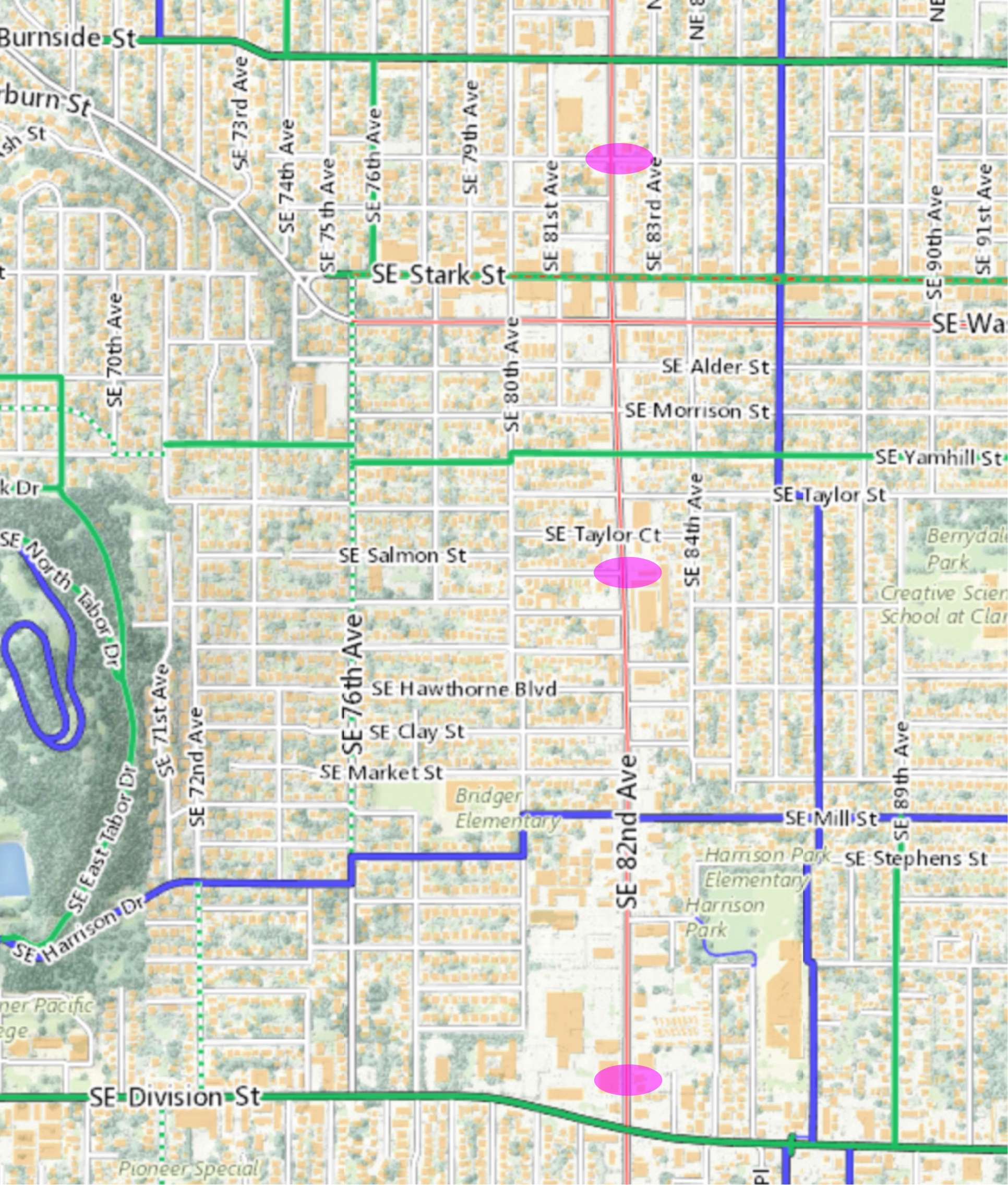
Location of three intersections that will get “enhanced pedestrian crossings”. (Base map is Metro’s Bike There map to show location of nearby bikeways.)
The Oregon Department of Transportation wants you to learn more about their plans to make several changes to SE 82nd Avenue. They’ll hold an open house for their 82nd Avenue Intersection Improvements project next Tuesday, January 26th.
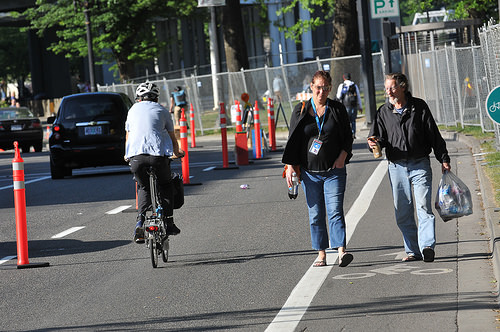
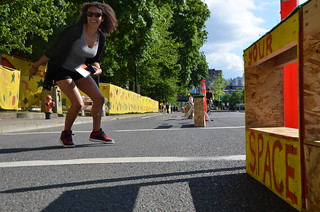
Fun on a better Naito, 2015. (Photo: M.Andersen/BikePortland)
One of Portland’s most interesting annual traditions just got a little more official.
After three years of doing short-term demos themselves, the volunteer-led street reinvention group Better Block PDX has struck a formal partnership with Portland State University’s Toulan School of Urban Studies and Planning. With the help of PSU planning and engineering students, this new partnership means Better Block will constantly churn out a pipeline of projects that temporarily re-envision public spaces around Portland.
The new agreement will create one of the only academic programs in the country to integrate hands-on uses of “tactical urbanism,” as these lightweight, flexible projects are often called, directly into a student curriculum.
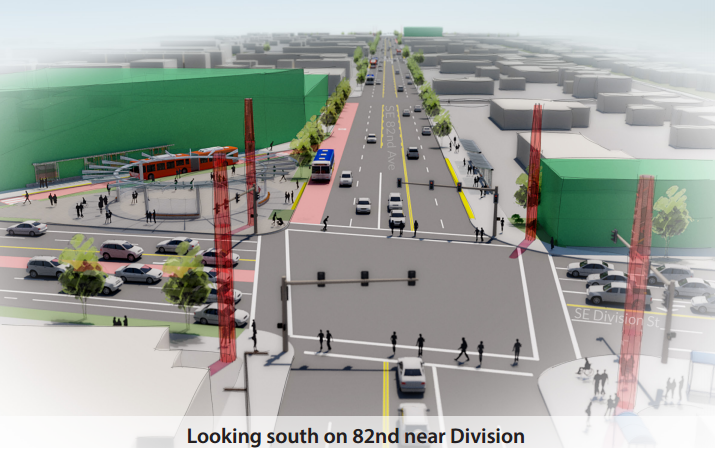
A draft rendering of one possible design for 82nd Avenue with one block of “business access transit” lane approaching the right turn onto Division. Cars could legally use BAT lanes only to turn into a driveway. (Source: TriMet)
The Oregon Department of Transportation says it needs to preserve five auto lanes on 82nd so the dramatically increased number of cars that Metro expects on the street by the year 2035 will have somewhere to sit during rush hour.
Should a new high-capacity express bus line through Southeast Portland run on the most important street in Southeast Portland, or 30 blocks away?
The question seems odd. But as Metro and TriMet ask the region whether the new “bus rapid transit” line they’re planning should run on half a mile of 82nd Avenue, here’s part of the subtext: In order to get permission to run the bus line on 82nd Avenue, project planners have agreed not to aspire to do anything for biking, walking or transit on 82nd that might significantly reduce the number or capacity of cars there.
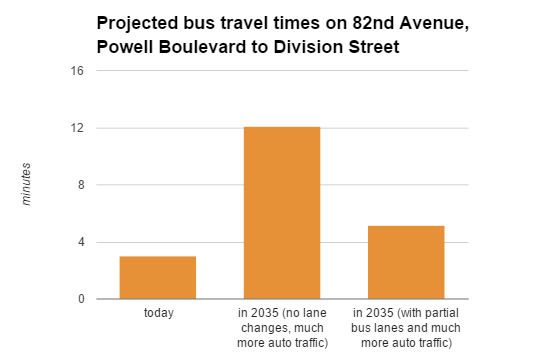
In fact, even if the highest-quality version of the project currently being considered were built, buses there are projected to travel slightly slower in 2035 than they do now. Rush-hour travel times would rise to about four to five minutes for the half-mile stretch, up from about three minutes during the afternoon peak today.
Advertisement
TriMet has not estimated travel times for a scenario with full bus lanes, because it is not considering that scenario. It also has not yet estimated bus travel times in 2020, when the project opens.
Among other factors, this is because the Oregon Department of Transportation says it needs to preserve five auto lanes on 82nd so the dramatically increased number of cars that Metro expects on the street by the year 2035 will have somewhere to sit during rush hour.
In this scenario, the major time benefits of the project to bus travel on 82nd Avenue would materialize only if the street becomes overwhelmingly jammed with cars over the next 20 years — which is what the official models currently expect to happen, despite the city and county’s official goals of cutting local auto traffic in half over the next 15 years.
Here’s why the project might be a good idea anyway: If it is not built, and if Portland does indeed fail to meet its goal of halving auto trips by 2030, then bus travel times on this stretch of 82nd will triple.
That’s because the hundreds of people in 82nd Avenue’s crowded buses would be stuck behind hundreds of single-occupancy cars — just like all the people in cars would be.
TriMet has 21 months to find funding and consensus
It’s important to note that this range of possibilities is not written in stone. Instead, this is a rare look into the pre-planning that goes on behind the scenes of every big transit project.
With this project, a quirk in the public process is opening a bit of that pre-planning to more public debate than usual.
At issue right now is a small portion of the 18-mile project: the 1/2 mile between Powell Boulevard and Division Street in mid-Southeast Portland.
The Powell-Division Transit and Development Project is a proposal from transit agency TriMet and regional government Metro to spend something like $200 million, half of it from the federal Small Starts grant program and the other half from undetermined local sources, to create an express line of big bending buses featuring flashy new stations with raised platforms and other features that make traveling by bus feel more like traveling by MAX.
Unlike MAX, however, the buses will mostly not get lanes of their own. Instead they’re expected to get, at most, a series of chances to jump ahead of cars at stoplights. To support this, some blocks would get bus-only turn lanes and others would have lanes that would at least theoretically ban cars that are not preparing to turn right.
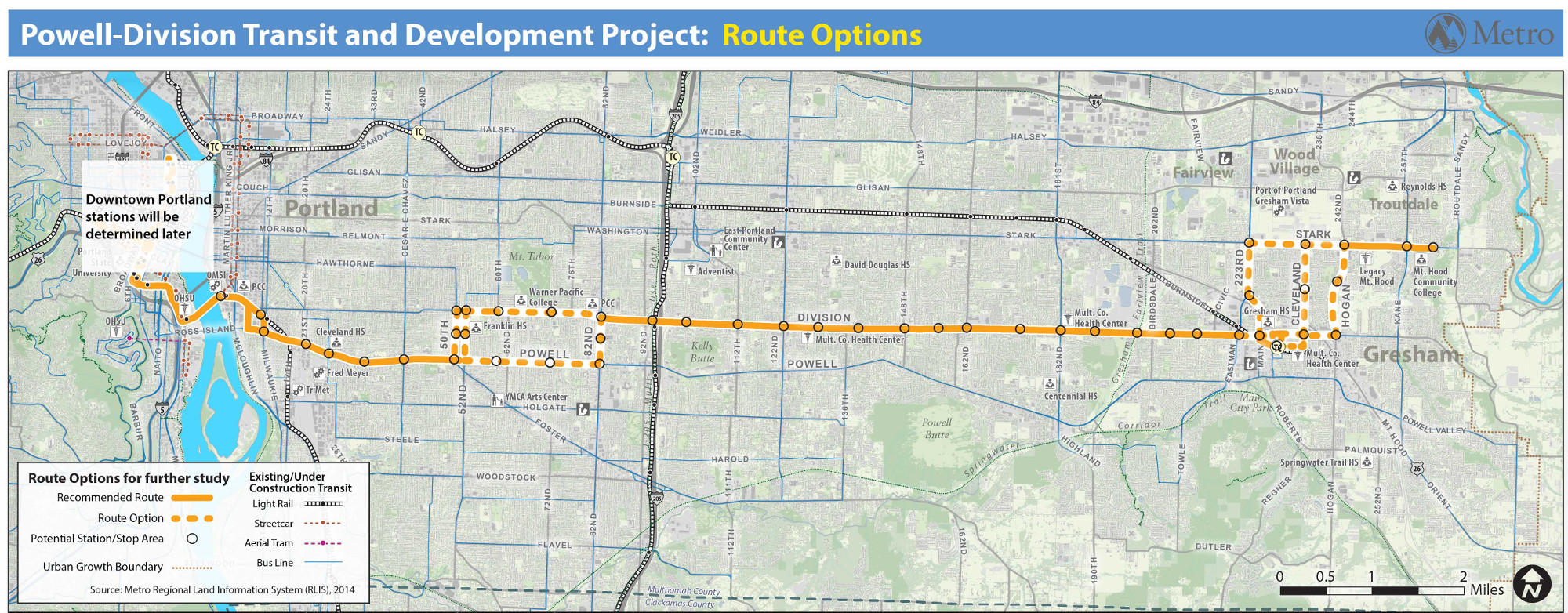
The full route would run between downtown Portland and downtown Gresham. It’d probably start on the south Transit Mall, cross Tilikum Crossing and join Powell through inner Southeast Portland. Between Powell and Division, the route will have to jog northward. That’d happen either at 50th Avenue, 52nd Avenue or 82nd Avenue.
Of those three, the likeliest prospect is 82nd Avenue, a state-run five-lane highway that doubles as a main street for much of Southeast Portland. It already carries one of TriMet’s most-ridden bus lines, the 72; the new express bus line might also run on that stretch.
It’s not yet official which route the line will take between Powell and Division, but 82nd is seen as the default option. (Map: Metro)
TriMet started applying for federal funds last May. It has until Oct. 2, 2017, to come up with a detailed plan for the route and a general sketch of how to pay for everything, including the new buses, stations, road work and all the associated planning efforts.
On March 28, the project’s steering committee is expected to choose a final route, including the decision of whether to run the big buses on 82nd. From there it’ll go to Metro, to the cities of Portland and Gresham and to other relevant agencies. If all goes well for the project, it’d open in September 2020.
For project managers, this is the moment they’re hoping to get buy-in from people who care about 82nd Avenue.
“There are a lot of attractions there; it works for the community,” Metro planner Elizabeth Mros-O’Hara said Jan. 8. “But they need to see what it’s going to look like enough to understand what the potential impacts might be.”
‘Every little bit counts for transit’
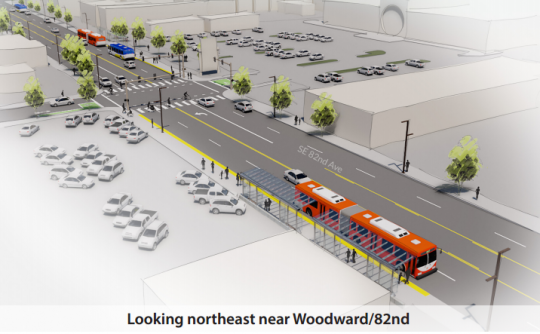
A draft rendering of the bus at one possible design of the proposed Woodward Street station, halfway between Powell and Division near Fubonn (pictured in background). Presumably this does not depict rush hour in the year 2035, when the project expects auto traffic to be thick.
Though they won’t get full lanes of their own on 82nd, the new buses would use digital communications with stoplights on the route to get traffic signal priority.
“It’ll say ‘Hey I’m coming! Stay green,’ or it’ll say ‘Hey I’m coming! Shorten that red and go green,'” said James McGrath, a project consultant for CH2M. “We’re using station placement to garner little advantages. … Every little bit counts for transit.”
McGrath is hoping that the buses, each of which would have room for something like 86 people, will be allowed to load and unload passengers right in their lane rather than pulling over and waiting for a gap between cars to get moving again. But McGrath said that’ll only be “possible” if having buses stopped in the right-hand lane isn’t expected to greatly slow auto traffic.
“If we’re allowed, if the traffic modeling shows that it’s possible, the bus will stay in the travel lane as opposed to pull out,” McGrath said.
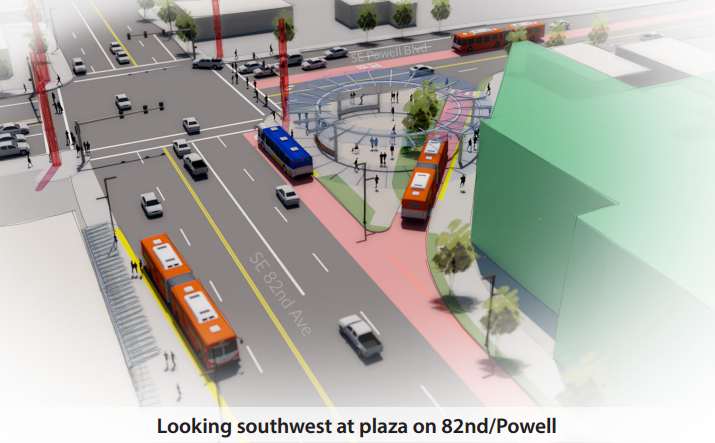
On their approach to busy intersections, buses would get either a short left-turn lane or a right-turn lane that can also be used by cars turning right into a driveway.
And at the corner of 82nd and Division, the new buses might get a new diagonal stretch of road to skip the stoplight completely.
All of that together, project planners said, adds up to quite a bit of travel time savings for people in buses — almost as much time as dedicated lanes would save, they said. But the planners couldn’t say precisely what difference dedicated lanes would make, because the project has not bothered to calculate them. That’s how far off the table dedicated bus lanes are.
TriMet has also not yet estimated what the travel times will be in the year 2020, when the project first opens.
At some intersections, McGrath said, the stoplight changes might add up to travel time savings for people driving.
Because so little road work is anticipated, the whole thing comes out to quite a bargain compared to a new transit line that would have new dedicated space. TriMet’s Orange MAX Line that opened last year cost about $200 million per mile. The entire 18-mile Powell-Division project, by contrast, is aiming for $200 million total, half of it from local money that has yet to be identified.
For comparison’s sake, a bike lane protected by concrete or hardened plastic bumps costs about $50,000 per mile, but only if it can be put on road space currently used for something else.
‘We have to try to make things better for everybody’
Another angle on a draft concept for a transit plaza, this one at 82nd and Powell. Note the red bus-only left-turn lane on Powell; it would end just to the right of this picture.
I asked the four public transit planners assembled at the Jan. 8 meeting what the problem would be with slowing auto traffic if it were to significantly improve public transit.
After a moment Jeff Owen, TriMet’s active transportation coordinator, answered.
“We have to consider all modes and all users.”
– Don Hamilton, ODOT on why the agency won’t consider full bus lanes on 82nd
“Our partners,” he said, referring to the state and city governments. “We can’t really do that much alone.”
The city didn’t have anyone at the meeting, but ODOT spokesman Don Hamilton was there. As the other people in the room waited for him to say something, he answered my question too.
“Because we look out for all users of the corridor,” he said. “We have to try to make things better for everybody.”
Even if that’s in the service of using devices that are destroying our planet and killing 30,000 Americans a year, I asked?
Those are larger problems beyond ODOT’s control, Hamilton replied.
Later, I asked Hamilton to clarify if “make things better for everybody” literally meant that ODOT couldn’t support any transit project that would increase auto travel times.
Hamilton said he hadn’t meant that.
“I meant that more generically, that we have to consider all modes and all users,” he said.
No bike lanes without more money, TriMet says
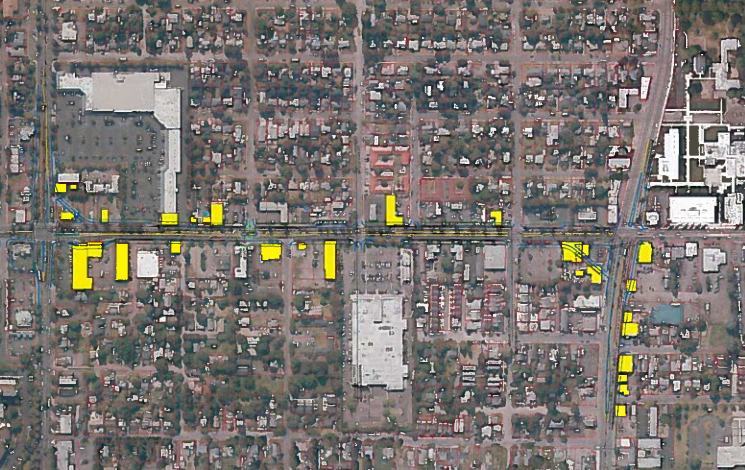
27 buildings (plus a few others that happen to be on the same tax lots) that would have to be remodeled, relocated or demolished to make room for bike lanes on both sides of the current 82nd Avenue. (Image: TriMet)
OK, so what about bikes?
Last month, Jonathan wrote about the unexpectedly tense meeting between the project staff and the Portland Bicycle Advisory Committee at which TriMet staffers tried to talk down the possibility of continuous bike lanes on this stretch of 82nd.
Officially, the project is considering what it describes as the “high-impact” scenario of putting continuous bike lanes on 82nd. There’s also a possibility that some compromises could be found between that scenario and the “minimum impact” one that has no bike lanes — a short bike lane might be added to improve a crossing or connect to a particular bus station, for example.
But after looking at this in detail and asking quite a few questions, I have to agree that it would be difficult for this project to include bike lanes. Here’s why.
“I think the reality is a lot of this area would have parallel bikeways.”
— TriMet active transportation planner Jeff Owen on bike access to 82nd
82nd Avenue currently has two auto lanes in each direction plus a center turn lane. Installing bike lanes as part of this project would require, more or less, one of these three things:
1) You could widen the roadway, which would force TriMet to buy and demolish various buildings. Much of the property facing 82nd is currently parking lot, but not all. If the acquisition were split evenly on both sides of the roadway (which would preserve the existing trees on both sides) this would require some level of demolition or relocation of buildings on properties. Metro and TriMet haven’t done any research into what this would cost except to say that they don’t think the project can afford it at its current scale.
2) You could have auto and bus traffic share a single lane in each direction with a center turn lane. This would make 82nd Avenue much easier to cross and open up room for wider sidewalks, but would greatly increase bus travel times.
3) You could remove the center turn lane and use a curb to block left turns. McGrath said this would require new space for U-turns at Division and Powell and probably also at Woodward, where Asian superstore Fubonn anchors a major strip mall. He said that tapering the lanes to allow those U-turns wouldn’t end up saving much space along the corridor; you’d still end up buying a lot of land and demolishing a lot of buildings.
Since none of these options have much appeal without significantly more money than the project expects to have, the project staff is convinced that the next best alternative is for the city to create a new neighborhood greenway on 79th and then make it easy to get over to 82nd here and there.
“I think the reality is a lot of this area would have parallel bikeways,” said Owen.
It’s possible to argue that half a mile of bike lanes on 82nd Avenue isn’t a big deal, since the rest of the street will still lack them. But there’s another side to that coin: If the project is built without bike lanes, will people spend the next 50 years saying there is no point putting bike lanes on 82nd at all, because this crucial segment won’t have them?
One possible answer to this is that as these properties gradually redevelop along 82nd, the City of Portland could require each developer to set aside enough space beside the road for both a sidewalk and a new bike lane. That would take decades, but it might work. The city currently has no such requirement.
As I’ve put this story together I’ve talked to quite a few people about the Powell-Divison project, and most people seem to have genuinely mixed feelings about it. We’ll cover those more as the project moves forward — and in the coming days we’ll also have a piece looking closer at plans for the 70s Bikeway that’s proposed on 79th Avenue.
Corrections: An earlier version of this post misstated the date of a meeting between BikePortland and various project officials. It was Jan. 8. It also misstated the passenger capacity of the bending buses (it’s 86) and the west terminus of the new line (probably the north transit mall, not the south transit mall).
A mountain biking youtuber, Seth, purchased a Walmart bike for $140. He immediately used his bike knowledge to tune it up (the wheels were out-of-true and undertensioned, headset was overtightened), then took it to a bike shop for the final review. The video above shows a novice riding the bike, then Seth riding it. You can see that by the third video Seth completely destroyed the bike. Certainly he subjected the bike to abuse, but it doesn’t appear a bike like this would stand up to daily use. (warning: spicy language)
I keep having these confrontations where a driver slows but does not stop, and heads at’ me. At least it seems to my hyper-vigilant paranoid commuting-in-traffic persona that they either don’t see me.
Previous one was a driver who was either intending to cross SE Salmon or turn east on it. Stop sign on the cross street, none on Salmon. He rolled the stop and I screamed at him, horn blaring. He chased me down the street to the next stop sign, and asked “What are you yelling about? I stopped.” Rolling stop. We like to think they constitute a stop (I stopped pedaling – that means I stopped) and drivers do, too. I think he honestly thought he’d stopped, and he could not see that my perception was appropriate to my vulnerability.
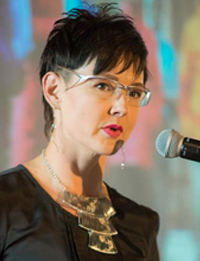
Sarah Iannarone, a doctoral candidate in the venerable Nohad A. Toulan School of Urban Studies and Planning at Portland State University, is running for Portland mayor. The Willamette Week reported the news earlier today and a source tells us Iannarone will make an official announcement this Thursday at 11:00 am in front of City Hall.
According to the Willamette Week, Iannarone was encouraged to run by none other than our current mayor Charlie Hales. The connection? Iannarone works with Nancy Hales at First Stop Portland, an organization housed at Portland State University that shows off Portland’s livability and urban planning successess to delegations from around the globe.
Iannarone, 42, joins Oregon State Treasurer Ted Wheeler and Multnomah County Commissioner Jules Bailey in a race that so far has failed to muster excitement from Portland’s large number of urban planning and transportation wonks.
Job Description *
The Bicycle Transportation Alliance (BTA) is a non-profit membership organization working to promote bicycling and improve bicycling conditions in Oregon. Since 1990, the BTA has worked in partnership with citizens, businesses, community groups, government agencies, and elected officials to create communities where people can meet their daily transportation needs by bike.
Our team is talented, energized and driven by a strong passion to get more people on bikes by making bicycling safer, convenient and accessible. We have ambitious goals, work in a fast paced environment and are committed to success – and we have fun while we do it!
BTA is seeking a highly organized and self-motivated individual to join our team to administer our SalesForce contact and donor database.
In this increasingly important and dynamic position, the Database Administrator will collaborate with staff across all departments. This position is integral to the BTA in creating and implementing tools and procedures to increase data efficiency and usability. We are looking for an individual with strong analytical and problem solving skills, who loves data and loves to talk to people about data. SalesForce certification is not required, but candidates should possess a proven ability to effectively utilize contact databases.
Key outcomes expected:
• Implementation of comprehensive plan to manage data integrity and security.
• Elevate BTA’s effectiveness through increased efficiency and usability.
• Minimize service interruptions and create a stellar end-user experience for both internal and external constituencies.
Responsibilities will include:
• Analyze and improve upon current database practices and systems.
• Maintain and administer BTA’s SalesForce database, including data integrity, data clean-up, application installation, storage management, and staff training.
• Collaborate with product vendors/app groups while designing the interfaces and 3rd party services, backend systems and various monitoring/analytical tools.
• Create processes that prioritize excellent e-commerce experience for members, donors, and stakeholders.
• Set up and maintain regular processes and procedures. Perform quality assurance on deliverables and work products. Audit, uncover and resolve data integrity issues.
• Create and manage custom lists, online forms, naming convention and uploads.
• Manage internal operations systems and processes.
The ideal candidate will possess:
● Moderate to advanced experience with SalesForce. Let’s be honest here, if you can’t operate our database, we are unable to hire you.
● A strong commitment to BTA’s mission.
● A love of problem solving and creating new and innovative ways of addressing issues.
● Energy, enthusiasm and a professional attitude.
● Experience with database administration, system maintenance, database development or data warehousing, and experience in analytics.
● Extremely high attention to detail, accuracy and efficiency.
● Self-starter with ability to improve systems.
● Integrity, honesty, professionalism and accountability are fundamental to the position.
● Excellent interpersonal skills, with strong written and verbal communication skills.
● Excellent time management skills, including ability to balance multiple (and sometimes competing) priorities. Ability to meet multiple deadlines.
● Degree in information technology, computer software, computer science or similar education and experience.
The BTA is an equal opportunity employer. We believe strongly that relevant experiences are better indicators of performance than educational degrees. All employees must be team players. We love people who bicycle, but do not hire based on how people get to work. We do expect that our employees embrace our mission and vision for creating livable, healthy and sustainable communities.
How to Apply *
Application Procedures:
Submit resume and cover letter describing your skills, professional goals and relevant experience to anne@btaoregon.org. Please put “Database Administrator” in the subject line. No faxes or phone calls please.
Job Description *
Why you should apply to this amazing job:
This position is perfect for anyone who loves to work with kids, be outside, to do physical work, loves to work with and on bikes, wants to learn more about bike maintenance, and is invested in making a difference in our youth’s lives. If you are up for the challenge we want you to join our team!
If you are looking to improve your bike maintenance skills or learn more about basic bike maintenance this job is for you. If you are looking to get into the classroom to support instructors teach kids bike safety skills, this position is ideal.
Before our first classes start up in the beginning of March we will train and support you so that you are prepared to help maintain the bike fleets, move bikes from school to school, conduct drills, practice classroom management techniques, engage in effective communication with kids, teachers, parents, administration and volunteers. Sound good? If so, our team is very excited to add your unique expertise and creativity to the program! Please see below for instructions on how to apply.
The Bicycle Transportation Alliance (BTA) is a non-profit membership organization with a mission to create healthy, sustainable communities by making bicycling safer, more convenient and more accessible in Oregon and Southwest Washington. We are hiring one temporary, part-time Education Logistics Coordinator who will help support the BTA’s
Bike Safety Education program from February 19, 2016 through June 7, 2016. The Bike
Safety Education program is a ten-hour curriculum that includes on-bike and on-street training geared towards 4th and 5th grade students at 40 elementary schools throughout
Portland. This year we are piloting a Middle School program and this person will get to be a part of the program delivery. Last school year our Education Team was able to bring this transformative program to over 2,500 students. Join us and help us increase this number!
The Bike Safety Education program is brought to schools all over Portland including but not limited to North Portland at schools like James John and Peninsula, schools in
Northeast such as Rigler and Sabin, Southeast Portland at Lent and Bridger, Northwest with Chapman, Southwest at Rieke and Maplewood, and East Portland at Gilbert Heights and Earl Boyles.
What we believe:
We believe transportation by bicycle has the potential to transform communities by offering viable commuting solutions that are sensitive to economic and racial inequalities, address issues of livability, aid in good personal health, and help protect our environment.
What you would be doing as a Logistics Coordinator:
• Move bikes with a truck from our bike storage location to schools.
• Maintain the bikes used for the Education programs.
• Assist in teaching bike safety to 4th and 5th graders by setting up drills, helping with class management, and coaching students.
• Engage community members and volunteers.
• Participate in required meetings and trainings.
• Participate in team accountability structure.
• Requirements:
o Able to lift 30 lbs. over your shoulders.
o Able to walk or use a mobility device for one mile.
o Able to ride a bike or an adaptive bike for at least 10 miles in one day.
o Loves to work with kids, be physically active, and be outdoors (in all conditions).
o Punctual, patient, and engaged.
o Applicants 18 years and older are encouraged to apply.
o Must have valid drivers license
o Able to drive a large box truck
o Eligible to drive a rental vehicle
o Must be available during school hours, Monday through Friday, February 19th through June 7th.
o Must be available 8:30 am – 2:30 pm every third Saturday of the month.
.
If you have experience in the following, please highlight it in your cover letter:
• Experience driving a large box truck
• Bike maintenance and repair experience.
• Experience working with kids.
• Experience with cultural diversity as represented in our Portland schools.
• Proficiency in Spanish, Mandarin, Russian, Somali, and/or Vietnamese. This is not a requirement but applicants with these skills are well positioned to teach in the program.
• Strong organizational skills.
The BTA does not discriminate on the basis of race, color, religion, national origin, age, sex, gender identity, sexual orientation, marital or familial status, physical or mental disability or legal source of income.
How to Apply *
Instructions for how to apply:
Please send a cover letter and resume or completed BTA application form in PDF format to sheilagh@btaoregon.org. Applications will be accepted until the position is filled. We will begin interviewing on Monday, February 3.
A string of tents, shopping carts and a few bedrolls are visible along the Springwater Corridor near 82nd Avenue.
(Photos: M.Andersen/BikePortland)
Last week’s post about a number of people living in tents and outside along the Springwater Corridor near 82nd Avenue has sparked a lot of discussion, but one big thing was absent from it: the perspectives of people actually living there.
Job Description *
Warehouse (All Responsibilities)
Available now, Warehouse position (All Responsibilities)
Location: St. John’s (North Portland, OR)
HGNR Inc is a specialty distributor of products in the Bicycle and Power Sports industries. We are looking for a part time employee to run our warehouse. This position is, one person, responsible for running everything in our warehouse. Work load varies from 20 to 40 hours per week March through October and 5 to 20 hours per week November through February. More hours will be required during training. Experience useful, but not required as we will train the right person.
DUTIES AND RESPONSIBILITIES INCLUDE BUT ARE NOT LIMITED TO:
• Maintain a clean and well-organized work area.
• Daily picking, packing, quality control and shipping of all customer orders.
• Product assembly including quality control.
• Receiving, quality control and stocking of incoming inventory.
• Loading, unloading and occasional driving of company vehicle.
• Assist the owner with inventory management.
• Assists the owner with warehouse organizational systems to increase efficiency.
• Experience useful, but not mandatory, as we will train the right person.
DESIRED SKILLS:
• Efficient, accurate, and timely completion of daily, weekly and monthly activities.
• Ability to lift 70 pounds and handle a full 55-gallon drum.
• Must follow all safety procedures.
• Ability to use scales, box knives, and calculators.
• Proficient in basic math, fractions, ratios and algebra.
• Basic understanding of mechanical systems.
• Computer literacy is a plus.
NECESSARY PERSONAL QUALITIES:
• Attention to detail, organized and cooperative.
• Self-starting, self-directing and able to take initiative.
• Interested and motivated to work for a small business.
SALARY and HOURS:
Starting pay: $12.50 per hour during training and acclimation.
Ultimate pay range: $12.50 to $17.50 per hour, based on efficient, accurate, and timely completion of daily activities.
Hours: Mon – Fri, 20 to 40 hours per week March through October and 5 to 20 hours per week November through February, depending on workload. Weekends occasionally required.
How to Apply *
TO APPLY: Send a short introductory paragraph describing how you would be a good fit for this job along with your cover letter and resume.