Sorry, this job has been filled. Browse more great jobs here.
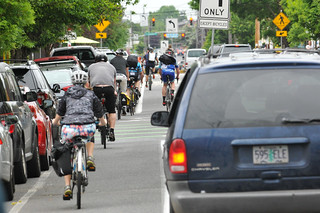
Hundreds turn out for Pedalpalooza Kickoff Ride (photos)
(Photos J. Maus/BikePortland)
Tonight’s Pedalpalooza Kickoff Ride was the largest in recent memory with hundreds of people (a thousand?) turning out to celebrate the upcoming month of rides, fun and new friends.
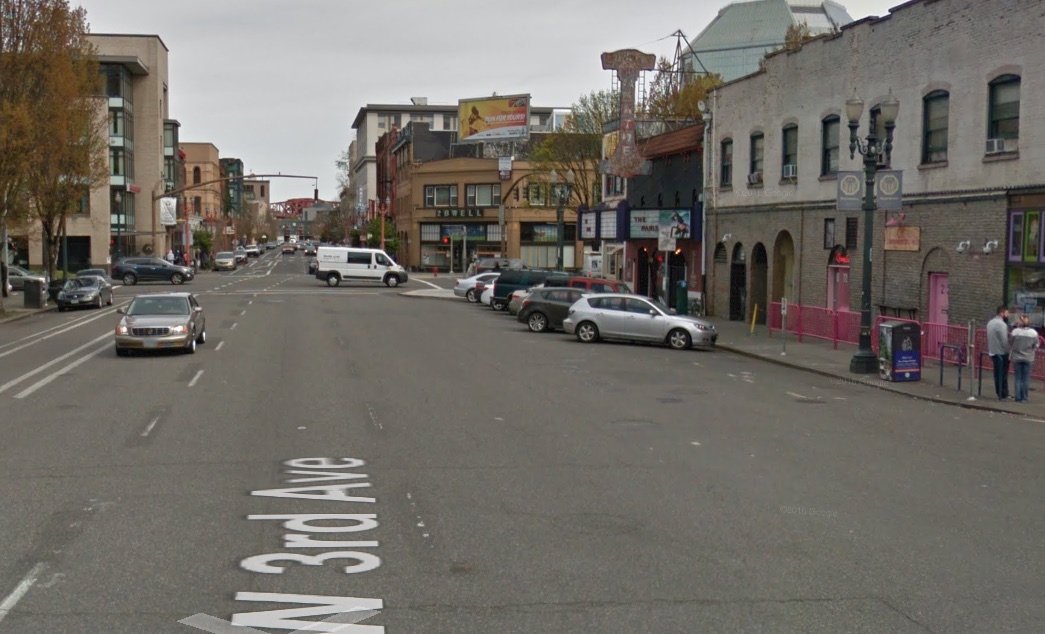
Coming soon: A new protected bike lane on 2nd Ave and a plaza near Voodoo Doughnuts

(Images: City of Portland)
The City of Portland Bureau of Transportation will make significant changes to 2nd and 3rd Avenues in downtown Portland this summer.
2nd, which is one-way northbound, will be re-striped with a parking-protected bike lane from SW Stark to NW Everett and there’s a new public plaza coming to the intersection of SW Ankeny and 3rd.
Over 11,000 people took the ‘Bike More Challenge’ last month

(Photo: B-line Sustainable Urban Delivery)
The Bicycle Transportation Alliance (BTA) wrapped up their 19th annual Bike More Challenge with a big party last night in southeast Portland.
This was the first year the friendly competition was held in May instead of September. The BTA made the move to encourage more people to keep biking through the summer, but it looks like the warm and sunny weather also boosted overall participation. A look at the final numbers shows that about 1,000 more participants were coaxed into the event than in previous years.
This year’s Challenge had 11,741 total riders who biked 1,656,098 miles. That’s up from 10,722 riders and 1,247,886 miles in 2015 and 10,350 riders and 1,212,271 miles in 2014.
Weekly Video Roundup: local bikes, teaching kids to ride, racing, and more
Welcome to this week’s roundup! The video selection was a little light this weekend until videos flooded in late Tuesday and early Wednesday. One of the last-minute videos is the above from River City Bicycles showing “Portland bikes”. How perfect is that? Dave shows off a Chris King/Cielo and a Mark Dinucci bike. More videos after the break.
Pedalpalooza starts tomorrow!
It’s almost here. The largest bike event of its kind on planet Earth is about to start.
At the Adaptive Bike Clinic, there’s truly a bike for everyone
(Photos: J. Maus/BikePortland)
“Demo days” are a common thing in the bike industry. It’s where a company parks their truck and tent at a trailhead and offers free test rides. They bring all the sizes and models so that everyone can try out a bike. But as we’ve learned recently in a robust conversation about access to the city’s bike share program, “everyone” often only includes people who are physically able to ride a common, two-wheeled bicycle.
On Sunday a host of organizations — including the City of Portland — hosted the 12th annual Adaptive Bike Clinic. It was an opportunity for anyone — including people with disabilities — to test ride the bike of their dreams.
Speak up now for dirt trails at Chehalem Ridge Nature Park

(Photos: Metro)
Imagine rolling your bike onto the MAX, getting off at the end of the Blue Line in Hillsboro, then pedaling 10 miles to some sweet singletrack. That could become reality, but only if you speak up and get involved.
About 23 miles west of Portland — and just 10 miles south of the Hillsboro Transit Center — lies 1,200 acres of undeveloped land called the Chehalem Ridge Nature Park. Before the economy tanked it was prepped for housing, but Metro purchased it in 2010 with funds from their Natural Areas Levy. And we’re lucky they did because it could someday be home to bike trails.
Metro says Chehalem Ridge is one of the largest publicly owned natural areas in Washington County. It’s about the same size as Oxbow Regional Park in east Multnomah County, yet it’s relatively unknown because of its rural location and lack of public facilities. The land itself (based on photos, I have yet to explore it) offers sweeping views of the Tualatin Valley and Coast Range to the west. Its gradual inclines, meadows, and groves of trees give it loads of potential as a place where off-road cycling could flourish.
ODOT to bicycle riders: Here’s your chip seal cheat sheet

(Photo: Peckham Asphalt)
For the first time ever, the Oregon Department of Transportation has published their list of upcoming chip seal projects specifically with bicycle riders in mind.
Chip seal is a type of paving material that mixes asphalt with pieces of fine aggregate (a.k.a. gravel). Road agencies love it because it extends the life of low-volume rural roads and it’s much cheaper to do than repaving. But for people who bike, chip seal is a drag. Literally. The tiny bumps don’t even register while driving, but on a bike they can really slow you down and cause fatigue. (And you do not want to think about what happens when you crash on it.) What makes matters worse is that road crews will often chip seal just the standard lane and then leave a ridge that crosses the fog line and goes into the shoulder people ride.
“My goal is to get the word out so bicyclists can plan accordingly and avoid an unhappy experience.”
— Sheila Lyons, ODOT Bicycle and Pedestrian Program Coordinator
Because of the groans that come with chip sealed roads, we were happy to get an email from Oregon’s Bicycle and Pedestrian Program Coordinator Sheila Lyons last week. She wanted to make sure people know what to expect when planning summer bike adventures on our state’s many excellent backroads. Lyons knows this is an issue, not just because she hears about it from Oregonians, but because she’s a rider herself. “It can be no fun to ride on,” she wrote in the email. “But it’s a cheap and effective surfacing treatment that ODOT is using more and more.”
Building bike parking shelters at Ockley Green Middle School
shelters at a north Portland school on Sunday.
(Photos: J. Maus/BikePortland)
Did you know that you can get a few volunteers together and build a covered bike parking shelter at any Portland Public School?
We wrote about the City of Portland’s school bike shelter program back in 2012. Since then the shelters have popped up at schools all over the city. On Sunday I got the chance to help build one myself at (the newly designated) Ockley Green Middle School in north Portland. It was a fantastic way to create better bike parking at my kids’ school and spend some time with other parents.
In some ways, bike parking shelters do for schools what intersection repair projects do for neighborhoods: The thing you make together is the icing on the community-building cake.
Bike traffic advisory: Expect delays on bridges due to repairs and Fleet Week
The lower deck of the Steel Bridge is always crowded during the warm and sunny summer season — but it’ll be even harder to bike through over the next week.
The Bureau of Transportation has put out a traffic advisory (below) warning of delays on all downtown lift-bridges due to the double-whammy of lifts (as ships depart from Fleet Week festivities) and for electrical repairs on the Steel Bridge. The delays are expected to happen on June 8th, 9th, and 13th.
Be advised and try taking the upper deck for the next few days. If you do ride the upper deck, please ride cautiously when other people are present — it’s narrow up there.
Centennial event marks a new era for the Historic Columbia River Highway
(Photos by J. Maus/BikePortland)
“While this highway was built for Model-Ts, its future is meant for cyclists, walkers, and hikers…”
— Barbara Roberts, former Oregon Governor
100 years ago today the State of Oregon dedicated the 73-mile Historic Columbia River Highway. It was a marvel of its time, the nation’s first Scenic Highway, and it was known simply as the “King of Roads.” Its 73-miles of curves and sweeping gorge views from Troutdale to The Dalles were an inspiration to engineers and explorers alike.
Then it was all but forgotten in the 1950s when Interstate 84 bullied its way through the gorge. The new interstate cut off sections of the old highway and it fell into disrepair. In 1987 the state legislature established the Historic Columbia River Highway Advisory Committee and work began in earnest to restore the highway to its former glory.
When it was rededicated today at a Centennial Celebration held at Multnomah Falls, there was one major difference this time around: Instead of automobiles marking the future, they now mark the past.