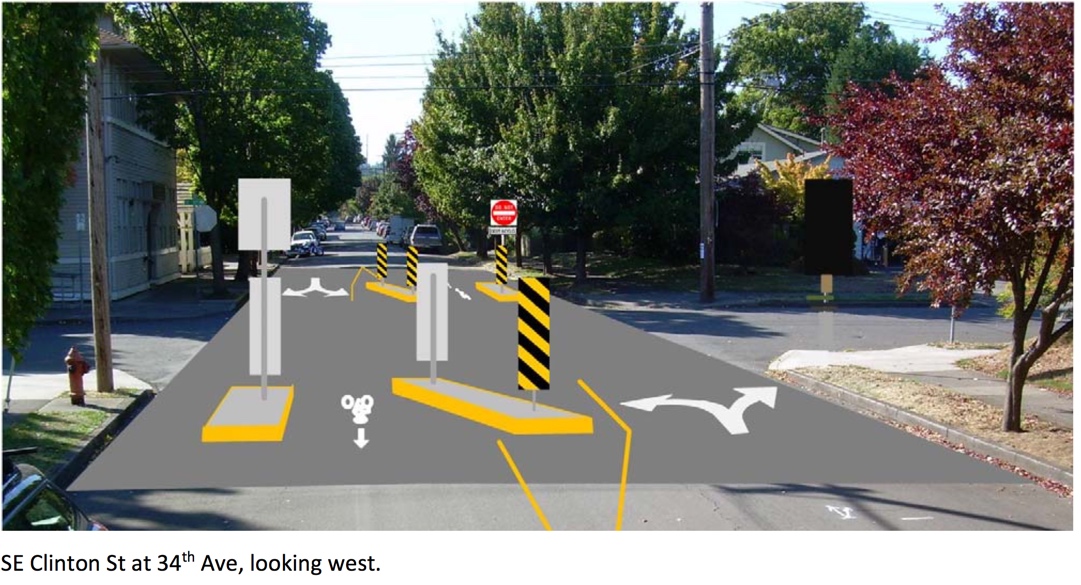
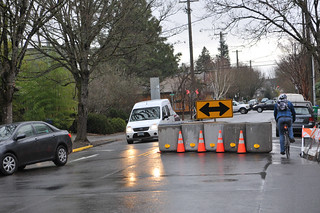
On the eve of the Bureau of Transportation’s Vision Zero Action Plan going before City Council, the City of Portland just released some positive safety news: The traffic diverters installed on Southeast Clinton Street are working very well and the one at 32nd will be redesigned and made permanent in the next few weeks.
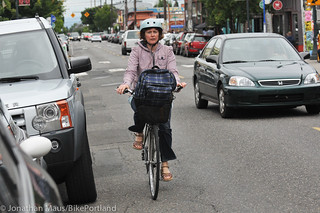
The diverters at SE 17th and 32nd were part of a comprehensive effort to tame auto traffic on Clinton that included educational outreach, public meetings, speed bumps, lower speed limits, “Bicycles May Use Full Lane” signs, and targeted enforcement. As one of the oldest and most used neighborhood greenways in the city, Clinton (which has about 3,000 bicycle users a day) was originally designed to prioritize bicycling; but driving skyrocketed in recent years as the surrounding neighborhoods added new residents, shops, restaurants and offices. In July 2014 we reported on growing rancor among bicycle users who called Clinton a “bikeway in name only.” Those concerns led community activism and became a rallying cry for the fledgling, all-volunteer bike advocacy group Bike Loud PDX.
Just four months after BikeLoud’s activism began, the City’s Bureau of Transportation launched a comprehensive assessment of the neighborhood greenway system (that would later be adopted by City Council) and agreed to meet with representatives from the group to learn more about the issues.
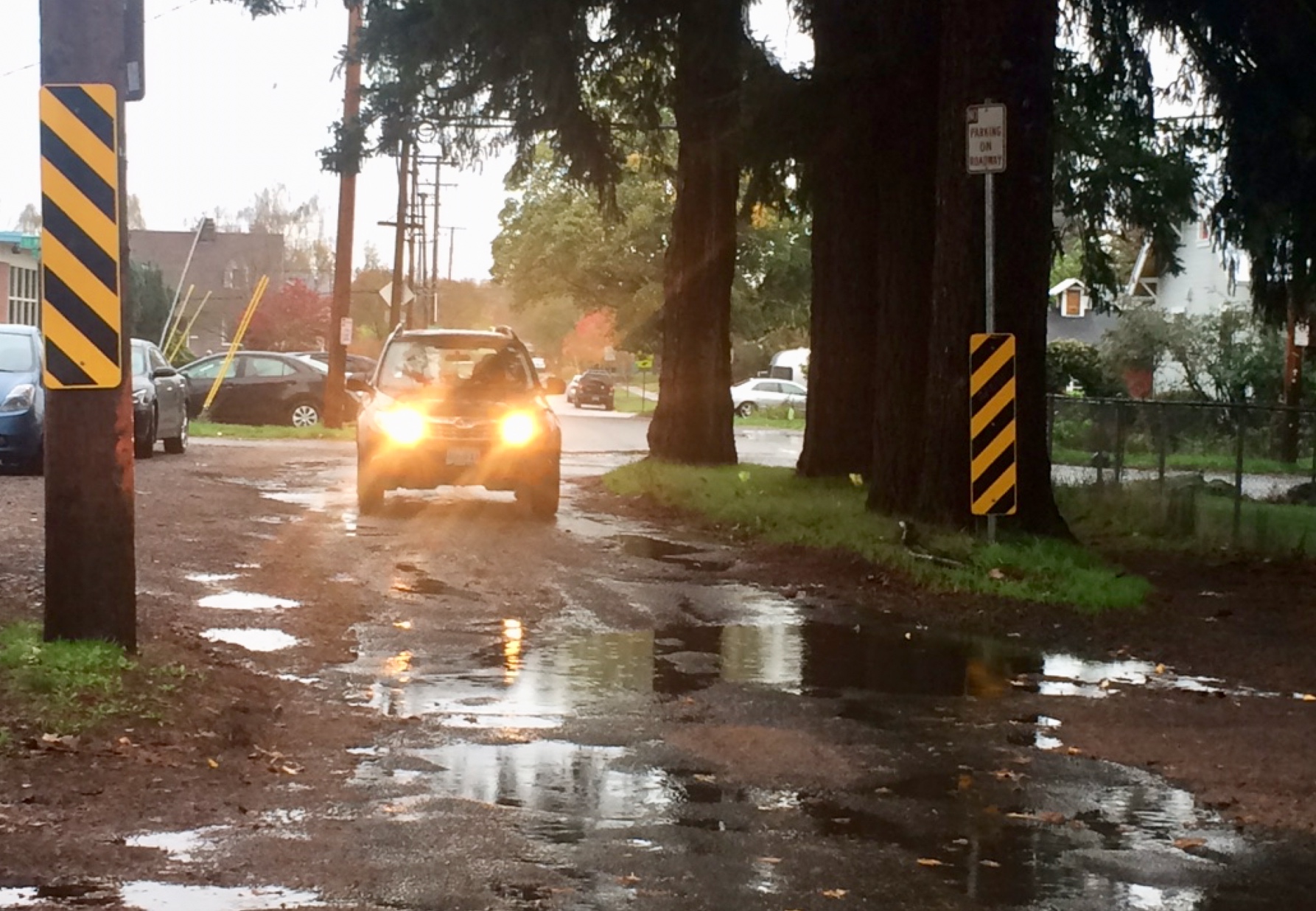
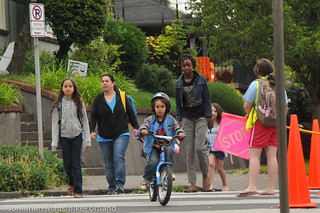
SE 80th looking towards Mill, right outside an elementary school. (Photos: Amy Wren)
(Publisher’s note: This week we’re excited to highlight a few of the projects created by students in Portland State University’s Traffic and Transportation course. As we reported in a profile earlier this year, the class has had a vast impact on Portland in numerous ways by churning out over 1,200 smart and inspired graduates since 1991. We worked with class assistant Rebecca Hamilton (a graduate herself who now works at Metro) to share three of the projects that will be presented by students in class later this week. Yesterday we shared Charles Tso’s work on parking benefit districts.)
Safer routes to Bridger Elementary School – Amy Wren
Tucked between Southeast 82nd Avenue and Mt. Tabor Park, Bridger Elementary School is surrounded by streets that lack sidewalks and that are littered with big potholes and gravel. Add in winter weather and vehicle traffic and you’ve got a recipe for danger and stress. For her project, Amy Wren (who took the PSU class after reading about it on BikePortland!) asked a simple question: Would you want your kids to bike or walk on those streets?
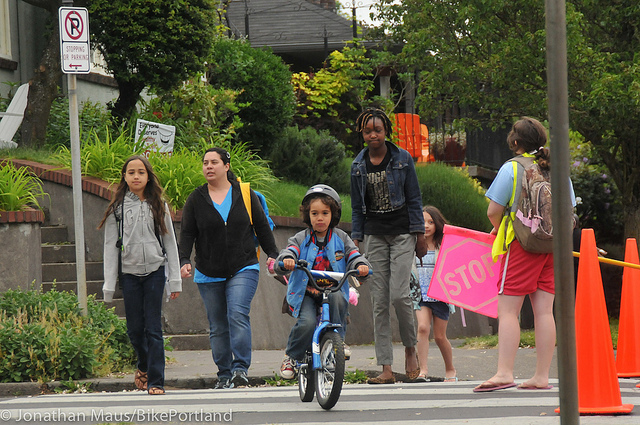
About a quarter of the grants went to Safe Routes to School programs. (Photo: J. Maus/BikePortland)
Here’s some good news: Metro just announced grants to 17 agencies and organizations throughout the region that will make it easier to get around without driving alone. The grants are worth a total of $2.5 million — money that comes from the federal government and is doled out by Metro via their Regional Travel Options (RTO) program.
Metro spokesman Craig Beebe said, “This cycle’s awardees continue the program’s trend of focusing on youth and underserved communities.”
On that note, a $178,000 grant to the Community Cycling Center will allow the nonprofit to implement a “community centered” Safe Routes to School program at Title I schools (where students come from low-income families). And the Bicycle Transportation Alliance won $203,000 for an “Access to Bicycling initiative” that will include a continuation of their Women Bike program and hands-on bike repair and riding clinics at workplaces and in communities around the region. In Washington County, the Westside Transportation Alliance will use its $196,000 grant to encourage biking, walking and transit use in areas with a high percentage of low-wage and shift workers.
Job Description *
This position is responsible for responding to customer phone calls, emails, and for working directly with customers in our store. Customer Experience Specialists provide product information, advice and order assistance. Qualified Customer Experience Specialists also review orders and price match requests and assist with site content, including product reviews, photos and descriptions.
Qualifications
ESSENTIAL FUNCTIONS INCLUDE BUT ARE NOT LIMITED TO:
Answer product questions & assist with the order process
Analyze customer questions, troubleshoot, and provide clear answers in an efficient and professional manner
Develop trust and loyalty with consumers and build value in our brands
Navigate a sophisticated order processing system
Generate performance reports and recommend improvements
Coordinate with Returns to assist customers with returns and exchanges
Assist walk-in customers with product questions and purchases
Retrieve products from the warehouse to assist walk-in customers
ADDITIONAL RESPONSIBILITIES/DUTIES:
Navigate a sophisticated order processing system
Work with Marketing to assist with customer-facing content, including site maintenance, product images and descriptions
Increase sales by genuinely helping customers learn about additional/alternative product options
MINIMUM JOB REQUIREMENTS:
Basic computer skills
Strong knowledge of cycling
Previous customer service experience is a plus, as is sales, service and mechanical experience in the cycling industry
KNOWLEDGE, SKILLS, & ABILITIES:
Excellent communication and organizational skills
Solid knowledge of cycling products
Ability to work in a high volume, fast-paced environment
Ability to work independently or with others to manage multiple task with minimal supervision.
We offer excellent medical, dental and vision benefits, generous PTO accrual, and 401k including paid holidays. We offer a multiple company discount program. We provide a positive and supportive approach to development and training daily, and encourage opportunities for both professional and personal growth.
How to Apply *
Please apply by clicking on application link
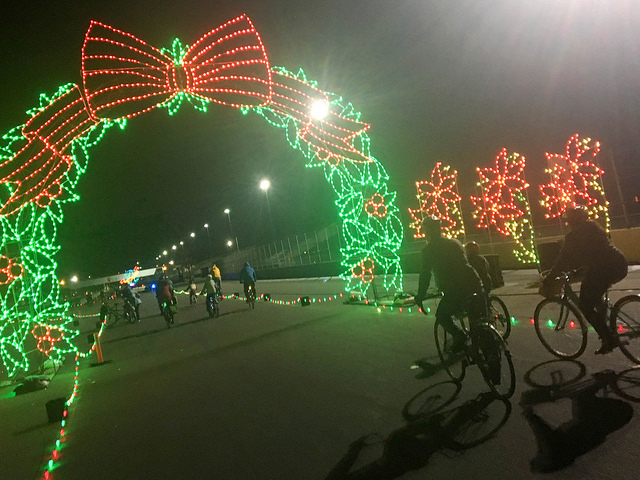
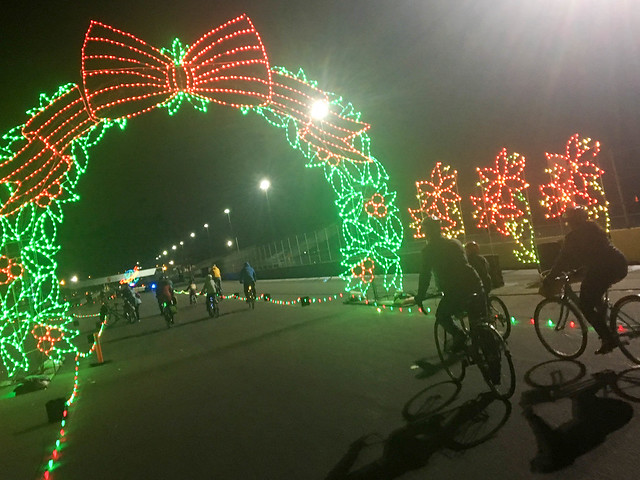
A rare window of dry skies was an unexpected treat. (Photos: J. Maus/BikePortland)
It was a perfect night to bundle up and enjoy the holiday lights at the annual “Bike the Lights” night at Winter Wonderland. With dry and relatively clear skies, hundreds of people (organizers expected over 1,200 based on last year’s numbers) showed up for a chance to pedal stress-free around the racetrack at Portland International Raceway.
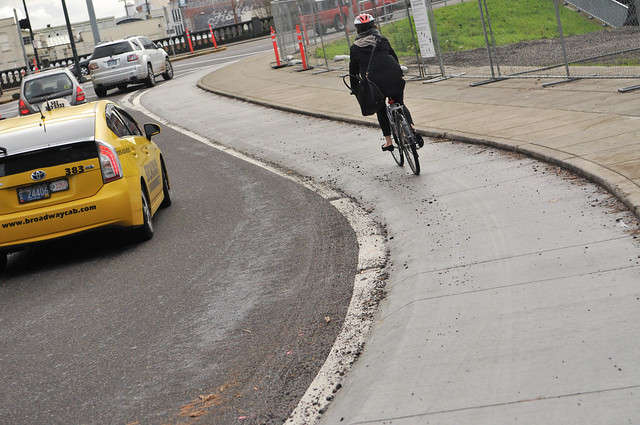
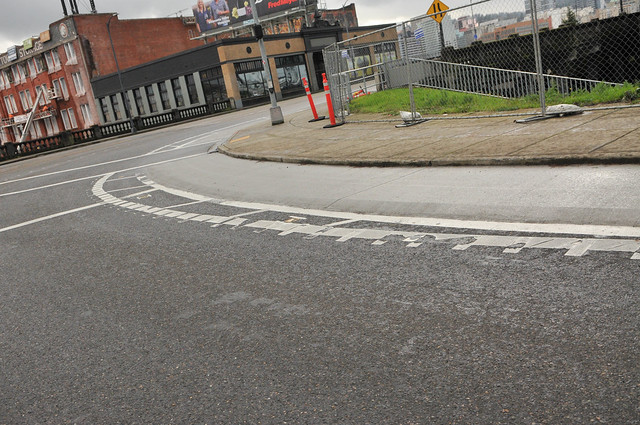
PBOT has given riders a raise on Couch as it winds onto the Burnside Bridge. (Photos: J. Maus/BikePortland)
For years now the Portland Bureau of Transportation has tried to keep people from driving into the bike lane on the Couch curve at the eastern end Burnside Bridge. They’ve used buffer stripes, reflectors with LEDs inside them, and even rumble bumps — all without much success.
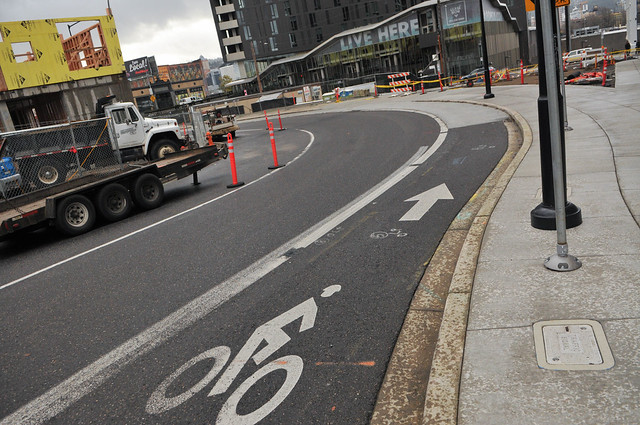
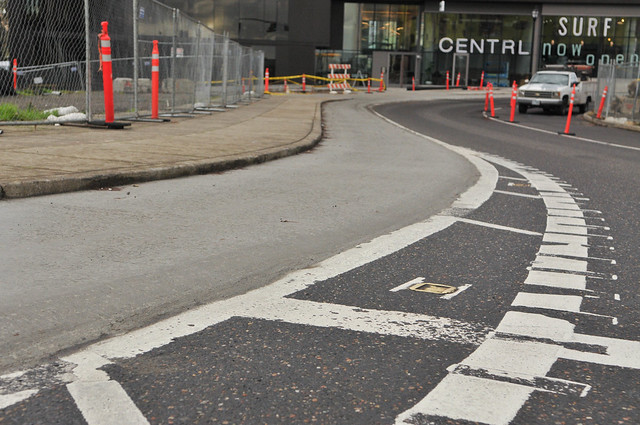
The curve. Note that the vacant lot on the right will soon be a new office building.
Have they finally figured it out?
Their latest attempt is a new concrete surface that’s raised a few inches above the adjacent roadway and that looks more like a sidewalk than a vehicle lane. We reported on this back in June and took a closer look at the finished product yesterday.
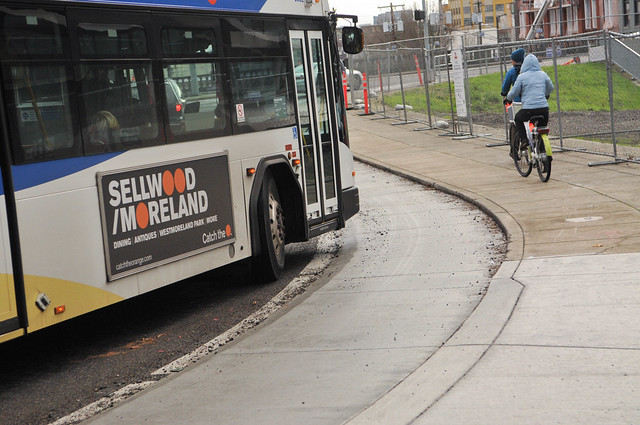
This section of Couch is a high-volume bikeway (especially during morning rush-hour) that collects traffic from inner southeast and northeast neighborhoods and then feeds right into Old Town/Chinatown via the Burnside Bridge. The road cross-section includes two standard vehicle lanes along with this new bike lane (which is the standard width of about five or six feet). Due to the curves (a design that was agreed upon in order to make the lot on the northwest corner of MLK and Burnside as large as possible for development), long buses and trucks need plenty of room to maneuver (see photo below).
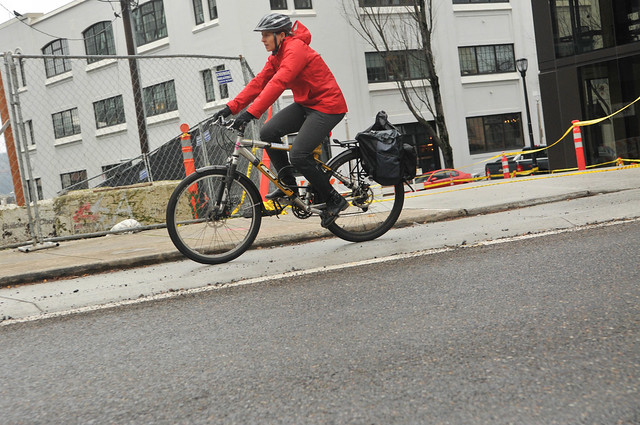
The raised bike lane begins right at the start of the “s” curve after Couch crosses Martin Luther King Jr. Blvd. Bicycle users take a gradual ramp onto the lane and there’s a mountable curb with a very slight angle between the bike lane and the standard lane. Between the bike lane and the sidewalk there’s a three-inch curb that isn’t rounded at all. The width of the bike lane isn’t wide enough for side-by-side riding and, as local urban planner Nick Falbo pointed out on Twitter last week, it’s barely wide enough for a freight delivery bike.
Before we share more feedback and images, it’s important to know the urban context at this location. The area around the Couch curve has, quite literally, grown up a lot in the past few years. In every direction there are new developments that have brought hundreds of new residential units and well over 100,000 square feet of office and retail space. That means the future demand for space on adjacent public spaces (which includes streets) will grow considerably in the years to come.
Advertisement
It seems crazy to me that we have two lanes of motor vehicle traffic bisecting a thriving new neighborhood in our central city; but I digress.
The good news is that the raised bike lane and all the development have already slowed road users down. That’s a natural reaction to the built environment that we hope continues.
As for the new bike lane design, it’s a nice step forward. We’d love to see physical separation, but making the bike lane a different color and texture than the other lanes and raising it up a few inches is an improvement. One puzzling thing about the design is how the mountable curb is between the standard vehicle lanes and bike lanes, instead of between the bike lane and the sidewalk. This means people on bikes who want to pass will leave the (relative) safety of the bike-only lane and enter a lane shared with motor vehicles — instead of using the sidewalk.
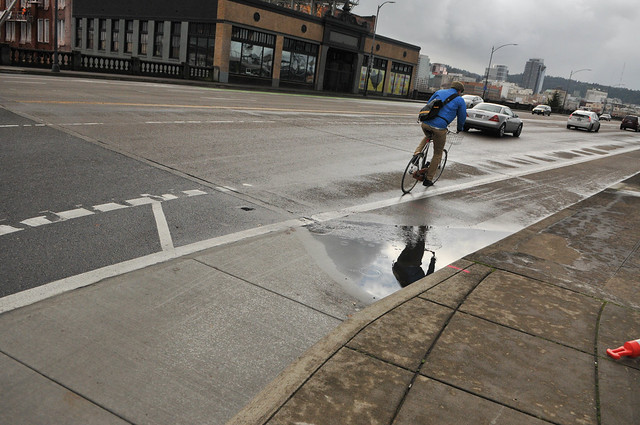
The issue we’ve heard a lot about since this new bike lane was installed is the big puddle that has formed where it transitions back onto the Burnside Bridge (see photo below). The puddle was still there on Monday and the people I observed left the bike lane to go around it. This puddle needs to be fixed.
Here are more photos…
Another thing to keep in mind is that there will soon be a new, carfree road that connects to the Couch curve from NE 3rd Avenue. This will create a potential conflict point where people on bicycles merge from the new road onto the existing bike lane. As with all the changes around the east side of the Burnside Bridge, we’ll be watching that closely.
Have you ridden this new raised lane? What do you think? Would you like to see more of them in the central city?
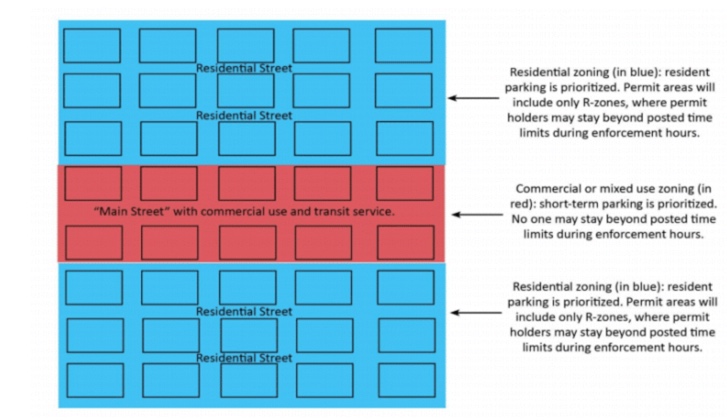
How parking is managed in neighborhoods and adjacent commercial districts can have a huge impact on the cycling environment. (Photo: J. Maus/BikePortland)
(Publisher’s note: This week we’re excited to highlight a few of the projects created by students in Portland State University’s Traffic and Transportation course. As we reported in a profile earlier this year, the class has had a vast impact on Portland in numerous ways by churning out over 1,200 smart and inspired graduates since 1991. We worked with class assistant Rebecca Hamilton (a graduate herself who now works at Metro) to share three of the projects that will be presented by students in class later this week.)
Parking Benefit Districts – a project by CT (who requested anonymity)
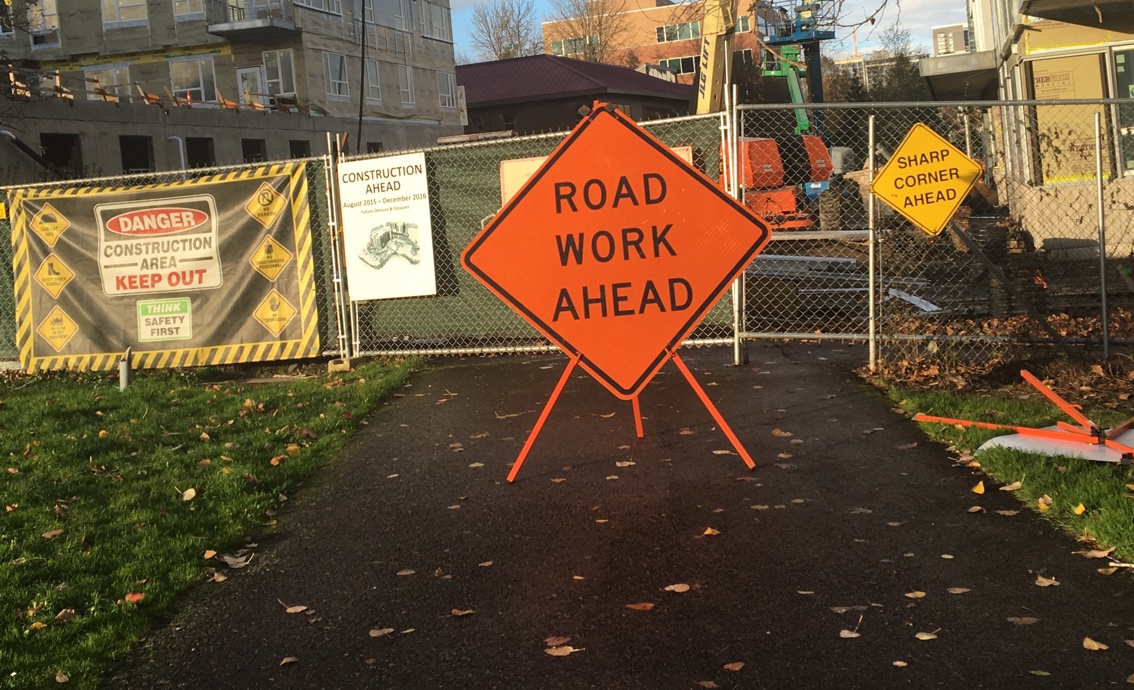
Willamette Greenway path closure through December 14th. (Photos: J. Maus/BikePortland)
A construction project on the west side of the Willamette River just south of the South Waterfront district has closed the Greenway path and the City of Portland has offered no official detour.
Crews from Fore Construction are building the Sanctuary Apartments at 4800 SW Landing Drive. A notice distributed by the company last week said work on the apartments will include the rebuilding and resurfacing of the Willamette Greenway path and the path will be closed through December 14th.
Fore’s statement said, “We will endeavor to keep as much of the trail open as possible during this period.” There was no specific timeline for when the path would be fully closed or open during construction and no detour map was provided with the company statement. We asked Fore and the Portland Parks & Recreation bureau what bicycle riders should do when the path is closed.
I went through the process of the insurance paperwork (now needs to be undone)
As I was just wrapping that up, my ebay query showed a hit and I found a link to my bike. The picture was blurry and a google image search happened to show me that the image came from a video reviewing the bike. It didn’t look exactly like mine so I decided to trust the seller and I was prepared to buy the bike if it wasn’t mine because it would have been close enough to be a replacement. I chatted with a cop beforehand and then I decided I would go in as a buyer and test-ride the bike. My brother came with me to stake out the bike. When we met up with the seller, it was immediately clear that it was my bike, it even had the fenders, rack and trailer hitch still there.
The next step was to pretend to go get cash from an ATM and we called the cops to go get the bike. Luckily, I had a key to the battery so that would prove the bike was mine. A serial number is what I should have brought with me.
Things to remember:
a) lock your bike up, always (double-check)
b) register all your bikes on https://bikeindex.org/ with serial number there! (Now)
c) if you want to find your bike these tips might help, they helped me http://www.bicycling.com/culture/advocacy/five-things-do-get-your-stolen-bike-back
Portland’s busiest cycling street is about to get even better for bike lovers.
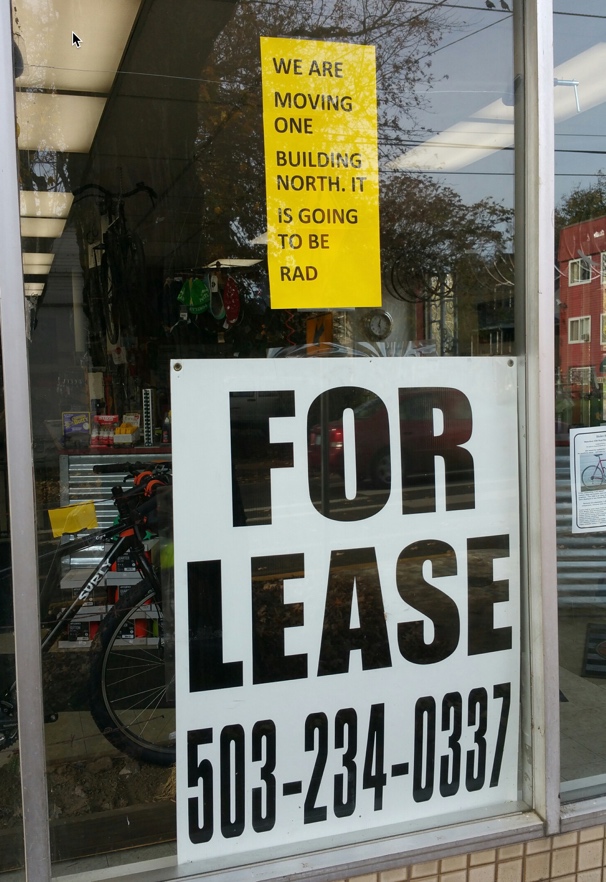
A new shop has opened in the bustling commercial block of North Williams Avenue between Failing Street and Shaver. And Metropolis Cycle Repair on North Page Street is planning to move across the street to a new and larger location.
The new shop is called 3928 Bike Shop and is located at — surprise, surprise — at 3928 N Williams Ave. That’s right across the street from the Hopworks Bike Bar in the old Jesuit Volunteer Corps building. It’s a new endeavor from Portland Bicycle Studio owner Molly Cameron. Cameron, a well-known figure in the racing scene, calls her new store a “pop-up bike shop”. She’s not a newcomer to the area, having opened her first shop (“Veloshop”) a four blocks east on Martin Luther King Jr. Blvd. back in 2001.
“If you have places in your system where you have unprotected road users and protected road users, according to Vision Zero you can’t allow a higher speed than 30 kilometers per hour [18.6 mph].” — Matts-Ake Belin, Director of the Vision Zero Academy at Sweden’s transportation agencyvia Citylab
Welcome back from the long weekend everyone. Hope you had time to enjoy your friends, your family, and yourself. We’ve got another full week of news cooking for you. But before we dive in, make sure you check out the best bike and transportation-related news we came across last week…
Straight dope on Vision Zero: This week’s must-read is Citylab’s interview with Sweden’s head traffic safety strategist. I wish all U.S. electeds and engineers would adopt his perspective — or at least print out this article, tape it to the wall of their cubicle, and bring it to their project meetings.
Wheelchair bike program takes off: ‘Healing Rides’ is the name of a new program in Illinois that gets wheelchair users out on the trails thanks to volunteers on customized bikes.
Seattle’s bike share saga: Seattle city council has made the end of Pronto official by setting a shutdown date. Read all about it on Seattle Bike Blog.
The Oregon Department of Transportation has inched ever closer to its goal of reconnecting a 75-mile paved path and low-volume road between Troutdale and The Dalles. Their Historic Columbia River Highway State Trail project just won a $28 million grant from the US Department of Transportation for the Mitchell Point Crossing.