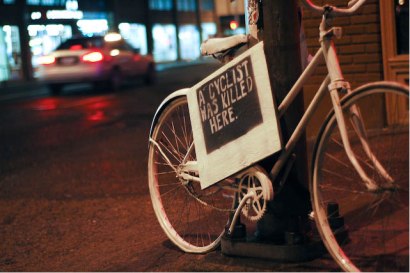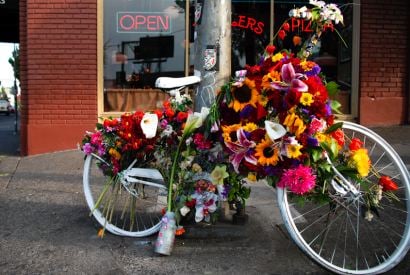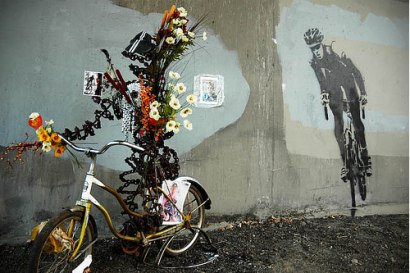
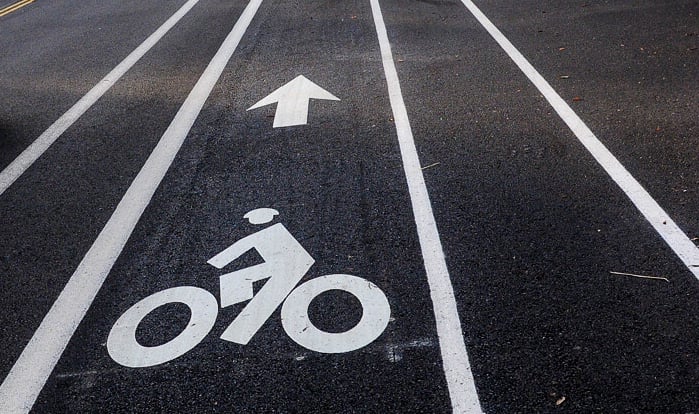
(Photos © J. Maus)
Yesterday, in cities across the country, Transportation For America launched their “Build for America” campaign.
The Build for America effort is focused on lobbying congress for increased federal investment in a “21st century transportation system” that will create new jobs via the construction of a world-class rail system, upkeep of our existing infrastructure, and construction of more public transit, sidewalks, and bicycle facilities. (See their, “Five Point Plan to Get our Economy Moving”)
A parade is planned for Thursday (10/16) to celebrate the new bike access and safety improvements through the Rose Quarter Transit Center.
The project was the result of collaborative effort between TriMet, the City of Portland, the Bicycle Transportation Alliance, and the Lloyd District Transportation Management Association.
A statement about the event issued by TriMet referred to the previous configuration of the transit center as a “critical barrier for cyclists”, and that “the alternative bike route around the transit center was difficult to navigate.”
The Office of Transportation has struggled for years to figure out how to safely manage bike and car traffic flow at the intersection of Broadway and Williams.
Following two fatalities due to right-hooks last fall, PDOT placed the intersection on a list of the 14 most dangerous in the city and initially planned to install a bike box. However, after further study of the intersection, it was determined that a bike box would not be a good solution at this location.
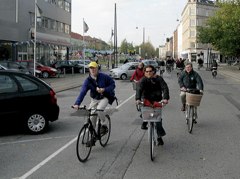
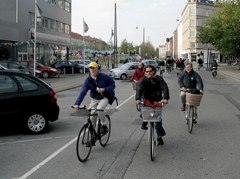
The recent, Metro-sponsored field trip to Copenhagen and Amsterdam concluded last week. The trip was intended as an inspirational master class on how those two cities have created a safe, efficient, and comfortable bike network that’s used by well over 30% of their residents (of all ages) on a daily basis.
As I reported last month, the Office of Transportation and the Bureau of Planning have embarked on a project to improve the 7 Corners intersection (where SE Division, Ladd, 20th, and 21st streets converge).
At last night’s Bicycle Advisory Committee meeting, Tom Armstrong from the Bureau of Planning introduced the three design concepts and received feedback on how the designs might impact bike traffic.
Armstrong told us that the two goals of the project are “How can we enhance this area to give it a more distinctive place, while at the same time maintain mobility through the intersection.”