
By Sarah Risser
After Portland committed to Vision Zero in 2016, things only got worse. The statistics have gotten better recently, but if we want to reach zero we must acknowledge current shortcomings to our approach and be laser-focused on the true risks.
First, let’s rewind…
For nearly a decade, road fatalities in Portland climbed (aside from small downticks in 2018 and 2022) until culminating in a three-decade, panic-inducing high in 2023 when 69 people were killed. Vision Zero was on the hot seat. People wanted to know when the carnage would stop. To outraged cries of “Vision Zero isn’t working,” City of Portland staff held firm. “It is working,” they’d say. Where the city invested in safety, fatalities were down. Not everyone was convinced.
Are we trying to make a dangerous system safer, or reduce the danger itself? They are not the same thing.
– Sarah Risser
Then, to everyone’s relief, fatalities dropped in 2024. And in 2025, they dropped sharply. The narrative flipped. PBOT issued a statement declaring progress, and many road-safety advocates put 2023 firmly in their rear-view mirror with a sigh of relief. But the two-year decline could simply reflect a post-Covid surge correction, rather than a structural shift. Moreover, Portland’s trends have closely mirrored national trends: a surge after Covid followed by a decline. This suggests larger forces are at play.
And still, the core question remains: Why are Portland’s roads so deadly?
Portland’s Vision Zero staff have quietly answered this question with a disclaimer on the first page of every Vision Zero Action Plan, Update, and Addendum: ‘Achieving Vision Zero goals depends upon available funding… Optimal performance depends on funding.’
Portland is cash-strapped, and its budget reflects its core values. Until the city consistently prioritizes human life through sustained investment, road fatalities will persist. Based on this, everyone should immediately moderate their expectations. I could end here, but there’s more to say.
Funding is only part of the problem
The program lacks authority as evidenced by its notable silence on politically sensitive issues that directly impact safety. There are many examples including but not limited to: not speaking up for dedicated bus lanes on 82nd Avenue or against high-speed police chases, refraining from weighing in on the possible widespread adoption of Autonomous Vehicles (AVs), and watching in silence as traffic-calming concrete planters are removed. A program tasked with eliminating deaths can’t sidestep policies that shape risk simply because they are controversial. To fully succeed, Vision Zero needs the courage and authority to engage in politically controversial policies and the unwavering support of Mayor Keith Wilson and City Administrator Raymond Lee when it does.
In September of 2025, City Councilor Tiffany Koyama Lane introduced a resolution to reaffirm Portland’s commitment to Vision Zero and created a cross-bureau task force (which has yet to meet) to build momentum for the program. This work should be applauded.
Ensuring city council is fully behind Vision Zero is important; however, the most successful cities had a mayor who provided inspiration and championed Vision Zero. Hoboken, New Jersey offers a compelling and well-known case: Former two-term mayor Ravi Bhalla was inspired to act after he was forced to push his child’s stroller dangerously close to traffic. Bhalla worked tirelessly to daylight intersections, reduce speed limits, and upgrade infrastructure. Similarly, in Paris, former Mayor Anne Hidalgo transformed the city by taking space away from motor vehicles and giving it to bikers and walkers. The result has been a much quieter, cleaner — and safer — city. Having a Mayor who cares about road safety and is motivated to consistently prioritize safety over motor vehicles and throughput is extremely important to the success of the program.
Limits of the Safe Systems approach
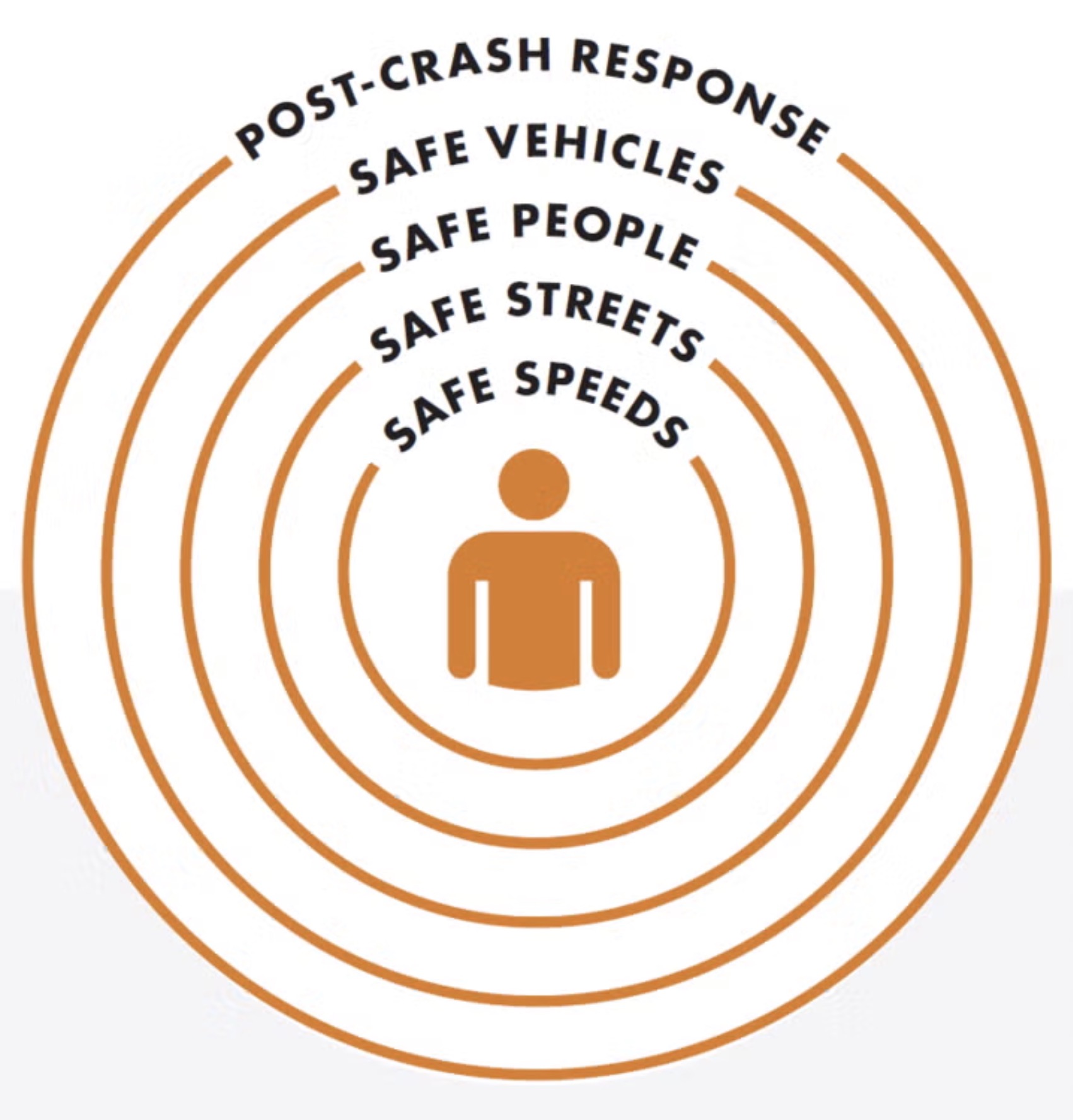
The adoption of the Safe Systems approach by the City of Portland represented an important paradigm shift and step forward from the more top-down “Three Es” of Education, Engineering and Enforcement. Safe Systems incorporates public health principles which formally acknowledge that humans make mistakes and aims to reduce the consequences of human error by ensuring multiple systems — people, cars, speeds, streets, and post-crash care — are safe and work to reinforce each other. This ensures that if one system fails, other systems will compensate.
But the Safe Systems approach isn’t perfect. Its ‘Safe People’ pillar calls for shared responsibility among road users, directly contradicting the central tenet of Safe Systems: that humans will make mistakes and these mistakes should be anticipated. The focus on shared responsibility also enables potential back-sliding into a victim-blaming mentality and confusion over what is ultimately responsible for harm. For example, Portland’s unhoused population, as well as distracted or inebriated pedestrians, are often cited as part of the problem. They are not. These groups do not contribute to road traffic violence. They are at risk of being harmed by road-traffic violence.
More importantly, the Safe Systems approach doesn’t clarify the cause of fatalities and serious injuries — the ‘pathological agent’ — nor does it provide a framework for prioritizing interventions.
Vision Zero needs more clarity on what actually causes harm
Recent work by Jessie Singer and David Ederer informs how Vision Zero programs can become more effective. In the video Singer produced for the nonprofit Families for Safe Streets, she argues that the safety science principles used in the workplace should be applied to road-traffic safety. Singer suggests applying “The Hierarchy of Controls” framework used in the workplace to prioritize interventions by effectiveness. Within this framework, the most effective intervention is physical elimination of the hazard (kinetic energy and the cars that convey it) with the least effective being personal protective equipment and education.
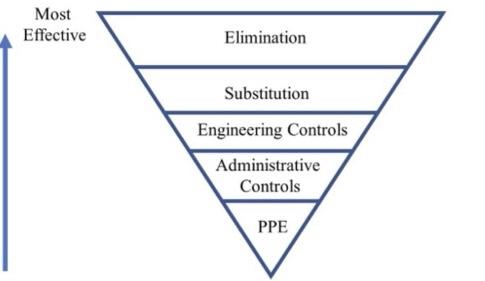
Ederer reframes road-traffic safety with an epidemiological lens where the agent of harm, kinetic energy, is transmitted by motor vehicles to inflict harm on relatively fragile human bodies. He presents the Safe Systems Pyramid which encourages interventions that have a widespread public health benefit and require little individual effort.
Both Singer and Ederer’s contributions call for clarity and focus on what needs to be controlled — the agent (kinetic energy) and vector (vehicles) — and how to prioritize interventions.
Vision Zero won’t succeed until it is empowered to clearly and unapologetically name the problem: kinetic energy, transmitted at dangerous levels by motor vehicles. Until the city fully commits to reducing that energy by lowering speeds even further and reducing the number of, and collective reliance on cars, fatalities will persist.
By skirting around the cause of harm, Portland’s Vision Zero program is too deferential to motor vehicles, which are not only the vector of death on our streets, but bring a host of negative externalities that extend far beyond traffic safety.
Are we trying to make a dangerous system safer, or reduce the danger itself? They are not the same thing. We need to reduce danger at its source. If we continue to focus on increasing safety while allowing more and more kinetic energy and large vehicles onto our streets, we will keep getting the same results.
— Sarah Risser is a member of Families for Safe Streets and a dedicated road safety advocate.


Thanks for reading.
BikePortland has served this community with independent community journalism since 2005. We rely on subscriptions from readers like you to survive. Your financial support is vital in keeping this valuable resource alive and well.
Please subscribe today to strengthen and expand our work.
How would you suggest that we as a community or that the city “reduce the danger itself” legally and within the context of local politics? (That is, without the usual absolutist “solutions” we usually see on the BP comments that are either unconstitutional or politically unlikely to ever happen?)
Is a community legally obligated to permit cars and trucks? I would prefer to live in a community that doesn’t allow them, but in the USA we’ve gone the other way, it seems. Someone else’s “right” to drive supersedes everyone else’s right not to be endangered by motor vehicles.
There are a couple measures that cities have successfully used to limit trucks/SUVs. London has a ULEZ zone where most trucks and older SUVs are required to pay high fees to enter. Paris and a few other cities have increased parking and other fees for specific types of vehicles such as SUVs. Fees are based on weight and/or emissions. NYC has higher fees for entering the congestion pricing zone for trucks. All of these are possible in Portland given political support, and are much easier to implement than an outright ban.
Yes, all possible given political support. Which is, of course, the crux.
No. Mackinac Island is an example of a small American community that has no private cars or trucks.
https://en.wikipedia.org/wiki/Mackinac_Island
“Politically unlikely to ever happen” is an extremely broad and lazy argument to discount all policies that would be perceived of as limiting car overuse. If this were a real controlling principle, all of the progress that has happened almost anywhere in the world would have been unsuccessful.
Why don’t you run for City Council on an anti-car platform in Portland? How many votes do you think you’d receive?
I biked and ran around Portland today and saw hundreds of people from 3 or 4 years-old to 80-90 doing the same. This is an extreme luxury for someone living in the US. I would run on more of that. Smart people like yourself understand that this is anti-car, but many people don’t make that connection and believe they can have everything that they see in a car commercial. We can focus on what makes people fundamentally happy, instead of scaring them by threatening to remove their training wheels.
UK MP Richard Ottaway on Congestion Pricing:
“The only purpose of the proposals is to raise revenue; they will do nothing to improve the flow of traffic, so the tax fails… the sums raised for the funding of the underground will be risible and will barely scratch the surface of the extra funding that is needed.”
Republican Congressperson Nicole Malliotakis on Congestion pricing:
“Congestion pricing is an unfair tax that will hurt working families and small businesses… I will use every legislative and legal option to stop it.”
Republican Congressperson Lee Zeldin on Congestion pricing:
“Congestion pricing will devastate Long Island commuters and businesses… we must halt this plan.”
Democratic Governor Kathy Hochul on Congestion pricing:
“The cost to commuters and businesses is just too high… I cannot move forward with this plan.”
The argument that things are politically infeasible, or that the status quo is the most likely so we should roll over and accept it is one of the most common (and lazy) fallacies I hear on this site. Things like congestion pricing are always unpopular prior to their implementation, and nearly always taken as an invaluable and integral part of a city’s transportation system after implementation. Rarely is anything “inevitable.” Given sustained effort by the council, mayor and advocates, the same is certainly possible in Portland.
That’s not the argument; the argument is we need a strategy to make these things politically feasible so they can get done. It’s lazy to ignore the problem and just hope some brave politician (Kotek, perhaps?) will push things through on their own.
Claiming something is possible is one thing; figuring out how to make it possible, especially in a state where unpopular decisions can be referred to voters, is where the real work is.
The argument is that people who are invested in the status quo or who lack imagination will reflexively dismiss important options. They also lack the willingness to say “oh, that is a good idea, I wonder how we could make that work. Here is an idea.”
I’ve shared some of my ideas — for example, stop voting for ineffective and obstructionist and pro-status-quo politicians. That concept is generally panned here by many who claim to want to change the way we do things, but won’t (or can’t) think beyond the next election.
Another idea that is generally ignored (but was mentioned by dw below) is to work with your neighbors to build community support for making change locally.
What are your ideas?
And people who voted for and are invested in the corrupt and climate-arsonist DPO status quo will always deny any blame when it comes to their support for the status quo.
“will always deny any blame”
They also seem to project their support for the status quo onto those who are willing to take action to overturn it.
This is also a lazy argument, why the needle hardly moves in Portland or any other jurisdiction, we basically keep asking the people we keep electing to do something different even when we know full well that they will not.
The answer is literally in the quote. Stop allowing more and more kinetic energy and large vehicles onto our streets. Exhibit A: Bus lanes on 82nd. Exhibit B: Diverters on every greenway every few blocks. Both of those things would reduce kinetic energy and vehicles on the streets.
Last I checked they are constitutional and only maybe the diverters are politically unlikely. The bus lanes are an easy dunk since it was politics that transferred 82nd to the city in the first place. And honestly the diverters aren’t as hard as everyone acts like they are. Especially since no one has even tried.
The thing that can be difficult to understand about the hierarchy of controls is that it’s not an absolutist approach. If it were, you’d only have to have one level to the hierarchy, eliminating the hazard. But whether it’s a factory floor or a city square, that’s often not actually feasible, as the hazard provides some critical purpose or function. Rather, the idea is to use the hierarchy as a decision tool in implementing corrective action that a root cause analysis has identified. Here’s how traffic safety might be improved by a control at each level in the hierarchy:
Elimination: Get rid of the cars on the road, and maybe even the road itself, altogether. E.g. remove a waterfront highway and replace it with a public park.
Substitution: Change what cars are on the road. This one is harder to do directly in the transportation environment, like you might in industry by changing out a dangerous solvent for a safer option, but anything that gets people into smaller cars or out of a car altogether in favor of a different mode could fall under here.
Engineering: Make design choices that provide physical separation or protection from cars. E.g. protected bike lanes, continuous sidewalks, modal filters, backup cameras, etc.
Administrative: Change the rules and how they’re enforced. E.g. lower the speed limits, mark a crosswalk, broadcast a PSA, change licensing requirements, put more police on the traffic beat, etc.
Personal Protective Equipment: Wear day-glo and wear a helmet
It’s not feasible to remove every car from Portland, not any time soon anyway, so you’re right in your implication. But the next step isn’t to throw up our hands, give up, and lay down in the middle of 82nd. Rather, that’s when it’s time to get informed on what kinds of controls work best and how they might best be implemented on any given street segment.
Helmets aren’t designed for, labeled for, or particularly effective in a car vs. bike crash. They’re no help with that kinetic energy.
I started wearing a helmet again after a break of some years because there’s some risk of a single bike crash involving head injury and the white shell contributes to visibility somewhat. It also quashes conversations with aggressive people who want to tell me what choices to make.
Helmets are primarily designed for your head hitting the ground in front or slightly to the side, assuming the helmet is being worn correctly (a big if in many cases). As I often repeatedly explain to well-meaning but clueless public agency officials who only drive but give away helmets at every public event, they are utterly useless in preventing cars from hitting you, and they don’t protect you if someone hits you from behind or t-bones you.
I personally wear a POC MIPS helmet whenever I bicycle, I feel naked without it, but it’s more out of habit than for safety. I have my bike lights on my helmet so I don’t forget them. I like wearing helmets that are orange, neon green, or maglia rosa (a shade of pale pink that matches the Giro D’Italia leader’s jersey, similar to breast cancer survivor campaign colors) because I like bright colors and I hope that our distracted motorists might see me before they fatally hit me. But I’ve given up on trying to get others to wear helmets, I’m not as totally certain any more that they really are worth it.
Where else can you find such cheap insurance against a totally life changing event? Even if helmets only work for some types of crash, isn’t that well worth the investment, given the astoundingly high cost of a head injury?
My doctor regularly argues that I should not bike on streets that have car traffic – my doctor would never do so and thinks such people are crazy (including myself), that bicycling in traffic is an irresponsible dangerous hobby. Mature adults drive. I can’t drive and I live on a collector street, so I basically have no or very little choice, but even if I did I know I’d still bike in traffic – use makes master. There are lots of potential life-changing events out there – cancer, infectious diseases, becoming roadkill, marriage, having kids, going to college, commenting on BP, and so on – and I do agree that wearing a helmet can help in certain situations, but it isn’t a cure-all.
There are very few cure-alls in life, and none of us lead our lives as if safety were our most important value.
However, where the cost is low and potential benefits are high, most of us will take reasonable steps to prevent bad outcomes, as you (and I) do by wearing a helmet.
Funnily enough, there’s public health research that demonstrates that even after accounting from the risk of collision and exposure to vehicular pollution, bicyclists have better health outcomes than motorists. Perhaps you should suggest to your physician that they should pick up a copy of Environmental Health Perspectives the next time they have some research reading time.
NO! NO! NO! WRONG! WRONG! WRONG!
The problem is,always has been and always with be HUMAN BEINGS!
Humans on bike, food, scooter, skateboard, driving cars, trucks, busses, motorcycles are fallible, distracted, unfocused. poorly educated/trained on how to safely move around an ever changing situational landscape puts one’s power of attention, training, motor skills, reaction time & response to the test in any given moment.
Yes, mass & velocity matter, but it’s human beings who are or aren’t in control of said mass & velocity. I can think of many examples of humans in control of tons of mass at high speeds that have a much greater safety record than Vision Zero could ever imagine.
And it ain’t about more laws, law abiding people and scofflaws.
There was a traffic research study in Germany some years ago, where they took away all the traffic signs and discovered that it was generally safer when different modes of travel intermingled.
Most people don’t leave home intending to injure other people.
Firstly and foremost, human behavior has to change and as we all know from our own lives, we often don’t change our behaviors until we suffer some negative consequences.
If traffic laws aren’t enforced with some negative consequence, points on license, fine, suspension and revocation of driving privileges behaviors won’t change and the carnage will continue.
Your thinking reflects the outdated 3Es of Education, Enforcement, and Engineering approach to road safety. Nearly all Vision Zero programs have ditched this for the more forward-thinking Safe Systems Approach which is somewhat grounded in public health principles. Trying to improve road safety by modifying human behavior through education and enforcement works only to a small degree compared to other interventions.
Well, it’s true cars don’t crash themselves or drive themselves over people.
But you could say your statement is true in all kinds of other areas beyond traffic safety as well. Nevertheless, society still takes measures to limit the damage people do when they behave badly or simply make mistakes.
Building codes, workplace safety regulations, vehicle design, equipment design…all are full of regulations and safeguards that limit damage due to poor human behavior. Enforcement and education are components of achieving safety in those areas, but there’s also acknowledgement that those aren’t nearly enough.
So can anyone: Pilots, train engineers, ship captains, race car drivers….all of whom operate within systems with incredibly comprehensive safety measures and redundancies contributing to the safety records they achieve as operators.
To me it’s more like stop trying to rely on human behavior for safety. Traffic lights and signs and crosswalks etc. are all suggestions that rely on human behavior to actually be safe. When distractions come in or blantant disregard the safety completely fails and instead becomes incredibly dangerous. Now a physical structure like a roundabout relies instead on physics for safety which is much more reliable and vastly preferable.
If the past is any guide, there’s going to be a lot of ideas here on what sorts of technical measures we could take to improve the situation. Most of these ideas have been well discussed, and some might work, but most would require political (and thus popular) support to implement.
How can we start building the type of popular support that would make possible the types of technical measures that could move us forward more rapidly? It seems to me that without that, everything becomes an uphill slog that usually results in little to no real progress.
The one measure I’m aware of that is both likely to make a significant advance in safety (by removing the most dangerous element in driving), and is also likely to happen is AVs.
How do we build the political and popular support to move other “likely to work” strategies into the “likely to happen” column?
It sounds a bit trite, but I think that talking to your neighbors is the answer. Be polite, listen, don’t lecture, be willing to compromise. Remember that we are all full of bias and contradictions. Pretty much everyone is trying to get from A to B safely and most people want to live on a safe and pleasant street. In my experience there are good people at PBOT who are willing to make improvements happen, but they need to hear loud and clear that the neighborhood wants it. If nothing else, hanging on the porch with your neighbors is pretty much always better than doomscrolling.
I agree — building community is a great way to start almost anything, but especially on specific localized issues like traffic safety.
Most of my neighbors and co-workers complain about helmentless bikers blowing though stop signs and endangering children when my daily bike-riding becomes a topic of conversation. At this point, I have given up and simply do not talk about transportation alternatives in Portland. I do pray for a major energy crisis (e.g. >$10/gallon gasoline with rationing) every day, however.
It would be nice if folks could get get a shock at what being fully reliant on “market forces” that can drastically increase the cost of using their ICE vehicle feels like before that price goes up permenently due to the gathering climate storm making refined oil unaccessible for most.
I’m so glad that we have the famous example of Hoboken (pop 50k) to show the world the power of the Swedish Vision Zero safe-systems approach.
Small nit to pick: Anne Hidalgo is still Mayor of Paris until March 29.
As far as the substance of the article goes, I am in full agreement that the principles of occupational health and safety have a home in the city planning sphere. Safe Systems is a great concept to shift how transportation systems are fundamentally thought about, but that’s only step one. The root cause analysis is how you dig into the details of what’s going wrong, and the hierarchy of controls is how you figure out the best things to change given practical constraints.
Let’s pick a budget, plan on it being 5x more than antiipated, and then get the same result in another 10 years.
Thank you for this powerful piece, and for explaining Safe Systems, and Ederer’s epidemiological reframing of it. I agree with his reframing.
Now on to politics.
Anna Hildago has transformed Paris, and thank goodness her first Deputy Mayor, Emmanuel Gregoire, has won the recent Mayoral race, so hopefully her policies will continue. They are both from the same Socialist party.
But don’t leave out the very capitalist Michael Bloomberg, and his transformation of NYC’s streets.
Bringing it home to Portland, you wrote:
In September of 2025, City Councilor Tiffany Koyama Lane introduced a resolution to reaffirm Portland’s commitment to Vision Zero and created a cross-bureau task force (which has yet to meet) to build momentum for the program. This work should be applauded.
Although I agree with the goal of a cross-bureau task-force, I can’t applaud Koyama Lane’s methods. How you win matters, and this resolution was passed in an underhanded way. That harms the cause of road safety by antagonizing colleagues and creating “winners” and “losers” when really what is needed is the hard work of consensus building. The Portland chapter of the Democratic Socialists of America (DSA) has yet to add consensus building to its tool box.
Let me take readers back to last year’s budget marathons. The DSA/Progressive Caucus (Peacock) gamed these meetings by engaging in a secret text message chain from the dais. This allowed them to manipulate Robert’s Rules of Order, and coordinate procedural votes all behind the public’s, and their colleagues’, backs.
The Vision Zero resolution was a sneaky one-two pass between Kanal and Koyama Lane. I watched it live, and had no idea that they were coordinating with text messages. Neither did anyone else (except for Avalos, Morillo, Dunphy, and Green).
It was sleazy and I don’t want to win that way. More importantly, it is detrimental to creating a strong movement for street safety.
That’s a fair point that building a coalition is more meaningful. I would say that the vision zero budget amendment wasn’t a total surprise out of nowhere and it’s not wrong for politicians to have strategy for getting things passed`, but fighting for the big picture does matter. Our leadership certainly hasn’t shown a consistent push for the Vision Zero goal at any level.
Thank you for the reply, tabihabibi, re-reading my comment I noticed that I made a mistake. Sarah is talking about a September VZ vote and I’m talking about the spring budget vote, which had the VZ Robert’s Rules, text-chain-aided, sleight-of-hand which I described in my post. Maybe the September vote was more collegial.
But my point still stands, and I agree with you that building support for a policy is more meaningful in the long run. I just dip into watching the occasional council and committee meetings (I’m a grazer), but when I do watch, I’m seeing too much gamifying Robert’s Rules and divisiveness from the Peacock folks. Even if you get something passed, how well is it going to be implemented if you non-stop try to undermine the mayor’s signature policy.
Undermining the republican CEO mayor and his fraudulent anti-poor “signature” policy is good. I really wish “peacock” focused more on this and less on social media.
In my opinion, PBOT made a critical error when adopting Vision Zero: they created a vision zero program with dedicated staff and projects. This means they will compete for budget and have a relatively limited impact. I believe that adopting VZ could and should have meant adopting VZ as a metric for each and every PBOT project- planning, design and maintenance.
By way of example, when the Greeley MUP was getting built, I worked really hard convince PBOT to address a few design flaws, including lowering the speed limit. I met with the project designer and her supervisor and we reviewed my requests. They agreed with my suggestions, but declined to make revisions. They acknowledged that not fixing them would likely bake them into our system for 10-20 years until they would work on it again. Their explanations is that the project was funded by “freight” dollars so needed to consider/prioritize freight needs. A young family had recently been hit and 2 girls died, but PBOT explained that VZ did not apply to this because it was a freight project.
If VZ is not a metric to evaluate success of every project, I cannot see how PBOT will ever make meaningful gains. All of PBOT should receive VZ training to understand how to incorporate VZ principles into their work and how to evaluate proposals against VS before they are adopted/implemented
For me it was when they thought a bunch of lawn signs was going to change what happened on the streets.
Before Vision Zero, Portland was a little over 10 pedestrian and 1 biker death a year .
Now PBOT comes with triumphant news that ONLY 23 walkers, 5 bikers, and 4 on scooters died!!!!! (per BikePortland)
11 years Portland has been on this path, when will our elected officials and PBOT say enough is enough?
They won’t without some sort of grassroots-led radical upheaval.
*crickets*
Thank you for writing this. The level of understanding of vision zero among elected officials is incredibly poor.
We live inside of a transportation system that is designed to sell cars, and people that have control over much of the system are lost in the teleological fantasy that cars are the organically selected pinnacle of transportation.
We have made more progress regulating the meat-packing industry that grinds up animals than we have with the meat-packing industry that shuffles people around pointlessly, mind-numbing hour after hour.
This is amazing. Thank you.
I really don’t think we fail at improving the sustainability, safety, and general vibes of our transportation systems in America because we don’t have the most correct frameworks. I think we fail because we don’t get serious buy-in on frameworks we have from all the people that need to act to improve things. We recoil from the bad-old outdated notion of EEE, but… even an EEE approach taken seriously could make real gains compared to today, where people pay lip service to the framework (or even a more-advanced Safe Systems framework) while using it to foist off responsibility for improvement and reinforcing the status quo. And… I understand that frameworks like these are what people do with them, and we might have to throw out ideas that could be made to work because they’ve been used badly and associated with bad habits and patterns, so that we can look at the problem with real intention. I just don’t know that it helps to constantly push for more radical frameworks when our problem is that we can’t get buy-in for actually doing anything. “Hierarchy of controls” is going to sound scary and radical to a lot of people and… not for no reason. It looks like, “We’re going to control your life and eliminate your car.” And… I mean… aren’t we?
There’s always going to be a part of me that reads a paragraph like the one about distracted and inebriated pedestrians not being part of the problem and rolls my eyes. An inattentive pedestrian put me in the hospital a few years ago. People will read that and be skeptical… but whether or not I tell the story the details aren’t the point, you’ll just have to trust me either way. You might say that cyclists, going faster, have more responsibility to look out for pedestrians than vice-versa — I fully agree! You might say that responding to the harm that was done to me by punishing the person that caused the crash would be useless — I fully agree! But I do think we have to acknowledge that pedestrians do have agency, make choices, and have the capacity to act wrongly and harm others. If we don’t how can we think about designing a better system that gives us each the best chance to avoid conflict and harm?
Homelessness gets tied in with this because of the perception that there are homeless people running wild across streets at random. The intersection of homelessness with traffic violence is important, but also hard to discuss, because people will use it to write off a bunch of traffic violence as unpreventable. So it gets politicized, such that it’s hard to really answer the question of how much traffic violence has resulted from our society’s broad failures pushing so many people into homelessness at a time of such general prosperity. I mostly buy the framing that homelessness is a factor that makes someone particularly susceptible to traffic violence, among other kinds of violence! I don’t buy the idea that we should mostly talk about that as a road safety problem… I think it mostly means that people that care about road safety have to care about homelessness and poverty.
If we are going to claw back any kind of control over cars in public spaces, compared to the current reality where the force of cars controls all our public spaces, we are going to need a lot of buy-in from the driving majority (the majority of people that mostly drive to go most places). We are, ideally, a democracy. The democratic ideal is a pretty vague one, but… at this point if our advocacy says, “We’re going to control and eliminate you,” and it’s rejected by the driving majority, I believe we’ll have earned that loss on democratic ideals. There’s a portion of that majority that we could be in coalition with on some issues, especially in big cities! Most of the driving majority hates seeing people run red lights. They might be buying into the crossover-ization of all cars but they hate being lorded over by giant trucks and people going crazy with speed and acceleration. I bet a lot of ’em hate the ultra-blinding headlights that have taken over the roads just as much as people outside cars do. I bet a lot of ’em resent the way driving practices have coarsened, become so much more aggressive and less forgiving, over the last decade or so, just as we resent how so many other parts of our culture have coarsened. A lot of ’em, especially in the cities, want to be less tied to their cars, and will vote for things that promise freedom rather than control!
More traffic enforcement please. Vision zero models work best when social contracts and traffic enforcement is in place. Infrastructure is needed, but it only works if bad drivers are scared to do bad things.
Pretty sure you didn’t, actually, read this article.
I did, and I’m with a lot of what you’re saying.
But, what am I missing?
“ Until the city fully commits to reducing that energy by lowering speeds even further and reducing the number of, and collective reliance on cars, fatalities will persist.”
This is a a true statement, but it needs traffic enforcement. They go hand and hand. I don’t agree that they can be mutually exclusive.
That’s right about the energy problem OP – Where harm reduction has actually worked like Carmel, Indiana (home of the Indy 500 for god sakes and they had the wherewithal to get it done right) where they reduced crashes by like 70% but most importantly they reduced fatal accidents by over 95%. This is because roundabouts create divergent angles as well as reduced speed. This dramatically reduces the kinetic energy release. Oh not to mention travel times stayed the same so it’s a win win (add another for annual maintenance costs savings which is significant) Doesn’t that sound nice?
Now we can go on figuring out how best to apply lipstick to our pig –
Wonder if Carmel formed endless committees and applied numerous lenses to doing what they did, or did they just do it?
One big problem in Portland is the city government thinks we have to consensus build and unless 100% are on board then something doesn’t get done. It’s totally and completely ridiculous. It’s why we elect the bozos we do, to do a job, not conduct popularity contests.
Do you really think Carmel didn’t have citizen support for what they did?
Maybe they succeeded at their project because they had consensus, rather than in spite of it. They’re no more an autocracy than we are.
And take a look at Google maps and tell me if you think Carmel is some kind of bicycling Nirvana.
The first roundabout in Carmel was very controversial, but didn’t replace any existing intersections. They built it when they built a new street. It took a while but people got used to it (and even won over on roundabouts!) so they had the political momentum to replace existing intersections with roundabouts.
I think Carmel is doing a lot of things right in regard to street safety, but I also think that Portland is doing a lot of things right. Comparing the two is truly apples to oranges. For one, we aren’t really building new streets, and where there are new streets being put in there are plenty of roundabouts going in too, but that’s at the periphery of the UGB.
I love roundabouts but they are not a panacea. I think that Powell & Ceasar Chavez (39th?) could use a roundabout but doing so would cost a fortune and probably involve demolishing a Safeway. Are we really going to burn that much political and financial capital for one intersection when there are a hundred that need the same treatment just as much? Could Powell & 39th be made safer with just signal changes and a red light/speed camera for a fraction of the cost?
Thank you for writing this article.
I found this moving:
“Portland’s unhoused population, as well as distracted or inebriated pedestrians, are often cited as part of the problem. They are not. These groups do not contribute to road traffic violence. They are at risk of being harmed by road-traffic violence. ”
I’ve noticed when I talk to neighbors about pedestrian deaths, and the most dangerous roads in Portland, they are very interested in reducing speed limits and adding crosswalks with stop lights. But if they start to ask more questions and learn more details about when the deaths are occurring and where, then I see their eyes glaze over and their interest shifts. I haven’t figured out how have conversations that maintain people’s interest in public safety after they’ve decided they personally are not at high risk.