
This guest opinion is by BikeLoud PDX Vice Chair Kiel Johnson. It’s a response to news that the District 4 Coalition is opposed to planned bike lane upgrades in Southwest Portland.
In cities where bicycling has grown rapidly, local governments have streamlined the installation of curb-protected bike lanes. They treat them as standard transportation infrastructure, not as optional amenities. Portland already has the policies in place to do the same. If we want to become the best bike city in North America, we must follow the policies we’ve adopted instead of second-guessing them every time a project moves forward.
Portland’s Transportation System Plan classifies every street in the city. Engineers and planners have determined what type of infrastructure belongs on each classification. Those policies were vetted through multiple layers of review and formally adopted by our elected officials. We have clear design standards for transit, freight, automobiles, pedestrians, and bicycles. Bicycle infrastructure should be treated no differently than any other mode — and it should be applied consistently across the city.
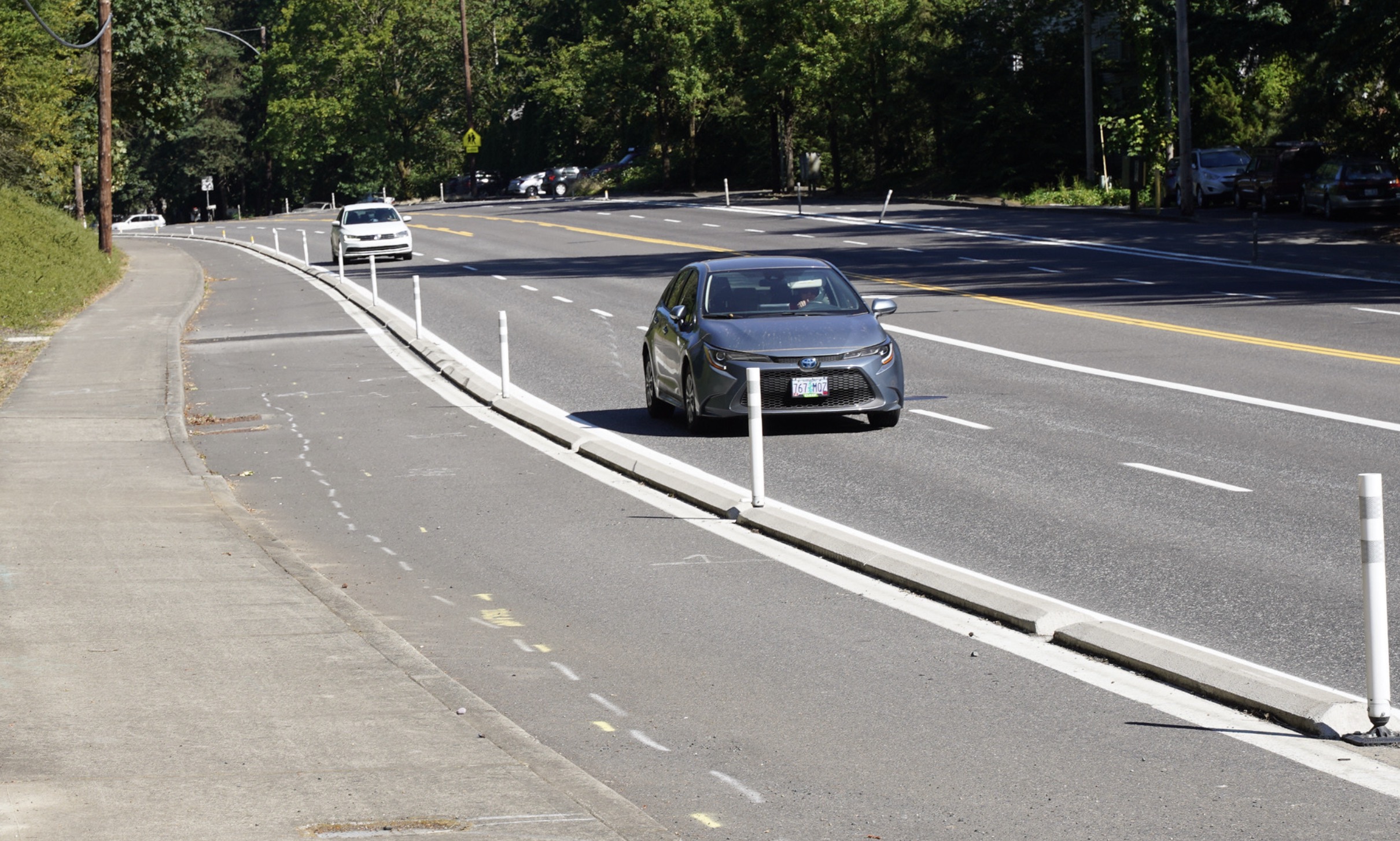
Our policies call for protected bike lanes on Southwest Capitol Highway, SW Bertha, and Beaverton-Hillsdale Hwy. The opportunity to build them is in front of us, and we should take it.

The recent effort to oppose protected bike lanes amounts to a rejection of this adopted framework — but only for bike infrastructure. It suggests that the Portland Bureau of Transportation (PBOT) must secure a vague and undefined “community support” threshold before installing protected bike lanes. We do not apply that standard to other forms of infrastructure. PBOT has installed hundreds of ADA curb ramps across the city. If each ramp required broad community approval, we would have only a fraction of them. We recognize ADA access as essential infrastructure. Protected bike lanes should be treated the same way.
There are times when PBOT gets things wrong. Public oversight matters. When Commissioner Mapps attempted to remove the Broadway protected bike lanes — despite their consistency with city policy — the community spoke up and stopped it. The claim at the time was that there wasn’t sufficient “community support.” But policy already provided the direction. Those lanes should have been installed a decade earlier.
Community engagement is important. The city should communicate clearly, gather feedback, and make reasonable adjustments when warranted. But we do not require a popularity contest to install water lines, traffic signals, or sewer upgrades. Protected bike lanes are basic safety infrastructure.
Everyone has opinions about where lanes should go or how they should be designed — curb height, parking removal, materials. Those are fair implementation questions. But at some point we must trust our adopted plans and our professional staff to execute them.
If every bike project is subjected to repeated demands for undefined “community support,” we will continue to spend disproportionate time and resources debating whether to build rather than actually building. Portland cannot afford that delay.
We have the policy. We have the standards. We have the opportunity. Now we need to follow through — and build the protected bike lanes our city has already committed to.

Thanks for reading.
BikePortland has served this community with independent community journalism since 2005. We rely on subscriptions from readers like you to survive. Your financial support is vital in keeping this valuable resource alive and well.
Please subscribe today to strengthen and expand our work.
Perfect! I couldn’t agree more.
Well said Kiel, time to build to the plan.
Well, at least until someone at PBOT reads this article
https://lapublicpress.org/2026/02/why-isnt-la-repaving-streets/
Not actually true; the city had to be sued into even pretending to put ramps in at any sort of scale. I would argue that a wheelchair user may see their needed infrastructure as being on a higher level of need, rather than equal to, bike infrastructure.
I think this opinion piece illustrates a big issue here in a backhand way: people are seeing this money as being taken from something else, as if it were a new project; rather, it is a continuation in some ways of the ‘start-imperfect-and-gradually-improve’ approach other places have used. It may well be that cycling advocates at PBOT are trying to leverage this issue and achieve the goals Kiel champions. This is under ‘maintenance,’ and there is no answer yet from the city on whether those funds can be redirected. There is no evidence yet that these monies were in competetion with funding new projects. I would argue that if the bureau tried to take 700K from Maintenance and put it in Development, people would scream about all the unfilled potholes that money could fix.
So if PBOT Maintenance is sick of repairing/replacings wands and paint, it is actually a win if the bike side convinced management to kill two birds with one stone. Get rid of the maintenance hassle, AND move the infrastructure up a notch. There is no indication the money to harden this section under other programs was ever going to be forthcoming. And as in other cities, hardening the city’s bike/ped infrastructure is the long-term goal. Whether you agree or not with the details or the order things get done, this IS what advocates have been championing for decades.
I think there’s a bit of shouting past each other in this argument. Both sides should be pressing PBOT for clarity on whether the money is fungible, or if rules prohibit it being used on new projects. If fungible, while I support hardening on BHH, I agree that much of that money could be better used elsewhere in the area to connect to the imperfect BHH route. If not movable, all parties should support putting this piece of the puzzle in.
To bring us back to the ADA issue, some aspects here reflect the controversy of PBOT taking out an existing, now-incompliant, but there ADA ramp and replacing it with modern ones, vs concentrating on putting ramps on corners that currently have nothing at all. Sometimes rules, budgets, and siloing prevent perfect solutions. Perhaps PBOT can help both ADA and bike/ped issues by being more upfront on how these factors figure in their decisions.
I personally prefer a public democratic process like SWIM, no matter how flawed, over a government agency making decisions for us, and I had thought most Portlanders would too, but apparently I’m wrong. According to Kiel, they in fact seem to prefer to have PBOT tell them what to think, to implement new projects not passed by City Council but those proposed and dictated by unelected city “expert” bureaucrats. Perhaps those same Portlanders can then understand why so many millions of Americans prefer to hear and take comfort in the lies and opinions of the current POTUS rather than those of our democratically-elected Congress? Not only is democracy dead, but so apparently is public process, at least in Portland Oregon. Good luck with that.
Wow, that paragraph is carrying a lot of water….and leaking like crazy.
Yes. Let’s have a public process for every pothole that should be filled or tree that might be planted. Let’s micromanage every city employee’s every action.
Or, we could participate in the existing, extensive public processes that do in fact take place at the planning stages, and let the city employees who are hired to do jobs actually do them.
When people make comparisons like this I feel they fail to understand that bike lanes are politically much different than potholes and the planting.
As just one example, there are no non-profits advocating for particular pothole projects, and fixing one is hardly ever controversial. Okay that was 2 examples.
Actually, I’m pretty sure you didn’t fail to understand the difference.
Cities have adopted plans and we elect leaders to support staff when they implement the plans.
This process should not be subjected to a case by case public vote or government would be ineffective.
Would be?
So the job of the voting public and their elected leaders is to passively support a bureaucracy that has willfully failed to implement adopted plans and has a history of refusing to transparently allocate legislated funds to safety infrastructure (e.g. sidewalks and bike lanes)?
https://www.portland.gov/auditor/news/2019/7/24/commitments-missed-fixing-our-streets-program
You and I have a very different concept of how democracy is supposed to work.
We should also build the bike network we already committed to. I don’t exactly disagree with this opinion, but I think it misses the point being raised by the people questioning the proposed SW protected lanes: People are not saying that PBOT needs to meet an arbitrary level of community approval, they are are saying PBOT is spending limited resources converting isolated segments of bike infrastructure from an OK condition toa much better condition, when what is needed is better connectivity. If resources were not an issue, or is wand-protected bike lanes extended further, I don’t think anyone would quibble about improving part of the route with a concrete curb. The issue is the missing links and extremely limited resources. Once PBOT spends these funds in SW, it could very likely be 10 years before they spend any more money. For people cycling daily, I can see why they would desperately want the money to be spent where it could go father and provide more benefit.
If better connectivity is desired, then D4C and SW residents can support and prioritize access to capital funding for those projects.
That being said, D4C’s choice to conflate “capital” and “maintenance” funding in their statement doesn’t indicate to me that they are seriously concerned with the balance between the two.
D4C = District 4 Citizens? Councilors?
District 4 Coalition
YES! Having lived on SW 66th Ave for four years the poor infrastructure of BH Highway desperately needed ( another ) upgrade. And while we need to extend protected infrastructure through the intersection of doom and into Washington County upgrading the plastic non-protection to protection to match the rest of BH Highway through Portland is a great first step. During my time there I constantly saw kids and the elderly choosing to bike on the sidewalk [ where it exists ] instead of in the bike lane that was right there. If that isn’t a clear sign the bike lane needs upgrading not sure what it is.
If Jonathan hasn’t already done so, he needs to ask PBOT if the funds are transferable in any way.
We all know certain fees/bonds/funds for, say, Parks can only be used to build new, not maintain existing. If the PBOT box marked maintenenace for this fiscal year can not be taken from to help fill the box marked development then the argument about higher priorities is moot. Better to take this improvement when you can.
I mean, someone could argue a higher priority is to take that 700K in the maintenance box and repave a street in East Portland, but let’s stick to this example before us for now.
Right in theory Jack, but keep in mind those can be one and the same. Many other countries have seen separated bike lanes turn into disability/rolling lanes. It’s just that most people in the US tend to think of cycling as a predominately male, predominately athletic sport, not simply a default manner of moving around for the average jane or person with a disability.
eawriste, that “country” is here in the US too…I often see persons using powered wheelchairs using protected bikelanes. (Just as they used to roll in the roadway when sidewalks had a steep cross slope or other deficiency like surface/ expansion joint created discomfort before bike lanes.) This is one of the ‘undersold’ benefits of a network of protected bike lanes. [In my technical opinion, I would love for the Access Board to add PBLs as an acceptable ADA facility for PROWAG while loosening the sidewalk uplift threshold by another fraction of an inch etc.]
YES please!
No one said they would, it was just example of the hypocrisy of PBOT. Both can be built at the same time. Maybe PBOT should put in bike infrastructure on the same blocks it’s doing ADA. Kill 2 birds with one stone. Would be a lot cheaper that way.
No, Portland does not have “great” bike infrastructure. If it did the % of people biking would be much higher.
Whether or not Portland has great infrastructure, it is a great place to bike. I do not believe (and I see no evidence to support the idea) that infrastructure is the primary reason Americans don’t like to bike in greater numbers. Given what we can afford to spend, you and I will be long dead, and our children too, before Portland achieves the perfect bike network.
By all means, let’s continue to improve bicycling conditions in and around Portland, but let’s do it to improve things for folks who actually ride, not those we wish did, but who probably never will.
I want protected bike lanes. I ride them. I think Portland should build more of them.
But you cannot keep voting further and further progressive, stack some of the highest taxes in the country, shrink the business base, and still expect to afford nice things.
Protected bike lanes cost real money. Concrete, labor, drainage, maintenance. That is not vibes. That is budget reality.
At the same time, we keep finding cash for performative add ons like hiring an immigration affairs officer to oversee policies that already exist. Maybe it signals compassion. Maybe it checks a box. But it is still another salary when we are told the cupboard is bare.
You cannot say we are broke when it comes to core services and suddenly flush when it comes to political signaling.
When the tax base wobbles, everything competes. Police, parks, fire response, road repair, and yes, bike lanes.
You cannot pour curbs with good intentions, mate.
If we want protected bike lanes, and I do, we need a city that businesses stay in and taxpayers can afford.
Because you cannot keep shrinking the pie and expect bigger slices
Actually, protected bike lanes are incredibly cheap, so far as infrastructure goes.
That’s why opposition to them is dumb. A few tens of millions, at that, for protected bike lanes? TERRIBLE!!! Hundreds of millions or billions for a new highway lane? Oh, well, that’s just modern life, you know…
And in fact the cost of these decisions is catching up to us *gestures at the ODOT bill fight*…
I like the reference to core services. Bike lanes (and public transit!) should be core services. Even more core than roadways. The fact we treat them opposite has caused all sorts of mess and costs each and every one of us thousands, sometimes tens of thousands, right out of our pocket year after year.
Mate, I’m all for bike lanes, but the issue isn’t the lanes — it’s that Portland’s blue politics have chased out our economic vitality. We’re broke, can’t keep the sidewalks clear, or respond to 911 calls promptly , but we’re still tossing money at multitudes of DEI officers, immigration affairs officers, Black Male Achievement Analysts , and wasteful nonprofits. Can’t keep doing that and still build bike lanes (which we both want)
In this case, the issue is about the lanes. This concerns decisions to pursue opportunities for which funding has already been allocated, not to dedicate any of it for the examples you take issue with (many of which aren’t even funded by the same sources).
I don’t recall any “political signaling” being outlined in PBOT’s plan to harden this bike lane. I do see the opportunity to shore up some “core services”, though.
I heard an interesting interview the other day on Novaramedia with the author of a book on contemporary China. He grew up splitting his time between both the US and China, and has deep familiarity with both countries. He argued that the US has what he called a “lawyerly culture”, whereas China has an “engineering culture”. The latter is able to “get things done* very impressively, quicky, and often very affordably, but that often comes at the expense of some individual rights. Whereas the former has more robust protection for individual rights (especially including property rights), but is a lot more static and less capable of improving the material welfare of the majority, and also tends to entrench the already rich and powerful in their places, at the expense of everybody else.
Following that author’s lead, I’d favor an approach a little bit more like China’s, where we make the rich pay more across the board for the benefit of the larger society. We can still protect individual rights, but we don’t have to keep putting the rights of the “Epstein class” on the pedestal they currently enjoy. Something a little more like China’s approach would allow us to advance a more pro-environment, pro-people agenda, while renewing the country’s deteriorating physical infrastructure.
I wish I could have a budget of $8.6B and be considered broke.
Sprawl “cost real money. Concrete, labor, drainage, maintenance. That is not vibes. That is budget reality.” Forget bike lanes, that’s the budget reality NA cities like Portland are unwilling to face.
Portland appears to have approximately 2,100 miles of roads that need to be maintained and eventually replaced. And a tax base of ~287,030 households to support it. And that ignoring all related infrastructure.
Meanwhile, take Montreal as an example. A city with a similar amount of road infrastructure – and a tax base consisting of ~900,000 individual households.
We can’t keep having it both ways. Unchecked sprawl and the related infrastructure to support + plus low taxes. And no reduction in the number of “performative add-ons” as you put it will negate the reality that the suburban experiment will bankrupt all of us.
We’ve already got the sprawl. It’s not going away, so we have to deal with it.
Then the sprawl must be financial solvent.
Unchecked? Did the urban growth boundary get dissolved?
Kotek is doing her best!
Why is it though, that Clackamas County, which is more sprawled, lower house to area ratio; seems to be fiscally more healthy, and the roads seem ok as well?
Considering Clackamas County has a budget deficit and rapidly inflating costs for road projects, I’m not sure they’re a great example of “fiscal health” or rational planning.
A more revealing approach (as opposed to a blanket comparison) would be to analyze census tracts with similar densities/road miles, and compare current/projected tax revenues with current/projected infrastructure expenditures (accounting for the age of infra., of course).
But the tax revenues from each tract are pooled. Analyzing on a micro level isn’t all that relevant.
We are stuck with looking at it at the county level. Clackamas runs on a conservative model of government,. Basic competencies are expected by the voters and not much extra.
Multnomah attempts a lavish approach to government. What this means in actuality is up for debate but alot of it seems to go to personel costs/admin. And while a walk around Copenhagen or The Hague shows you the potential benefits of such an approach, Portland, an island in the huge sea of America isn’t going to be able to single handedly create socialism.
Personally, I would prefer to live in Clackamas County if i was comfortable driving, I’m not.
So if I come back from the cheap, friendly life in Asia, itl’l be to Portland, not Clackamas.
But that would literally be the only reason–walkability.
Everything else is better in Clackamas. I had a bunch of trees have issues–took care of it myself in Clackamas. In Portland a huge tree died, the neighbor started screaming and threatening to sue me. Portland took 2 months to approve me cutting down a dead tree and quibbled with me about the particulars of the tree I replanted.
The other neighbors in Portland let the house turn into a meth head drug den–that took 3 years to resolve because the city would allow them to no-show at hearings and reschedule for 6 months later. Clackamas that just doesn’t happen.
In Clackamas the government maintains the roads, puts drug theives in jail where they belong, and otherwise just stays in the background and lets you live your life. Its not trying to create Copenhagen.
And that whole European thing is falling apart at the moment in case you haven’t noticed, because Pakistanis, Bangladeshis and Congolese, aren’t part of the social compact. So their (and the DSAs) whole argument that America is structurally irredeemably racist and Socialist Europe is caring is just as fake as most of us ethnic minorities already knew.
Southern Italy, Eastern Europe the roads/infrastructure never was there in the first place and even the crap neighborhoods of Milan and Paris, Northern England same.
It’s entirely relevant if you’re trying to figure out how individual tracts perform/contribute to the tax base. Unless you’re suggesting that the revenue source doesn’t matter because it will all be pooled at the state level anyway? Remember, much of East Multnomah County (or even SW, for that matter) has similar land use and infrastructure as Clackamas, it’s just 30+ years older.
I would consider transportation infrastructure to be a “basic competency”, no? I’m not sure how a discussion involving tax bases and revenue generation to pay for infrastructure in the United States implies a connection/desire to “become Copenhagen”. Unless you believe that some of your criteria for your place of residence (walkability) is an outcome of “socialism”?
Given Clackamas County’s current funding gaps, it doesn’t seem like the “conservative model” provides security against deficits or inflating costs. The issues with the Courthouse project and Sheriff Office indicate to me that the county is no stranger to “lavish” approaches that “seems to go to personel costs/admin”, either.
Clackamas is a County, while Portland is a City. The actual “City” of Clackamas is unincorporated (like much of the County). While I sympathize with your tree care issues, I’m not really sure if this is a one-to-one comparison.
As someone who has ridden a bicycle in the Netherlands Portland does not have “great bike infrastructure”. Better than Florida is not the standard we are shooting for here.
It’s also worth remembering that the Dutch demanded change to their transportation system, a change that Americans have not yet asked for.
pithily put, Jack! This is my feeling just about every time I read the comments on a BP article about a bicycle facility.
I don’t really follow you here, this is a carefully planned and funded project, it isn’t perfect but it is a big improvement, I want it built. Not building it because a few folks think they have a better idea is the perfect being the enemy of the good in this case imho.
I agree. We cannot afford to “get out over our skis”. Even in Portland, there are plenty of anti-bike car fanatics. And there is a balancing act required between building infrastructure that is aspirational and encourages new riders, vs overbuilding beyond any currently realistic ridership demands. Failing at the former is certainly bad, and implies not living up to our potential. But running afoul of the latter also poses real risks of blowback, sadly.
I’m curious if anyone knows if Kiel has ridden around SW Portland (over the hills portion of SW) with a six year old.
If folks have not ridden our streets with a young kid, you should. It will be eye opening. It will help you understand how impossible it would be to even bike with them to access one of these facilities being discussed in today’s articles. To say the bike system in SW is fragmented is an understatement. It’s horrific. I’ve watched cars slam on their brakes to miss my kid. We have to ride on a 1/4 mile stretch of asphalt that can only be described as an Interstate 5 on ramp to get downtown (this to avoid other miserable stretches of Barbur or Taylors Ferry). It’s a complete joke.
SWIM is a few handfuls of bandaid projects. Even if all of them are built, the bike system (and active transportation infrastructure in general) would barely be upgraded to maybe slightly less horrific.
Once again we find ourselves in a familiar situation where there are a few crumbs that get swept to SW and everyone with an informed opinion knows this is all we are getting this decade so fight!
Kiel, I get the enthusiasm for protected bike lanes (I’m a big fan of them), but your piece completely skips the most important question: how are we going to fund them? Portland added ~1,000 employees between 2022–2025, with median salaries near $90K, while the private sector shrank and major revenue streams — business taxes, commercial real estate, tourism — are falling. Payroll alone is up 26%, now $831M. Just two months ago, the City Budget Office projected a $67 million deficit for FY2026; as of February 2026, that gap has ballooned to $169 million! That’s not a rounding error — it’s a fiscal emergency.
Advocating for more infrastructure without proposing a funding plan comes across as tone-deaf to reality. If protected bike lanes are essential, outline how they fit into a constrained budget: reprioritize spending, tap federal or state funds, or phase projects. Otherwise, it reads like a wish list rather than a serious plan. Portland can’t build on hope alone — it needs a clear, realistic path to pay for it.
Let’s spend money on infrastructure instead of public employees doing endless community outreach for starters 🙂
A non-answer to an important political question from a 501c3 nonprofit corporation vice president.
Funny, that’s exactly what Keith Liden (and D4C, by extension) proposed.
FYI, the proposed letter at the D4C Land Use and Transportation Committee was not approved last night, and it has never been endorsed by the committee. As a committee member I didn’t see it until about a week ago. Also, to be clear, our committee is only advisory to the D4C Board of directors. Yes, it’s a bureaucracy!
It’s clear more information is needed, particularly regarding the funding fungibility. I don’t know, but I suspect the letter may be revised and re-submitted.
I appreciated the comments of Kiel and others at the meeting. Everyone has a different perspective and it’s good to hear
it all.
Thanks you Scott. Invaluable to folks like me trying to figure out the inner workings of SW bureaucracy, and unclear impetus for this letter, and what specifically Liden’s preferred projects would otherwise be. To me Bertha and Capitol don’t seem to fit his criteria well enough to object to them outright.
Thanks for the context, Scott. I wasn’t aware of the endorsement/ratification process for the committee (and whether or not the proposal had any teeth), so I’m glad to hear that it’s still being workshopped and that discussions are taking place.
The fungibility question is a good one, and would definitely have the biggest impact on the validity of some of the alternatives being proposed. I can’t say I’m not jaded by past instances where similar arguments for better resource allocation end with nothing being done, though. Still, kudos for putting in the time and effort!
How much is that really? You’re freaking out as if the $169 million had just been added to your mortgage. It’s actually 2% of the $8.4 billion current fiscal year budget. I’m not say it’s nothing, the city has to balance its books. But, you can’t quote one number and pretend to understand the situation.
To look at it another way, the closest major line item in size to that deficit number is the fire department at $167 million. It’s a big number in that sense, and a large slice of discretionary funding, but we’re still going to have a fire department next year.
Portland needs a well-connected bike network that addresses the increased stress* of biking in Portland (vs 2014) far more than it needs a few disconnected segments of world-class fully separated bike lane. Fully build out the the network cheaply (if necessary) and then upgrade it over time.
IMO, we desperately need a bike network that is able to boost mode share to the point where active transportation has some political power more than we need Urbanists skeeting their excitement about another 300 feet of dutch-style curb-separated bike lane.
*absolutely feral drivers make cycling a really shitty experience post-2020
Much of Portland has a “well connected” bike network already. A lot of it was cheap to implement as well- the only expenditures needed were some labor, paint and a few signs. Many of these have been upgraded over time, too!
When you dive into the actual pinch points, they tend to share something in common: a lack of protection or separation. It’s not just the “urbanists” who appreciate this form of hardening, either.
We are not discussing a pinch point. We are discussing PBOT pouring concrete and almost a million dollars to build a small segment of bikeway that is disconnected from even barely acceptable infrastructure. And this tendency of PBOT to blow its budget on performative concrete is not new tactic, IMO. For example, PBOT has installed a number of traffic barrel diverters that were perfectly functional but were then replaced with poured concrete (at the expense of other projects). I personally view this desire to spend a ton of money on a few projects as an intentional tactic that avoids spending money on cheaper projects that PBOT leadership views as unnecessary (diverters) or divisive (NAs are upset about lane reduction, oh my gorsh).
We’re discussing an extant “interim” treatment that is being hardened after funding was made available. This is literally the process you claim to advocate for (“upgrade it over time”). Nothing about the sequence that you proposed would lower the installation costs, because that’s the sequence that is ALREADY being used.
Most of those traffic barrels weren’t replaced with poured concrete- they were removed outright. Either that points to specific issues with the iterative process (which some advocates choose to ignore), or it shows that certain locations needed the poured concrete upgrades more than others.
If you think that certain organizations/individuals are organizing opposition to bike infrastructure, feel free to point them out (NAs are only one). Otherwise, I’ll assume that you’re demonstrating the same ignorance of funding structures and flexibility that many community members share.
I can almost always assure you that the limiting factor isn’t “performative” metrics- it’s organizations (or individuals) that have a knowledge (and ability) to affect policy channels.
I guess you forgot about the the lack of a “well-connected bike network” part of my comment. And now that you mention it again, I find your claim that “Much of Portland has a well connected bike network already” to be completely absurd.
I used the word “diverters” intentionally. PBOT has repeatedly replaced complete functional sewer barrel diverters with poured concrete at significant expense. The traffic barrels that you mention were not diverters because they did not divert anything.
“I find your claim that “Much of Portland has a well connected bike network already” to be completely absurd.”
Most of the east side inside of 82nd, downtown, and much of NW have a quite good bike network. East Portland, and the deeper west side do not.
I didn’t. You just immediately followed it up with:
We already have a “network”- we’ve had one defined for over 50 years. The hardening that you want will occur at different times, with different incentives (both funding- and traffic-based). The only thing you are currently arguing against is a project that ALREADY has funding allocated. You ask for piecemeal solutions, and you’ll get piecemeal projects.
You are entirely welcome to inquire about the potential to reallocate funds (like others have). I guess you forgot about the “organizations (or individuals) that have a knowledge (and ability) to affect policy channels” part of my comment.
We may have aspirational “plans” but but the limited infrastructure that we do have is degrading due to absolutely feral and amoral drivers, a lack of signaled intersections that cross feral-driver infested arterials, and a chronic lack of basic maintenance of existing infrastructure.
I 100% agree. That’s why I agree with Kiel’s guest opinion as well.
And that’s exactly what PBOT proposed to address with the B-H Hwy lane hardening project.
Ted, your take doesn’t seem relevant for SW Portland (over the hill). No, paint and signs, doesn’t get us a connected bike network. Ride on Taylor’s Ferry with a kid to get to the Cemetery route. Ride on Barbur to get to Terwilliger or Corbet.
Great! So you agree with Kiel, I assume?
These statements can be true/false insofar as they are taken as non-operational definitions. It’s important to define exactly what is meant by “well connected” and “pinch points.” The most salient question is: well connected and pinch points for who?
PBOT and the city would do well to pay more attention to the needs of people such as Amelia, as she is an indicator of the typical target demographic PBOT projects have historically excluded. I do think PBOT has made concerted efforts recently to include a wider demographic in their projects (e.g., 4th, NE Broadway, Naito). The argument from Geller/PBOT that we have a “well-connected network” falls flat when including people such as Amelia, but holds up well if we generally exclude learners, people with disabilities, “interested but concerned,” people who avoid rolling next to cars, etc.
Here is a list of streets that generally have the highest demand based on bike counts, and have largely excluded the above people for decades. If “well connected” means accessible to people such as Amelia or other learners, then our network at it’s most important points is anything but. It’s a little like saying, “We have a great network…. except for the places where most people would ride.”
I 100% agree, especially with the “finer grained” approach to network development, which also provides context for why projects like the Beaverton-Hillsdale Hwy lane hardening are so crucial.
However, it’s strange to me that the “complete network” boosters seem to focus on segments based on levels of demand, rather than actually “completing the network”, which necessitates projects in areas with “little demand”. Notice how none of the “highest demand” streets are in SW…
The debate in this instance isn’t which levels of access need the most focus, it’s whether or not dedicated funds will be used for creating a “low stress bikeway” (#2 on your cited parameters). I’m not really sure what your point is- the streets you listed have improved in those timeframes. Could they be better? Absolutely! What’s your funding source?
Ted, I say this with respect. You are sidestepping my arguments consistently. You are objecting to things claimed by others, and using examples I have not given.
This is false for the segments I cited. Please return to those segments and look at the counts if need be. Those are generally the highest demand segments in the city, and they have had no improvement that would allow all ages to use them despite being at the center of the network. Can you please acknowledge that is an essential problem in Portland? We can choose to do the same as successful cities like Victoria BC, who have separated those high-demand places in the center of the city first with semi-permanent materials.
Exactly.
This is precisely the tone-deaf response I frequently see from Geller/PBOT: “But the overall network is slowly improving, so what’s the problem? More people should be riding any time now…”
This is one of those mirror moments. Your response highlights the pervasive disconnect coming out of PBOT and the city, where broad strokes of gradual improvement across 145 square miles override prioritization of separation at key streets in N and the CEID where most people would ride. There is little sense of urgency or plan for prioritization and that recognition needs to happen.
I’m not “sidestepping” your arguments, I’m discussing them within the context of the thread. Sometimes topics can overlap between points made by multiple people, and that’s okay!
If you reread my initial comment, you’ll notice that I was never opposed to hardening, particularly for segments or intersections with high demand. My point was that the majority of those projects are ALREADY in inner neighborhoods. Despite that, we know from documentation that the most dangerous segments of roadway are not near the intersections you listed- many of them are closer in form/quality to B-H Hwy than SE 21st & Clinton (outer Eastside roads have conflicts more akin to SW arterials, not Central Eastside intersections). How can we make cycling safer for people like Amelia if we ignore those areas?
Do you think PBOT is unaware of this? Should PBOT forgo projects (with scheduled/allocated funding) due to an adherence to a “demand based” model? Do you agree that there are metrics apart from demand that can influence project placement, priority, and elements?
Again, I’m afraid you misunderstood my initial point, eawiste.
I’ve noticed that too. What funding sources would you suggest PBOT leverage to help speed up project delivery? What are the allocation structures that think PBOT could successfully implement?
We already have access to (and have implemented) many of the interim solutions you’ve mentioned in the past. Which policy elements should PBOT leverage to implement the solutions that they already have? You mentioned Victoria, B.C.; we know WHAT they’re doing, but HOW are they doing it? WHO supports it, and WHY?
I’m not sure what insights we’re going to get, or what change we’ll spur, by restating the forms of hardening that we need. Professionals (and readers of this site) are largely aware of the safest standards, routes, and materials needed. The current debate is HOW to access these improvements (financially, in particular).
*absolutely normal drivers being sloppy can give you a shitty moment at any time in 2026.
This is yet another example of a Goldilocks approach to bicycle transportation, while car transportation plays out like “The Fisherman and his Wife.”
Thank you Kiel Johnson for this article and for the good work you and BikeLoud have been doing.
In addition to increasing riders’ safety, many studies also show a direct link between protected lanes and increased ridership. These studies, conducted over many years and in many cities, per example this recent study
https://road.cc/content/news/protected-cycle-lanes-encourage-more-people-cycle-314251 are clear in their conclusions.
I know people who would love to cycle but have seen or heard of too many injured or dead riders. Some of these reluctant people were hit by a car. They say that they would happily hop on a bicycle if they felt safer.
If the city is serious in meeting the goals of the 2030 Bicycle Plan which includes a goal of 25% of trips being made by bicycle by 2030 then much more needs to be done including major investment in protected lanes.
The new treatment on 4th ave downtown should be the template for protected bikeways everywhere in the city.
I just participated in an online tactical urbanism presentation given by a design group and the city DOT in Nashville TN with numerous solutions to slow traffic down, way down, to make bicycling safer even on streets without facilities. I know Portland has done many of these kinds of projects, but why doesn’t the city do them system-wide? As the staff person from Nashville DOT pointed out, it’s far cheaper to take away a traffic lane and put in a two-way protected bike/walk lane than it is to build curbs and sidewalks, plus it slows cars way down.
What I don’t understand about Portland, even after living there for 17 years and even after working for PBOT for 6 years, is why the same kinds of bike, stroad, highway, and sidewalk infrastructure is darn expensive in Portland than it is in say Tennessee or North Carolina, by at least 4x times? Does Portland have a special local artisanal organic hemp-based concrete mix?
Yeah, I can sorta understand the SW Hills with clay soils and poor drainage, but most of the rest of Portland doesn’t have those issues. We have cities in NC with similar clay soils and they use a wonderful ancient system called a “storm sewer”, one for storm water only, no household waste allowed, and then monitor the storm water before it goes out into the rivers in case it needs cleaning, and many cities are working to separate the two systems (household versus storm) courtesy of huge federal subsidies.
How many of those jobs are union in NC and TN? How many pay a living wage? How many of the towns are a good 5 hours from any other large metropolis with construction supplies available at scale regionally?
But do they actually DO that? Or are they just as resistant and afraid of driver complaints as PBOT can be?
Good for them. We don’t have too many non-combined sewers, esp on west side. You think getting money for a painted sharrow is hard? Wait until I tell you how much two sewers would cost – and who would be paying for it (think Big Pipe fess).
Again, just look at Clackamas, roads are fine, density low, fiscal health fine.
This is a bit of an illusion; most streets in Clack co are new because the development is new. Many roads have zero walking or biking facilities, which will be expensive to add later on if the community deems them to be important. For the sake of the residents, I hope that the tax base can increase through density and job growth in order to maintain the infrastructure they already have; though I’m not holding my breath. I suspect in 30-40 years they will be in the same boat as SW Portland, East Portland, and some of the other older inner-ring suburbia.
I get it, Portland bad; Clackamas good, but it just isn’t that simple.
Maybe if PBOT can fix the left hook danger they created.
I think PBOT should proceed with replacing plastic wands with concrete curbs. If nothing else, for the physical narrowing of the road, which has been proved to reduce speeds and increase safety for all users. Raised physical features that can damage a tire or bust a wheel give drivers a great incentive to slow down and pay attention.
One thing to consider in this is something that’s not evident in the article’s photo, which shows new curbs protecting a bike lane adjacent to a sidewalk. In long stretches where curbs are proposed to be added, there is no sidewalk. The bike lane doubles as a sidewalk. So the curbs are not just protecting bike riders, they’re also protecting pedestrians.
There may not be a high number of people walking long stretches along these routes (although more might if they had more protection) but there is need to walk shorter distances, say from neighborhood streets then along the busy streets to businesses or bus stops.
Some people pointed out how bike lanes sometimes double as ADA rolling routes. Here, they also definitely double as pedestrian routes (with no alternatives) which to me helps justify the cost of the curbs in many places.
From the previous article:
Definitely qqq. Todd was talking about tweaking the ADA codes to make this an acceptable treatment. I’d like to hear more from the disability community, but it’s certainly a more pragmatic approach to increase all abilities access.