

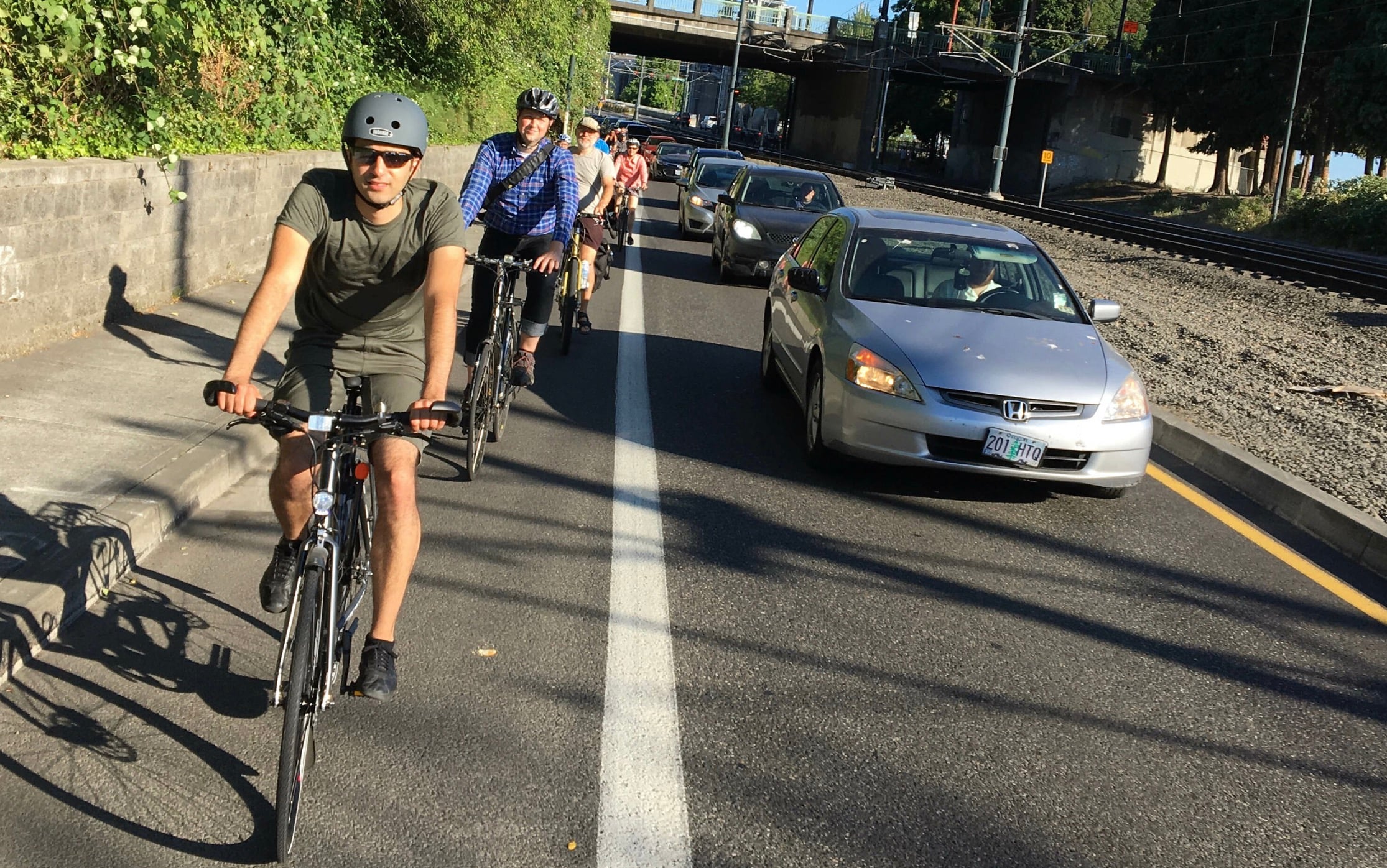
Could paying organizers to blanket neighborhoods with groups rides and a marketing campaign that spreads the good word about bicycling spur a Portland cycling renaissance? That’s a key question some advocates, insiders, and at least one Portland city council member are seriously pondering this week as ideas swirl around City Hall for how best to spend a $15 million chunk of climate tax revenue.
This funding is being debated as the Bureau of Planning and Sustainability goes through its annual adjustment of the Portland Clean Energy Community Benefits Fund (PCEF) Climate Investment Plan (CIP). The PCEF Committee has recommended an adjustment that would transfer $15 million from electric vehicle subsidies to home energy retrofits. But that change isn’t final and councilors see an opportunity to chart a different path for that funding. You might recall my story last month about how City Councilor Mitch Green wants to use the $15 million to backfill TriMet’s budget and rescue them from “doom loop” of service cuts.
Now Councilor Steve Novick, who has a history of pushing for higher transportation spending from the PCEF tax, has come forward with an idea of his own. This issue was first discussed at the City Council Climate, Resilience, and Land Use Committee on January 15th and a more robust conversation is planned for the next meeting on January 29th.
One of the ideas Novick supports is based on an intriguing plan to boost bicycle ridership first covered by BikePortland in November 2024. It’s an idea championed by noted bike planner Roger Geller, who’s led the Portland Bureau of Transportation’s bicycle program for over 30 years. Here’s the gist: Geller and Novick believe that since the bike network has improved dramatically in the past decade while ridership has cratered, what’s needed now is a grassroots effort to get people to actually use it.
In 2024 Geller told the city’s bicycle advisory committee: “You can’t watch anything on TV during the football season without seeing five Bud Light ads over the course of an hour right? That’s the level of campaigning that I want to do for biking. That’s what I think we need.”
The idea came and went for most of us, but Geller has never stopped thinking about it. Now with the opportunity for funding presented by PCEF, the plan’s moment in the spotlight has arrived.
At last week’s Climate Committee meeting (which Novick co-chairs), Bicycle Advisory Committee Chair Jim Middaugh hinted at the plan: “We have a world-class system that gets people on their bikes. There is clearly opportunities for more investment to make that system better, but we can also make the most of it today by encouraging people to bike.”
Due to his role as BAC chair, Middaugh has certainly been privy to renewed interest in Geller’s plan from Councilor Novick. One element of the plan — that appears to be just one part of a more fleshed-out and formalized version of Geller’s 2024 memo — was posted on the BikeLoud Slack channel by bike bus advocate Rob Galanakis a few days ago. It reads:
This effort will see PBOT contract with an organization who will enlist coaches who will be responsible for lead rides and encourage participation. Each coach would be responsible for an area that encompasses 1 square mile or approximately 4,500 households.
Coaches would:
- Lead regularly scheduled, advertised rides in neighborhoods throughout a project target area. Rides would reliably leave daily from set locations at set times.
- Promote the rides throughout their assigned area of the project target area. Promotion would be in the form of door-to-door canvassing, putting up flyers in neighborhood destinations and attending events and public meetings.
- Depending on scale, the effort could reach up to 181,000 of Portland’s 304,000 households in the following neighborhoods: Central City, Interstate Corridor, Lents-Foster, Montavilla, Hollywood, MLK-Alberta, Belmont-Hawthorne-Division, Woodstock and Sellwood-Moreland-Brooklyn.
As you can see, the plan would be akin to a get-out-the-vote campaign, but for cycling. And this is just one element of the bike marketing plan. If what Novick’s cooking up tracks with Geller’s 2024 vision, it would also include a few high-visibility network improvements, a professional marketing campaign, and demonstrations of political support. I hope to share the full plan soon so you can see the whole enchilada and make your judgments based on that. But for now, what are your general thoughts about this approach?
Councilor Novick sounds like he wants to give it a try. “I tend to agree with Roger that since infrastructure has improved somewhat over the last decade but ridership has plummeted, we should at least consider some non-infrastructure ideas,” he told me yesterday.
Novick says we can expect an in-depth discussion about this and other ideas for how best to spend the $15 million, at the Climate Committee meeting next week (January 29th). Stay tuned.
Thanks for reading.
BikePortland has served this community with independent community journalism since 2005. We rely on subscriptions from readers like you to survive. Your financial support is vital in keeping this valuable resource alive and well.
Please subscribe today to strengthen and expand our work.
You mean PCEF money, which was intended for transition to clean energy (the CE in PCEF), not marketing bike riding in Portland.
We’ve done stuff like this before, and we know it doesn’t work. The rise and fall of biking in Portland is not a marketing issue; it’s one of cultural trends, and there is nothing sadder than the government trying to make something cool.
If Portland wants to fight climate change, we should be putting all our money into heat pumps, home insulation, and electrifying any engines running on fossil fuel (reserving maybe $15M or so for a marketing campaign to make veganism cool).
Hi. This comment seems to really expose your bias against bikes. I mean, what would you call a “transition to clean energy” if not getting more people to ride bikes instead of use cars? It’s not even a debate whether PCEF should help bike riding in Portland, it’s just a clear fact. It already funds all types of bike-related things.
Also, I disagree that we’ve done this type of thing before. I’ve followed biking in Portland pretty closely for 20+ years and can’t remember anything like this being proposed.
And if you think cultural trends just happen organically I have some bad news for you about how marketing works.
And PCEF puts a ton of money into home energy retrofits, and that’s great. Also worth noting that transportation is the #1 GHG emission source and this particular $15 million was initially allocated to the transportation category (not the home energy category)
I ride a lot and I think bikes are great. I am part of a multigenerational bike family. I am not biased against bikes. I am biased in favor of getting results.
Every time we piss away another chunk of PCEF money on things like sweeping streets or marketing bicycling, we lose a chance to make a real, albeit small, impact on the climate crisis.
If we could get the mastermind behind Portland’s big bike surge in the 2000s back to do it again, it would be $15M well spent. But of course we can’t, because that trend was organic, not the result of yet another hapless PBOT marketing campaign.
There’s basically one strategy that can be implemented at the city level that we know works — electrifying everything, and converting our electricity generation to renewables. Everything else is a distraction.
Roger Geller might’ve been that “mastermind”…
good to know you’re a big biking fan. Will keep that in mind when I read future comments from you. I want results too! I just think you and I see things pretty differently. I think we need to try new things and what I’m seeing in this proposal so far looks very intriguing. I also think there can be multiple paths to progress at the same time.
We should try new things! But just because they’re new doesn’t mean they’re likely to work. We need to apply a little rigor to this conversation.
See my most recent post for my attempt to do so, and why I think the marketing idea seems so ridiculously off-base. (And where I propose a much more plausibly effective use of $15M to reduce emissions.)
How do you know how much rigor has been applied to this? I happen to know that Mr. Geller has spent many years pondering how best to spur more cycling and the dude is no slouch. You haven’t even seen his plan (I shared one small part of it, will share the whole thing soon) and you are already dismissing it? I just think you should give Geller and this idea more respect. He’s a nationally recognized dude who doesn’t just spitball things on a napkin and call it good. I think it’s an extremely thoughtful and interesting idea that has merit and deserves a lot more consideration.
Because it’s marketing.
Is Roger willing to tell us how many miles of driving he expects his publicity campaign to avoid, and how he arrived at that number?
I have a lot of respect for Roger, but I think he’d be the first to tell you he has no real idea why bicycling increased so rapidly or collapsed when it did.
There is zero evidence the problem was lack of marketing.
it’s a lot more than that. Again, wait for the full plan. Marketing is one element of it, but the main expense is to hire ride leaders and have regularly scheduled rides in neighborhoods so that folks can be exposed to the existing network.
maybe because this is a sociological phenomenon and not a scientific one and therefore it cannot be precisely understood? That being said, Roger in fact does have some real ideas about why it declined. I’ve read them, have you? Not sure why you’d assume he doesn’t.
One reason to believe marketing is important is that the bulk of expense and expanse of our bike network is on n’hood greenways, which are hidden from the vast majority of people. I think our greenways are the best part of our network, but it’s a big problem when most non-biking portlanders have no idea the routes exist because they are not routes folks drive on. So therefore I believe it’s reasonable to think if we did something to educate a bunch more people about these neighborhood routes, they’d enjoy them and start using them more. Call it marketing or ride organizing, or whatever you want.
Our greenways are mostly greenways in name only. I hope they plan to spend some money on diverters, pavement, lighting, and signs to make these routes more functional for bikes. NE 7th greenway didn’t prioritize bikes at Davis, 3 blocks form the Blumenauer Bridge!
Our backstreets are pretty great for riding on. Many of the best routes also happen to be greenways. So if you are saying that, as a category, greenways aren’t pretty good, I’m a hard disagree.
They’re great.
You need to describe one greenway in detail. Until then I will continue to believe you are an AI bot, not a person who cycles regularly in Portland.
Why do you keep responding to an AI bot?
Please don’t accuse comments of being AI bots unless you can provide me with evidence. It’s rude and not fair. If you disagree with someone, find a different way to debate them than dismissing them as an AI bot. Or show me the proof so I can delete them. Thanks.
I hope that wasn’t directed at me 🙂
Well take it as a general warning to everyone if you need to. I just want folks to know I’m sensitive to commenters accusing other commenters of being bots or AI (or trolls).
Fred was the only person who accused someone of being an AI bot but you ignored their comment and went after the person who was accused.
It was really more of a general statement of concern. If it doesn’t apply to someone, then just ignore it. I’m not “going after” anyone.
We have a disagreememt about greenways and there’s no need to bang on about it, but my take is that with Idaho stops, the level of service for bike riders is very little different on NE Skidmore than on NE Going St. Indeed Skidmore may be better because it has stop signs instead of speed bumps. Speed bumps do little to deter cars but they are a gratuitous pavement defect for bike riders.
I’m fascinated by the different perceptions of the same ‘bike network’ exhibited here. It really highlights how subjectively infrastructure is experienced. Your views are shared by many, but 2WheelsGood’s description of the greenways matches my experience. OTOH, I regularly go rounds with 2Wheels and other commenters regarding the protected portions of the network.
I also disagree with you regarding the “need to bang on about it.” I think finding and communicating a consensus vision for street improvements to help biking in Portland would be very valuable for our community. I don’t see it happening without at least discussing the issues.
We may also disagree about biking in Portland in general. I think it’s pretty good here. It can always be improved, and I hope it will be, but I think a lot of people don’t appreciate how good we’ve got it.
Sometimes I think I’m the only person here who actually likes to ride their bike.
I love riding my bike! I am year-round commuter and year-round recreational rider. For the most part, the infrastructure is more than adequate for me. There are many people in my community who ride occasionally or would like to ride, or they have kids who they want to instruct how to ride safely, etc. I am also a consultant who works on City street design projects. It is from this perspective that I feel it is valuable to criticize PBOT. For people already cycling, a lot of what they build is not necessary or even unhelpful. For the people who are bike-curious, but nervous about cars/safety, many of the projects fall short, often due to compromises to accommodate the driving public. I know full well the compromises required for public work, and I have been doing it for 20 years. My criticism of greenways is rooted in the definition of a greenway and Portland’s reliance on them to build a bike transportation network. By definition, greenways are supposed to prioritize bikes using tools like diverters, speed bumps, signs, parking control, etc. PBOT is resistant to using diverters or daylighting parking which introduces a lot of conflicts from too many cars driving to fast on the greenways, and cars blowing stop signs across greenways. To forma bike transportation network, greenways are good secondary connectors, but they do not do a great job for longer, primary routes because they tend to be disjointed, and they do not have strong, safe crossings at arterials. That is not a big problem for me, but for a new rider or a nervous rider, the poor wayfinding, inconsistent lighting, and frequent unprotected crossings is a huge problem.
TLDR: I think we agree that biking is great for us in Portland, where we may disagree is that I believe PBOT is not planning or designing effectively for new or nervous riders.
I do like to ride my bike. I don’t like to be taken out of the experience by road design and common driving practice that require me to manage traffic encounters that have real potential to overlap my rig, weighing about 150 kilos, with a car weighing 1500 kilos.
I think of it as a ‘conflict’ if I have to brake or steer to avoid contact with a vehicle moving without right of way. There might be none for a week, than two or three in one day. I can’t afford to lose any of those.
There are situations short of contact where a motor vehicle operator’s intentions and trajectory aren’t clear until almost the very threshold of my reaction time and stopping distance. I’ve done this enough that I have a pretty clear sense of those limits but still, fuck that.
Lol, not really though, right? The plan is to try to get the absolute lowest common denominator person with such an unbelievably fledgling interest in riding that they will attend a bike tour from the city, but won’t just go ride their bike around and that is how permanent mode shift will happen? What is the penetration rate expected, 1-2%, anything more than that is hyperbolic optimism.
Google maps, cycling overlay, not hidden anymore. It literally is that simple and definitely doesn’t cost millions of dollars. Google will even route around hills, busy roads, etc.
Are you a sociologist? Doesn’t sound like you have a firm grasp (or any grasp) on how to change culture.
Oh yes, the purveyors of cultural movement, the infamously qualified government hired sociologists.
I am an exemplar of a transportation-oriented committed bike rider (and I have options — I have to walk past the very pleasant car I enjoy driving to get to my bike). I’ve done the politics, the evangelism, the advocacy, the “bike fun”, Zoobomb, Critical Mass, Ladd 500, the whole bit. I’m certainly not the only one here, but I’ve done more than most. My kids (licensed drivers all) have free access to my car (and one actually borrowed it once), but generally they bike everywhere, even places I would not. I am not biased against bikes, but I do recognize a lost cause when I see one.
The fact is that getting people to ride bikes is not something that is within PBOT’s power to do. It’s as simple as that. We’ve tried all the ideas, and none of them work. If they did, things would look a lot different than they do.
If we want to see how “coaches” work, let’s study the program BikeLoud is running. Does it produce durable change? Do people “just put on a jacket” or give up when it rains? Do people give up their cars? Would it work with people who are not already interested in riding? Can it scale?
Everyone who thinks this is the answer should try coaching a friend or neighbor and see how it goes after a year.
We need to face the fact that bicycling is not the solution to driving or climate change in Portland. It can nibble away a bit around the edges, and that’s great, but it’s just not going to be a primary mode of transportation for any but a small number of freaks like me.
We’ve been having the same conversation for 25 years, and it never seems to go anywhere. We seem doomed to repeat our history.
Once you stop worrying about other people, you can focus on enjoying riding your bike, and life really does improve. Biking in Portland is great.
Jonathan,
I like Roger Geller, too, but I think it is worth acknowledging that a marking campaign is good for him personally and for his career. He gets a paid very well (salary and benefits) for his PBOT job, and he also gets paid to give presentations about big ideas. I am not calling his experience or knowledge into question, but I think it s worth questioning how much this $15m would benefit cycling in Portland and how much it would personally benefit Geller.
Hi.
I’m fully aware and have shared openly that Geller’s personal investment in the bike network creates a powerful bias for the way he sees all of this.
But I totally disagree that Geller is doing this for personal financial gain. I have known him for 20 years and consider him a friend and I assure you that he is not in it for the money! Have you actually looked at his salary? It’s public. He’s never been a ladder climber and his salary reflects that.
Why does it always have to be a bias against bikes? Can’t folks have any other motivation?
yeah they can for sure. Sometimes I’m just hyper-sensitive to anti-bike bias and I will focus on that as the framing of my argument, when in hindsight, I should be more careful about throwing that term around because I realize it triggers people and is often inaccurate. thanks.
Totally agree. I love biking, but group rides aren’t going to get me to bike more when I don’t have a good bikeway connection to my destination in the winter when it’s dark out super early. I would love to see this money going to building insulation, heat pumps, etc. which is what I thought I was voting for back then.
Cycling is clean energy end of story. There is no way to word game your way out of it.
marketing is not clean energy.
I agree 100% that City-led marketing campaigns are very expensive and not very effective. I would prefer the money gets spent on making it better to ride: lets reduce speed limits to 20 for streets with bike lanes (like Interstate), lets add some diverters on key greenways, Lets ban turns on red for all street with a bike lane on them or at intersections with bike lanes (the new Broadway project should have no right on red). Geller has hi head in the sand about our improvements- we have spent a lot of money but the projects come with too many fatal flaws/missed connections. I think spending 15 million cleaning up some of PBOT’s whoopsies would go a lot farther than a marketing campaign. Is it just me, or is “Coach” a turn off? I am fine with a ride leader, but the idea of a coach shouting encouragement or telling me what I could improve is a total turnoff.
spend that money on celebrating year round bike use
Which is another way of PBOT admitting that the bike infrastructure they have (or lack) in other parts of town kinda suck.
PBOT used to to this same sort of thing with Timo Forsberg’s “Smart Trips” group back in the early 2000’s.
I think a better solution is spending $15 million to bribe outright bicyclists to ride – if you want 100,000 new riders, that would be $150 per person…
“I think a better solution is spending $15 million to bribe outright bicyclists to ride – if you want 100,000 new riders, that would be $150 per person…”
It would definitely be the more honest route, as well as more accountable of where the money was going as well as measurable.
I like the idea Novick and Geller are coming up with, it sounds a bit like a lot of bike busses for adults. However, using PCEF funds no matter how legally appropriated for a marketing campaign is just too much. If the spending goes through and no matter how much I support the end result, is there anything left that the funds can’t be appropriated to do?
I see the PCEF committee is still hiring for unpaid (but incredibly powerful having control of so much money) volunteers. We could do away with that committee and just put the money into the general fund. No more need for legal shenanigans whenever the City Council finds itself short of funds.
That’s such a great point. You can buy a pretty decent bike for $150, especially in bulk, and get 100,000 new bikes to folks in Portland. It’s better than squandering it at some marketing agency.
The bribe is actually a great idea. Maybe there’s an app, and every ride you log to an event or work gets you a free meal, drink, $ payment, voucher, etc. Once you ride to work a few times you gain the motivation to do it more often. A bribe would definitely be one way to get the ball rolling, and have more effect on me than yard signs or a billboard.
What would stop someone from just logging every driving trip as a cycling trip?
Some of these incentives could be given out in person, to people with/on bikes, so that would be an easy filter. As for an app-based approach, there are ways to auto-detect cheating, look up what Strava’s done with comparing distances, speeds, routes, etc. Maybe you take a pic of your bike at the destination and upload that. Nothing is perfect, but I’m sure there’s a fairly simple way to make this work using existing tech and programming.
Probably not much we can do about that, since everyone logging into our theoretical app would basically have to admit they need to be bribed (or incentivized) to bike, but since Roger & Co at PBOT aren’t really interested in getting more people to bike per se, but rather being able to actually measure a significant rise in bicycling-to-work mode share, maybe we could link the app to people’s home and work addresses? Require a confirmation by their employer? (assuming they aren’t independent contractors or self-employed). Naturally we aren’t really interested in people who bike for pleasure, kiddies, retired folks, and those of us unemployed – as important as we might be – only employed people matter on mode-share, and really only those who answer the Census ACS (American Community Survey) – but no one is perfect. I did think of requiring some sort of GPS tracker for your bike, but of course anyone could throw their bike in the car and also drive to work. Maybe we could put a geotracking device linked to your phone number that excludes any mileage on freeways?
We aren’t really interested in mileage either, it’s more about the number of trips we can record and how many people claim to be biking to work versus other modes.
I think it would be pretty simple for a smart phone tracking app to distinguish between a trip made by car, by transit, by bicycle, or by walking. My phone tracks steps pretty easily. Put the phone in your pocket, ride your bike. Pedal action and speed will identify it as a bike trip, and the app can total your miles as well.
Rewards could be stuff like free drinks or pastries, half-off meals, or discounts on merchandise or services at local businesses who want to encourage cycling.
Given the social cost of carbon, one mile of avoided driving is worth about 10c.
Design your bribes accordingly.
A reduction in the social cost of carbon is only one benefit of cycling. There are health benefits, there’s less impact on animals, there are reduced costs associated with relieving congestion, and there are costs that fall on people who live near petroleum extraction and refining facilities.
I could know more about how people estimate the social cost of carbon but my intuition is that the 10¢ per mile figure may be low, perhaps it is a safe lower bound called out in the name of being rigorous. Does the present day cost of carbon build in the impact of something like an unstable ice sheet that hasn’t yet put an extra 25 cm of water into every estuary, every harbor, every Pacific island, every low lying country where millions of people are still recovering from the last flood? Has somebody put a value on the plants and animals in the Sierra Nevada that can’t pick up and walk north through the Klamath basin?
COTW.
This is one of the tools OHSU uses to incentivize biking, walking, and transiting to campus. It’s great! Every time you arrive without a car, you log the trip in the app, then you get paid a small amount for each trip ($3 for biking, $1.50 for walking and transiting).
Not sure how well this would work with the public at large, though. People would scam it.
Watch them spend all $15 million on the app. I actually do think this is a great idea, I’ve just worked on the marketing/dev side enough to see how quickly a lot of money can be wasted by local governments.
But bribing people to get them started riding is really smart. When I was more broke than I am now, I would ride everywhere just because it was free. I am sure a lot of folks out there could be motivated by gaining a couple bucks for commuting on their bike.
I think putting part of the money into bribery is a great idea. Lots of details to work out, but perhaps in combo with the marketing its worth a try. Start with the traditional commuters that are on the sidelines- Half off pastries if you walk into grand central with a bike helmet on X days between 7-10. Then worst case, we are giving money to local businesses.
Or spend a chunk of it helping other businesses downtown finance a corporate bike incentive program. I work at a company where some bike, but lots have or would and sit on the fence, but we haven’t gotten the inertia to put together an effective program.
Still do. Smart trips Portland. There used to be a ton of outreach aimed at people new to the neighborhood (recent movers) but not sure if this is still happening. I don’t know what the details of Roger’s idea are, but I sure hope it’s not a re-invention of something that’s been tried, and still exists to some extent. Also, the idea of spending money on mainstream media advertising just makes me want to vomit.
If this outreach is still ongoing, we know it is not an effective way to boost ridership.
well, it’s about active transportation (biking, walking, transit, carshare, etc) but yeah your point is well taken.
While I’m generally sympathetic to your overall point (marketing dollars are often ineffective, especially when what they’re selling actually kinda sucks), but I have to disagree here.
To begin with, there’s no counterfactual. You say we know it’s not a way to boost ridership (emphasis mine), but we really know no such thing.
First, this program started back at the beginning of the cycling boom in Portland and was in effect throughout it. While I won’t make the same mistake you do of ascribing causality without any evidence, it seems like bringing any sort of intellectual rigor to the conversation would include this data point.
Second, we have no way of looking at the counterfactual. Without the SmartTrips program, would ridership have declined faster? I can’t answer that question, because we have no way of knowing, but that’s my point so I don’t have to.
Finally, it doesn’t seem like you have any knowledge or understanding about this awesome program, so let me briefly describe it (as someone who has moved around Portland several times in the last few decades, I feel like something of an expert). Every time I’ve moved within city limits, some mechanism notifies the city that I’m at a new address (I have no idea if this is through the postal service, voter registration, an army of fortune tellers with crystal balls, or what), I get a welcome packet from SmartTrips with walking, biking, and transit maps of my new neighborhood, a HOP card, as well a bunch of other doodads and a checklist of free resources that they will send me if I would like them (more maps, event calendars, water bottle, etc.).
I’ve been walking, biking, bussing, and MAXing around Portland since the late 90s, but the first time I moved to Foster-Powell, I had no idea what the transit and biking situation was over there. Ditto Darlington. And Brooklyn. But each time, I got a welcome packet with all the info I needed to start making Smart Trips™ right away.
Again, I agree with your overall point, but you’re a bit out over your skis here, talking smack about a program you clearly haven’t bothered to educate yourself about at all.
You are right — without SmartTrips, we could have even fewer cyclists around, (though that seems hardly possible).
Maybe the most rigorous thing we can say is we’ve been doing it for 20 years and we have no idea if it works or not.
And I do know a bit about the program, having been, like you, a happy customer,
Seems like it would be prudent to pause the smart trips program and see if it has any affect.
I’d rather see that money be used for maintenance, or for things like Sunday Parkways that are good for neighborhoods and businesses.
I dunno about the idea that infrastructure has improved thus so should ridership. Infrastructure has not improved evenly or completely, and in many cases it has been compromised to preserve car access (20s bikeway, I’m still bitter. And how about 7th Avenue?). Despite better Naito and 4th ave and NW Flanders bridge and some other good projects, it’s quite clear to the casual observer that cars still rule, so why not join them. Heck, an uber for two is usually cheaper than Biketown for two!
Step 1. Find a brick building downtown to paint a huge mural that says “Welcome to America’s Bicycle Capital”
Step 2. Pay off the Oregonian to stop writing trash anti-bike editorials.
Step 3. Obtain Kompromat on Portland Metro Chamber executives to stop them from sabotaging everything that is good.
Step 4. Hire drivers to drive the speed limit side by side on high crash corridors to slow speeding traffic and model good behavior at pedestrian crossings.
Step 5. Install a mole at a high level of ODOT.
https://bikeportland.org/2014/05/06/city-of-portland-orders-removal-of-americas-bike-capital-mural-from-downtown-wall-105559
Step 6. Put up huuuuge banners saying “Trump hates bicycles! No more cycling” and then sit back and enjoy the crowded bike lanes.
Lmao. Libs will just do the “Oh I love bicycles and support bike lanes except on this street where I want to park my 2021 RAV4 and heres 800 reasons why I can’t ride a bike and we have to think about equity and what about disabled people who can’t ride?” At least conservatives just say bikes are gay and move on.
Except Republican president George W. Bush, he at least biked. Has any other president ever been seen on a bike?
Biden was unfortunately videotaped falling while coming to a stop on his bike.
https://www.newsweek.com/joe-biden-falls-off-bike-during-delaware-ride-1717133
I think Biden biked
You don’t remember seeing various photos of Obama and his kids riding bikes?
I am always enjoy your support of FSB comra-I mean, fellow honorable checkist and future PMC mole-person member. With only very small smile and your help we can make meaningful, straightforward, data-driven projects a thing of scorn!
Instead of using 15 million to quickly build via cheap materials a rudimentary, separated network connected to downtown on major corridors (e.g., Williams, Burnside, Hawthorne) like most other cities that have been successful in adding new ridership, we must attack reactionaries who doubt we have world class system! We must redistribute wealth of bike vouchery to the loyal velocipedists so they will tell us that our city is world class!
hilarious!
I’d be incredibly excited about the above (as opposed to Geller’s Pedalpalooza-lite green-washing).
More people won’t bike until they feel more safe on our streets.
How many diverters could we install for $15million?! Per the old BP article, the big round barrel planters can be implemented “At a cost of just $1,500 to $3,200 per installation”.
https://bikeportland.org/2021/08/03/pbots-new-concrete-barrels-on-greenways-are-a-very-big-deal-335946
Let’s go with $3k/per diverter. $15,000,000/3,000=5,000 diverters. Those could transform our greenways and other side streets into much safer spaces, that far more people would be inclined to use.
You mean the ones they removed because drivers were hitting them too often and the maintenance was too expensive?
Speaking of they removed the ones on Salmon four months ago because they were going to put in more permanent diverters/traffic calming and there’s still nothing. Why the hell did they remove them before they were prepared to start the work?
PBOTs explanations are real SUS sometimes. I’m starting to think they might not be completely honest with us.
They aren’t going to put anything back on Salmon. Their “more permanent traffic calming” is speed bumps with SUV cutouts.
This is why I would NOT trust PBOT to spend $15M on marketing. They.do.not.belive.in.bikes. They say they do. Geller says he does. Bit look at what they actually do, over and over. The marketing idea is too mushy, and PBOT is not the right source. They need to be held to much tighter account. Spend in diverters, lights, fixing missing connections, etc.
hell yeah!
Worth a shot. I do think that increased ridership creates a snowball effect (and decreased ridership too). So something to encourage more people to ride now and then, with tons of support, might have an outsized effect.
(To the crowd that likes to play dumb, bicycling is clean energy)
I know you hate it when people “play dumb” and wave their hands around using words like “outsized” and “tons” (when not referring to mass), so let’s do some math.
Using a cost of CO2 emissions of $252 per metric ton (a much higher cost than most figures I’ve seen), $15M would be the cost of emitting 60K tons of CO2.
The average passenger vehicle emits about 400 grams of CO2 per mile, which means you have to drive 2500 miles to emit one ton.
Therefore, if by spending $15M on marketing, we can divert 150M miles of driving, it will be worthwhile. Ideally we want to do better than that, but that is the break even point.
Will Roger’s marketing campaign avoid 150M miles of driving? If not, let’s do something more effective.
Here’s an idea: One serving of beef emits 15.5kg. 65 servings emits roughly one ton. PCEF could spend $38 to replace each of 390,000 servings of beef in public schools with something healthier and less emissive (an equivalent serving of chicken emits 1.82kg CO2, and tofu emits only .08kg) and break even with the cost of emissions.
Or hell, spend $19 per serving and spend the other $19 on taking the commissioners back to Austria, and we’d still come out ahead. Or go big, and spend $2 to replace a serving of beef and actually avoid some real emissions.
Can your publicity campaign do that without resorting to fantastical thinking?
https://costofcarbon.org/
https://www.epa.gov/greenvehicles/greenhouse-gas-emissions-typical-passenger-vehicle
https://www.co2everything.com/co2e-of/beef
There are so many problems with this comment it’s hard to know where to start.
First, you’re ignoring that the car manufacturing itself has a huge cost. Even for electric. Driving the car uses it’s finite life. Exposes it to collisions that total cars. Uses up tires. All that is on top of the tailpipe emission.
Furthermore, people often have multi car households. A small reduction in reliance on cars can be the difference between needing one or two of the. All those tins of CO2, gone.
And maybe the most pernicious is the effect of roads being choked by cars making alternatives hard to sell. The bus works badly because traffic makes it slow. Bikes are more dangerous because the roads are full of cars. No room for bike lanes because cars. Bikes aren’t as visible, because few people ride, which makes drivers tend to ignore them. Same way it’s safer to ride in a group than a lone cyclist that is easy to ignore. I don’t know the word for this, it’s like a network effect, or a snowball, or whatever. So reducing car dependency even a little has a big effect, imo.
You’ve identified a lot of negative externalities of car use, however, Watt’s comment is about the cost effectiveness specifically in regard to CO2 emissions. Or rather, reducing CO2 emissions, which is what the PCEF was sold as. Sure, it has legally been ruled a slush fund, so, whatever. Watts (and many others, myself included) are trying to communicate that they are upset that a tax that was billed as being to reduce CO2 emissions in the city of Portland is now just a whatever feels good fund. Farts have methane, an extremely potent greenhouse gas) so I’m going to apply for a grant to convince people to eat fewer beans (JK eat beans they rule and fiber is good for you)
Yes, cars do have embodied CO2 due to their production, and driving a car puts wear and tear on it. However, if you’re concerned about cars wearing out and ‘wasting’ that carbon cost of manufacturing, you’d be better off educating people about the importance of regular preventative maintenance. My car has 250k miles on it and is still going strong but this isn’t CarPortland so I won’t beat on that drum.
My question for you and other boosters of this idea is; do you think that blowing $15 million on a marketing campaign will make a meaningful difference in the number of people riding bikes instead of driving? Even then, would switching 2-3% of people from their cars to their bikes really make a dent in mitigating the harm that cars cause? I suspect that many who have the choice and are choosing to drive have already make up their minds, and no amount of advertising is going to convince them otherwise.
For what it’s worth, I still think we oughta get (many!) more people on bikes, partially for the environmental benefits, partially for the public health benefits, and mostly because I just genuinely think that streets filled with people biking are just much more pleasant. This isn’t the way to go about it though, in my opinion. Something like this should be led from the ground up – like maybe Bikeloud or neighborhood groups should be doing it.
The government’s role should be to keep bike streets in good repair and make sure traffic laws are enforced so that people feel safe biking on them.
The money would unironically be better spent on subsidies for beans.
Can you not connect two dots that are that close together? Is this really that hard to understand?
I can spell it out although I shouldn’t have to: Embedded CO2 is emissions! It’s the same thing! If someone totals their car in a fender bender, they BUY A NEW car. That’s emissions. Even if it was an EV.
If you can get people biking even a little, that has a huge impact. It is obviously clean energy (as in CE), exactly what PCEF was meant for and sold as.
You people keep whining about this not being the most effective way to spend the money. Well I have some great news for you! $15 million is not, in fact, all the money! Not even close! So to all the dishonest arguments about more effective ways to spend the money, why do you list more than one option? One of those has to be in some sense better, so why list the others? Could it be we can AND MUST do more than one thing at a time?
“we can AND MUST do more than one thing at a time”
I absolutely agree, but they need to be effective things.
The key is you don’t know what is effective, so some money should be spent thinking outside the box.
Not all money! If PCEF was going to spend a significant part of their budget on this I’d be pissed off. But this is a drop in the bucket, and it’s the kind of thing you don’t know the outcome of unless you try it.
Do you have any numbers, or is this just more hand waving? How many miles of driving do you think a PBOT marketing campaign will avoid? 1000? 2000?
You list numbers to act faux intellectual. They don’t make your case, you are literally lying with numbers, you do it all the time. You do it with your EV and self driving boosterism. You’re leaving out a lot of details which actually make a difference when you hand wave away anything other than tailpipe emissions.
I don’t know how small minded and in what small world a person must live in to think a small uptick in bicycle riding in Portland Oregon makes any difference as far as the climate is concerned.
Beyond Silly.
The same can be said for any climate related funding. They’re literally all small things. So if you want to throw up your hands and give up, or contribute nothing of value to the conversation, that’s your prerogative. I don’t know what you’re even doing here in that case.
“You’re leaving out a lot of details”
Perhaps, but you’re leaving out all the details.
Make a plausible case that we will get our money’s worth from $15M in promotion. How many new riders will we get? How much will they ride? How much of that riding diaplace driving?
The purpose isn’t to come up with an exactly precise plan, but rather to see if this plan can plausibly be worth the money.
I calculated you would need to displace 150 million miles of driving to make it worth the outlay. Is it even remotely plausible we could do that with marketing?
Help me see why you think this would be a successful and worthwhile strategy.
You calculated a lie by omission, and present that as an argument against spending clean energy funding on a clean energy project.
Your only argument, your driving principal is that nobody can be swayed on anything, the only way forward is to let the market decide everything, and hope and pray that the market wants to do anything about climate change.
You don’t know as much as you think you do. You certainly don’t know how to change people’s behavior. Because it’s a hard question.
Meanwhile, this initiative seems like, preliminarily, a good idea that should be explored.
People can absolutely be swayed to do all sorts of things. Give them the proper incentive, and they’ll grab it.
Put some numbers to it and see if it makes sense.
Let’s make it easy. Just fill in the blanks:
___ new riders attracted by the campaign
___ % of those riders who primarily drive
___ miles each new rider will ride as a result of this program
Multiply these numbers together, then multiply by .10c, and that will tell you the maximum we should spend on a publicity campaign if our goal is to reduce GHG emissions.
Feel free to add in any factors you think I missed. We’re going for ballpark plausibility here, not exact figures.
Even if those numbers were knowable, which they are not, they would STILL be missing the point. The difference between having two cars and one can be a matter of a small number of miles driven. That car cost tons of CO2 to build. That goes on the savings side.
A few new riders making cycling more visible does more than just save that handful of miles. It makes it easier for other new riders to try. It lends weight to the argument that we should build more infrastructure. Weakens the specious “the bike lanes are empty” argument. Builds the network of riders that help other new riders. Makes the bus faster!
But again, the numbers are not knowable. Maybe some can be guessed at (I wouldn’t know, you definitely don’t). The thing to do is try it (depending on more details which we know exist), see if anything happens.
Some things just need an emperical test, we don’t have an omniscient AI oracle to ask.
They don’t have to be knowable, they have to be believable. If you can’t even come up with numbers that both prove your point and pass the smell test, you don’t have much of an argument.
Add in a factor for how many people will not buy new cars because of this program if you like. Whatever you feel is right.
Or start from the other end — how many coaches can we reasonably hire; how many coachees will each one coach; how many people will stick with the program; how many miles will they ride? Can you make $15M pencil out?
> They don’t have to be knowable, they have to be believable.
So you’re actively suggesting they should be made up, cool.
It is pointless arguing with someone who has a fundamentally different view of how the world and economies work.
It is not the job of governments to run a business. This isn’t a business proposal.
We need to do more things with the money than just the current single most bang for your buck option. You’re being logically inconsistent if you argue against this plan because it isn’t the top priority, yet you’re OK with installing heat pumps and solar panels. What’s that “and” doing there? Surely one of those is more impactful than the other, and Watts the oracle can be consulted to figure out which one, so we should stop everything only do that!
Maybe heat pumps are that. Who knows. You think they should stop every bit of spending and only install heat pumps? I don’t think that’s effective. There are other priorities in the realm of clean energy that should be worked on in parallel. One of them is getting people out of cars.
You really couldn’t have summarized my problem any better than that. I fundamentally believe in evidence and rational thinking, and I want to focus our efforts on things that at least have a possibility of working.
One way of evaluating that is to sanity test an idea, something that every engineer, scientist, economist, and policy maker does as a matter of course.
The fact that you’re unwilling to share your math tells me that you either haven’t done it, or you have (as I have) and realize that what you’re proposing is utterly off the mark and you don’t want to admit it.
Nice try. I also believe in evidence and rational thinking. I just don’t think you’re doing either of those things. The problem with people who insist as part of their argument thay they’re hyper rational and evidence based is that they usually discount their own blind spots. The presence of numbers does not equal evidence. You did some weak, full of holes back of the envelope math-ish stuff and called it evidence. You don’t know and I’ve already pointed out several facts that make your guestimates worse than nothing because of how misleading they are.
I think it is well within plausible that the “math” does in fact pencil out, but you or I are not the people who are going to come up with it. There are too many details you didn’t account for. It’s as bad as the car brained ODOT math that assumes all things are constant when you reconfigure lanes. Again, it’s lying with numbers.
And further, an honest and rational look at the problems we face would cause you to admit that there are hard problems we don’t know how to solve. The only way to come up with solutions in that case is sometimes to experiment.
“You did some weak, full of holes back of the envelope math-ish stuff and called it evidence.”
Your characterization is accurate, but I did not call it “evidence”. It is a quick plausibility check.
In the real world, no one spends $15M without first asking “can it work?”
Carbon pricing can be weird, but there are ways to approximate it that people with “normal” math skills can follow and/or verify.
On the voluntary carbon credit market where projects like this would normally be, the cost of reducing a metric ton of CO2 would be less than $10. However, on the high end, the EU can pay $100 metric ton.
Across different vehicle types, a good figuring amount is that about 2500 miles of driving puts a metric ton of carbon in the air.
What you’ll find is that 2Wheels calculations are extremely conservative and that it most likely takes far more than the 150 million miles as that would be $100/ton which would be generated after only 1000 miles of driving.
To make that pencil out, you would have to convince 100,000 drivers of vehicles that make worse mileage than a Ford Excursion to replace 1500 miles per year with cycling based particularly expensive carbon credits.
In other words, not remotely in the range of possibility
COTW
Comment of the week
Can’t emphasize enough that those who claim
have pretty low standards. For more equitable and effective outcomes, instead of spending PCEF funding on a marketing campaign, we should invest in making dangerous bike connections safer, build more protected bike lanes, and provide financial assistance to those who can’t afford good bike gear. Even diverting these funds to Biketown to decrease the cost per ride would be better. Marketing moves won’t reach new cyclists or non-cyclists in meaningful ways because the main reasons for non-cycling are safety (real and perceived) and cost. Not whether cycling is cool, or if there are bike rides you can join
Group bike rides are often more intimidating to new riders because of the close proximity of other cyclists. It took a while for my partner to feel comfortable riding side by side with me on bike paths because she didn’t feel comfortable in her bike handling skills.
That’s a good sign in a riders — shows self awareness.
Putting riders with the least developed physical skills, reflexes, and judgement together is inherently unsafe. That’s why crashes on organized rides are common but extremely rare in real life.
The number of people willing to ride close to strangers here blows my mind. I automatically don’t trust strangers who get close to me — demonstrates bad judgement which are often matched with similar skills.
The bulk of Portland’s bike network is (expletive) second class by design. Bike routes are almost always laid out on streets that are rougher, not continuous, and have more and steeper gradients. There’s not enough money in the PCEF or elsewhere to market away the visceral message that bikes and bike riders are not serious road users.
You might as well whistle for ridership to increase, and for the world’s attention. It will work just as well, and it’s free.
Right on the nail Robert. If I could point to a specific policy decision (unofficial or otherwise) that has led to declining return on investment it is this: investing outside the most demanded corridors in the hope that low-hanging-fruit will lead to the same outcome. PBOT decided to not invest it’s time and money into developing a separated network connected to downtown (e.g., Hawthorne, NE Broadway, Williams/Vancouver). Instead, they marketed greenways, which are nice, but frequently do not get people where they actually need to go (e.g., commercial centers), nor are they very visible.
COTW!
Color me very skeptical about this for the following reasons:
Bike Summer, which has way more rides & bikers than any Pedalpalooza, apparently hasn’t translated, based on reporting, to more commuter ridership.
Bike commuting, as healthy, good for the planet and people, as it is, isn’t generally fun & convenient for most people.
Folks can be in their jammie-jams, sweats, etc, hop in their car & drive a mile to the Safeway. In any other season but Summer, I’ve to consider the weather, dress appropriately, maybe have charged my bike lights and mount them up to make the same trip, which I often do a few times a week.
SE Gladstone is a major E-W bike thoroughfare. I see many bikers of all kinds, biking on it at all times of the day. But yet, leaves filled the bike lanes, at lest into mid-December. And it’s not just the leaves, put the big pools of water the develop around the leaf clogged storm drains.
Lastly, who wants to ride a bike through a city, that an any given time of day, some f’ing idiot is doing very dangerous shit with their car like drag racing, rollin’ coal, or doing doughtnuts in a neighborhood intersection.
Just a few weeks ago, I’m riding home from the Safeway on the same route I always take and in the intersection of SE 37th & Center, here’s this jackass doing doughnuts in broad daylight, with cars parked all around him and one with a driver in it.
I just ride up on the sidewalk, sit and wait. I couldn’t take a video because I had about 20 lbs of food on my front rack that I had to balance. Then, the young white male, go figure, drives off while flipping the finger to everyone.
Who wants to bike in a city that seems filled to the brim w. these mothereffers?!?!?!
IMHO, none of these seemingly well intentioned and well qualified politicians seem to have a clue about basic human behavior and motivation.
If I were king, I’d instead fund a door-to-door survey and ask folks to open & honestly answer the question, “Why don’t you ride your bike to work, the store, coffee shop, concert, sports events, etc.
Then take that info, figure out what to solve those barriers, problems. Why not incentivize people to ride their bikes places, by giving them a punch card the could get punched everytime they ride somewhere and then get a reward at the end of the month?
This could probably be very easily done w. a phone app, that can capture location, distance traveled, time of day, number of trips, etc.
Then you’d have actual useful data that can be analyzed to solve problems, make improvements, provide additional incentives.
IDK man, I’m pretty skeptical this will work. I think the best way to get people on bikes is to make building housing stupid easy and really focus on bringing a wide variety of jobs back to the central city. The $15M should be spent on subsidizing things like heat pumps, rooftop solar, and good insulation for that new housing.
Portland has a basic isolated network downtown, and some low stress stretches scattered across the city. Portland does not have a world class separated network in any realistic sense. Admitting this blatant self-deception is the first step in solving the problem.
If someone wanted to ride a bike from Albina to downtown, they would see this. Riding from Hawthorne to downtown? This is what you see. That’s a no for most people who would want to bike. People don’t bike because it’s not safe, not because they need to be persuaded/reminded.
Plan that would likely have an effect on increasing bike mode share:
1) Purchase 15 million in paint and basic recycled curbs.
2) Paint and separate the Broadway main street project and extend that design along the Broadway/Weidler, and Williams/Vancouver couplets.
3) Then, market/advocate for rides along this newly safe(er) space, which people might actually use outside of a group ride.
If we look at the cycling boom in Portland, most people at that time hadn’t ridden a bike since they were kids.
For a short time from late 2000s to the early 2010s we were collectively able to recapture that feeling of fun, innocence, and excitement from our childhood.
But then we started to get hit by cars, our friends were hit by cars, our friends were killed, we experienced road rage by motorists, our bikes were stolen. We slowly collectively lost our innocence and cycling started to decline, people got back in their cars.
The number one reason people give for not riding, is they don’t feel safe.
The 15 million needs to be spent to slow cars down, divert car traffic off greenways, build physical protection on bike lanes, create theft resistant bike parking. We need to enforce our traffic laws against dangerous drivers and restore public trust that the police will be there for us when we need them.
We need to bring that feeling of safety back, not marketing, not organizing group rides, we already have those. We want to be safe , we want our family to be safe.
Yup, Well said, and I entirely agree.
Pretty sure every single person around this issue understands that lack of safety is the number one reason people aren’t riding. OK, so then what? We just wait until the network feels safe to everyone? That will never happen. We need to diversify our tactics and get creative – while continuing to build out the network and improve safety. We can walk and chew gum folks!
It doesn’t have to be safe for everyone. It has to be safe for at least experienced cyclists like who are in this conversation. The ones who are saying they don’t feel safe. Preferably it would get safer for more people over time as more and more people see that it’s actually possible. People are making great suggestions here for physical barriers to protect cyclists and slow cars and calm traffic and your counter is more billboards.
I will wait and see the full plan, but if you are leading with the best to entice people than I am a little worried. 15 million is a lot to piss away on a project that will have zero measurable results.
You say we can walk and chew gum? If we could we wouldn’t be where we are now.
You have tunnel vision.
We can and MUST do more than one thing at a time.
” If we could we wouldn’t be where we are now.”
You are literally complaining that “we” are trying to do this thing when we should be focused on exactly one other thing. YOU are the one complaining that we are trying to walk and chew gum at the same time!
You say we can walk and chew gum? If we could we wouldn’t be where we are now.“
My own quote.
No, In simple Americanized english I am saying we have proven by the current results we can all see that we cannot walk and chew gum at the same time.
Results mean a lot to me in my personal life. I am not part of a generational wealth train so I can’t count on there being a constant stream of money unless I work. Other people rely on me financially so I won’t spend money on things that don’t generate a measurable return. So no alcohol, gambling or going to clubs.
In other statements I see that you think the 15 million is not very much money and that the PCEF funds are never ending so you want to treat the money like gambling or alcohol, use it up, have fun and if we get lucky with increased ridership (that we have no way of linking to this plan) than great. If we lose it all then no big deal, always more money later.
An even bigger complaint I am making is why the city council isn’t pushing this. Why not give them the money and they can use their loud platform and push the benefits that increased cycling can do for the individual and the city as a whole? Why is this turning into a cult of Geller personality? The city turns out resolutions and regulations aimed at disrupting ICE so I know they can do the same to promote cycling, they just don’t want to. The 15 million would be better spent bribing the council.
Generally maybe, but practically no. There is a genuine disconnect between the abstract talk about improving the “network” and “safety” and what projects Geller and PBoT prioritize.
When PBoT (and bikeportland) talks about “the network” they tend to speak abstractly, referring to the area across the vast swath of Portland as if all is equally important like some meaningless platonic ideal we’re working toward for some distant perfect future. PBoT’s priorities and projects reflect this. At the current rate of building projects, we might have a rudimentary network in the CEID connected to downtown in 20+ years. That’s one of the main reasons cycling has stagnated.
In a nutshell this is PBoT’s current plan: build a shotgun blast of largely unconnected projects across an entirety of 145 square miles, and hope it will have an effect. Unsurprisingly, it largely hasn’t and will likely continue to have a negligible effect.
We need to radically change how PBoT prioritizes and implements projects. Projects should be prioritized by their likely affect on increasing cycling:
1) Connected to the downtown network
2) Already have a demand for cycling
3) Built quickly with cheap materials and flexible design
“Pretty sure every single person around this issue understands that lack of safety is the number one reason people aren’t riding.”
Not me. It might be true, but it might not.
I think a lot of perception of riding a bike being unsafe comes from the lack of traffic enforcement. Whenever I drive I am always astonished at the behavior that I see. I think visible traffic enforcement would contribute to a feeling that the streets are safer. And would probably make them empirically safer as well.
We know anecdotally that a cohort of young people left Portland because of the cost of living. Those people may have been disproportionately bike riders. Some others either had kids or advanced in their careers to a point that they travel more or just have less time.
I don’t know exactly how a person would research this to wring some data out of it but I suspect there may be something to it.
I’ve had the same thoughts and I recall this paper talking about how rising rents resulted in lower transit ridership. I think bike ridership may be under a similar effect. To me this reinforces the importance of the intersection of housing and transportation policy and I think this could suggest that for the biggest gains in bike ridership we should focus a bit more on parts of town with lower household income.
https://www.sciencedirect.com/science/article/pii/S0966692324002576?ref=pdf_download&fr=RR-2&rr=94702006b85db976
I have not seen much evidence of PBOT being able to walk and chew gum at the same time. I also have not seen them directly address the increased danger and lawlessness on our streets
What about their automated speed cameras that write thousands of citations every day?
I’d settle for a hundred per day 🙂
“Portland’s speed safety cameras, which were being replaced with a new vendor as of late 2025, are designed to catch thousands of speeders, often averaging over 100 tickets per day at active locations to reduce traffic fatalities. The system has successfully reduced speeding by over 10 mph by 88% to 94% at monitored locations since 2016″
You are right though in that the cameras are effective.
I like those! I think they are more effective and a better use of PCEF funds than this marketing campaign. The marketing idea and the coaches is kind of cute, but I am pretty skeptical. If PBOT wants to try it, they should use their own funds or look to volunteers. I think it is totally inappropriate to spend $15m on this. That is a large amount of money that should be put to a better use.
I think we need to move beyond this type of zero-sum thinking and scarcity mindset.
OBVIOUSLY we know that the fear of cars and lack of safety is the big reason a lot of folks don’t bike – at least that is what they would say when asked. But that should not be the end of the conversation and we should not just freeze everything else until we solve for that. This sounds similar to why I get frustrated with how some folks talk about general city issues by always coming back to something like homelessness. As if we can’t do anything for anyone anywhere or move any policy forward or invest in anything else until we solve homelessness. That’s just bonkers. That’s not how a city runs and that just now how things work…. So why are some cycling advocates so good at shooting ourselves in our own foot by always thinking we can’t have it all and walk and chew gum at the same time?
We’re already spending more than $15 million on all that stuff!! That’s the daily work of PBOT and the County and ODOT and the PPB. So how about maybe we move past that conversation and talk about other tactics that might benefit us? Let’s demand it all. Let’s stop acting like if we spend money on one thing, it means we have to defund something else. That’s just not how it works. We need a mix of approaches and I think it’s time to consider some of the creative ideas of Geller/Novick/PBOT that this plan is getting at.
JM, If a state highway department built the freeways the same as most cities build their bikeway infrastructure, there would be sections of 2-lane city stroads mixed with controlled access sections, then sudden drops onto narrow muddy gravel tracks and single-track, then car traffic going at 5 mph through shopping malls mixed with pedestrians, then a dead-end onto grass, then back onto the freeway, and so on. The highway engineers, if they don’t crucified, will at least be fired and replaced, and the politicians run out of office. Instead, they plan ahead, get huge federal and state subsidies, cut poor neighborhoods into tiny pieces, and pollute the Earth – and most of all, they plan ahead, build the core segments, add bypasses, develop a coordinated whole – which is exactly what we expect to get from our local transportation departments/bureaus. And yet, after 40+ years of unsafe painted bike lanes in Portland and most other US cities, we still can’t get that sort of bike infrastructure planning and implementation from most of our local DOTs. Yet, somehow, in spite of the same political obstacles, some cities (and societies) are able to pull it off – which then begs the question: “If they can do it there, why can’t they do it in my community? What’s the hangup?”
Most cities in NC do it exactly the same way as Portland: they build a segment here, another over there, a path through a park, then try to connect everything with painted bike lanes on stroads with much too fast car traffic which get dropped altogether near signals, or if they don’t have space, some sharrows on some out-of-direction residential streets.
However, here in NC we are inspired by Charlotte NC, our largest city (and Mr. T’s least favorite in NC), who started by building some really nice bike paths, realized their planning mistake and instead changed focus to a very short 1-mile segment of barrier-protected two-way bike lane on 5th through the downtown core and planned in advance their segments, and the segments after that, and so on. From there they extended the protected bike lanes to connect to the pre-existing paths; then extended the protected bike lanes to each of the main high-density residential areas near downtown including historically black areas; now they are extending the protected bike lanes even further out. They are funding all of this with revenue bonds, the same as what PBOT and ODOT uses to fund highway projects that are high priorities.
Portland knows how to do this. They did it very successfully with light rail – built the Blue line in the 70s and 80s, then made it longer to Gresham and Hillsboro, then a line to the airport, then the green and yellow lines, later the orange. All very straight forward, very logical, and yet the city is somehow incapable of doing the same for its bike infrastructure? Why is this?
Can I nominate another COTW? is there a monthly category?
I love that folks are still nominating comments. Unfortunately I just have not been sharing the COTW posts like BP was doing regularly when Lisa Caballero was still working with me. I’d love to bring it back but I am just not producing as much content as I used to so I’m not sure if it will happen.
We (or at least I) appreciate the work regardless. The quality and breadth of stories has not waned despite Lisa’s absence.
Thank you so much for saying that. I appreciate it!
“But then we started to get hit by cars”
And it started raining and we got older so the hills got bigger and everything got farther away.
We get all get older, it will always rain, the hills stay the same. How many time have you been hit by a car? How many times have you been hospitalized by a careless driver? Have you had to live with that trauma?
“How many time have you been hit by a car?”
Once and a half, no serious injuries, thank goodness.
I’m not discounting the horror of being hit by a car, but I am skeptical that’s the primary reason Portlanders stopped riding.
Well said Jay Cee! I ill add that driving fundamentally changed during covid. People started speeding a lot on emptier roads, running red lights became common, double parking/parking in bike lanes and u-turs are prevalent. Even the street takeovers seemed to come out of lockdown. Distracted driving and aggressive driving have been a problem for a long time, but they seemed to get worse during covid, too. This may not be revolutionary observation, but I have not seen any evidence of PBOT acknowledging or addressing it
Comment of the week!
The slight/backsliding improvements of bike infrastructure does not convince anyone new to try using a bike, relative to the vast wasteland of streets given over to car supremacy. You can’t get 25% of people to bike when the induced demand is still set for 99% car. $15M of diverters without $45M in public outreach would be amazing. Give every child who is below driving age free placement of one jersey barrier. Clapping for people to ride in a painted door zone bike lane next to five lanes of car traffic won’t do it.
Safety is an issue, but it’s disingenuous to claim that’s why ridership is dropping off. The infrastructure is so much better than it used to be and culture much friendlier. Anyone who thinks it’s gotten worse is kidding themselves — I seriously question when and where they rode.
People don’t want to sweat, get cold/hot/wet, mess their hair up, can’t haul stuff, don’t like to apply effort or deal with dark/wind/hills. But they do enjoy having a personal environment in the car. It’s never been easier to ride, and as others have mentioned, there’s been a massive cultural shift — that 100% motorized transport can qualify as “active” transport on a cycling blog nowadays speaks to that.
Lighting cash on fire is a lousy way to reduce greenhouse gases. Here’s a quote from this thread that puts things nicely into perspective:
But it would be totally on brand for Portland whose raison d’etre is performative ineffectiveness. Heck, they could throw in some cash to pay obscene amounts to to finance a small number of ebikes to be ridden a few times for trivial distances and rebalanced with dino juice powered vans to sweeten the deal.
Having said that, I am on board with the bribing plan, particularly if it’s paid by the mile. Not because it’s a good idea, but rather because I’ll make out like a bandit. If they’re wasting cash, may as well be on me 🙂
The PCEF has been worse than ineffective because it discredits real effort. I strongly supported it first time around but will be strongly opposing next.
I agree for the large part—however the one thing where I’d say it’s not “easier to ride” than it has been in the past, is the issue of bike security and lack of secure parking. Imagine if you could actually just park a bike at a Max or FX2 stop, or somewhere downtown, for the day instead of always lugging it with you. I do work around this with a lot of planning and thinking, but it’s just one more very large inconvenience. Obviously part of a systemic issue but I do think this has contributed in some part to the decline.
IMHO, none of these seemingly well intentioned and well qualified politicians seem to have a clue about basic human behavior and motivation.
If I were king, I’d instead fund a door-to-door survey and ask folks to open & honestly answer the question, “Why don’t you ride your bike to work, the store, coffee shop, concert, sports events, etc.
Then take that info, figure out what to solve those barriers, problems. Why not incentivize people to ride their bikes places, by giving them a punch card the could get punched everytime they ride somewhere and then get a reward at the end of the month?
This could probably be very easily done w. a phone app, that can capture location, distance traveled, time of day, number of trips, etc.
Then you’d have actual useful data that can be analyzed to solve problems, make improvements and provide additional incentives.
The lack of incentives for a mode a transport that provides many benefits to the city and its inhabitants,such as no air or noise pollution, no damage to the physical infrastructure, no significant contribution to traffic congestion, less injuries, death & property damage and generally serves to calm//slow down motor vehicle traffic, really frustrates me.
The city is asking people to do something that is generally less convenient for them on a day to day basis w/o any incentive and all the risk and burden. Makes no sense to me.
This logic presumes a solution based on motivations, and barriers that don’t correspond with most peoples’ reality
I used to work for OHSU where they did exactly this. A portion of the parking fees paid a cash incentive to those who logged bike rides (actually it showed up in your paycheck). It was noticeable, over a couple hundred bucks a year.
Even better, staff could borrow bikes for free. When the tram was being repaired, you could borrow ebikes for free to get up the hill — pedaling up Marquam is more intense than most people like.
Sounds great, right? Parking fees disincentivize driving while incentivizing cycling. Good for health and the environment. I couldn’t see any evidence this had any impact on behavior even though I personally enjoyed it.
One thing to keep in mind is the average commute in the PDX area is about 7 miles. My guess is the average commute for readers here is significantly less. Cyclists who care about speed tend to get dismissed as elitists here, but speed matters if you have more than trivial distances to cover. The stuff people complain about in the core is absolutely nothing compared to most of what most people have to deal with. And the elements are a bigger deal.
The experience of riding needs to be part of the draw, and there’s little potential for that to be the case except for a subset of those who already have the easiest commutes. If we want to move the needle, that’s not who things need to improve for.
One of my former employers had a similar program; you could get a not trivial amount of cash each month for walking or biking. I always took advantage of that, but very few of my coworkers did.
As best I can recall, all drove, despite having to pay for parking.
“I’d instead fund a door-to-door survey”
I’d bet good money the city (and/or Metro) has done detailed surveys asking about transportation habits, and has some good data available to be mined (and I’m also confident it has been mined).
I’m surprised by all the self-assured claims that safety is the number one factor in biking rates. NYC has the highest share of bike commuters, and I assure you it’s not because people feel safer biking there than here. Boston has similar rates to ours, and as someone who biked to work there for years, Portland is far, far safer to bike.
There are tons of factors contributing to how many people bike. Traffic is not bad here comparatively, and parking is easy – those are the big things that make people seek other transportation than cars in other cities. Our population in Portland is aging – younger people are more likely to bike. It’s more expensive to live in the bike-friendlier neighborhoods than it used to be, and those wealthy people are less likely to need to save money by biking.
I don’t have any big opinions on this proposal, I’ll wait to see it fleshed out more. But I think if we want to make more people bike and use transit, the only thing that will really push them there is making driving worse.
km, nearly every research paper for decades indicate the reason why people don’t bike is safety.
Having lived in NYC and seen the steady rate of implementation of around 30-50 miles of separated bike lane miles practically allowing people to move within the city I can tell you with relative certainty that increased safety is the number one reason an increasing number of people ride in NYC. NYCDOT counts new riders on nearly every new protected bike lane. Mamdani who is not really a cyclist, but just an occasional citi bike rider, rode on Allen and 1st/2nd. Without those separated bike lanes, he would never have attempted that ride (nor would I).
That doesn’t mean it’s necessarily safe. The resistance to congestion pricing, Adams rejection of the streetsplan, NYPD targeting cyclists, the recent bill in NJ outlawing ebikes, super-speeders bill and families for safe streets having originated there are all indicators for how dangerous the culture remains.
I’m not going to pay to read that study, but I’d be interested in the methods. I don’t think asking people why they don’t bike is reliable at all, for example. It’s not an easy question to answer.
I will say, I read too quickly from a graph on the page below – NYC does not have the highest bike rates at all. They graphed raw biker numbers, which is not useful at all. So my apologies there.
I would stand by the general point that a lot of factors are involved. Safety is one of them, but I’m not at all convinced it’s far and away number one.
https://data.bikeleague.org/data/cities-rates-of-active-commuting/
> NYC has the highest share of bike commuters, and I assure you it’s not because people feel safer biking there than here
Yes, it is. Bike mode share in NYC has only skyrocketed since 2009, when Janette Sadik-Khan started building protected bike lanes in Manhattan en masse (something Portland doesn’t have). Sure, the streets are still more chaotic than Portland, but protected lanes offer the feeling of safety that makes people actually feel comfortable biking.
Sorry, I misread a graph that annoyingly was raw biker count (https://data.bikeleague.org/data/cities-rates-of-active-commuting/) – so of course NYC looked like it had the most. Portland actually has twice NYC’s rate (https://data.bikeleague.org/data/cities-rates-of-active-commuting/).
I’ll just agree to disagree with you about how safe biking feels in Portland vs. NYC. I grew up on the east coast, and biking in Portland is delightfully safe and easy compared to my prior experiences.
Post 2020 bike mode share has steadily increased in NYC from 2019 levels. Bike mode share in Portland cratered post 2020 and has remained at pandemic lows of 3%. Even worse, bike mode share in Portland has been steadily decreasing since 2014/2015. Portland (and Eugene OR) are text book cases of transportation cycling failure. People should be studying Portland for what not to do.
I don’t know, I’d be curious to know how the raw number of bike trips has changed vs mode share, because one of those is heavily influenced by people moving here from places that don’t have a biking culture. That, and driving people who do bike to move (affordability).
It’s hard to say if we’ve done particularly bad or if it’s actually just different people from 2014 with different habits. If it’s the latter (population changes), yes of course we should keep making infrastructure better, etc, but we have to consider other options that might increase ridership.
One thing that would help is having more people living close in! And closer to places they work! What won’t increase cycling is people moving to Portland and commuting out to Nike.
This is a valid idea John V. The previous commenters were noting how affordability for housing closer in has waned, which might have had an effect on displacing people who otherwise may have biked at least on occasion. Making housing affordable is certainly an important piece of the pie. Some interesting stats here.
Regardless of the various theories on the reduction in mode share, the basic necessity of connecting denser population/commercial centers via safe and separated space is still going to be a requirement for increasing mode share.
Where we have data (thanks largely to volunteers), the pattern of street use remains fairly consistent (with some variation) from 2019 to 2024 with the waterfront/esplanade, inner SE and inner N the highest counts (see pg 28). That means if we want to increase mode share, concentrating on connecting those with safe and separated spaces should have been PBoT’s priority. It wasn’t.
Similarly, if Tri-Met were designing MAX and bus routes based on “low-hanging fruit,” avoiding the main streets connecting downtown to inner hoods, and instead focused on short, disconnected bus/light rail projects away from the largest demand areas, we would be confused and concerned. When the city/PBoT does something similar, we instead make conjectures on why our cycling mode share has declined.
The report you cited shows that bike trips remain at post 2020 lows, just like the 2024 census data I referred to. And many other cities have recovered their pre-2020 mode share, unlike Portland. This weird cognitive dissonance reminds of how this blog and many cycling advocates kept on insisting that mode share was “stagnating” even though it was steadily dropping each year (based on both census data and bike counts*).
*PBOT did not even bother releasing bike counts for many years when they were trending down.
NotARealAmerican. That’s correct, it was trending down consistently on almost all count locales. Sorry, not sure what you’re saying exactly. Can you rephrase? I was trying to show the geographical pattern of street use with bike counts.
My apologies. I completely misread your comment.
A 50 year “solution” (under capitalism) to a ~3 years to 1.5 C crisis.
Have you actually ridden in NYC? The “feeling of safety” is definitely not part of the experience.
To be fair, riding a bike feels just about as comfortable and safe as walking around NYC to me. At least in the busier areas. Feels like as soon as you relax you’re going to get bowled over by some mega SUV with tinted windows. NYC is fun but it is a terrible, demonic city.
dw yeah it’s a terrible place honestly. Even the people who live there know that, but it’s the only place in the US you can live and consistently not really need a car for 90% of stuff. Getting stuck in a poopy elevator for a day, having the subway turn into a river, or having your entire apartment overrun by the neighbor’s bedbugs notwithstanding, it can still be lovely at times.
While I’ve been burnt enough by candidates, I recognize how instrumental Mamdani’s policy will be in transforming NYC. Some of the avenue PBLs have already reached capacity and require widening. With the streetsplan back in action after a hiatus of 4 years with Adams, NYC is going to look very different in 4 years. Transalt has the mayor’s ear. That’s no small feat. Will families for safe streets eliminate all superspeeders who launch themselves off interchanges overnight? Zero chance. Will there be a significant change in both policy toward dangerous driving and building out separated space? You betcha.
I don’t agree with all of what you posit, but if we want to get people on bikes and transit we need to be bringing a shit-ton of jobs and housing to the city.
“But I think if we want to make more people bike and use transit, the only thing that will really push them there is making driving worse.”
Agreed. And make driving uncool and selfish. Maybe the marketing campaign can include ads like “When you tell your grandkids about your life, wouldn’t it be cool to tell them how you biked to work”
The home of the Indianapolis 500 car race built an entire network of roundabouts. They actually achieved vision zero, reducing deaths by over 90% permanently! All the other ideas are tertiary in regard to safety
The efforts and Carmel, IN are definitely to be lauded, but reducing deaths by over 90% is by definition, not vision zero.
Indianapolis itself, which has the racetrack, hardly has any roundabouts, but suburbs north of it including Carmel have lots of them.
I remember talking with a government traffic engineer in York UK who told me they only put diverters in residential or small neighborhood commercial areas, then stop and yield signs at very low-level intersections, signals when traffic got to a somewhat higher level, but beyond that they only put in roundabouts – the busier the street, the larger the roundabout – and full high-speed rotaries or double or even quadrupedal roundabouts at motorway (freeway) interchanges. What was interesting in talking with her was that while she worked in York exclusively and helped design projects there, her employers were not the local municipality (“council” as the call city governments in the UK), but she actually worked for the Ministry of Transport in London.
My initial reaction is to support the idea of paying “ride coaches” (like Coach Balto) to organize and lead rides in neighborhoods. It could be an important tool for increasing bike modal share in Portland. I have long thought that the missing link is not infrastructure – it is culture. Right now any of my neighbors in SW Portland could get on a bike and ride, as I do almost every day. There is basically no bike infra but if you want to ride, you still can.
The kids on my street all love to ride their bikes and do so regularly – but only on the street in front of their houses, where their parents can see them. Their parents do NOT bike – they drive everywhere, and they drive their kids everywhere. So kids don’t grow up seeing biking as a way to get places – you need a car for that.
But if a cycling coach could get parents onto bikes, it could be a game-changer. Riding a bike five miles avoids 2 kg in GHGs (see https://www.epa.gov/greenvehicles/greenhouse-gas-emissions-typical-passenger-vehicle#burning), so think of the climate impact if we could get more families into cycling regularly instead of driving cars.
Jonathan’s right about it not being a zero-sum game. Why is everyone on this site always so critical? Who knows if this is the best approach, but there is at least something positive about getting more people out on bikes. I personally am tired of being an object of everyone’s pity or confusion whenever I show up somewhere on my bike. There is inevitably some kind of comment about it. I have to be emotionally strong and it does deter me from riding my bike places. Maybe some of the commenters here don’t care what people think of them (and there are certainly good things about that, and I aspire to that) but let’s at least acknowledge that it’s a factor.
That’s it, Steph. “I care what people think of me based on the comments they make” is a cultural staple that DOES impact how people think of cycling and what would motivate them to do it (or not). So paying people to address this aspect of cycling could be very meaningful.
“Here’s $5 to stop pitying me.”
That’s the comment I expected from you.
It was a joke, and it was a pretty funny one at that.
But seriously, how can paying people solve the social perception problem that Steph described?
I think people are critical of using PCEF funds for a marketing campaign. The funds are supposed to be used reduce greenhouse gas emissions. The marketing campaign sounds aspirational at best. I am skeptical of Geller’s marketing idea, but I don’t oppose it 100%. I DO 100% oppose using PCEF funds for it.
Spending $ on marketing is unappealing, but spending $ on neighborhood coaches, who will do a kind of personal marketing, is very appealing to me.
> critical of using PCEF funds for a marketing campaign.
Why? One, it isn’t actually just a marketing campaign, and it is every bit as relevant to clean energy as anything else. This is about GHG emissions.
If you know a way to do transportation that doesn’t use energy, go get your Nobel in physics.
Move less stuff, use less energy. A car is over 1000 kilos of stuff.
The overwhelmingly negative reaction to this campaign in the comment section and bike advocacy circles is amusing. It’s funny to see folks who consistently malign PBOT’s low-quality bike facility implementation pushing for even the relative peanuts this proposal would shunt towards bike network activation and education (paired with a bit of new supportive infrastructure!) to go instead back toward the same infrastructure implementation that tomorrow they will complain about as ineffective, insufficient, a missed opportunity, and largely a waste of money. I know it’s unreasonable to expect consistency from netizens, but I can’t help but point it out. Another hallmark of netizenry exhibited here is insisting we should only be focused on one side of a completely manufactured divide (in this case infrastructure vs human infrastructure), not recognizing the synergy between and necessity of both.
Enjoy your circular firing squad as we circle the drain.
Another “insider” belittling the laser focus of BikePortland readers, who actually bike for transportation, on PDX’s crappy and deteriorating bike infrastructure and the utterly wacked and antisocial behavior of drivers post-2020.
That $15 million could fund 15-30 diverters (or at least it could if PBOT and active transportation insiders had any backbone).
Thank you for providing Exhibit A in “don’t spend resources on A; spend them on B (which I don’t think will be done well, anyhow)”. Let’s assume the money won’t fund 15-30 diverters because it doesn’t today, either. You’ve gotta play the ball as it lies.
Laser focus and myopia are mighty similar.
I think it’s safe to say lack funding isn’t the reason we don’t have more diverters. Or bike lanes for that matter. It costs almost nothing to add a buffered bike lane when a road is remade, but we know they avoid doing it even when the law says they have to. Look what happens when anyone tries to even superficially inconvenience drivers! They lose their shit.
So yeah. $15 million could go along way sabotaging cars to get them off the road, but that doesn’t mean anyone will do it.
If someone genuinely wants to address the cratering of transportation cycling in Portland then the people who are a barrier “to doing it” should be the political target. The focus on easy bike ambassadors (TST and BikeLoud) bike fun (Shift and PBOT) instead of the very hard political fight is, IMO, why we are where we are (and likely no where near the bottom).
Yes, I’ve mentioned why we’re not focused on the City Council’s inability to champion cycling or any other non-auto transportation many times. I don’t know why we give them such a big pass. Just for the record…,that I find the Council’s ignorance of the benefits of public/people powered transportation repugnant, short sighted and cowardly does not mean I hate Portland.
Maybe the money should be spent on marketing that targets PBOT to try to convince them to value safety and alternatives to driving!
I want to live in the world where 15 million of tax money is peanuts. How do I get there? That that kind of money that can buy thousands of diverters or tens of thousands of bicycles or food that causes less pollution or all kinds of other measurable results can be instead be used to pay well connected cyclists quite a bit to ride and party it up is a little annoying. Believe it or not, money does not actually grow on someone else’s tree and this plan (so far, maybe the actual plan will be better) just seems like the ingrained habit of Portland which is to give money to our friends rather than on the problem.
If these bike leaders wanted to volunteer their time, it would be completely different. That there is tax money that is going to be used makes all the difference.
So is the bone you’re picking with the effectiveness of the approach or that people should be paid for this work, effectiveness aside?
If the intent is more people on bikes, I’ve not seen one person saying “spend it on diverters” contend with the fact we have more diverters (and every other item on a bicyclist’s infrastructure wishlist) in every part of the city than ever before and Bike + Micromobility usage is low by any metric.
There are tons of things we could do to get people to bike more, starting with making driving more expensive and having actual consequences for breaking the law while driving. But none of these are on the table; the discussion is what to do with $15M of PCEF transportation-programmed dollars related to addressing transportation emissions.
Why “related to addressing transportation emissions”?
The question we’re discussing is whether this $15M would be well spent pursuing a strategy of marketing/coaching.
Each dollar in PCEF represents an opportunity. A much better question would be “how can we get the maximum emissions reduction for each PCEF dollar we spend.” If marketing pops on that list, then we go for it.
How do you imagine new things ever happen? How do new inventions get created, how are new strategies ever tried? If you ran the world, nobody would do basic science or ask any questions, because you dumb back of a napkin number munging would show that it doesn’t pencil out. We’d all be a bunch of incurious automatons just waiting for the free hand of the market to come save us all. Like some cargo cult.
If I ran the world, there would be a staggeringly huge amount of basic science going on. That doesn’t mean just randomly mixing chemicals in a lab until all the money is gone; it means understanding chemistry and knowing what might yield interesting results and what definitely won’t.
Have you tried working in materials development? I think “randomly mixing chemicals in a lab until all the money is gone” and “understanding chemistry” look pretty similar, even to experts. An issue with ‘accountable’ or ‘efficient’ basic research is that many scientific discoveries are serendipitous, so it’s hard for funders to drive progress in a desired direction.
Citation, please.
Subramanian, M.A., Li, J. Challenges in the rational design of intense inorganic pigments with desired colours. Nat Rev Mater 8, 71–73 (2023). https://doi.org/10.1038/s41578-022-00486-1
I can’t read the paper, but does it really say the way to get good colors is just to mix things randomly, without being guided by knowledge and scientific insight about what you’re doing?
And even if it does, that does not prove your point in the general case. But maybe my high schooler could get a job doing this for the summer. They can do random.
The (freely available) abstract reads:
I offered it as an example of a common scenario. It seems to be high-quality research done at OSU. I can look for a comprehensive review if you really want, but many government efforts to find new, improved materials have failed (integrated circuits are still based on Si and photolithography, catalytic converters still use Pd, etc.). I’m not saying that research should not be guided by “knowledge and scientific insight” (“hypothesis-driven research” in the parlance of our times). I’m saying that research programs that are intended to advance science in one specific way often end up advancing science in an unintended direction. My observation is that this is unhealthy for the funding ecosystem, because individual agencies do not see a good payoff from investing in basic research. It would be better to fund science as a goal in itself than as a way to develop new technologies, even if new technologies are a welcome and predictable result.
Hopefully robots will be doing the cook-and-look (based on LLM predictions), so I wouldn’t recommend it as a summer job for your high schooler. I will make a prediction for you: I bet LLMs are no better at rationally designing materials than human experts have proven to be.
Of course that’s true, specifically because researchers have a good understanding of what they’re doing, and their actions are not random.
That is a completely different statement than
—
I fully agree with this statement, which is why I said if I ran the world, I’d fund tons of basic research. Let private companies focus on application, with all the risk and reward that entails (oh, capitalism!).
That model shouldn’t sound revolutionary, or even innovative.
I don’t know about LLMs, but I do know machine learning did a bang-up job on protein folding, and I suspect that strategy will work in other fields as well. We’ll find out if your prediction for materials is right, because a lot of people are trying it. I hope it works, but I am making no predictions.
When the breakthroughs are unrelated to the motivating hypotheses, it looks pretty similar (to me, anyway) to advancing knowledge by random combinatorial experimentation. It’s not a knock on the motivating hypotheses or those who posit them — it’s just an observation about how we have been advancing the field in the last three decades. Advances in theoretical and experimental methods (AI/ML, autonomous experimentation, improved light sources, microscopes, etc.) may make the future different.
Make it rain, dude. I’m here for it all day.
This sounds a lot like Geller’s argument but the thing is that while the total number of “wishlist” items may have increased this is occurring from a low baseline and the network as a whole has deteriorated. Neighborhood Greenways, the backbone of Portland’s bike network* have seen infrastructure removed (intersection barrel diverters), have been very poorly maintained (missing sharrows/diverter decay), and have seen increasing amount of aggressive cut-through traffic.
* It says something about Portland’s investment in transportation alternatives that this is still the case.
It’s amusing Geller is the one largely responsible for this “build it (well enough) and they will come” myopia and yet he’s taken the time to reflect on his life’s work, how it’s fallen short (including considering everything anyone in this forum is saying), articulated these deficiencies, refined the problem statement, and charted a well-reasoned adjusted path forward for promoting bicycling in the city. And still the “we have a hammer so everything is a nail” crew he has helped set loose won’t be turned and won’t listen. It’s time to look in the mirror instead of trying to manufacture poorly supported* reasons the solution you prefer (that has been the primary thrust of PBOT for decades) isn’t working well. Is that scary to do because you think infrastructure is the only tool in the box?
*gradual degradation in infra quality + gradual increase in asocial driving behavior + increased amount of new (higher than ever quality) bike infrastructure = somehow absolutely crating bike ridership. I’ve been told I’m a supersmeller, but I don’t think you need that to know this equation doesn’t pass the sniff test. Here’s an example of what’s actually happening—the regular monitoring that gets done of bike facilities including recommendations and money for making adjustments when they aren’t performing as they are supposed to be.
This was performative at best and delusional at worst.
We continue to spend more money on bike infrastructure, I but I take serious issue with this claim. I have seen diverters, barrels and bollards removed. I have seen more crosswalk closed signs installed. The infrastructure added often does not connect well or safely to other segments. The quality of the bike infrastructure is also lower- pavement is not being maintained and traffic is not being slowed or diverted. You are correct that we have more stuff, but the stuff is not good We need safe, efficient, interconnected segments in order to make a network. Segments need to connect safely to each other, to destinations and ideally to transit. I have seen Geller try to make this point with maps and charts showing miles of routes, etc. It sounds good, but it is not planned well, designed well, constructed well and maintained, it is only limited utility.
This still brings us back to dealing with the reality of this specific choice. Which is not the choice most here seem to claim it is—between bike network activation and doing infrastructure the “right” way. We don’t do it the “right” way. The real choice is activation vs a bit more money toward the infrastructural approach we’ve been seeing over the last 20+ years—compromised, inconsistent, poorly maintained designs built atop crumbling general transportation infrastructure. It is not going to somehow be implemented any differently this time. So deal with the choices that actually exist, not the ones you’d like but that we don’t actually have, as frustrating as that may be.
The “real choice” is an insipid slogan because Portland is incapable of developing the will to fund infrastructure and effective limits on automobility? Such a grim and self-deating vision…
“this specific choice”
Our choice is not whether to spend $15M on coaching or on bike infrastructure, it’s whether to spend it on pet projects or something that will be more effective at promoting our transition to clean energy.
OK, well THIS choice- using PCEF for marketing/coaching does seem like a good idea. PBOT has failed to deliver a decent bike network, they are dihonest or unwilling to acknowledge the obvious shortcomings, and now we are supposed to trust that they have the vision and commitment to judiciously spend $15M to activate a system they don’t appear to understand? Some kind of marketing/activation is probably a good idea, but I do not think PBOT should be doing it and I don’t think PCEF money should be used.
“World-class system” lol. It’s so world-class that I can bike from PSU to the Library to Powells, to my job deep in the Pearl over to Providence park and back to PSU. That trip has a grand total of maybe 200 feet of bike lane.
I’m not trying to cherry pick a bad route, this is a trip I take many times a week. I live in the West End, which means riding on streets with 3-4 lanes of ONE way traffic with zero protection. It’s world-class though!!
Rant done: yes any more funding towards biking is good infrastructure investment or not I just felt attacked by the claim that our system is good!
I had the same reaction to that comment about the world-class system. I think of it every time I ride down Barbur and have to merge into the travel lane with the 18-wheelers that are avoiding back-ups on I-5, since ODOT can’t figure out a way to provide continuous bike lanes in both directions, even though cars/trucks have two lanes in both directions.
The network will be fit for purpose – let alone “world class” – when we have continuous bike lanes everywhere, and not before.
One of the problems with our reactions when we hear “world class” associated with the word “network” and instantly cringe is that it lays bare the discrepancy between different ways of defining that word.
We all have a specific idea of “bad” or “unsafe” place in our minds, particularly as people who tend to bike. But those places are relative to our personal tolerance of exposure to unsafe conditions. Ride Barbur every day and you become accustomed-ish to riding adjacent to a semi. Ride I-5 on a bike and eventually you might gain a tolerance there (until you die). Is that technically unsafe, or just a perception? I’m not sure it matters.
A lot of people take that personal frame of reference and generalize it to other people. Then, they are shocked to learn that something so relatively benign in comparison (riding on Hawthorne or NE Broadway) might elicit the same reaction from someone else.
We forget that learners, people with disabilities often, and people who do not bike frequently do not have that tolerance for unsafe conditions we have generated. It’s clear PBoT, Geller et al. have a view of tolerance for unsafe conditions that does not reflect what learners, and infrequent cyclists have when it is so perplexing to them why people don’t bike.
Seems a lot of folks here are arguing past one another. I just read all 141 (and counting) comments and I believe everyone generally agrees on the following:
With that out of the way, some of us (myself included) feel strongly that the things we try ought to be thoughtful, based on some sort of evidence, and include measurable outcomes. Other folks appear to prefer a “try new stuff as long as it’s about bikes” stance. I think that’s the major disagreement in a nutshell.
For my part, as a long-time bp reader but very infrequent commenter, I do not believe spending $15M on a city-run outreach campaign based around new regularly scheduled rides to TBD destinations will be effective. Of course I could be wrong. I’d love to be wrong even. It’s just my opinion.
So why not let the city try it and find out? Because I believe the opportunity cost is too high. Even excluding some of the other non-bike-related alternatives that folks have highlighted already, is this really the best use of $15M that we can come up with?
These are just ideas, not solutions. I don’t know what would get more of us to bike more often, but I know what might get me and others like me to do so, and what certainly will not.
I was in my 20s and 30s during Portland’s bike boom. I didn’t have a car, lived in inner SE and N, worked downtown, went to PSU for grad school, attended events at Velocult, joined pedalpalooza rides and night rides, it was awesome. Then I moved away, then came back, then worked from home and made more money, met my partner, got a dog, and a car, and a house further from the city center, and the city changed, and I changed, and my habits changed. And I barely pull my bike out of the garage anymore, and only occasionally use biketown when I’m out and the weather’s nice.
I understand that these are my individual choices. I could bike more, I should bike more, but often I choose not to. That’s not PBOT’s fault or responsibility, it’s mine.
But it is PBOT’s responsibility to ask themselves, how do they reach tens of thousands of others like me who keep making individual choices that lead to the same result: not biking.
For my part, it’s not a lack of scheduled bike rides, it’s 100% the tradeoffs between riding my bike and the much more convenient and/or practical alternatives. If they’re not going to spend that $15M to directly target those tradeoffs for some segment of Portlanders, than they’re better off spending it on something else entirely.
I see your point, but this is so uncharitable as to be just outright wrong.
I think a program that is actively *pushing* to get people out cycling, instead of passively hoping people will come out and ask about things is a good idea.
It’s not something where the effect can easily be predicted. You could predict related things, like how many interactions these programs will have with locals, etc.
But wouldn’t it just be a huge bummer if a really effective marketing (and other things!) campaign never happens just because, although we know outreach works for all sorts of other things, nobody tried it because some intellectually enfeebled economist couldn’t come up with a way to show exactly how effective it would be up front? It’s more than just billboards or commercials! It’s education. It’s coaching. It’s the only plausible thing that can reach out to the vast majority of people who don’t already bike and the idea doesn’t even enter their heads to try.
Take this website. I already AM a cyclist, and I go out of my way to read this website and I get useful information. This entire world and all the discussions we have about infrastructure and mode share is just completely invisible to most people. They didn’t make some decision that they don’t want to bike, they never thought of it! They’re not going to come get a discounted or even free bike, they don’t care how good the protected bike lanes are. They don’t think of it. There needs to be some way to reach those people, to start building a critical mass.
This is an intriguing idea (and not mutually exclusive, btw). An interesting effect of flooding the city with that many bikes, it might go a long way to reduce theft, which itself is one excuse people (seemingly daily cyclists) give for not riding.
Cool idea, but as I’ve pointed out, it isn’t in the cards. Lack of funding isn’t why we don’t have diverters.
How is that meaningfully a different thing than exactly what this program is!? Seriously. That’s what it is.
Anyway, rant over. This to me seems like a pretty obviously worthwhile thing to at least hear out the actual proposal on, and I’m sick of the small minded, self contradictory, lazy thinking attacks just the idea alone has gotten. It’s ridiculous.
We can’t have nice things so we should just give up and fall back on what this city government does best — marketing. I’m really glad New York, at least, elected someone who sees through this kind of defeatism.
Small minded is thinking bicycles will overcome climate change…. if the entire city of Portland rode bicycles it would be a blip in Oregons CO2 emissions, let alone the US. As far as the world is concerned, it is beyond trivial but since its other peoples money, you are more than happy to waste it.
You might want to visit other parts of the world sometime, your myopic small town views are really ridiculous and hilarious.
Mayberry is calling….,
Ads for Bud Light do not get people who are drinking iced tea to say “Oh now I should drink Bud Light!” Americans spend around $113 billion dollars on beer per year. Bud Light ads are hoping to shift tenths of a percentage point of that spend to one particular brand when they are already drinking beer. The vast majority of commercials these days are for commodity products/services (insurance, retail venues, fast food, cell service, personal tech, cars, beer) in saturated market segments, desperately trying to shift people to buy the same product from one brand to another of mostly indistinguishable quality. They are not changing societal behavior; they are just about changing the abbreviations on credit card statements.
Best way to increase cycling is to require 100% of all city staff to be in the office 100% of the time. Costs nothing too. win win
Mostly likely correct, though this elides the fact that most city staff, if they fully return to the office, will drive to work (as they did before, during, and following the pandemic), which will put pressure on the parts of the bike network that are sensitive to increased auto volumes.
More biking isn’t good in and of itself. If emissions reduction is one of the main reasons to get more folks biking, full RTO is probably net-unhelpful on emissions reductions. There are other worthy reasons to consider full RTO, though.
“More biking isn’t good in and of itself. “
It actually is good all by itself even if it didn’t have so many secondary and tertiary positive effects for people, their immediate environment and the greater environment. Cycling really is the patient zero of a healthy transportation system and it is all because it is good in and of itself.
The cost is that the tax payers (us) having to pay for lease space that really isn’t necessary. No, not all jobs should be allowed to work from home, but those that easily can, should. IT, accounting, payroll, phone callers, etc. are the jobs that would be just fine at home.
Afterall, people at home support their neighborhoods, why should downtown be the only ones supported by workers?
Just in my case, when I was able to WFH full time I went out to eat in my neighborhood more in a month, than I did in over 10 years working at my downtown location. Now that we’ve been forced back downtown, I’ve gone out all of ZERO times. Yeah, such a win win for everyone.
A. The local cycling infrastructure network *has* improved over the last decade. (Insert all the caveats about pavement, lack of connection etc.)
B. Yet cycling mode share hasn’t improved.
C. Covid era challenges (shift to remote work, aggressive car speeds, lack of enforcement, camps on facilities) may account for some of that mode share problem, but cannot explain it all since the decline started half a decade before.
D. This provides some evidence that factors beyond improvements in infrastructure have an effect on cycling mode share.
E. It’s possible to write a long list of reasons why cycling in Portland flourished, then gradually declined, and with so many factors at play, its unlikely we will ever be able to say “this single reason is why cycling declined.”
F. It follows that a single *solution* to the decline would be also unlikely.
F. According to data from the League of American Bicyclists, Portland is not alone in experiencing a decline or stagnation of bike mode share: https://data.bikeleague.org/data/cities-rates-of-active-commuting/
G. If the cycling decline has also happened in other, very different American cities, that seems to imply that local decision making is not entirely to blame.
H. In that case, local decision makers may not be able to offer a solution, either.
————————-
I don’t mean to imply that we shouldn’t try to increase cycling mode share. Even if we only make life better for the cyclists who are currently riding here, I still would advocate for bike safety. I mean, Cities spend all sorts of money trying to make life better for noisy constituencies- and bike safety improvements save lives.
And since marketing can shift culture, maybe it makes sense to market our bike facility network. Marketing does work!
That said, I am mindful of blue states’ and cities’ problem with expensive boondoggles, often paid to for-profit and non-profit contractors. Without concrete results to show, we are undermining taxpayer confidence by blowing money out the door on things like California’s high speed rail, the Columbia River Crossing, or the ridiculous bus shelter in LA: https://en.wikipedia.org/wiki/La_Sombrita
Just because the money is disbursed doesn’t mean it was well spent!
So, I’d like to hear more about this plan. The best way to spend a marginal dollar will always be contentious. Maybe with more meat on the bone, we can better assess its predicted effectiveness.
“A-H”
I think you’ve laid out the issue nicely, much better than I have been able to.
This conversation has been helpful for me because it has helped crystallize my thinking. I think the major problem is that we are not approaching emissions reduction from a “given our limited resources how can we have the maximum impact” perspective, but from a “here’s something I would like to do that I could argue might have a climate impact, where can I get some money” perspective.
Though it may not seem like it in the era of Trump, energy transition/emissions reduction is the overriding issue of our time, and we are just pissing away one chance to make a small but real impact, and perhaps also to show other cities how they could make an impact too.
A few other lone voices aside, I see very little evidence that anyone else cares, especially those on city council overseeing PCEF.
The sad thing is that emissions reduction would be a lot cheaper than doing business as usual but Portlanders are so afraid of change that we instead rely on greedy investor-owned utilities and conservative PMC-friendly bureaus to somehow effect transformative change.
“I think the major problem is that we are not approaching emissions reduction from a “given our limited resources how can we have the maximum impact” perspective, but from a “here’s something I would like to do that I could argue might have a climate impact, where can I get some money” perspective.”
That’s not a terrible way of putting it.
I’m not up on the math of it all, but just to give one example: Multnomah County’s regulation of residential wood burning might have a bigger impact on pollution than any cycling infrastructure we could possibly build. Here’s info about Multnomah County’s initial wood stove replacement program: https://multco.us/info/wood-burning-exchange
Multnomah County’s continued regulation:
https://multco.us/info/wood-burning-restrictions
And here’s info about how much carbon residential wood burning puts out:
https://www.dsawsp.org/environment/climate
To a local bike rider, that’s not a very exciting way to reduce carbon, compared to the prospect of a world class bike network.
Carbon is a real problem! But marginal decreases in the local contribution to global carbon levels are hard to see, and the tragedy of the commons means that even zeroing out local pollution wouldn’t protect us from global climate change.
Personally, I think the citizen safety argument for improving cycling routes is stronger and more durable than trying to reduce carbon by increasing cycling mode share.
Optimistically, as superior electric vehicles replace gas vehicles, transportation will make up less of the world’s carbon pollution. Pessimistically, people are just not interested in reducing their consumption.
On top of that, the statistical linkage from either improved local infrastructure or marketing to increased cycling mode share is going to be hard to prove, given the stagnation of the last decade.
Or, maybe local air quality is a more compelling strategy: regardless of how many new coal plants China fires up every year, if Portlanders burn a lot less carbon, our air is cleaner, and our skies are clearer. That local pollution causes a lot of asthma, and apparently increases the risk of heart attack:
https://www.epa.gov/air-research/air-pollution-and-cardiovascular-disease-basics
But there’s less money and excitement around these issues. No one is saying “cycling fatalities is the crisis of our time,” or “asthma is an existential risk.”
Portlanders probably wouldn’t pass a big tax increase to fund solutions to these issues. So… follow the money.
I think that’s the basic problem of discussing this issue in this forum. Here, bikes are the proverbial hammer, and everyone wants more funding for their favorite things.
I absolutely support further improvements to bike infrastructure, and I agree that a safety focus is appropriate. I just don’t think calling it “climate mitigation” is honest, even if, in theory, there could be some marginal emissions benefit.
I agree with both your optimistic and pessimistic takes; I think the fact that EVs are nearly universally preferred to gas/diesel vehicles, and that the world is rapidly transitioning in that direction gives me confidence that the optimistic take will win out. In America will too; Trump’s fever dreams won’t outlast him, and at some point economics will drive the issue regardless.
And yes, I too like the county’s efforts regarding residential wood burning, but Washington County is doing it (much) better.
Unfortunately, I see a lot of people making this false, but understandably very common, leap in reason, and PBoT/Geller may hold this opinion as well, so I think it’s important to show how transparently false it is.
It certainly does provide evidence. It shows that the 1) specific type of infrastructure (typically residential streets with markings, standard, or buffered bike lanes) in 2) the specific areas (typically in outer lying neighborhoods where demand is lower, unconnected to the existing separated network downtown), have a negligible effect on mode share. If you look at the projects PBOT has built, the outcome is fairly predictable.
We can build an infinite amount of “infrastructure” and get a negligible ROI (effect on mode share) if we try hard enough. For example, imagine building hundreds of millions of dollars of bike lanes on SE Flavel. It might be great for that neighborhood (I’d move there), but it is unlikely to move the needle on mode share to any measurable amount for the city because the demand is significantly lower compared to the CEID.
Look at your graph. There’s an outlier that has decided to build 1) a specific type of infrastructure (physically separated) 2) connected to the existing separated network in central locations where demand is greatest. Is it coincidence that it’s the only city in the US that has made that concerted effort?
I think you’ve got some good points about the specific types of improvements you believe would increase cycling mode share. I agree that NYC is an outlier, and, though I don’t know much about its current cycling infrastructure (I lived there, but it was 20 years ago), I’ll accept you characterization of its bike facilities.
That said, I would never have claimed that Portland installed an optimal bike facility network. In fact, my claim specifically referenced one of the problems you’ve just mentioned!
“The local cycling infrastructure network *has* improved over the last decade. (Insert all the caveats about pavement, lack of connection etc.)”
If you’re going to argue that my claim implies we’ve built out an optimized bike network, then I apparently can’t write for shit.
If you’re going to argue that the the local cycling infrastructure network has *not* improved over the last decade… then we’re just not going to be able to find a common set of facts to debate over!
My commuting route uses SE Main to go from the Hawthorne Bridge up toward the Park Blocks. In the last decade, SE Main went from having no bike facility at all to having a big buffered bike lane for one block, and then having the whole, full size right lane as a bike lane, all the way up to Broadway! How awesome is that!?
A decade ago, there was no Better Naito. No Better Broadway. These are both physically separated bike facilities in the CEID.
Maybe you’d argue that these facilities aren’t optimal. I could see that. But do you think NYC riders don’t have complaints about their bike facilities? (If you can’t imagine New Yorkers complaining about their streets, you’ve never lived there.)
Are you going to argue that these facilities don’t make connections outside of downtown? If so, have you ever heard of the Eastbank Esplanade or the Springwater Corridor? What about the new bike facilities around the Tillikum Bridge?
Finally, would you really argue that SE Main, Better Broadway, Better Naito, and the Tillikum bridge area don’t constitute any kind of improvement???
Like you, I am 100% on board with making a better, safer built environment for bike riders. Unlike you, I’m willing to say that the City has been doing exactly that.
Would I like more? Yes!
Will I pretend that I am blind to the last decade’s improvements, so that I can argue that they’ve done nothing? No!!!
If you really want to argue that a *specific type of improvement in the CEID* might have put our cycling mode share on the same trajectory as NYC, then you’ll have to argue that all of these obvious improvements somehow don’t count.
Certainly it has. The problem is where it’s improved has negligible effect on ridership.
They do definitely make decent connections from downtown. The Springwater is the reason my dad can ride downtown, and largely why I started biking. The problem is that’s incredibly limiting on a network to rely on those options alone, for a place that is supposed to serve as the hub. Broadway, Burnside, Hawthorne, and Morrison bridges have very limited/unsafe connection to the CEID, if we want people to ride that do not wish to ride next to or with cars.
You’re absolutely right. This gets a chuckle. Hell yes they complain. See the bumpdani.
Agreed, it’s huge.
I’m not sure I follow this statement. The point here is that where matters. A lot. Building a bike lane on SE 136th is great, but there’s no way it’ll have anything but a negligible effect on mode share because the demand is significantly lower compared to the CEID/inner N.
So imagine for a moment if, 20 years ago, PBoT used its very small amount of money and very small amount of political capital, and decided (as the 2030 bike plan stated) that they would focus on connecting “Major City Bikeways,” which is essentially what NYCDOT has largely focused on. That means anyone riding downtown would have a separated bike lane across the Broadway Br. to Williams/Vancouver, and Broadway. It would mean someone riding across the Hawthorne bridge would have a separated lane on Hawthorne and Madison.
Just those two basic connections alone would allow tourists, learners, people with disabilities etc. to ride/roll in/outside downtown and connect to lower stress residential streets or vice versa. It’s hard to translate how essential that basic ability would be to folks who tend to assume “infrastructure” or “network” is an abstract cumulative thing, and not a specific requirement for connectivity.
I agree that having separated infrastructure on SE Hawthorne would be good. And I agree that dumping money on bike facilities in less dense locations doesn’t seem to be driving cycling mode share up (even if riders living nearby appreciate the increased safety).
But your first comment referred to improving the network of separated bike facilities in central locations in the city. When I pointed out four new separated facilities downtown (which connect to two existing separated facilities on the inner east side) you then moved the goal posts across the river to the fact that SE Hawthorne’s bike lane isn’t a separated facility.
If you’re arguing that “separated facilities that connect to central locations” would have increased cycling mode share like NYC, why haven’t the actual “separated facilities that connect to central locations” done so?
Is there some difference of definition here that I am missing? Is there some subtlety of “separated bike infrastructure” or “central locations” that I am blind to?
If you’re having trouble convincing a 20 year bike commuter, urbanist, and reader of BikePortland of this fine a point, what makes you think that someone who doesn’t currently ride will *start* riding a bike when PBOT makes infrastructure that recognizes the superiority of your definition, over mine?
I don’t think we disagree about what a better future would look like: lots more 8-80 infrastructure across the region.
But I really start to bristle at the negative comments about existing improvements on our streets: a number of these improvements make my personal commute safer and more pleasant. If they’re as ineffectual as so many bike activist commenters say, why should the City have bothered making them? Does discounting the value of these improvements create political will for continued improvement?
I’m also getting tired of monocausal explanations for a decade-long downturn in cycling mode share that affected most US cities. This has been a tumultuous period for the whole country (in terms of technological, economic, demographic, and political changes), with effects differing greatly, depending on the locality. That should make us all cautious about pronouncing clear causes and effects for local phenomena.
Sorry if I seem grumpy. It’s just hard not to take it personally, when I can literally see how much the City does that makes my ride better and safer.
Charley, grumpiness is warranted here, and I don’t mean to disregard the projects that have made your ride specifically better. Nearly all projects that PBoT has done have “improved cycling.” I like and appreciate 136th, and also assume it will have almost no effect on cycling share.
I’m not sure where you’re going here. I don’t assume reduction in cycling has one cause. Mode share is very dependent on a separated, practical network, but bikeportland has covered a lot of other likely causes for decline.
Again, I’m assuming you’re talking about these:
Certainly, they are a fantastic improvements (particularly Naito) and I’d throw 4th avenue in there. But other than the bridge, they are not connected to the CEID with anything other than standard bike lanes.
Given the pullback of businesses from downtown, I’m not convinced that bike mode share is primarily driven by connectivity into downtown, as opposed to more localized bike projects that facilitate shorter connections to lunch, groceries, etc.
(to the extent that mode share is driven by infrastructure at all, as opposed to safety (cars, machete men, etc.), cold, rain, hills, social pressure, vulnerability, coolness, cost, environmental concerns, perceived fun, habit, distance, alternatives, theft, bike parking/storage, etc.)
I see. You’re placing a lot of emphasis on the “difficult connections” between truly separated, high quality bikeways, like the variety of lane widths and lane placements on SW Main. That’s valid. Maybe I don’t notice those as much as an “interested but concerned” person would.
I still disagree that this disproves my original claim.
If I recall correctly, the dominant thinking of the early decades of the century was that if cities build bike infrastructure, some strong and fearless riders will start to ride it. Interested but concerned people will see these early adopters and, encouraged by the perception of safety, will follow the early adopters. There was a belief in “safety in numbers”: that people felt more safe riding when they saw other people riding, so greater numbers of riders would encourage greater numbers of new riders.
That matched the correlation we were enjoying: we built more infrastructure and more people started riding! A lot of us thought that this put cycling mode share on some kind upward flywheel. The logic was: bike infrastructure improvements causes increased numbers of riders.
Over the past decade, the City kept building new infrastructure, yet the cycling mode share did not increase. Correlation was not causation.
That is why I made the relevant claims in my original post:
1. The local cycling infrastructure network *has* improved over the last decade.
2. Cycling mode share did not increase.
3. This provides some evidence that factors beyond improvements in infrastructure have an effect on cycling mode share.
These are pretty cautious statements. For one, “improved” just means the system is better than it was in the past. It sounds like we agree on this.
Since the logic of “bike infrastructure improvements causes increased numbers of riders” turned out to be false, our analysis wasn’t the whole truth. That’s why I wrote that this chain of events provides “some evidence” of other relevant factors.
You said that was “transparently false.” I’d say your argument points out one of the possible factors: “separated bikeways that connect to central locations with lots of demand”!
In other words, I don’t believe you’ve disproven my claims, but that you have put a finer point on them.
You could argue:
1. Improvements of the kind Portland made in the past (standard bike lanes, neighborhood greenways) seemed to increase cycling mode share 20 years ago.
2. But for the last decade, it hasn’t seemed to work.
3. NYC built separated bikeways that connect with high demand areas, and their cycling mode share increased.
4. Therefore, to increase cycling mode share, we need to build separated bikeways that connect with high demand areas.
That wouldn’t disprove my claims, but it would be a sensible argument. I still think there’s a correlation vs. causation problem, but it’d be a stronger argument than what we believed in, say 2010.
Thanks Charley. I think we’re starting to get closer to understanding.
You are very welcome. 🙂
$15 Million? The automotive and insurance industries, who are financially linked, spend this much advertising against bikes every month. The automotive industry has spent billions to make sure they’re the only way to get around, and some of it was so illegal that it makes ones head spin ( NCL for example). This is such a tiny amount, spend on marketing, bribe someone, have a GM executive killed (it is not enough money really). If Portland is going to match the evil the auto industry has inflicted on cyclists and reverse the trends it’s going to take a real hail Mary event, maybe heavy duty marketing would get somewhere.
And , yes, connecting the bike infrastructure so it actually goes someplace would be brilliant too.