

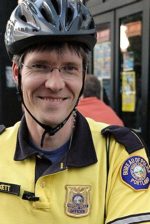
(Photo © J. Maus)
The article below was written by Portland Police Officer Robert Pickett. Pickett — who regular readers know by his user name “PoPo” (he’s a regular commenter and member of the Portland Bike Forums) — is a former member of the SE Precinct Bicycle Patrol Unit and now works in the Bureau’s Neighborhood Response Team division. Pickett is also a former BTA Alice Awards nominee for his dedication to community policing.
Pickett was recently selected by Police Chief Sizer to be an official communications liaison to the community on bicycle issues. On BikePortland.org he previously shared his thoughts on humility and wrote about why cops ride on sidewalks.
I was racking my brain last night, trying to figure out if there was anything constructive I could provide to this commentary in the face of the knowledge that whatever I write will certainly be ripped to pieces by upset, anonymous critics. (I am now anticipating many comments opening “here’s what would be constructive, PoPo…”)
I also wanted to be constructive and not simply defensive, since of course, a part of me feels that way.
Policing is a complicated, difficult, sometimes dangerous job. Cops are also under close scrutiny from many angles, and are quickly judged. Information generated from official investigations is also usually slow to come, as it takes time to collect and write, and sometimes can’t be released immediately for fear of jeopardizing successful prosecution of a case.
At the same time the public and the media is screaming for information now! Sometimes the best the police can do immediately after a controversial incident is release a brief overall statement, leaving out the smaller, but perhaps pertinent details. This can leave the police open to somewhat one-sided criticism for awhile, based on incomplete or possibly biased information, but that is part of the deal. Cops know it and decide to do the work anyway.
“Generally when officers end up having to use force, it is in response to their perception of the subject’s resistance, and not a result of the particular infraction observed.”
And indeed, sometimes cops make bad calls and that comes out too. We appropriately have high standards for our officers, but they are human.
So there I go, being defensive anyway. Sorry about that. Anyway, it seemed that while I can’t talk about the incident in particular, for reasons stated above, perhaps I could try to provide perspective on numbers and how police usually work.
First of all, I asked for some statistics regarding use of force in the Traffic Division. They have about 32 officers and sergeants who actively work the street (others are investigators, command staff, etc). These street officers (mostly motorcycle-mounted) are distributed across seven days of the week and two different shifts, and their primary job is enforcement of traffic laws.
From 6/1/2007 to 6/1/2008, the Traffic Division issued 53,895 citations and made 1,647 arrests. (These numbers do not include other citizen contacts and traffic stops that resulted in warnings.) Many of those arrests are certainly for DUII and hit and run, but some come as a result of other criminal activity discovered during the stops. During this period, Traffic Division officers used force in only 31 cases — using force means something more than handcuffing or specific control holds-using a Taser, pointing or shooting a firearm, punches, tackles, pushing down, pepper spray and utilizing a baton are all examples of “use of force.”
All the above numbers means that force was used in about .05% of the cases.
Situations where officers are trying to arrest someone generally provoke more force incidents than simple traffic stops. Traffic officers used force in 1.9% of the 1,647 arrest situations during that time period, which is actually lower than the Bureau average. The entire Operations Branch, which also includes all precinct officers—the ones who patrol neighborhoods and respond to 911 calls–used force 6.65% of the time when making an arrest.
Officers are allowed to use force if they perceive that citizens are refusing to stop when lawfully ordered.
Generally when officers end up having to use force, it is in response to their perception of the subject’s resistance, and not a result of the particular infraction observed. Does that make sense? For example, usually police use force not because someone ran a red light, but because the person resisted when an officer was trying to stop them for running a red light.
The general idea behind Tasers is that while painful (I can attest to that personally) they actually reduce injuries to all parties involved, as they can take the place of protracted physical struggles, which might involve tackling or punching or strikes with a metal baton, or the danger of a suspect grabbing one of an officer’s weapons while fighting in close quarters with an officer. And on the other end, sometimes, based on the specific situation, it is feasible to attempt to use a Taser in a situation where using deadly force (usually in the form of shooting a gun) would be justified.
This is not to say, however, that anybody likes to be Tasered.
The dark uniforms Traffic officers wear, with reflective police patches, were specifically designed to stand out more sharply during the daytime, and to be more visible at night, than the traditional blue uniforms. It doesn’t mean they are perfectly recognizable in every case, but the intent was to make them as recognizable as possible. The Traffic Division is actually considering the uniforms for it’s non-motorcycle mounted officers as well, because they are more visible, and therefore safer for officers who spend a lot of their time stopped on the side of the road in traffic.
I’m sure there will be many frustrated, irritated comments replying to this one. Completely understandable. But Jonathan has created an excellent forum that traditionally has quite thoughtful commentary from all different perspectives. I wanted to help continue in that tradition if I could, knowing that not everyone would agree. I am always happy to attempt to explain.
The southeast Precinct Bicycle Patrol will be hosting a family-friendly rodeo, as part of Pedalpalooza, Friday afternoon from 5pm until 8pm at Sunnyside Park. If you are interested in how police bicycle officers are trained or want to try our slow-speed cone course, please come by with your bike.
We will also do our best to answer how cops do and why we do things.

Thanks for reading.
BikePortland has served this community with independent community journalism since 2005. We rely on subscriptions from readers like you to survive. Your financial support is vital in keeping this valuable resource alive and well.
Please subscribe today to strengthen and expand our work.
Thank you for writing this. This sort of perspective is always helpful.
Thank you for your willingness to add to the dialog.
PoPo:
I just wanted to thank you for the work you choose to do for the city of Portland. It\’s not often that police officers hear that, so I wanted to put it out there.
Also, thanks for the candid look at the statistics and the quick run-down of police mentality. I for one completely understand the view that most police officers have when out on the street. You never know who\’s going to pull a gun or some other weapon on you, and it\’s hard to balance the constant tension with the correct judgment. I admire the police officers who do it with aplomb.
Hopefully someday soon you\’ll be able to give us an actual commentary on this specific incident, since all we get is what we read in the news or from the rumor mill.
Again, thanks for your service, Officer Pickett.
Thanks for the perspective.
Are there typically investigations or followup reports in cases where physical force or tasers are used. What type of citizen oversight is available for cases such as this where there is a wide difference of opinion about the circumstances and degree of force warranted?
Thanks for performing a hard and demanding job and posting on the forum.
These are all interesting points, and individually they may hold some merit. But when applied to this specific case, they hold none.
I recognize this officer can\’t comment on the specific case. We can. Nothing we have heard, from anyone, has provided a justification for the unprovoked attack on Rev. Phil.
He was not evading arrest. He was not posing a danger to himself or to others. And as many have noted the police failed to properly identify themselves; Rev. Phil had every right to act as he did throughout the entire affair.
Policing is a hard and demanding job, and it is a job that comes with enormous scrutiny. It cannot be any other way. In a free society, giving anyone that kind of power requires constant and exacting oversight, and zero tolerance for misuse of force. If cops don\’t like that they are always free to find another job.
In any case, this event and others like it suggest some of the basic rules and procedures the popo function under need to be changed. Cops serve the public. Too many of them have forgotten that fact.
I\’m more concerned about the few officers who have very high rates of use of force. It is far too easy for us to say that the police force as a whole doesn\’t have a problem with excessive use of force, or that on average portland police don\’t use racial profiling, rather than looking at which officers are statistically far from the norm and trying to do something about them. It is great that force was used only 1.9% of the time in traffic arrests, but what is more relevant is the percent of time this officer uses force, and how it compares to that 1.9% number.
Also there is nothing about a grey car with lights behind the grill and no light bar on the top that says designed to be easy to see to me. I\’m glad the uniforms are designed to be easy to spot, the next step is to make the cars match.
It\’s too bad the 99% of Police Officers give the other 1% a bad name.
I\’ll try to leave my \”frustrated, irritated comments\” on the other thread. I have no doubt that most police departments have many professional officers who don\’t gain pleasure from inflicting pain. The problem is that to the casual observer there are only excuses for the officers who are not caught crossing that line on camera, in a manner that few can deny.
We need a police force for a civil society unfortunately. We also however as tax payers and citizens deserve a police force that really has a mission \”to serve and protect\” and not a group that sees themselves at best as outsiders who are our betters, and at worst as military occupiers.
Force should never be used on someone who just hesitates. They should not even be touched until asked or commanded to stop, assume a certain position, or attempted reasoning first. Unless, of course, you park your car in a bike lane, cut-off or door a cyclist – then it\’s reasonable 🙂
I\’m not speaking about this case per se, as I wasn\’t there. I guess I watch Cops too much. Thanks for the insight, and without cops our city would really be in the shitter.
POPO You wrote: \”Sometimes the best the police can do immediately after a controversial incident is release a brief overall statement, leaving out the smaller, but perhaps pertinent details.\”
That has a Make-it-up-as-we-go-along-spin-it-in-our-favor kind of ring to it. Good god, You are unreal. I hope my opinions make you \”seeth\”.
I am not going to defend what the officer did – obviously he made a bad judgment call. But I will say, I think it must be really, really tough to have to make those kinds of split second decisions about whether this guy is resisting arrest because he\’s zipping his sweater up and doesn\’t have his hands free or this guy is resisting arrest because he\’s reaching into his sweater to pull out a weapon. And when, instead of complying he starts yelling loudly, what do you do? This cop went over the top and I am in no way condoning the use of force, I\’m just saying it\’s really easy to judge from the onlooker\’s perspective, but can we all be sure we would have reacted totally calmly? If you\’ve ever been a parent, babysat, taught, or been in charge of kids or people, I\’m sure you\’ve had a moment or two where you did or said something when you made a bad judgment call or said or did something you wish you could take back. But the police aren\’t in charge of cute little kids, they have daily run-ins with the disenfranchised of society. I\’m sure it would be easy to become over-stressed, scared, jaded…
PoPo (Officer Pickett)
Thank you for your perspective. I understand you have a hard job. And, as I have read on this site, you ride a bicycle fairly often. So put yourself in this situation. You are riding your bicycle down the street, relaxing having a night out when someone walks up to you and says, \”Hey buddy, we need to talk to you.\” You shrug it off and continue riding, the statement shows no authority what so ever, and then all of a sudden the person reaches out, tries and does remove you from your bicycle.
If anyone ever tried to remove you from your bike, would you not put up a fight? Your moving on two wheels, you\’ll at least resist the temptation of falling, or resist, it\’s human nature, then you stand up wondering what the hell.
Sometimes the actions police take, could be taken with a little more thoughtful tact. Thats all. If i screw up at my job its OK, but sometimes when the police make mistakes people get hurt, and the police don\’t hold up to the responsibility of their actions.
Cause and effect, push a person off a moving bike, they stand up in defense. The officer should have looked around and assessed before the volts of electricity was flowing.
Policing is a dirty job that sucks. Now that 75% of modern TV is about police, we get that. Some officers actually do serve and protect, and we probably almost never hear about them on the news.
I encountered some police officers in several cities in Holland, though, and it\’s interesting how the cops there are helpful, friendly, and liked. I watched friendly riot police on horseback in downtown Sydney Australia controlling thousands of drunk, shouting people in the street after a soccer game, and no one in the crowd seemed at all worried about being hurt by the police. In fact, everyone, including the horses, seemed to be having a great day.
Why are the police in the US seemingly at war with everyone? Did it happen when the MPs came back from Viet Nam? Is it the TV?
Tragically, in Portland as in other US cities, there are some trigger-happy incidents occurring, and these are not being handled in a way that promotes peace and understanding between the LEOs and the citizenry. I think we need to change what we reward and punish on both sides of that blue line.
What\’s really frustrating lately is that while some officers seem to be gleefully tasering non-dangerous people repeatedly as punishment for disobedience (real or imagined), idiots seem to be running rampant on the light rail and bad things happen a lot in some of our neighborhoods.
Can I get a WTF? Surely in a smart, progressive city like ours we can do better. I believe we must. What are our elected officials doing about these issues?
Can we please have consequential citizen review of all officers who use force often, and some effective police presence on the trains and platforms and other trouble spots? Neighborhood policing, anyone? Less Robocop … more Adam12?
I want to feel safer when I see the police instead of more threatened. I don\’t know if that\’s achievable, but it\’s a goal I think we should all work toward, because the situation has gone way too far in the wrong direction.
Popo, I greatly appreciate your words and the work you do for Portland.
I encourage all to re/view the Portland Police Manual of Policy and Procedure. Download it to your hard drive, read it again and again. It is located here:
http://www.portlandonline.com/police/index.cfm?c=29867
Section 1010 references Deadly Physical Force and Physical Force. When can an officer push a person from a bicycle?
Also check out section 1051 – Use of Taser
This section outlines when tasers can be used, who not to use them on, cautions for taser use, warnings.
I\’m not an expert, but these sections appear to set a policy for use of a taser as a method of control when a subject is engaged in Aggressive Physical Resistance. It\’s also interesting that Section 1051 also mentions that officers should consider the \”severity of the crime.\” prior to using a taser. The verbal warnings (a subsection of 1051) given by Hoesly and/or Smith are still unclear. It would be interesting to know what the Portland Police policy is regarding an officer\’s responsibility to clearly identify himself before issuing a command to stop. Also, what are Police procedures and policies for allowing a subject time to actually comply with a command before physical force is selected as a
The reading is quite interesting, at least for me.
Popo, if you\’re willing perhaps you can shed some light onto some of these Police Policies. I\’m hoping you can go into greater depth on what \”lawfully ordered\” is (you mention it in your 11th paragraph).
Here are 3 exerpts from Jonathan\’s report:
From Rev. Phil: He then sprinted, lunged and tackled me.
From the written statement of PPB\’s Brian Schmautz: The officer, then reached out to stop Sano and they began to struggle.
From the witness: … the cop took two steps after him, grabbed him by the shirt, yanked him off the bike,,,
Here\’s what I want to know. What is the official Portland Police policy for dealing with a bicyclist who doesn\’t respond to an officer on foot giving a verbal order to stop. In particular, a bicyclist who is not posing any immediate threat to himself or others but is merely in (possible) violation of a traffic infraction.
Somehow, sprinting after the bike, possibly struggling with the cyclist, and then knocking him/her to the ground does not seem appropriate in such an instance. I\’d like to know if indeed police are instructed that this is appropriate behavior.
It seems that everything else that happened in this particular encounter is a direct result of natural behavior of all parties resulting from this act, especially if Rev. Phil was unaware that it was a police officer he was involved with. (It is not clear to me from the report that Rev. Phil should or should not have been aware of this.)
If this is acceptable police behavior, I think we (meaning bicycle advocates and police policy folks) need a discussion to come up with a more reasonable initial behavior for a police officer in this situation.
Mr. Pickett:
Thank you very much for sharing.
Truly,
Mark Allyn
As a black woman who is regularly mistaken for a male, I shudder to think what would happen to me in a similar situation. Personally, if some man shouted at me to stop while I was out riding at night, I would sprint as fast as my little legs would take me.
According to all the witness reports we\’ve heard so far, the officer in this incident failed to identify himself. Correct me if I\’m wrong PoPo, but isn\’t that sort of one of the basic rule #1 type things that officers are supposed to do?
That and the comment from another poster about this same officer\’s excessive use of force during the rose festival parade, makes me think that he needs to be relieved of badge and gun until he can go through some anger management training.
I too appreciate your perspective, and the fact that you are such an active participant in this forum. But for this case, it\’s hard to think what information might come to light that will make this make any sense.
PoPo
Thanks again for writing.
It seems to me that this situation could have been averted if a bicycle mounted officer was present and had halted Phil by simply pulling in front of him. Being yanked off your bike from behind would produce a negative reaction from anyone.
Can you comment on the use of bicycle mounted police during enforcement operations targeting bicyclists? Or in this case, the lack there of?
Kendra James. James Chasse. Siobhan Doyle. Brett Jarolimek. The list goes on and on and on…
Now this.
The facts speak for themselves. The PPB has a serious problem. You may not have been a part of it, but once you start apologizing for it you become part of the problem. Sycophant.
I don\’t think that he is apologizing for the PPB. He\’s just trying to add some perspective.
Admittedly though, if I understand it right, this was just flat out dumb. I mean what did they think was going to happen? Targeting bicyclist after dark without lights using officers on foot in dark uniforms without lights? And combining that with an apparent policy that allows immediate \”use of force\” after a simple audible command? What if the guy is hard of hearing or wearing ear phones? Or as in this case simply doesn\’t understand? Again, this was just needlessly dumb.
To #19
I disagree completely. The officer was just explaining from his view. I didn\’t take his article as apologetic in any way shape or form. Also, because you say, \”I\’m sorry\” doesn\’t mean you\’re part of a problem.
I would ride like a mad man if someone yelled at me. Cripes what was the officer thinking?
I have been a bike commuter for 28 years now. I have a good repore with the PPB but again I have to agree with the earlier post WTF?
kev
peace
Come on, now. Let\’s keep an open mind.
I didn\’t read anywhere in Officer Pickett\’s letter where he apologized for the specific actions of the police who tasered Rev. Phil. Pickett stated very clearly, \”While I can’t talk about the incident in particular … perhaps I could try to provide perspective on … how police usually work.\”
IMHO, having Officer Pickett share his persepective, as a police officer, makes him part of the solution, not part of the problem. What we need is more honesty and more dialogue, not more name calling.
PS. I\’m a friend of Rev. Phil and served as a witness in his 2006 case, in which the police f***ed up badly. I know the police can make mistakes and sometimes use excessive force. Nevertheless, denigrating Officer Pickett isn\’t a solution to anything.
During the silent ride a few weeks back, we (the riders who rode) received a courteous and professional escort by a well-coordinated and, from where I sat, empathetic fleet of motor cops.
While some or most or none of them agreed with our cause, they all took our safety above their own and provided safe passage where, without their presence, there may have been none.
They didn\’t do it do because they mourned the loss of a friend or family member. They did it because they are civil servents and they were told to do it.
It takes a special kind of person to suffer the daily slings and arrows of second guessers and armchair officers and face again and again the horrors and terrors and ugliness from which most of us would recoil.
I have no idea beyond what I\’ve read what happened to the subject in question on the night in question at the hands of the officers in question.
But I know when I dial 911, someone out there, despite their headache or their mounting financial issues or 9th-hour hunger, is going to come running to help.
I feel that if you forget that hanging need, that potential disaster from which you may require rescue, you run the risk of forming an opinion that is only partially relevant.
I understand the desire and need to have effective oversight of this profession. I don\’t understand the third hand gossip and attendant alarmist rabidity I\’ve been reading in response to an encounter that could have been avoided if the subject had been using the light given to him by the same folks that found it necessary to shock him when he, in his own words, took a defensive stance against an officer who, by all accounts, gave him a lawful order to stop at a scene decorated by the flashing lights of a cruiser.
In general it seems police cars are moving away from being marked and uniforms are becoming more military like. This is not a good trend.
I have to wonder if this was a motorist with a headlight out and their window rolled down would the officer reach through the window of the moving car to try to rip the motorist out of the car?
Unfortunately as we all know cyclists are more vulnerable largely because we pose a far smaller threat. It is incidents like this that make me oppose all cycling equipment legislation.
Bjorn
Thanks for your extremely thoughtful comments. I\’m at home reading them aloud to my wife, learning and thinking.
Some people asked about police oversight and investigating allegations of police misconduct. Below is a link with information about the Independent Police Review Division and the Citizen Review Committee as well as other related resources.
http://www.portlandonline.com/auditor/index.cfm?c=26646
\”Apologizing\” is not meant literally, you fools.
This \”perspective sharing\” bullsh#t is meant to make you go, \”Oh, they have such a hard job. And they\’re not all bad. Let\’s cut \’em some slack.\”
Meanwhile, THEY KEEP MURDERING PEOPLE.
And they keep you sheep divided and unable to effectively challenge the creeping state power…until it\’s a POLICE STATE. Until nobody seriously questions things like this. It\’s already happening…
There is a serious problem in the PPB. If you can\’t see it, you\’re either in denial or blind.
Where\’s Kendra James\’ perspective? She\’s dead. Murdered by the PPB.
Where\’s James Chasse\’s perspective? He\’s dead. Murdered by the PPB.
You think these are the only two?
Pickett doesn\’t mention any of this in his \”perspective.\” He doesn\’t mention the PSU student who was arrested by PPB officers for exercising his free speech rights last year, then intimidated and beat up illegally while he was in jail by PPB officers.
He doesn\’t mention any of the DEATHS CAUSED BY TASERS. Instead he claims they \”reduce injuries.\” It\’s positively Orwellian.
When it\’s your brother, sister, mother, father, son, or daughter, you\’ll change your mind…
How many more will the PPB have to kill?
Officer Pickett
You state you wish to be constructive, even though a part of you feels defensive. This is unfortunate, because you nor your profession are under attack here. The actions of a few police officers are under attack and you are under no obligation to defend them (unless of course your boss told you to, which incidentally is part of a larger problem. Police bureaus are not supposed to be fraternities where officers watch each other\’s backs at times where they should be looking out for us – community members – as in this case).
You say the PPB have high standards but sometimes, police officers make mistakes too. There is a huge difference between the kind of mistakes that are \”human\” like forgetting important things because you are distracted, and those mistakes which are physically and emotionally detrimental to other human beings. Accidents happen, but this incident was no accident. The officers in this incident purposefully, intentionally inflicted physical harm on a person where it was not necessary to do so. What is the worst that could have happened? Rev Phil might have gotten away without using a bike light? How terrible would that have been?
And also, as a statistician, I can tell you that your statistics are meaningless. 1.9% of the traffic incidents were cases in which force was used and that is below the bureau average. What\’s the national average? What\’s the average of other police bureaus around the city, the state, the nation? What about the averages of just traffic incidents? Does the PPB use force more often in traffic incidents than other police bureaus in traffic incidents? Your statistics are just numbers without context and they mean nothing. It almost seems like you are implying that a certain amount of force, however mild or excessive, is acceptable if the numbers of cases that result in the use of force fall within the desired percentage. Also, we don\’t know the specifics of those cases in which the officers used force. We don\’t know if it was warranted. Now, Rev\’s Phil\’s traffic incident will be added to those numbers, but the details will be lost.
And still with regard to this incident, I don\’t think the use of tasers in any way reduced the injury to Phil. It was the police officer\’s choice to use it, and from the sounds of things, they used it with abandon.
I don\’t necessarily agree that the uniforms (at least as far as patrolmen are concerned – not about SWAT or such) becoming *more* military-like. However, my impression of the traffic uniforms (at least on the motor officers I\’ve run across) – the reflective patches work well in specific instances. (for example, coming up behind an officer while illuminating him with automobile headlamps). But in other instances (for example, approaching an officer on foot without illumination) the reflective patches alone don\’t help a whole lot.
I think it\’d help if the traffic officers had higher visibility sections on their uniforms, particularly the upper body or arms. Not only would it help them be readily identified as officers, but it can only help them in the line of duty considering how much time they have to spend on the road at the risk of being run over themselves.
Let this be the lesson: Don\’t even unknowingly let the cops have ANY fear of you. It is their right to always be in control of you. Wear your Junior Communty Police Officer peel-n-stick badge and try not to be too intimidating.
Everyone is equal here on the Farm,but pigs are more equal than all the other animals.
Get back to work.
Walk on two legs not on four.
Walk on four legs breaks the law.
I honestly don\’t understand why police can\’t comment. It seems like a blanket cover your ass kind of policy. Details like what time the incident took place and whether or not the police identified themselves as police before yanking the guy off his bike should be pretty cut and dried. I\’m sure the police officers involved have already written up their reports. Why can\’t those be released? Waiting just makes it seem like the police are getting their stories straight and making sure no embarrassing video footage contradicting them comes to light.
I still haven\’t seen a direct response to the fact that the incident may have taken place at 9:30pm, which is before dark at 9:37pm, so lights might not have even been legally required.
With everyone else, I say thanks to you officer Pickett for having offered explanation you can about the workings behind the actions of the officers that stopped Phil Sano on his bike. The following excerpt from your comment seems particularly key to understanding this incident:
\”Generally when officers end up having to use force, it is in response to their perception of the subject’s resistance, and not a result of the particular infraction observed. Does that make sense? For example, usually police use force not because someone ran a red light, but because the person resisted when an officer was trying to stop them for running a red light.\” popo/pickett
Unfortunately, it seems as though many people don\’t understand how their actions might be seen from the perspective of police procedure. It\’s like two different world\’s colliding. Some, but not all of the public may be capable of reading the PPD policy and procedure manual, learning from it and by other means how to respond safely in an encounter with the police.
People commenting in this thread have mentioned James Chasse and Kendra James. Each had personal problems that significantly impaired their ability to abide by a standard, police issued order. As a result, their lives vanished abruptly in encounters with the police. Given the specifics of current PPD policy and procedure, there\’s significant reason to doubt that people such as they, will be able to survive an encounter with the police.
It seems Phil Sano, riding his bike last night, was just smart enough and sufficiently in control of his mental faculties to avoid the fate of Kendra James and James Chasse. If he were just a little more \’out there\’ than he really is, he would possibly have been dead. Really, can anyone say that\’s good enough for Portland and the PPD?
Policy and procedure for the PPD needs to be reviewed and revised to create a much more conscientious and reliably safe means of managing encounters between the police and the people they\’re sworn to protect. I\’m not sure what form that would take, but something has got to be done.
re; the dark uniforms: if anyone has a link to where we could see exactly what they look like, I\’d be interested. All I really remember is that they\’re black. The reflective details on the front of the uniform is something I can\’t remember at all. I\’d like to see if there is any such details on the front of the black uniforms.
Whatever everyone else says… especially when it comes to police cars and having them blend in to public…. Those of you that have that problem, you are not trustworthy. To be watch, means you act differently. To be observed, you act accordingly. I myself could care less, as i haven\’t a problem with the PPB. My problem lies within, being accountable for actions. Thats it. PoPo wrote his article, and I thank him for, and i personally wish Portland had more officers like him. Portland would be a better place.
All I really remember is that they\’re black. The reflective details on the front of the uniform is something I can\’t remember at all.
Which is decidedly non-fantastic. Even if each and every member of the PPB were identifying themselves correctly upon an effort made for arrest, it presents a problem: any hulking, intimidating human mass done up in all black hollering \”STOP! POLICE!\” could conceivably stop the law-abiding citizens. Regardless of the details in this latest incident with Rev. Phil, there needs to be some enhancement in terms of unique identifying markings to indicate legitimate PPB personnel, rather than some savvy gang of random thugs looking to \”confiscate\” the contents of one\’s wallet.
And yes, that\’s an overwhelmingly optimistic perspective. Even in the best-case-scenario, the PPB could present a much more clear and obvious program to catch violators of actual traffic violations, rather than at-whim selective enforcement that contributes to all negative PPB myths.
this statement is posted by a 911 dispatcher in Jefferson county.
and i have her permission to post what is said. her statement is a follows.,
there\’ll always be people who hate police regardless of the great things they\’ve done for the good of the many. Its the minority few who ruin it for everyone else. Its sad that people are calssifying \”Po-Po\” as one of those few, but it took courage to post his own artilce and take on the incident, knowing full well he\’d be attacked and misunderstood. His article was objective with a hit of embarassment because of his profession.
Given that we as a society grant police the power to order us around, carry weapons, and sometimes use those weapons on us, I think we\’re always within our rights to push back on, and question the slightest hint of abuse of that power.
This country was founded on suspicion of – and resistance to – concentrated power. (And from the little I know of him, the good Reverend is a grand champion of that tradition.)
PoPo, thanks for making the effort to bridge the divide.
You say, \”Officers are allowed to use force if they perceive that citizens are refusing to stop when lawfully ordered.\” Can you elaborate on the \”lawfully ordered\” part?
Also, you cite the statistics: \”Traffic officers used force in 1.9% of the 1,647 arrest situations during that time period, which is actually lower than the Bureau average.\” Are there statistics for how that breaks down on a bike stop vs. car stop basis?
It seems like cyclists are treated differently by cops, and I have the nagging feeling it has to do with us being such easy targets relative to car drivers.
Case in point, we can be dragged off our bikes by a guy on foot.
Could it be that, to people whose day to day jobs involve the application of power, those of us with less power – i.e. not in cars – are more likely to be treated with contempt?
In my own experience, the times in my life I\’ve been pulled over while driving a car, the interaction has been as polite as can be: lots of \”sir\”s, very businesslike, and with no emotion expressed. Whereas my one experience with police while riding a bike – a Critical Mass in which I rode safely and legally (with the exception of some rolling right-on-reds) – I was growled at by the escorting officers, and generally made to feel like I was a criminal just for being there.
All of which causes me some trepidation when considering my first-ever World Naked Bike Ride this Saturday…
Officer Pickett,
Thanks for stepping up to the plate here…
but…
\”The dark uniforms Traffic officers wear, with reflective police patches, were specifically designed to … be more visible at night\”
this sort of statement stretches credibilty and not a little bit.
It\’s VERY obvious that the uniform choice and stealthy light bar on the unmarked cars are designed to be invisible to casual observers.
Thanks, but I\’ll pass on your Coolaid today.
I\’ll pass also. protect and serve?
(to provide services that benefit or help)
Officer Picket, Thank you for your input and for all you do. The problem I see with this incident as it has been presented so far is that the police response is so incredibly inappropriate. The offense was riding without a light at night. This is very dangerous mostly for the person on the bike without a light. The act of tackling a person off their bike could be deadly all by itself. It should be viewed as the extreme action that it is. Everything that follows that act is fairly irrelevant because after the initial assault by the Police officer you are dealing with a beast of a different nature.
The Police officer took a fairly benign situation and made it into something very dangerous through his own actions and decisions.
this is all pretty basic:
Dude got tased for not having a light. He never laid a hand on any of the cops, never said a word. Never harmed anyone, never put anyone in danger. He was tased to the point he needed medical attention.
Rodney King may have got the beat down, but one could justify it because he was putting others in danger prior to said beat down. The Rev WAS RIDING A BIKE WITHOUT A LIGHT.
I\’ll just repeat that for everyone, HE WAS RIDING A BIKE WITHOUT A LIGHT.
wsbob – I don\’t have any photos, but from what I recall, they\’re black with \”Police\” in large letters on the back, I think with a reflective stripe underneath it. On the front I think there are two reflective stripes, one at each breast pocket.
Trouble is, unless you have very specific conditions (illuminated by car headlights) you basically have a black uniform with greyish lettering. Particularly in twilight when you have vehicles without lights on, you\’re a ninja.
With hi-vis yellow arms, not only would the uniforms be more recognizable in all conditions, but it would make gesturing (such as ordering a vehicle to stop, or directing traffic) easier as well.
Not to mention the safety factor for an officer who spends a fair amount of time along the roadside, whether at a traffic stop, accident response, or whatnot.
Thanks you, Po-Po for sharing your perspective and continuing to be a bridge between the Bureau and the cycling community here. 🙂
Yes, PoPo, being tasered does not feel good…being tasered 3 or 4 times feels even less nice.
Sorry you\’re judged here for the actions of others….but exactly where is the disconnect between your training and mannerisms in the field and these trigger happy morons?
I generally have a lot of respect for what the police have to do. It\’s a tough, mostly thankless job, and I think that most cops wouldn\’t be there if they weren\’t trying to help people. They catch a lot of flak for every little thing they do.
But, I\’m speaking in general terms here; as is PoPo in his letter. The issue is you can\’t use generalities when looking at an individual circumstances. Statistics are irrelevant to whether or not this was justified or even an understandable error. Granted, police have to make split second decisions, and sometimes they decide poorly, but there was no emergency here to even warrant the need to go into that mode.
The officer in this situation was way, WAY out of line. Rev Phil was TASED MORE THAN ONCE – meaning that he was tased after being completely disabled (not to mention being ripped off his bike in the first place). I think part of what is so disturbing about this is that any one who bikes could picture themselves in the same situation, and that is scary. Usually there is at least something to provoke an officer – even if the officer overreacts, but it sounds like this guy acted like any normal person would if someone started yelling at them and tackled them off their bike. This could have been any one of us.
I realise that PoPo\’s letter isn\’t justifying this incident. The letter seems like more a plea for the biker community not to take this one incident and turn it in to a generality. However, the way to do that is by holding the officer accountable, not by listing statistics. The biking community has a right to be angry and scared over this and I hope that the police force is going to do more about it than send out their biking mascot to smooth it over.
Dude, you are a glutton for punishment! Regardless, very well written and informative. Thank you, again, for shedding some necessary light and perspective on this contentious issue.
Thanks for writing this, but all your points assume that the enforcement officer you are referring to is trustworthy and honorable, and we know there are many who aren\’t.
\”The general idea behind Tasers is that while painful (I can attest to that personally) they actually reduce injuries to all parties involved, as they can take the place of protracted physical struggles.\”
This statement contradicts the majority of studies out there, which show that cops are using Tasers when no force would, otherwise, be applied at all.
http://network.nationalpost.com/np/blogs/fullcomment/archive/2008/06/13/colby-cosh-on-tasers-the-shocks-keep-coming.aspx
PoPo, about those uniforms: They are completely unrecognizable by a cyclist or pedestrian on the street or sidewalk at night. Maybe if you\’re behind the wheel of a car at a traffic stop with headlights and such, people could recognize you for a LEO. I honestly don\’t think I could even with my bike light on. That could be due to my lousy night vision, but I\’m not the only human being in Portland with that problem…
Perhaps there are times and places where they are of benefit. A community where people actually conduct their lives outside the confines of their motor vehicles isn\’t one of them.
And yes, I will definitely pass my thoughts along to Chief Sizer, Mayor Potter, and Commissioner Adams…
well, here\’s the thing, yes a cop\’s job is suckey and hard. but guess what, so are a BUNCH of other jobs. but in those jobs, when someone pisses you off, you don\’t have the right to beat the living crap out of them.
Police work is statistically one of the more SAFER jobs you can work. the most dangerous job (highest rates of injury/death)? Farmhand. and yet, people treat and pay immigrant farmhands like shit, and cops get put on a pedestal. just trying to put in some perspective.
i respect individuals, not uniforms. if a cop is respectful with me, i return the favor, as i would anyone else. the problem is when they (cops) power trip.