

The City of Portland is gearing up to persuade everyone who uses the transportation system that the time has come to pay more for it. At a meeting earlier this week, Bureau of Transportation staff offered the most detailed look yet at four new revenue mechanisms they say hold the most potential for lifting the city out of its street budget crisis.
As I reported last month, City Councilor Olivia Clark, in her capacity as chair of the Transportation and Infrastructure Committee, is spearheading this effort. She tasked PBOT to publish a report on new ways the bureau could raise revenue. We got a glimpse at that report in December. At the T & I meeting this week, staff returned with estimates on how much in new fees we might be asked to pay, and how much revenue the city could raise.
PBOT finds themselves at this undesirable juncture because their budget is breathing its last gasp. PBOT Director Millicent Williams told councilors Monday that the agency, “has faced years of reduction and currently there is no end in sight.” With uncertainty at the state level, Williams said PBOT would lose an additional $35 million over the next two fiscal years if the Oregon Legislature isn’t able to pass a new funding package.
To restore PBOT’s coffers and rebuild streets, Williams said her team has further vetted four funding ideas from the report. They include: a street damage restoration fee, a transportation utility fee, a retail delivery fee and a third party food delivery fee. I summarized each of these last month. What’s new this week are estimates about how much each fee would raise.
Street Damage Restoration Fee
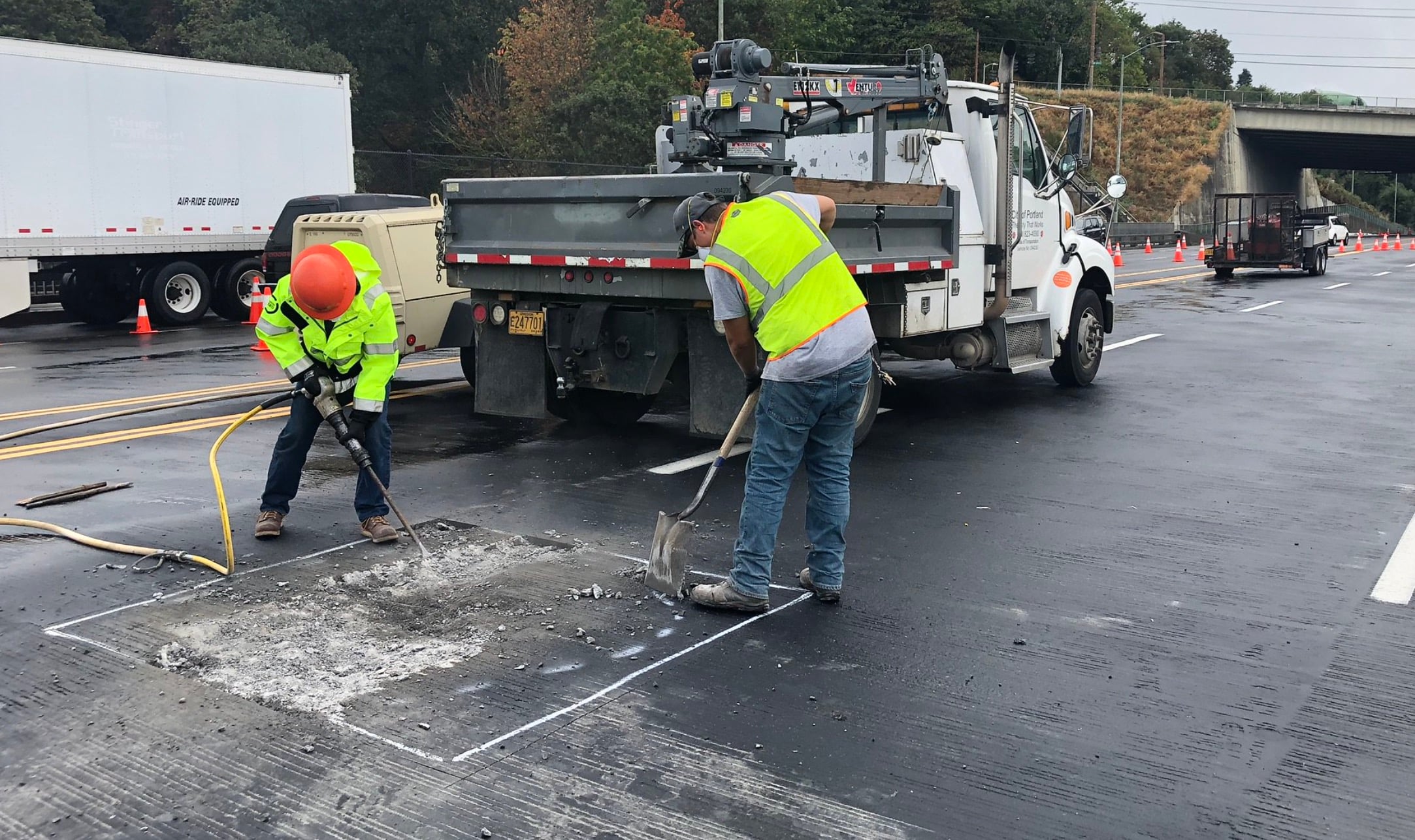
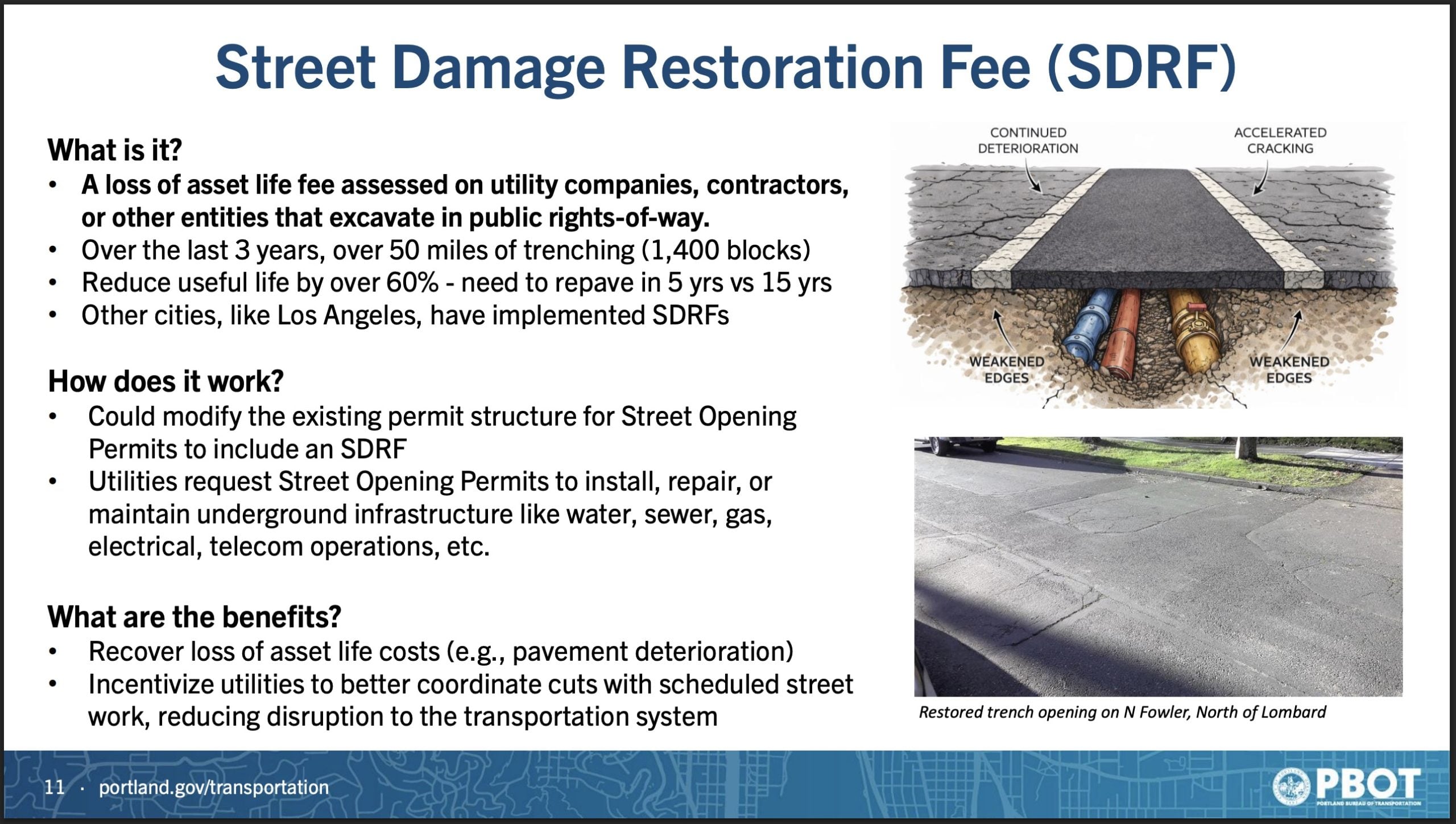
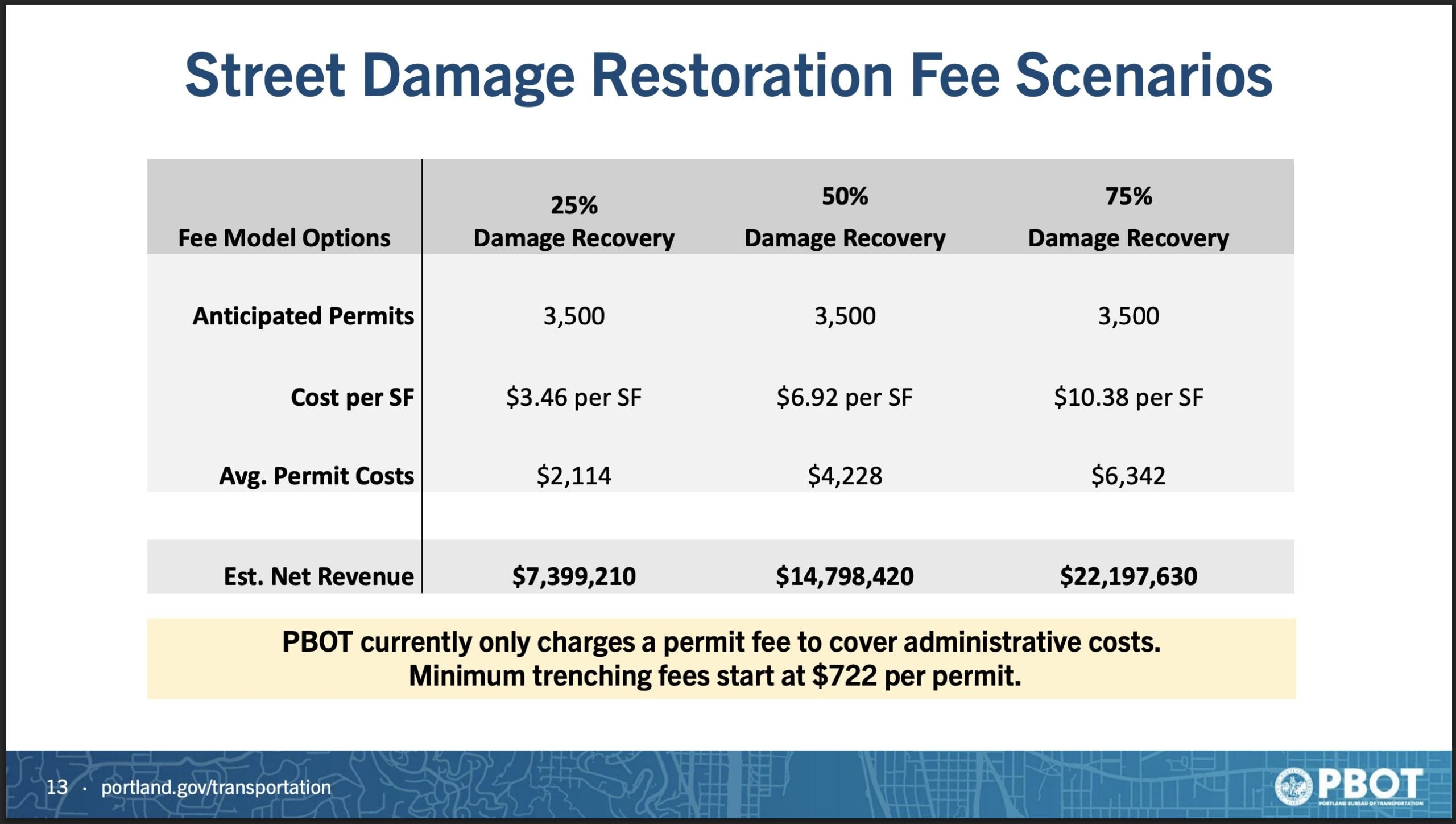
This fee would be charged to entities like utility companies who cut into city streets to install pipes and other infrastructure. PBOT estimates that in the past three years Over the last 3 years, various companies and agencies have ripped open 1,400 city blocks. Currently PBOT only charges for administrative costs related to permitting these projects and they do not charge for the street repairs. (To be clear, the agency/company is required to pay for patching the street back up, but the work often leaves the street worse off and PBOT is left making up the difference).
PBOT presented a range of “damage recovery fees” from 25% to 75%. Depending on what they settled on, this fee could raise between $7 million to $22 million per year.
Transportation Utility Fee
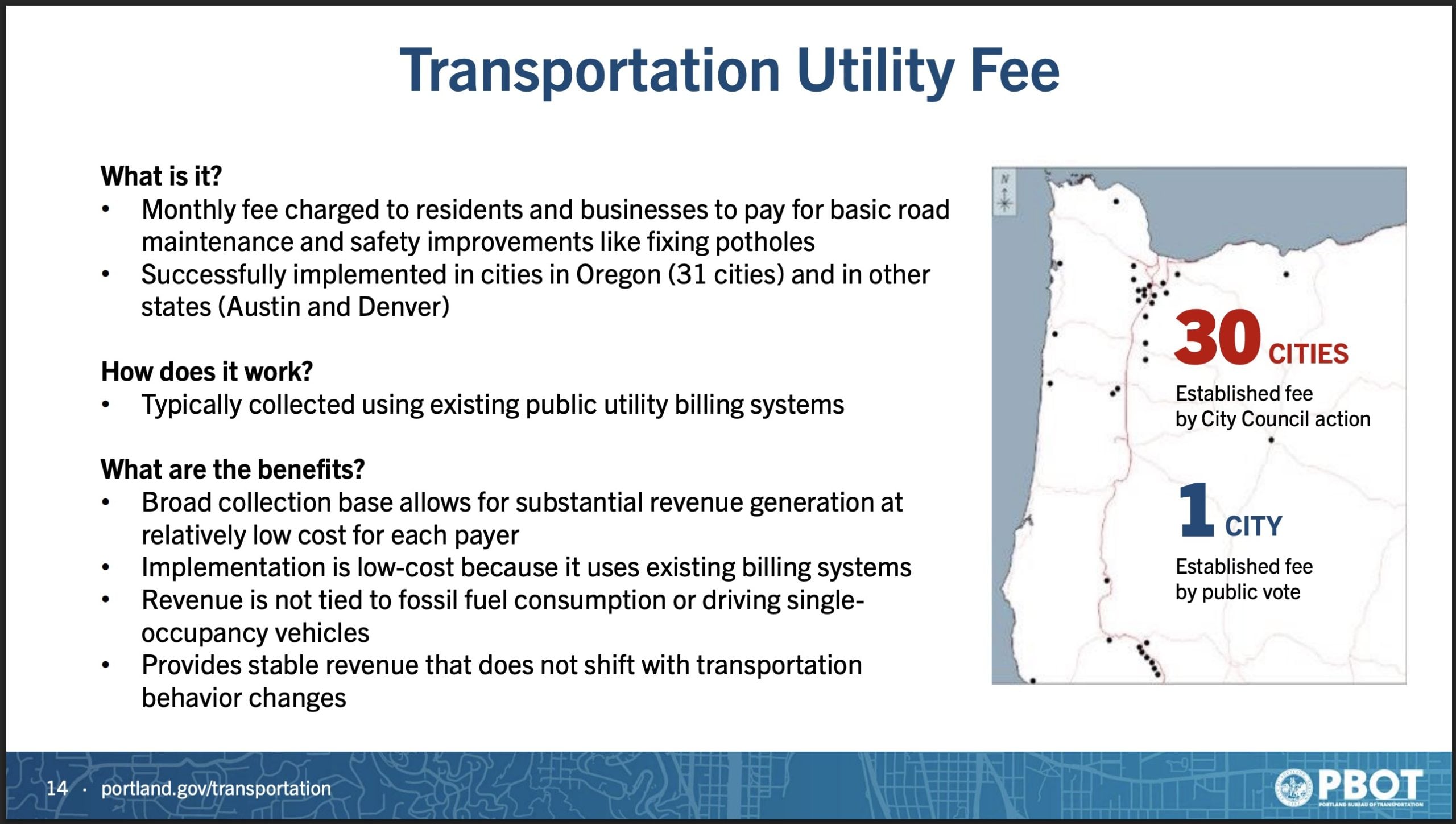
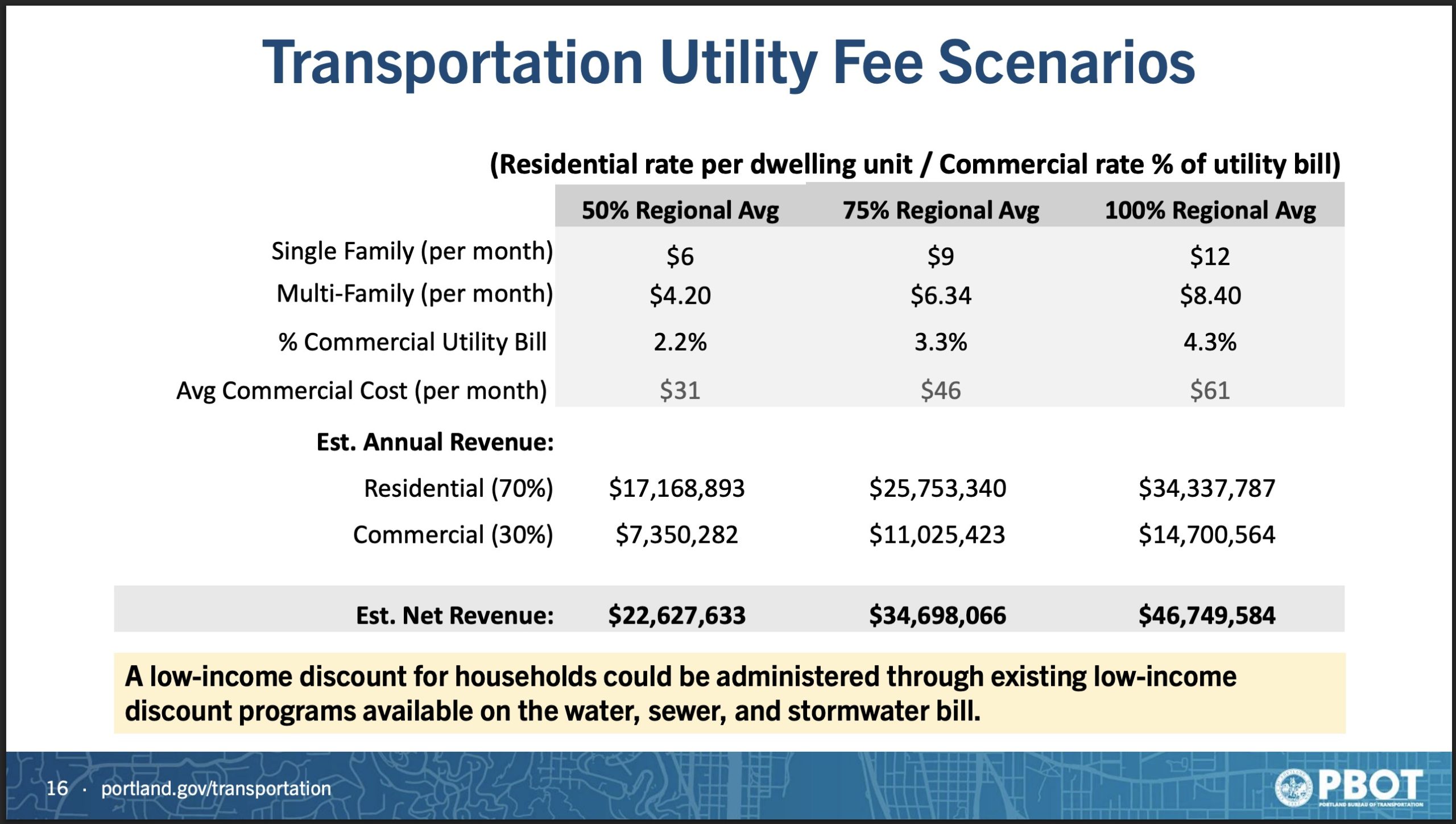
According to PBOT Policy Partnership and Resources Manager Mark Lear, “Of all the potential new revenue sources that we evaluated in our report, the transportation utility fee (TUF) scored the highest on our evaluation matrix.” This would be a monthly fee charged to residents and businesses based on their use of the transportation system.
There are nearly a dozen cities around the region that already have a TUF. The fees range from $3.79 per month for a resident of a multi-family dwelling, to $18.53 per month for a single family home. Depending on how much they decide to charge, this fee could raise about $23 million to $47 million per year.
Retail Delivery Fee
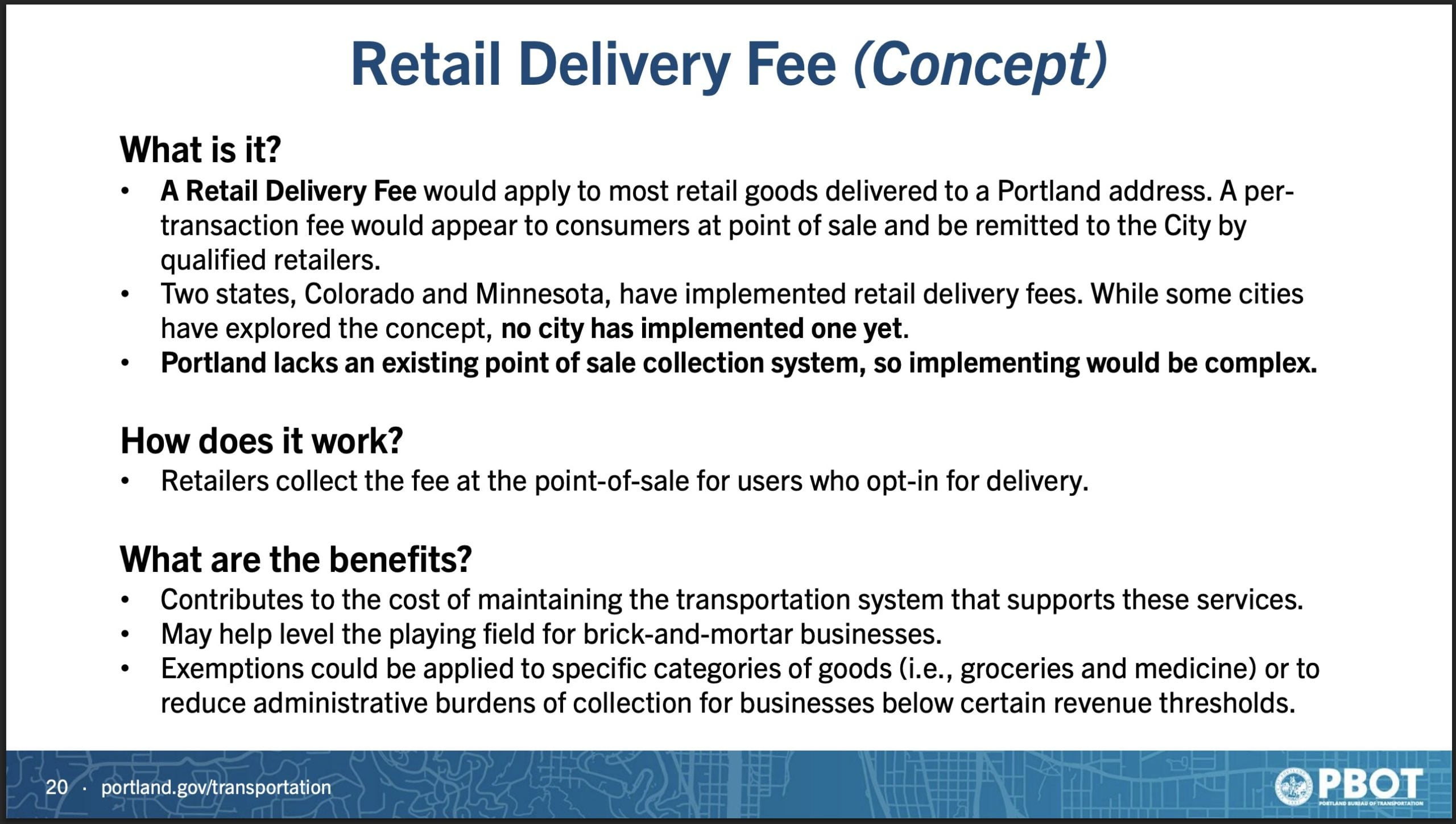
Unlike the two fees above, this one is still in concept phase. It would be charged to consumers who choose to have certain items delivered to their home or business. PBOT Mobility Innovations Manager Jacob Sherman told councilors Monday that two other states have already instituted a retail deliver fee, but Portland would be the first city to do so. With e-commerce exploding by 40% since 2019, PBOT says the time has come for someone to pay for the added trips these purchases add to our road network.
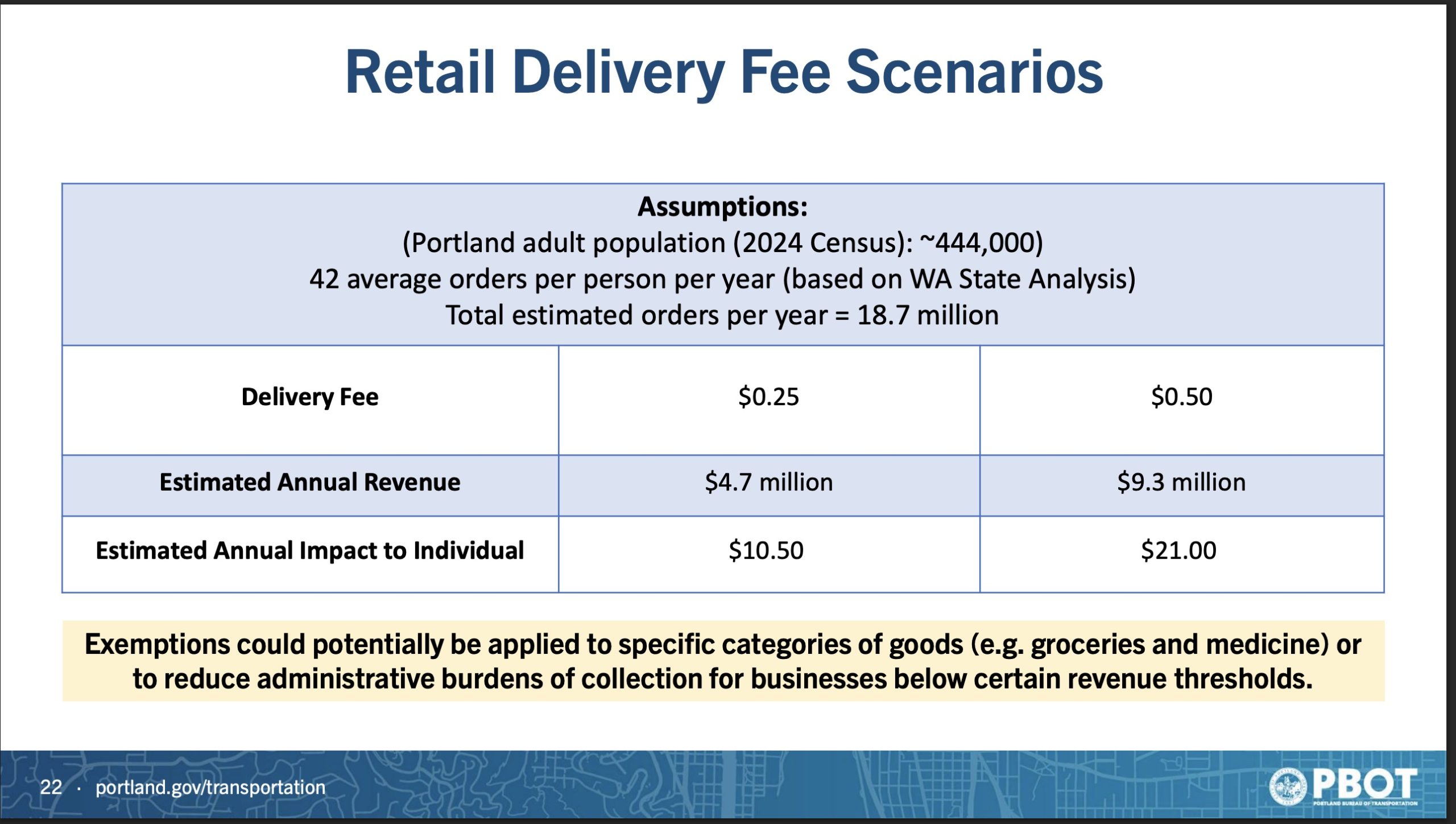
PBOT floated a per delivery fee range between 25 and 50 cents that would raise an estimated $5 million to $9 million per year. Note that exemptions would be made for deliveries that include groceries or medicine.
Third Party Prepared Food Delivery Fee
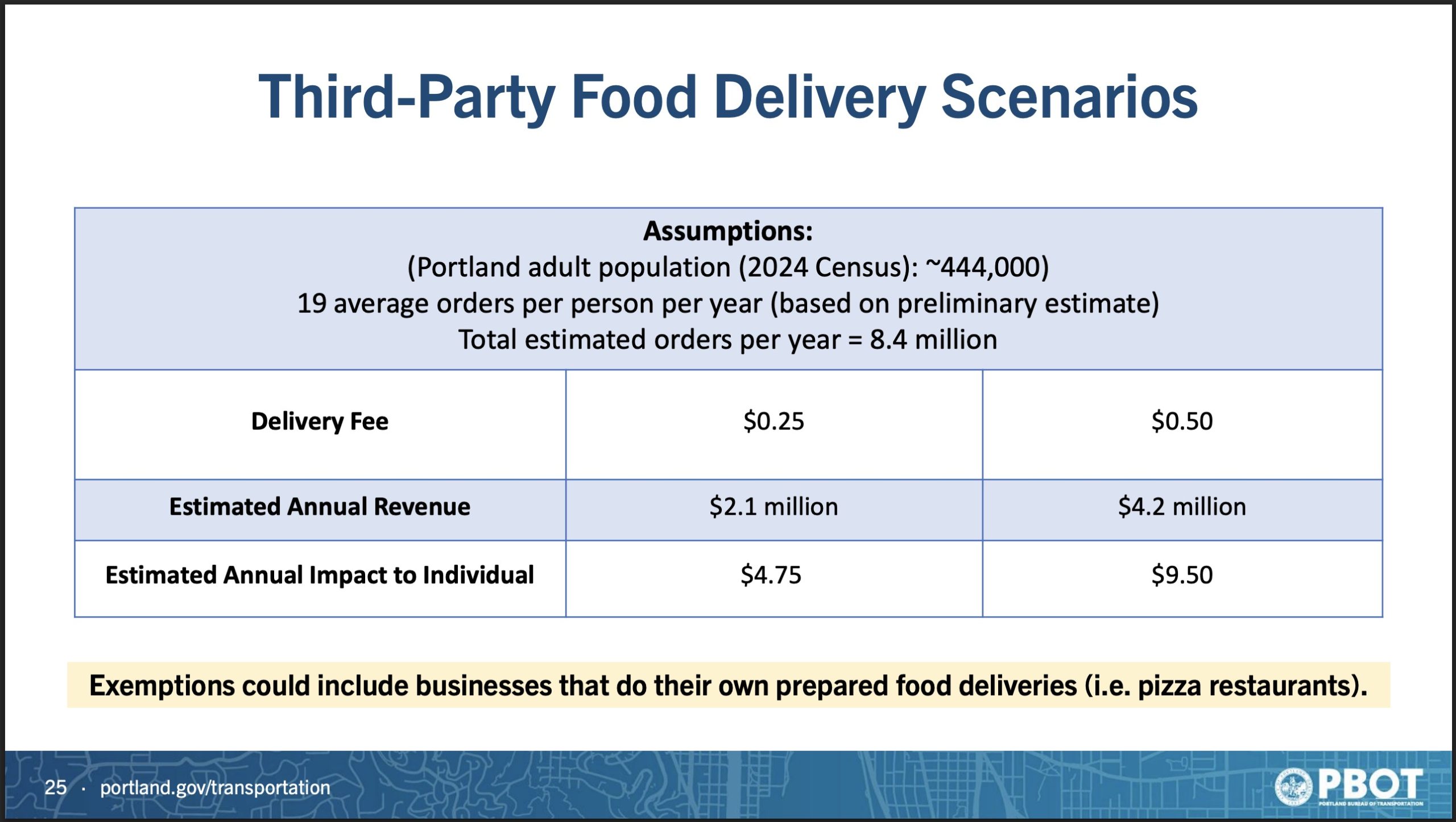
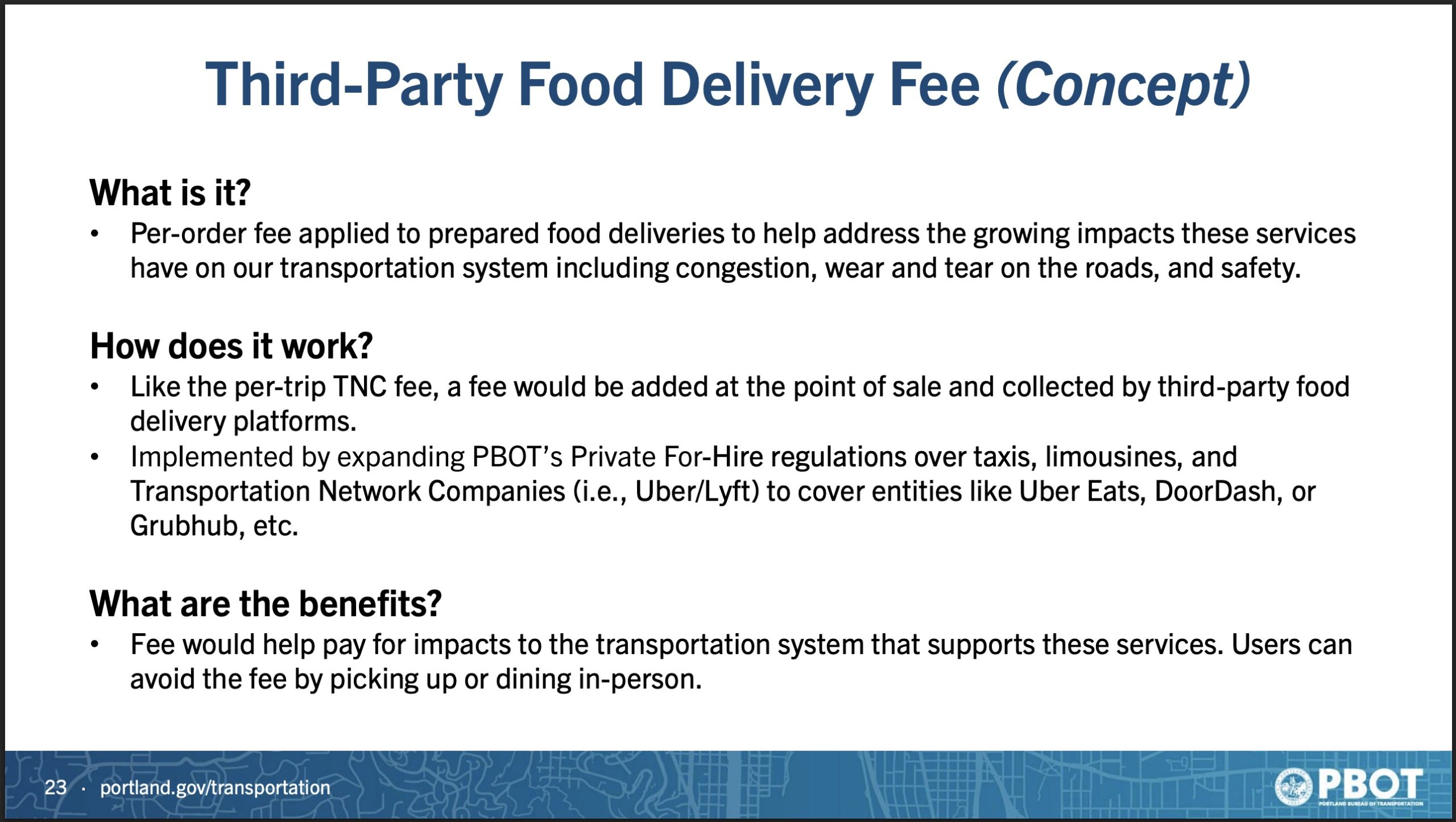
Also still in concept phase, PBOT likes this idea in part because it might encourage some people to patronize businesses in person (which has a ripple effect on the local economy). The idea would be a fee similar to PBOT’s current surcharge on Uber and Lyft rides. “By implementing a fee on these convenient services, it would send a price signal to consumers and generate resources to maintain and hopefully improve the transportation system,” Sherman said.
A per delivery fee of 25 or 50 cents could raise between $2 million and $4 million respectively.
Bonding
One other idea City Council asked PBOT to explore is bonding. Cities can sell bonds to get money up front for infrastructure projects. When interest rates are low, cities can pay back these bonds on relatively good terms. Director Williams told councilors that PBOT has explored selling $50 million in bonds that would cost them only $4 million in debt service over 20 years. “This could be a meaningful part of the proposal we discuss over the next few months,” Williams shared.
When it came time for councilors to ask questions and share opinions about the new fee ideas, there wasn’t a lot of pushback or fireworks (it’s still early enough where no one is being asked to make hard decisions).
Councilor Mitch Green cautioned PBOT about setting the TUF rate too high. Green feels like the regional average of $12 per month is, “Kind of a lot to ask.” He’d like to see something closer to $6 a month. When it comes to the delivery fees, Green said PBOT should consider going much higher than 25-50 cents. That amount, he said, “Is not going to be a meaningful impact to get people to change… You’ll just absorb that. It’s a rounding error.” “A delivery fee needs to be something that you notice on the bill and are like, ‘All right, I’m done. We’re going to take this bus trip into town,” he continued. “If it’s at least a couple bucks, then people say, ‘All right, let me go in and spend my money at this place,’ and that will have broad benefits to our economic development. So so I think we should be a little more aggressive on that front.”
Green also PBOT if they could make food delivered by bikes (or any non-car vehicle) exempt from the fee. “Most definitely,” PBOT staff replied. “Those are things we’ve been thinking about.”
From here, PBOT will organize a series of open houses in each district. Those dates haven’t been released yet, but we can expect them to happen at the end of February and early March. Stay tuned.
— View the full presentation that was shared at this week’s T & I Committee meeting.
Thanks for reading.
BikePortland has served this community with independent community journalism since 2005. We rely on subscriptions from readers like you to survive. Your financial support is vital in keeping this valuable resource alive and well.
Please subscribe today to strengthen and expand our work.
The report and the options presented appear well thought out. My concern is the report doesn’t compare actual annual maintenance outlays to how much money the city should be spending to maintain our $22 billion transportation system. Clearly, we haven’t been spending enough for decades, and it shows as noted in the report with almost 3/4 of our local streets and over 1/2 of our major streets and bridges in poor condition. Roughly 1/2 of our $22 billion system has fallen apart or is close to it. That’s astonishing!
Fixing Our Streets has raised considerable additional funding, but obviously it’s not nearly enough. Although it will be a very depressing conversation, the city needs to identify what it will really take to stop the condition of our street system from ultimately sliding to rock bottom. If we only get another nickel or dime when we actually need a dollar, this fund raising will only delay the inevitable.
They already have. PBOT reports on the its maintenance backlog every year. It’s currently up to $6 billion or $600 million a year for 10 years. It was $4.4 billion in 2023 and $1 billion in 2015. I tried to find the actual report but I can only find news articles like this mentioning it:
https://kval.com/news/local/portland-oregon-cities-will-soon-feel-impacts-of-a-failed-transportation-bill-politics-kotek-republicans-democrats-money-funding-buses-transit-repairs-roads-highways
This is the page it’s supposed to be on but they only have the 2024 report and older.
tl;dr None of their suggestions come even close to raising enough money to fill the maintenance backlog. The 100% TUF fee would need to be 13 times higher to raise enough.
It’s a depressing conversation only for those truly concerned that smooth pavement equals prosperity and economic well-being in their community. I’ve been to numerous communities, I’m sure you have too, where the streets were generally beat to crap (Philadelphia & DC come to mind) and where the average street condition was no longer a priority. I figure at some point, and it may have already occurred, that the citizens and elected officials in Portland are going to be resigned to having bad pavement forevermore and will move on to more pressing issues. The nice thing about crappy pavement and nasty potholes is that it does tend to slow down speedy motorists.
Nothing more taxes can’t fix.
Over 30 cities in Oregon have a transportation utility fee. We can do this!
It’s on page 2 of this report https://www.oregon.gov/odot/Programs/RUF/Item%205%20-%20Local%20Government%20Revenue%20Options%20Overview.pdf
To me, the most straightforward option seems the transportation utility fee. I guess it is regressive, but buy that argument so is a fee for trash service. The thing that sells it to me is that it would be simple to implement and doesn’t rely on people continuing to drive or buy gas – or use services like delivery that drive or burn gas. Regardless of whether someone drives, bikes, walks, takes the bus, has everything delivered, they pay into it and benefit from it. 8-12 bucks a month is doable for most people I think. Especially if the gas tax and parking fees don’t have to be raised or re-implemented constantly to bail out PBOT.
Green is missing the point here. I also think that Doordash is degeneracy but this is about funding PBOT, not changing people’s behaviors. If he really wants people to opt for dine-in or takeout, he needs to make sure that restaurants are able to operate without getting buried under surprise fees and red tape. Also making sure that the city facilitates affordable, local restaurants opening within walking distance of people’s homes.
You could make it less regressive by making it a property tax. Their estimate of the average homeowner’s assessed value for the parks levy was $220k. To raise the average TUF of $12 a month for a single family home that would come to $0.65 per $1k assessed value.
I agree and like this idea, but my understanding is that would require voter approval every 5 years, just like the parks levy does. The proposed TUF could be done entirely by council action if I understand correctly.
Disagree – it should be like the Arts tax.
Anyone who lives here should pay.
yes, but for some it’s not; so the mention of an exemption/reduction based on need is an excellent idea.
It might be straightforward to exempt folks who qualify for TriMet reduced fares. Could even go so far as to ask TriMet for that data and then just auto-exempt folks so they don’t have to go through another administrative hurdle.
Right, simplicity and broad base is key. And the mechanism already exists to assist low-income folks on utilities. As for delivery app fees, maybe a reduced fee for bike/ebike delivery?
So much this, particularly the whole fee system debacle surrounding outdoor dining. The city needs to incentivize that, not punish it. Restaurant business is incredibly difficult as it is.
Firstly and most obviously, the %70 Residential v 30% Commercial revenue split is upside down. Heavier commercial vehicles do more damage to roadways.
I appreciate the low income discount for households, but if a household doesn’t have a motor vehicle registered to it, that household shouldn’t be taxed. People who walk, bike & take public transportation are already taxed in terms of time & convenience, not too mention that they also provide societal benefits low, maybe even no air & noise pollution as well as not contributing to traffic congestion, property damage, injury and police, fire and healthcare costs from motor vehicle crashes, not to mention the subsidizing of parking private motor vehicles on public roadways.
Some cities & states have a vehicle luxury tax for vehicles that have an MSRP over a certain price. I think that’s more than fair and I’d suggest expanding it to motor vehicles that are much heavier, much larger, much greater horsepower, etc.
It would be easy to tough out the average residential motor vehicle in terms of size, weight, MSRP, HP then maybe add %20 for good measure and then tax people w. vehicles outside the average.
Of course, have an exception policy if folks need wheelchair van or a truck for their landscaping business, for example.
But yeah, you tech bros by day & street racers by night, you gotta pay more for your Alfa Romeos.
And lastly, if you get caught street racing, there should be an additional street repair fee on top of any fines as well as having to pay for any damage done to infrastructure.
I don’t not believe you, but I’d like to see a reference if you’re working from one. Single semis obviously affect tarmac more than a typical SOV, but in total, what’s the actual split?
This so so much. Plus smash your car, turn it into an equivalent mass of hot wheels, and community service means distributing them door to door like John Turturro in Big Lebowski.
I think The City could add weight/length taxes that get paid at registration/DEQ. All the people driving sprinter motorhomes around town should be paying more!
Just say “only the ‘rich’ should pay for a system everyone benefits from”.
I would support this if it were $0 (or better yet negative) for multi-family residents and more like $200+ per single-family home residents.
A 100% Street Damage Restoration Fee and Burrito Taxi Fee are no brainers. Also, why the **** are public funds being used to repair damage caused by greedy investor-owned utilities and communication companies?
I’m concerned that utilities will simply raise prices in response to this. And utility bills are already growing at an insane rate…
That’s not how utility prices are set.
Actually, it is, albeit indirectly. A utility goes to the PUC and shows them their expenses and revenues to justify a rate increase. As expenses go up, the PUC will inevitably approve a rate increase.
Nominally the Utility License Fee is supposed to be used to pay for the damage done when utilities dig up the right of way, but since it accrues to the General Fund it actually all just goes to PPB/PFB
The real doom loop.
If you think greedy investor owned utilities are making enormous profits, but invest in them. You can then afford to donate your share to causes you care about.
The first two options are the best, the street damage fee and the utility fee. Unfortunately city crews are not the choice pavement repair people, because their work is mediocre* and nobody will make them go back and fix their mess.
The utility fee is distributed over everyone who needs streets, it’s easy to administer and pretty much impossible to evade. The city needs to put their back into this, communicate the benefits of the plan and just not take any shit.
The delivery fees don’t raise a serious amount compared to the scale of the problem. They are a nightmare to put in place and administer, and the biggest players are the ones most likely to find a way to avoid them or pass the buck.
If we need money from deliveries, use a carrot instead of the stick. Put in place convenient parking spots in select locations that are privileged for users that pay a fee for each marked vehicle. Anybody who cheats on the spot gets a boot on their wheel and a stiff fine–more money.
My worst criticism of this plan is, it is just so very shy. They should double the target amount, at least. As a bike rider, I’d happily pay $100 per year for a pavement repair utility. In 2002 a failed pavement repair on SW 4th Avenue cost me five weeks work. I was lucky to recover from my broken shoulder without lasting pain or disability.
*Ride NE Tillamook East bound between between Rodney and MLK. That’s the water department’s work.
The public would likely have to vote on a general utility fee, so maybe it would be better not to go too heavy on the tough love. Given the public mood, I’m not at all sure that people would pass another Arts Tax But For Roads.
Maybe the city could just dig into the Arts Tax like it was PCEF.
All of the people who’ve said Portland’s taxation schemes are a mess have a point, going all the way back to the state property tax referendum that capped revenue and built inequities into the system that arise from the date of property transfer, among other things. There are tax initiatives that I voted for and would still defend that have unintended consequences.
I think that paying for streets as a utility makes sense because we all share in their use in one way or another, the individual impact of bad streets can be suddenly disastrous, and the measurable public benefit of good streets is many times greater than any fee proposed so far. That’s what I need to hear from the city, without apology.
If I could volunteer for 10 hours a year and the result was smooth pavement I’d start tomorrow. It’s even easier for me if it were 10 hours of take home pay because I wouldn’t have to get up from this chair.
Obviously, someone needs to pay to maintain the streets. The question is what funding formula will voters will support? My personal feeling is that a street utility fee will be a hard sell in today’s Portland, regardless of its merits.
The City, County, and State have all demonstrated an acute inability to return value in exchange for the tax revenue they collect, and that makes it more difficult to ask folks who are already feeling pinched for more.
That’s not a moral argument, that’s a practical one that any tax proposal is going to have to overcome.
And, like Kotek and the ODOT funding, do you think the D3 and D4 councilors who are up for election want to be running on the same ballot as a tax increase they themselves proposed?
“The City, County, and State have all demonstrated an acute inability to return value in exchange for the tax revenue they collect, and that makes it more difficult to ask folks who are already feeling pinched for more.”
This statement captures my sentiments exactly. By disposition I am a pro tax big government kind of guy. I want the folks that govern me (from Mitch Green to Ron Wyden) to understand that the biggest hurdle to stable funding is perceived failure to deliver services in a reasonable manner. I still support increasing taxes, but, man, I can smell in the air the reasons people think their taxes are being pissed down the drain. The thing the city seems best at doing is projecting a perfect sense of hapless incompetence.
Well said.
Well, there are street murals…
The City has technical specifications that include asphalt repair. Utilities should adhere to the City’s published standards. Further, the City needs to inspect the work (paid fo as part of the fee) and if it is substandard, the Utility can re-do within 2 weeks or PBOT can redo it and charge the utility time and materials.
I think the anyone who digs up the street should pay to have the City to pave it properly. The City has an obligation to do it well because they own the streets and are beholden to the residents, whereas the utilities are incentivized to do a cheaper, quick, crappy job and us cyclists have to deal with the lumps and holes!
I’m aware that some inspections are done after road work. I also know that rough patches can be on the street for years.
If the water department does lousy work, who is in charge of upholding the standards on that?
Amen! For example, NE Tillamook west of MLK!
Why isn’t the city charging a parking tax to every business for every parking space on their business property? Also, any business with a drive-thru should also be charged a use/utility tax.
Maybe these taxes would encourage businesses to think differently and even run their businesses differently.
These free conveniences that businesses provide to their customers is a financial burden on the city and its residents.
There are cities that have started parking fees similar to this. One idea I think the city can consider is charging an annual tax that increases every year for any spaces more than 10. That creates an incentive to develop/sell that property over a longer term, particularly in the CEID where soo much space is empty parking lots.
Maybe in peak Portlandia 2010’s good vibes times, but in the current moment that would result in a bunch of businesses closing or relocating to the suburbs.
Don’t disagree that the land could be better used; but I don’t think more taxes is the way to make it happen.
That just sounds like a worse land-value tax to me.
Why isn’t the city enforcing parking restrictions in residential areas? The lack of enforcement is essentially a subsidy to those folks violating the laws.
Yes. Let’s do this. Implement multiple fees, and soon. I’m sympathetic to Green’s argument that if a TUF is implemented, it should be kept low enough to avoid major political backlash. My preference would be a combination of the SDRF, a Food Delivery fee (at least $1 per order), and a low to moderate TUF–in that order of preference.
Many, if not most, of the utility cut and patch jobs I see (and feel!) are in some degree of failure– that is, they settle well below the street surface, making a dangerous condition for bike riders and wear and tear on motor vehicles. I think Street Damage Restoration Fees should be adjusted to cover the full cost of re-doing those patches to match the original street surface.
The ones they made recently on Madison between 7th and 12th have been killing me and they’re getting worse by the day. There doesn’t seem to be an easy way to report them either.
What solid guarantee do Portland residents have that these revenue sources for transportation won’t suddenly be yanked out from under PBOT by a future city council to pay for police, parks or housing like they did long ago with the ULF (which was for restoring ripped up streets)?
Good point. There’s a backlog of street damage from utility cuts. Restore the ULF to its original purpose.
Now you’re seeing why some are arguing so strenuously to keep the PCEF tied stringently to its stated and original function. As the ULF was reapportioned out of existence, so too can the PCEF.
tbh all of these taxes sound worthwhile to me:
I would like PBOT to create a reporting system where you can send ina photo of a delivery vehicle parked in a bike lane and that company gets fined a set amount that escalates with more infractions. It could generate A LOT of money, and if if companies changed their policies, then we get our bike lanes back.
There is a goldmine already sitting on our streets. We need more residential enforcement of vehicles parked in the wrong direction, abandoned, unregistered, etc.
Yes. So this already exists in NYC and DC I believe (there might be others in the US). There are 311 app-based systems that take a very short time to report (and allow for the city to respond to your report, which may or may not happen depending on the precinct).
Currently, if you want to report a vehicle parked illegally in Portland, you have to listen through and navigate a several minute long answering machine service (so painful), and remember to leave a voice message with all the pertinent info. It’s straight out of the 90s. Unfortunately, on top of that the city has a prioritization system where hotels downtown get top response and blocked crosswalks in SE get pushed closer to the bottom of the list. I would argue for ADA reasons alone blocked crosswalks should get the priority.
The TUF in Bend is very favorable to auto centric residences and very unfavorable to car-lite or car free urbanist residences. The fee is the same for a 2000sq ft downtown lot with 0 or 1 vehicle as it is to a 9000+sq ft lot on top of Awbry Butte that has 4 vehicles and is generating 10x the VMT and is dependent on expensive plowing and cindering in the winter. Residences outside the city limit pay no fee and are even more vehicle dependent on city roads.
Yeah it seems like a bad idea to charge the person living in the city, walking to work or to get groceries instead of focusing on the people driving ten miles in from a suburb in a private vehicle everyday.
A realistic resolution would be things like higher parking fees and increasing the areas for paid parking.
We should incentivize the behavior we want to see (people living close in and biking and taking transit) and penalize the behavior we don’t want to see (people driving across our roadways when they don’t have to, or making them pay the cost of they do regardless).
I totally agree with you, but as a Portland resident and bike commuter. I want the roads I frequent to be smooth and safe, even if it costs me a few bucks extra.
If PBOT has more money, maybe they can also install diverters and other traffic calming in town to keep cut-through traffic on the freeways and major arterials. We should also reduce parking lots and expand fees for street parking, including residential streets. Gotta pay to store your private property in the public ROW!
Jeremy B, as a simple start, the City could a require a permit for anyone to park on the street. They could start by letting every household get one permit for free. That would get rid some of the second/third/4th cars and trailers/ rvs that are just stored in the street
The City pours resources into the West Hills in the winter with de-icer and gravel and plowing- should they be paying more?
All of these tax proposals are well-thought out! The fact that there has never been a street damage restoration fee is wild to me. k
LOL.
Now we know why for all these years PBOT and our politicians have ignored maintenance to build new things instead. Remember our politicians could have said “No PBOT you can’t do that shiny new thing you have to do maintenance this year.” Did we ever hear our politicians say that? I can’t say I have.
Time to stand up and say we are overburdened with taxes, enough is enough, and PBOT to get out in the field and start doing maintenance. You have the personnel and equipment. Enough with the pity parties for them.
If any of these come before me for a vote I will of course vote NO!
Portland City Hall says relax everyone it’s not a tax it’s a fee.
Then immediately rolls out four new fees and starts brainstorming a fifth.
Street damage fee transportation utility fee delivery fee food delivery fee.
If you order dinner and the driver hits a pothole you basically owe a combo platter.
PBOT is broke the streets are cooked and the answer is apparently hey mate just chip in a bit more every month.
Call it whatever you want but if it empties your wallet it’s a tax.
The doom loop is real.
Next up a small convenience fee for thinking about driving followed by a modest surcharge for noticing the fee.
Yeah, the cost of driving is astronomical. If you want “nice things” you have to pay for it.
Unfortunately for the citizens of Portland our elected officials are the ones that want the “nice things” (photo ops make for great re-elect me fliers) and don’t want to use our burdensome taxes we already pay to be instead used for maintenance.
Stop driving, it’s cheaper!
I presented PBOT staff with ‘street damage’ and ‘everyone at once’ regulations from other cities a decade ago, Not much interest. ‘Everyone at once’ regs mandate anyone cutting the pavement had to contact every other utility that might also have future plans to work in the area… laying a new gas line? Gotta ask sewer, water and other utilties if they want to do work while street was open; otherwise big fees for recutting surface. Bit of hostility to that one, as it required bureaus to coordinate.
I first became aware of the total lack of coordination among Portland bureaus when PBOT paved a bikeway I rode daily and then six months later the water bureau tore the whole thing up to replace everyone’s mains, turning the street in to a roller coaster.
Bonds seem like a bad idea. It doesn’t make sense to sell bonds for regular maintenance! Maintenance keeps happening, bonds have to be paid back. It’s just a loan. You don’t take out a loan so you can change the oil in your car.
I suppose I could see it for paying off the maintenance backlog, but then they need a plan to pay off the bonds as well as funding for continued maintenance.
I generally support the SDRF and TUF, but I’d like the City to offer voters a lockbox-type amendment to the city charter that mandates transportation funding be used for road maintenance and safety improvements. Nothing else. We have a massive maintenance backlog, and I don’t want future city councils raiding transportation funding to pay for various pet projects. That includes transportation projects like off-street bike paths, new pedestrian viaducts, or extending the Portland Streetcar.
I’m perfectly willing to vote to tax myself to fix our roads. But I’d like assurance that money WILL be used to fix roads (and/or make them safer), and nothing else, today and into the future.
Douglas, I also support the TUF and SDRF, and I like your suggestion to ensure the revenue stays for transportation. But couldn’t an off-street path or bike/ped viaduct improve safety?
Yeah, but if there’s merit to projects like that, the city can find funding elsewhere. My stance on this is “fix and improve (for safety) the streets that already exist. Don’t build new stuff with it.” Off-street paths and new viaducts, whatever their merits, fall into the category of “new stuff.”
And I say this as a car-free cyclist who likes off-street bike paths. But I prefer to spend this money on fixing streets and making them safer.
The only “new” thing I’d want to see this money spent on is paving gravel roads that are already in the public right-of-way. I see paving an unpaved (but existing) street as akin to maintenance.
We were assured PCEF would be used to help poor people with heating/cooling and insulation improvements on living spaces. Guess what, it’s being raided now and will continue to be.
We were promised years ago the Utility Fees would go to transportation; it was raided over and over.
Sorry, it’s sad, our politicians lie, cheat, and steal from us all the time and they can’t be trusted at all.
NO on any and all new taxes and fees!!! Enough is enough!
That’s ENTIRELY the point of putting a lockbox in the city charter for street repair. It doesn’t rely on unenforceable promises; it creates a legally enforceable requirement to spend the money on fixing streets and improving safety, and NOTHING ELSE ever.
It’s the historic tendency for politicians to raid funds for stuff other than the intended use that makes me want to see something put in the charter.
Is that possible? History says it is not.
I would have loved to see a neighborhood permitting option to both pay for the street system
Curious what you mean by that?
Well I didn’t complete the thought, hence “both”.
Many cities of our size and most(?) larger cities use permitted passes for overnight/work parking. This limits the amount of cars parked long term on the street. It creates a general barrier to car ownership which also would help move people to active transportation.
I’ve lived in Bend for the past 2 years. I have not really noticed the impact of our TUF on my utility bills. And, though I heard plenty of whining when they were implemented in 2024, I hear no whining now. Instead we have decent roads, safe crossings, and more roundabouts on the way!
People will get used to an additional cost. It’s fundamental knowledge that our roads are not able to be maintained with the current pot of money. Costs have gone up everywhere. Vehicles have gotten heavier (ie, more damage) and more fuel efficient (ie, the gas tax is less effective) Short of a per mile charge for road use (my ideal taxation strategy), levying a small fee for everyone seems like a great way to fill the pot. I hope Portland follows that route.
Let’s guess you don’t have any of the following in Bend:
Oh heck, there’s more, but just because you can afford your TUF doesn’t mean everyone in Portland can afford this in addition to all the other taxes we pay.
People thump their chests in Portland about how housing is unaffordable, well add yet another tax that folks have to pay means less $$ for their rent or mortgage.
Our local governments have plenty of money, they just don’t spend it wisely.
Don’t get me wrong, Bend is great town and I think the improvements to the streets have been great, but it’s time we tax payers say enough is enough in Portland and for our politicians to quit trying to make international policy or telling us what we can or can’t eat and just take care of the citizens with the money they already get.
What’s with all the complaints about the arts tax? Does $35 per year break your budget? If so, you probably are exempt from the arts tax. My state and federal taxes dwarf all the local taxes you mention to a rounding error. And at least I can see the benefits of local taxes.
“Does $35 per year break your budget?”
$35 is affordable for most people. And yet the Arts Tax is one of the most reviled taxes in Portland.
Maybe the reasons people don’t like it are not directly related to its financial impact.
Where’s the plan that charges the trucking industry? Aren’t large, multi-ton vehicles the ones that do the most damage to our roads? And isn’t the trucking industry the biggest proponent of our most expensive capital road projects? Their entire business model seems to hinge on being subsidized by the public.
And what about studded tires? I realize we wouldn’t make much money off them, but maybe banning them will help prevent the disproportionate damage they cause to the roads.
“Where’s the plan that charges the trucking industry?”
I was under the impression that the trucking industry already pays a lot of taxes for using the roads. So much so that the Democrats passed a law to lower their relative contribution. (It was part of the ODOT funding law they passed last session.)
Of all the ideas , I’m not seeing studded tires mentioned once. If you want to fix the-roads(.?) the first thing to do is stop needlessly tearing them up. I tried to get a ballot initiative on the ballot in 2011, to ban or fee studded tires. The tire industry ( Les Schwab), did everything to stop me and were successful. They cause millions of dollars in damage, yet they pay nothing. If they were so important 100% of drivers would use them. The last numbers I saw was that only 10% of drivers have them.
Please consider the administrative costs associated with collection and reporting. I fear the overhead costs associated with food delivery fees will be huge.