
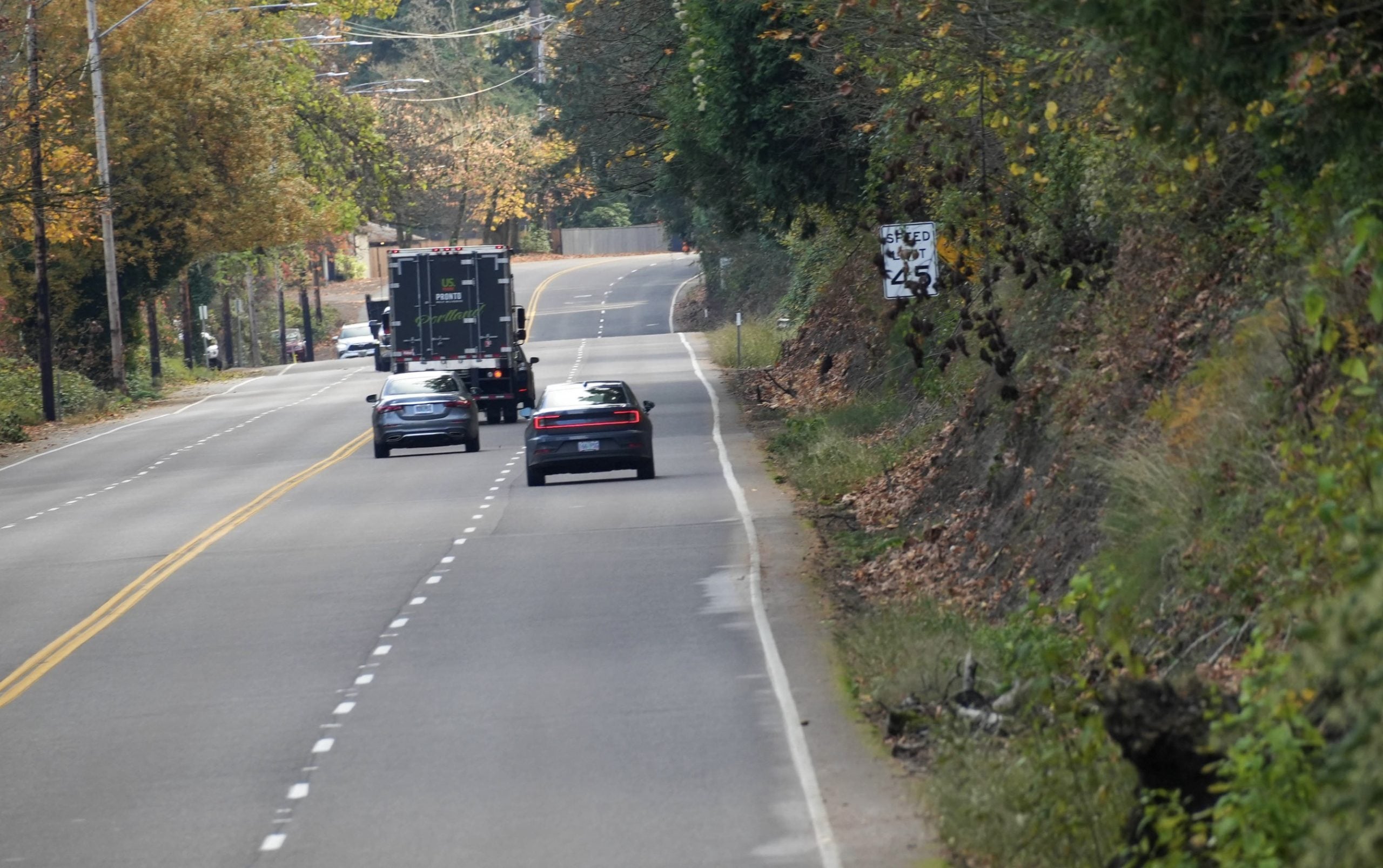
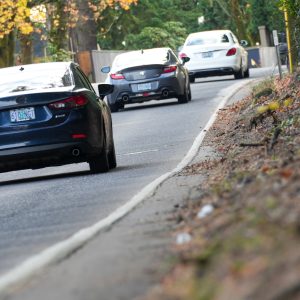
The Oregon Department of Transportation manages a highway near Portland’s southern border that’s the only way for some bicycle riders to travel between Sellwood and Lake Oswego. Unfortunately this highway, Highway 43, poses extreme risks to cyclists who encounter a shoulder full of rocks and dirt with just inches of space between themselves and car users driving over 50 mph.
68-year-old Rutilo Jorge learned that the hardest way. He was killed while bicycling on Highway 43 on November 11th. Police officials say he hit a rock in the shoulder, lost control and then was involved in a collision with a driver.
It’s unclear exactly what happened that night; but it’s clear the current conditions cannot stand. ODOT must provide a greater level of safety for bicycle riders in this corridor.
As I reported last month, ODOT Vulnerable User Crash Response (VCR) team took a closer look at the location of Jorge’s death with an eye toward identifying changes that might prevent future tragedies. I’ve been in touch with ODOT Region 1 Public Affairs Manager David House about the ODOT investigation. He said the goal of the team is to, “identify risks and potential options to reduce risks to vulnerable users such as cyclists.” House shared that the VCR team has dedicated funds to implement projects, but those are limited and very uncertain at the moment given ODOT’s current funding crisis.

House says the VCR team has recommended the installation of warning signs, “as an immediate measure that can be done with available funds.” The plan is to identify four to six location in the area where Jorge was hit where caution signs would be installed. House says the signs, “would increase car driver awareness of cyclists.” The signs are expected to be installed sometime this spring.
As for longer-term options like widening the highway or restriping existing lanes to make space for a protected bike lane — those would require a much larger financial commitment that ODOT is unwilling to make at this time. It’s worth noting that this location has already been identified as a top priority for investment, and Jorge’s death only makes it more so. It will be up to advocates and community leaders to hold ODOT’s feet to the fire and push for more substantive solutions. “We would need to develop long-term solutions with the local communities’ transportation plans as well as coordination with local cyclist and pedestrian proposals – such as Lake Oswego to Portland Trail Plan,” House shared with BikePortland in an email.
“While our current funding situation is in limbo and a long-term funding solution for ODOT may be years away, ODOT Region 1 traffic investigations will be maintaining and tracking a list of requests/improvements that we can put into effect once an alternative source of funding is found,” he added.

Thanks for reading.
BikePortland has served this community with independent community journalism since 2005. We rely on subscriptions from readers like you to survive. Your financial support is vital in keeping this valuable resource alive and well.
Please subscribe today to strengthen and expand our work.
“As for longer-term options like widening the highway or restriping existing lanes to make space for a protected bike lane…those would require a much larger financial commitment that ODOT is unwilling to make at this time”
Been using this stretch for 23 years now. when is the time?
ODOT needs to widen a bunch of freeways first.
How much is ODOT paying for a gallon of paint these days??? Restriping, even if just in a few sections, is absolutely the cheapest thing they can do,
Other than nothing, of course.
I think the cost would be the labor to do the striping, and the traffic control required to make sure the crews could work safely.
Oh and also the $200/hr consultants to design mailers and run public engagement meetings with every bored boomer in Lake O and Riverdale.
A broken link like Highway 43 is one reason that you see few people on bikes in Lake Oswego, along Willamette Drive (with its stranded bike lanes) or in West Linn. Hell, anybody who grew up there had no use for a bike, their parents would probably rather they ate shrooms or went BASE jumping than ride a bike.
Me taking a heroic dose of shrooms before BASE jumping on a bicycle
Probably never. Even if there was the political will and finding, they’d still e to contend with boomer NIMBYs throwing temper tantrums about losing driving space. They want the rail to trail thing to happen on someone else’s dime (which will never happen because of boomer NIMBY temper tantrums) so they can be absolved of having to provide any kind of bike facility.
No “temper tantrum” required; if the rail line is closed, the land reverts back to the adjacent owners. It’s practically automatic.
To build a bike route in its place, all you need to do is take a large sack of money and find out how much it is worth to folks to allow a linear campground to be developed across their property. Our unwillingness to deal with the problems of addiction and homelessness makes projects like this nearly impossible.
PS: If you have a strong argument, you can make it without demeaning others.
People should be riding the trail as it is now. Southbound and Northbound, aside from the trestle(easily bypassed), it is open and can ridden. Plenty of shoulder if you like riding dirt and have a light for the tunnel.
I wonder if any studies have been done around the efficacy of those types of signs. Do they affect driver behavior enough to make a difference, or are they like thoughts and prayers?
Anecdotal story: some years back a couple of friends new to bicycling spotted one of the black/yellow caution signs and took it to mean that they should go that way…which, of course, is pretty much the exact opposite of what it signifies in reality. They survived but experienced a fair amount of unpleasantness.
Anecdotal story: I rode by a place for many years that had a “deaf child” yellow/black caution sign. By about year 10 in occurred to me that the aforementioned child was in fact no longer a child; and yet the sign persisted for at least another decade (and I don’t know how long it had been there previously…). You decide what my point is.
There could have been successive deaf children in a family or facility.
possibly, but it’s a single-family residential neighborhood (on SE Lincoln at ~ 28th IIRC).
Apparently ODOT’s response to a cyclist being killed on Highway 43 is to install a few signs reminding drivers that cyclists exist. Bold strategy. Meanwhile the road itself remains a gravel-strewn death chute with inches of shoulder and cars flying by at 50+ mph.
If we’re being honest, the only sign that wouldn’t be pure performance would read: “CYCLISTS: THIS IS A DEATH ZONE. ENTER AT YOUR OWN RISK. ODOT AWARE.”
Will they also install signs to increase driver awareness of signs? If they’re not paying attention to actual vehicles on the road what are the odds they’re paying attention to a sign on the side of the road?
I suppose the problem could be they saw the cyclist they just didn’t care to drive around him safely. What kind of sign could we put up for that?
Speaking of I haven’t seen a sign for the person who died on Harrison and Chavez. They haven’t updated their Deadly traffic crash response page since 10/21/2024. Is the page outdated or have they stopped doing it? Has anyone else seen any of these signs going up in the past year?
They’d probably get more bang for the buck getting targeted ads for the drivers’ phones seeing as that’s where they’re looking anyway.
So true.
It would certainly be seen by my neighbor who posted a virtue-signaling get-your-COVID-shot-to-protect-your-loved-ones Instagram selfie showing herself with her fresh Walgreens vaccine bandaid.
The only problem was she took it (as was very clear by the reflections in her sunglasses) while she was driving down Highway 43 near the Sellwood Bridge.
Put a warning sign up on the road that has deadly conditions. That will surely fix it.
Putting up signs is ODOT’s version of “thoughts and prayers.”
These signs will do absolutely nothing. They are the worst kind of performative governance.
But performative government is what voters here support right? Gaza, foie gras, “correct” vocabulary (unhoused, houseless, undocumented, etc). You get what you vote for.
I bet ODOT would have the cash to stripe some bike lanes if they weren’t paying hunks of cash to email job consultants to make dumb trafficpocalypse slideshows.
This is a great point. ODOT seems to spend almost as much time and energy telling us all what they can’t do if they don’t get funded, as they do in their actual job.
Not to mention the millions they’ve sunk into the RQ and IBR freeway widening projects that will probably never happen.
It would cost less than a billion dollars to widen Highway 43 so it is just uninteresting.
These signs are a waste of money. Maybe better to warn bicyclists about the dangers of this road. “ODOT knows you can be killed on this road — and doesn’t care.”
Meanwhile on Highway 43, ODOT has begun it’s “ADA Curb Ramp Upgrade” project. I was excited to see that several intersections on Highway 43–a few between LO and the Sellwood Bridge, and many more north to downtown–will get new curb ramps that will facilitate crossing the highway.
But when I contacted ODOT (initially about their putting up a pedestrian detour that blocked a crosswalk and forced people to walk several feet unprotected in the middle of two driving lanes–and they didn’t correct it until a vehicle crashed into the barricade after I warned them that would happen) I found out that their maps that were calling out “ADA curb ramps” are going to get “CROSSING CLOSED” signs instead.
So instead of helping pedestrians and increasing crossing opportunities, they are eliminating them. That includes (I’m hoping to get a verification from ODOT soon) several locations that were NOT listed in a separate, earlier list of locations on Highway 43 where CROSSING CLOSED signs were proposed.
It was bad enough that ODOT is closing crossings instead of upgrading them, but worse that they hid the closures by calling them “Sidewalk Curb Ramp Construction Locations” on their map, and even worse (again, need verification from ODOT) if they’re closing crossings at locations they left off their closures map.
https://deagis.maps.arcgis.com/apps/instant/basic/index.html?appid=4556e7261dec40d0b396cafdde5af983
All this, along with ODOT’s response to the death in this article, leave me unimpressed with ODOT.
PBOT does this too- it is maddening
Meanwhile, the person ultimately responsible for ODOT is up for election, and somewhere between 90% and 100% of folks here are going to vote for her again.
Her likely opponent favored a plan to eliminate all ODOT funding for pedestrian and cycling safety improvements.
Luckily, that plan would not have passed the legislature (though what the Democrats got us isn’t much better).
I don’t know if you ever play card games, but sometimes you’re stuck with a hand that just sucks, and your best option is to waste a turn to dump it and get some new cards.
We keep trying to play with the same crappy hand, and we’re losing; it might be time to acknowledge we need to flush out the system and try for a hand that will let us move forward.
And also, as Mamdani is demonstrating, when people actually get power, sometimes they leave their most toxic, oppositional positions behind and take on the mantle of leadership. With a Republican in office, the Democrats might be more motivated to get their act together in the legislature. The world is a lot more dynamic than your flat, 1-dimensional analysis suggests.
Either way, it might be time to invest one cycle to finally be able to move forward.
Or maybe we should just stop complaining and try the same thing a few more times. Maybe next time will be different.
We’re currently “flushing out the system” at the Federal level and I do not think it’s been worth the very many deaths that have resulted.
https://hsph.harvard.edu/news/usaid-shutdown-has-led-to-hundreds-of-thousands-of-deaths/
Like you, I am frustrated with ODOT’s priorities and mismanagement. Unlike you, I have no interest in amping up the variance of our political seesaw, hoping that the next swing will ensure good governance forever after.
I don’t think any Oregon Republican would (or could) govern like Trump — he’s a singular “talent” that no one else I’m aware of can match. In Oregon, a supermajority in the House and Senate would give Democrats a huge check on the governor, which is a very different situation than we have at the federal level.
I expect Kotek to be reelected, and I expect the status quo of dysfunction, inaction, and regression on virtually every front to continue for another 4 years.
That’s just not something I think I can support — kudos to you if you can.
Restripe the highway to one traffic lane each way between Lake Oswego and the Sellwood Bridge, along with a two-way bike lane. It’s really that simple.
There are only three traffic lanes along most of that segment anyway. More significantly, there are two northbound lanes and one southbound lane between Lake Oswego and a point just north of Breyman Avenue, Then, for no evident reason, the two northbound lanes converge into one, and southbound traffic gets an extra lane, Which means that both northbound and southbound traffic get only a single lane all the way through.
Since one lane clearly is enough to handle both northbound and southbound traffic, there’s no reason to have two lanes in either direction along any part of that segment. Creating an adequate bike lane requires nothing more than paint (and maybe jersey barriers if you want it protected).
I’ve been driving that stretch regularly for years. You’re right that here’s no need for the second lane. It actually harms driving safety, since as soon as it opens from one lane to two (or before it goes from two to one, it becomes a race to pass others no matter how fast they’re going.
Also, in hundreds of trips, I’ve never once got caught behind a slow-moving vehicle in a single-lane stretch. (Also never once seen a cop.)
Traffic is light enough you can speed even at the height of rush hour.
So your idea would benefit drivers also, although many wouldn’t see it that way.
This! Just drove it the other day for the first time in many years. The lane configurations are so arbitrary.
AND if ODOT really really really doesn’t want to do that they need to partner with the city to convert the trolley tracks to a multi-use path. That’s the only other option. Ideally of course we’d do both.
This would be a fantastic road to implement three different lane sizes in each direction.
A protected bike lane (right), an oversized vehicle lane (center) and a passing lane for appropriate sized vehicles (left). The extra space created by downsizing one of the car lanes would go to the bike lane. The bike lane could be protected by armadillos.
This is both extremely disappointing and predictable. As clearly seen in the 2013 evaluation of Lake Oswego to Portland bike/ped alternatives, ODOT wants someone else to provide off-road facilities (Metro, e.g.). Re-purposing a state road to accommodate anything but motor vehicles isn’t in their mindset (I’m talking about upper management at ODOT, not every employee).
I’ve contacted my State representative and senator to see if they can help push ODOT. No luck. Representative Gamba thinks Lake Oswego might be open to re-looking at the Oak Grove to Lake Oswego (OGLO) bike/ped bridge they rejected some years ago. If anyone in Lake Oswego wants to help in that effort, please let me know (Scott.Kelly@Sellwood.org). Another river crossing between Sellwood and Oregon City would be great. But the more direct route from Sellwood to Lake Oswego is on or parallel to Hwy 43.
I ride this stretch of 43 a few times a week. Crazy I know. And look down and see the seldom used LO Trolley trails and wish they would become a Rails to Trails option; safer, prettier and probably too sensible to gather political traction.
Or, perhaps, too legally tricky. As has been reported by other commenters on other stories, the trolley runs on easements that revert to the adjacent property owners if the land is no longer used for rail service of some sort.