

Hi folks. I’m slowly getting the gears turning again after a nice and needed holiday break.
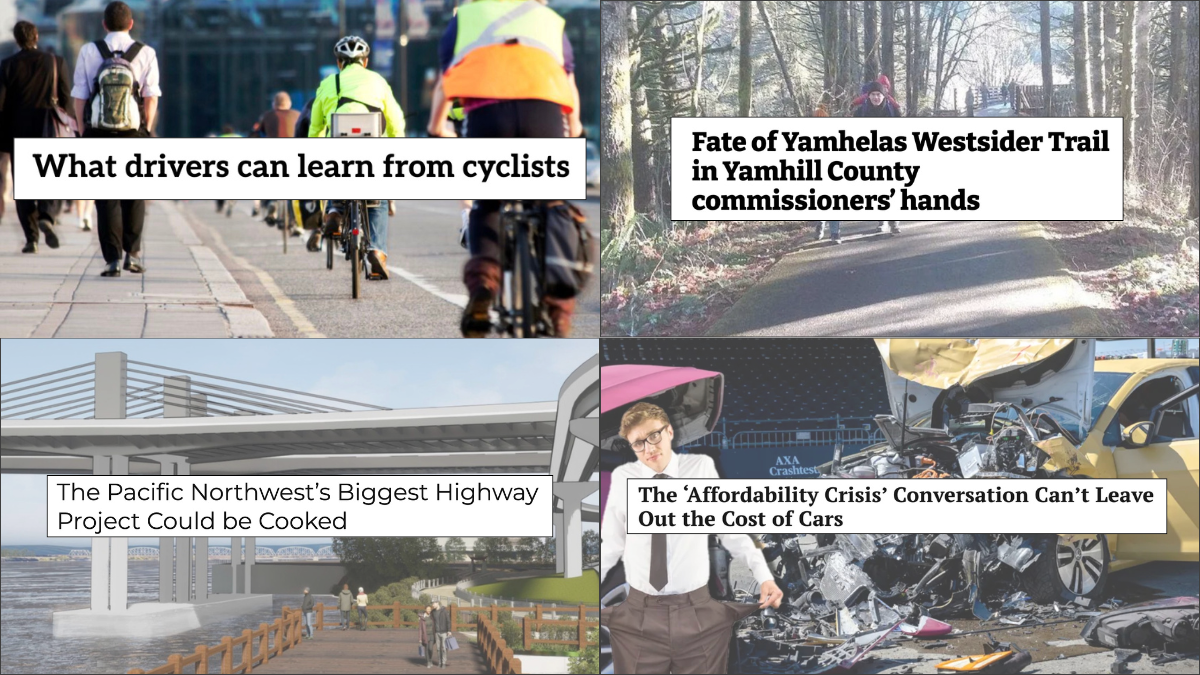
Cyclists drive better: This is a topic that comes up a lot in conversations, so it’s neat to see an article about it. The author shares a list of 10 ways being a cyclist carries over to safer driving. (Canadian Cycling Magazine)
On affordability: With all the talk of affordability in political and general policy circles, let’s not forget the huge impact the cost of cars has on Americans’ pocketbooks. (Streetsblog USA)
More about car costs: It’s not just advocacy outlets that are talking about the high cost of driving and how monthly payments have skyrocketed for folks whether they opt for a new car or a used one. (Washington Post)
Suburban divide: Fascinating dynamic in Dallas where several suburban cities want to leave the regional transit partnership because they don’t feel their residents get enough bang for their buck. Will they design their own transit systems or just not offer any service? Will the defections hurt the transit agency’s other customers? (Texas Tribune)

Yamhelas update: The proposed rail-trail in Yamhill County could be deleted from the transportation system plan if anti-trail County commissioners get their way. Meanwhile, supporters of the trail have mapped out an exciting plan to save the trail regardless of political shenanigans. (Newberg Graphic)
The O weighs in: In news that shouldn’t surprise anyone, the editorial board of our state’s paper of record has penned an essay saying Oregonians shouldn’t have to pay more for transportation services and they blame Oregon Governor Tina Kotek for the transportation bill SNAFU. (The Oregonian)
Grim outlook for IBR: This is a solid recap of where things stand with the beleaguered Interstate Bridge Replacement project with some interesting quotes from a Washington lawmaker about how one way out might be to drop the light rail component to save money. (The Urbanist)
Thanks to everyone who sent in links this week. The Monday Roundup is a community effort, so please feel free to send us any great stories you come across.
Thanks for reading.
BikePortland has served this community with independent community journalism since 2005. We rely on subscriptions from readers like you to survive. Your financial support is vital in keeping this valuable resource alive and well.
Please subscribe today to strengthen and expand our work.
The Oregonian editorial was pretty damn accurate regarding Gov. Kotek’s feckless leadership. She was a complete no show during the legislation and preemptively sunk the negotiations with her idiotic veto of tolling in a pathetic suckup to the car lobby.
You are big cheerleader of hers for whatever reason, maybe you can explain what she does right?
BB,
read more carefully before you assume how I feel about Gov Kotek. I have certainly not been a cheerleader.
I agree, I don’t see much to disagree with in the Oregonian’s analysis of Kotek’s performance. I wonder if Kotek has considered using her bully pulpit to advocate for the bill instead of advocating to repeal it?
If you were running to keep your job as Governor, and you had some of the lowest approval ratings in the country, and you had only narrowly beaten your likely opponent in a previous election, and you had very few accomplishments to show for the last 3 years of your governorship, would you want to be fighting for a mediocre transportation funding bill that merely highlighted your poor management?
Even if she thought the measure would pass, it will hurt her more politically to engage than it would to defer the question until 2027 or 2028. She can always blame Republicans for the fact that ODOT has no money.
Based on her performance, I have a very low opinion of Governor Kotek as an administrator, but I think she’s making the right call from a political standpoint, even if it forces TriMet to make deeper cuts and hurts Oregonians who need that funding, and even if it emboldens Republicans to use this ballot mechanism again in the future.
And on the positive side, it may drive the final nails in the coffin of those megaprojects we love to hate.
Kotek is better off discussing Transportation than her handling of housing, education and the economy of the state.
As bad as she is on Transportation, it’s probably one of her Strongest talking points, an issue that is not at the top of most peoples attention.
I’m not too familiar with the names in Oregon politics, but can you describe a candidate who can run on the Democratic ticket (this seems to be the requirement to win the governorship) that is better than Kotek? How do we hold the Democratic Party accountable for finding qualified administrators?
I’m hoping for someone who did not come up under the Democratic political machine. Nick Kristof comes to mind; he’s made sure that his home is in Oregon (so harder to disqualify), but he hasn’t talked about running again.
I don’t actually know a lot about how he’d govern, but I do know he’s sane and not a party apparatchik. Also, our AG, Dan Rayfield, has been talking like he wants to run. I don’t know him well, but he’s not Kotek.
As for holding the Democrats generally accountable for their failures, you really have to be willing to vote for another party. If that’s a bridge too far, then you may just need to accept the inept governance we’ve gotten used to.
I definitely agree with the idea of diversifying political parties and moving toward a more platform-centered approach to running candidates instead of this all-or-nothing party line cluster we currently have. What I unfortunately don’t see is the vast majority of other Americans coming to this realization soon enough..
One way is to call/email your state senator and representative. If you pester them regularly, an aide will probably learn your name and recognize your complaints. Prolly won’t do much good, but I think they will get the message that their constituents are pissed off.
You are probably right about this being an OK political decision, but I hate to see her dodge the problem of her own creation. I hope you are right about this killing IBR and I5RQ!
Re: affordability, VTPI gave a more academic treatment recently that I enjoyed: https://vtpi.org/ITEJ-eta-Jun2025.pdf.
It’s an important topic and one that seems like a relatively promising way of finding common ground and maybe swaying the views of people who are currently car-brained.
IBR: I was looking online to find any comparable bridge projects, and none were even remotely as wide as the IBR. Most are 2-lanes in each direction plus shoulders on each side and usually a sidewalk/bike lane on one side or the other (rarely on both sides). There were some that were 3-lane in each direction, but 4-lane in each direction was rare on a single deck (but common on double-deck bridges).
The costs for new bridges (those built in the last 10 years, which aren’t very many in the USA) tends to be in the $1-$7 Billion range, the cheaper bridges being narrower and not as fancy, often very plain and utilitarian (like the I-205 Glenn Jackson bridge).
I wonder, to what extent does Portland with its huge variety of different and often iconic bridge designs encourage grandiose (and very expensive) bridge replacement designs?
Given how ugly the IBR is supposed to be, I’d say Portland’s preference for a nice looking bridge contributes just about nothing. Off hand, I can think of a lot of bridge projects that are of vaguely similar scope to the IBR. The I35 replacement in Minneapolis comes to mind, though there are a lot more crossings of the Mississippi than the Columbia, and that had to be replaced after a collapse. I have no idea if the De Soto bridge in Memphis is going to be replaced any time soon, but that’s a good comparison even if Memphis is a bit smaller of a metro area and East Memphis is no Vancouver.
The I-35 replacement bridge is “only” 10 lanes wide (not the 20 for the IBR they once discussed) and it cost a measly $234 million and was completed early. It’s now called the St.Anthony Falls Bridge. The Mississippi at Minneapolis isn’t particularly wide at that point. It’s also probably worth mentioning that the Columbia River is actually the biggest river in the USA by volume and so bridge piers there are likely of heavier construction than anywhere on the Mississippi.
The Columbia is definitely not the largest river in the US by volume. Wikipedia tells me that the Mississippi has 3x more flow at its mouth than the Columbia. The Ohio alone has more than the Columbia. Any bridge crossing the Mississippi below the Missouri/Illinois confluence area (St. Louis) has to deal with higher flows than any part of the Columbia.
Memphis is a good point of comparison. It’s also in a seismically active area, and there are significant water navigation considerations as well. I found a 2023 study of an I-55 bridge replacement project with total costs between $500M (in-kind replacement) and $1.6B (new corridor with lots of new interchanges). That’s probably the best comparison we have, though I-55 is generally less of a critical corridor than I-5.
The affordability aspect of autocentric living is a slap in the face from Streetsblog and WP. If paying $1000 for a car plus incidentals is becoming the new norm then something is clearly wrong. I would think it would be a kind of transportation canary in a coal mine where the only answer as a society is to get out now.
So much money wasted to make our mental health and our world environment worse off than before we climbed into an auto for our daily commute or trip to the mountains or wherever we feel we need or have to go.
Would be nice if state and local governments cared as much about poor and middle class people as they say they do since one obvious way to put money back into our pockets is to provide a transportation system that we can safely and comfortable use instead of needing to maintain something that is actively doing us mental, financial and physical harm.
I agree with you but don’t think most regular people see it that way. The predominant view in regard to the cost of driving is that the government should “make” cars cheaper.
That’s a comment that I can agree with, except to note that you probably were thinking $1000/month which is roughly the price of a full fare annual Trimet pass.
COTW!
I’m also in agreement with the Canadian Cycling article by Matt Hansen linked under “Cyclists Drive Better” above. I bookmarked it, Hansen has saved me some time and surely did a better job than I might have.