Multnomah County Circuit Court Judge Christopher Ramras ruled Tuesday that a lawsuit filed against the City of Portland for lack of compliance with the Oregon Bike Bill can move forward.
The decision could have vast implications on how the 1971 law, that requires a minimum investment in bicycling and walking infrastructure in tandem with major road projects is applied going forward, and could result in the City of Portland being mandated to build dozens of bike facilities.
The lawsuit was filed 13 months ago by BikeLoud PDX, a Portland-based cycling advocacy group. The suit was initially dismissed in May 2023 but the judge allowed BikeLoud and their lawyers to append their arguments and refile. So they added context to BikeLoud’s complaint, added names of 15 Portland residents as individual plaintiffs, and listed 21 locations they allege are examples of Bike Bill non-compliance.
The two law firms representing the plaintiffs, Forum Law Group and Thomas, Coon, Newton & Frost (TCN&F)*, have a long history of cycling and transportation-related experience and expertise. Reached for comment today, lawyers from both firms told BikePortland they are eager to move forward into the discovery phase where they’ll be able to interview City staff about project decisions and compel them to produce detailed documentation.
“I think [Judge Ramras] got it right. It’s nice to finally get past this preliminary legal question and get into the the merits,” said Chris Thomas with TCN&F. “We are now entitled to learn exactly what’s been happening at the City with respect to these allegations.”
And Scott Kocher with Forum Law Group said, “I’m really thrilled. We’ve got an opportunity now to have real accountability about whether the City has complied with the Bike Bill or not. It’s no longer like ‘Pretty please, pretty please,’ it’s an equal playing field, we’re at the table, and we’ve got a judge calling balls and strikes — instead of us just begging for scraps.”
Lawyers for the plaintiffs say their clients suffer because the City of Portland has not adequately invested in bike-specific infrastructure. Oregon Revised Statute (ORS) 366.514, aka the “Bike Bill”, states that, “reasonable amounts shall be expended as necessary to provide footpaths and bicycle trails,” on streets that have been “constructed, reconstructed, or relocated.” There are exceptions, but the decision-making process for when the law is triggered is opaque and even challenging for agency staff to follow. It is often difficult for the public to verify if a road authority like the Portland Bureau of Transportation or Oregon Department of Transportation is following the law and why they might choose to ignore it for a specific project.
City of Portland attorneys urged the judge to dismiss the case based on three arguments: The plaintiffs don’t have a “legally recognized interest” or “standing” to bring the case because they can’t prove a specific safety interest beyond what any other Portland road user experiences; the plaintiffs’ alleged injuries are (according to court filings) “not imminent or concrete because they are based on their subjective fear that it is unsafe for them to bicycle on certain City streets”; and that the proper mechanism to enforce the Bike Bill is the State Highway Transportation Fund.
In his ruling Tuesday, Judge Christopher Ramras disagreed on all three fronts.
In his five-page decision, Ramras cited a 2016 case (MT & M Gambling. 360 Or 544) where the Oregon Supreme Court found that, “a person who… is the statute’s intended beneficiary, has standing to seek a declaration as to the statute’s validity, meaning or effects.” Ramras wrote that the plaintiffs in this case, “belong to the class of people that the [Bike Bill] was intended to benefit, i.e., citizens of the state of Oregon who have an interest in safe paths to access via bicycle for work and recreational purposes.”
And Ramras appeared to agree with lawyers for the plaintiffs that the City’s alleged failure to comply with the Bike Bill exposes these bicycle riders to greater harm because they are forced to take alternative routes or accept an, “increased risk for collision with a car that would be lessened if the city complied with the statute.”
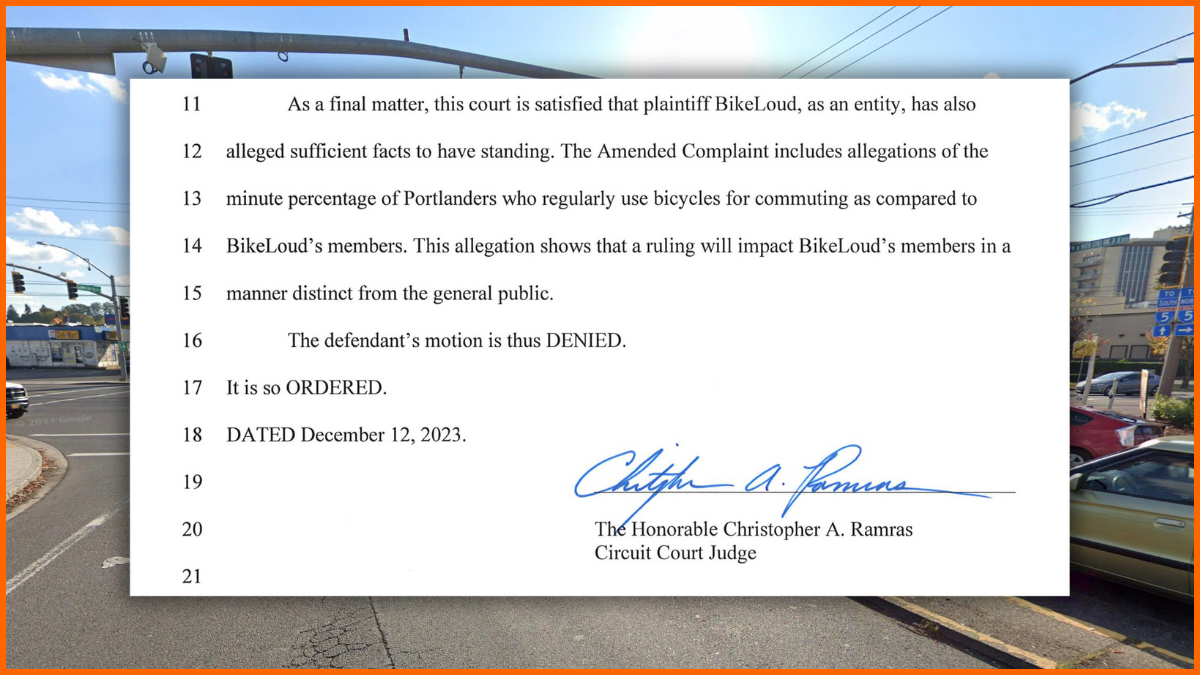
On the matter of whether or not BikeLoud itself has legal standing, Ramras pointed to filings from the plaintiff’s lawyers that includes the fact that a high percentage of their members ride bicycles regularly compared to the general public. “This… shows that a ruling will impact BikeLoud’s members in a manner distinct from the general public,” Ramras wrote.
From here, it’s very likely the case goes into discovery where evidence from both sides will be used to litigate the facts of each location (the plaintiffs will also be allowed to add additional locations if they choose). If the judge ultimately decides in favor of BikeLoud, there could be a number of different outcomes. Those might include: a negotiated settlement where the City of Portland dedicates a certain amount of funding to mitigate harms experienced by the plaintiffs, a requirement by the judge for the City to add bicycling and walking facilities at specific locations, or some other remedy that satisfies the plaintiffs.
It’s still very early in the process, but regardless of what happens next, Kocher and Thomas both agree this is a step forward.
“We just cleared the first hurdle, and the first hurdle was the biggie,” Kocher said.
“The more court decisions we have that interpret this important law and provide guidance about how it how it can be used, is helpful for cycling, advocacy and state,” Thomas said. “It’s absolutely an important step in clarifying who has the right to bring cases under the Bike Bill, and I think that alone should be celebrated.”
*Disclaimer: Forum Law Group and Thomas, Coon, Newton & Frost are financial supporters of BikePortland.