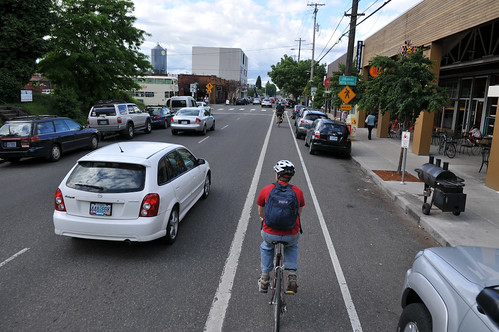
How can we make Williams safer and more pleasant to use?
(View looking north on Williams just before N Failing.)
(Photos © J. Maus)
(View looking north on Williams just before N Failing.)
(Photos © J. Maus)



Year: 2012
Brand: Trek
Model: 700
Color:Navy Blue
Size:15 inches
Serial: WTU077c5951G
Photo: http://www.dandq.com/prodimg/824%201309011.jpg
Stolen in Portland, OR 97201
Stolen:2011-11-15
Stolen From: Smith Building Portland State University Broadway Street
Neighborhood: Downtown
Owner: Lizet Martinez
OwnerEmail: lmart2@pdx.edu
Description: Lmart2@pdx.edu
or
Dianaolson08@gmail.com
The reflector is on the left side of the bike.
Police record with: Campus Police
Police reference#: 11-0688
This registrant has documented proof of ownership of this bike
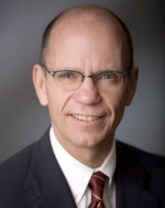
Did anyone else see this interview with Gerding Edlen CEO Mark Edlen on BlueOregon last week? In it, Edlen talks about the future of Portland and he mentions biking and walking several times.
His comments show that planning for a future where cars play a much more minor role in our transportation mix isn’t only on the minds of activists.
Edlen lays out the reality that Portland is likely to see millions more people moving here in the not so distant future and in order to prepare for that we need to create new industries (cough, bicycles and bike parts, cough) and create streets where people can safely walk and bike.
Edlen also talks about “resiliency” as it pertains to a sustainable city (his firm specializes in green building) and shares this story:
Below is the official transcript of U.S. Congressman Earl Blumenauer’s speech to Metro’s Joint Policy Advisory Committee on Transportation, November 10, 2011. (See related story here)
I’m looking over the course of the next 11 months to spend a little more time with some of you in some of these areas, because there are some important landmarks that I think give us an opportunity to step back and look at success. I have some modest interest in ODOT. It was legislation that I had that created the state Transportation Commission and mandated a multi-modal, state-wide transportation plan 20 years before ISTEA. I just had this conversation with Matt, and we’re coming up on the 40th anniversary.
There are a couple of you old enough to remember a speech that I gave at the City Club in 1987. We are coming up on the 25th anniversary of that where I talked about what the region was going to look like and laid out some of my vision for expanding light rail, for regional cooperation, for streetcar, a whole series of things. Now 25 years later, it is time to step back.
What did we do and how did we do it? There are a lot of people who don’t understand what happened, the trade offs and such. I’m proud of having my fingerprints on some of these things. One that gives me the most satisfaction was the development of the regional rail program that ran out of Portland but included everyone in the region.
Twenty years ago, as we were looking at how to transform a light rail line into a system, we included Barbur Blvd, for instance, and invited citizens from the region to come in and help us think about what it would look like, how it would be designed, and how it would be financed. We made trade-offs as a region.
We didn’t have to go to Hillsboro, and there were some trade-offs that we could have looked at a little differently. But it was part of trying to stretch a little bit as a region. We didn’t have to build the tunnels for the West Side light rail line. It was an engineering challenge and $100 million, but was part of an effort in terms of dealing with potential delays, environmental and citizen challenges, and it also provided some operational efficiency for when the big one comes, the tunnel is going to be the only place that is safe in the West Hills. You know, as the Zoo slides into the canyon.
But it was, and I can remember lots of soul searching with Tom Walsh, but I think it was a decision that was right to stretch. And we can go on and talk about other areas where we have done that as a region, which sort of begs the question, where are we now? There have been some significant successes; this week we had the C-Tran vote, where I was surprised by the margin and hoping for the best.
I was working in Cincinnati last week where they rejected the most bizarre Tea Party inspired proposals that would have placed a ten year moratorium in the city charter that they could not consider any rail transportation. Not the funded streetcar line that they have, not light rail, not commuter rail, not higher speed rail, and that was rejected. Most of the funding initiatives around the country passed, going with what we have done here with our friends in Multnomah County and the legislature coming up with a registration fee.
But it is not clear what our regional transportation funding strategy is, it is going to be much harder over the next two to three years on the federal level. There has been a zeal which I don’t fully understand; this notion about earmarks that I have worked with a number of you on that didn’t just go to my “district,” but went throughout the metropolitan area and outside the area in the Gorge which we have made transparent and tried to keep in alignment with what your vision and goals were. It has paid massive returns over time.
Someone is going to make these decisions, and my Republican friends I guess would rather have the Obama Administration make them than congress. As long as we have some reasonable relationship with them, with Ray LaHood thinking we are the most livable place in the country—than that’s cool. Sort of.
But it does have some very significant potential limitations, in things that we’ve done in the region, for example dredging the Columbia River would not be possible, under what we’re doing now and it adds very perverse effects in terms of some of the things people would take for granted to fix local problems fall under this bizarre definition of “earmark” so people are twisting themselves into knots to figure out how to move forward.
The transportation legislation that’s moving forward is dramatically restricted in terms of costs and revenues. It is likely to take away some tools that we have used in the region in terms of enhancing funding that have been able to really magnify some of the impact, very likely that we’re going to have a two year bill.
Because I think that there is no support for a bad six-year bill that would lower the floor for transportation investment for a decade, but this is up in the air. There are issues for us as a region in terms of how we trade off our regional cooperation and shared vision with being able to focus and have priorities when it comes down. I think JPACT offered up a letter on the TIGER grants. Which as near as I can tell will have no impact on the administration other than to move us down a rung because they’re five projects and no priorities.
That may have helped in terms of making everybody feel good because there were five areas that people wanted, unless everybody around the table really feels they were all equal in terms of merit in impact to the region and value. I have some very close friends of mine that are doing the screening, including people I’ve worked with and something comes through that is five things, ok, that’s cool, we’re not going to fund five, this region is zeroed in on this and it is consistent with what we want for TIGER grants and you’d do the same thing if you were there and got billions of dollars more of requests than you can possibly fund. There’s lots of pressure and there are people that are going to be making phone calls and checking in.
We as a region need to be very clear about what we’re doing and there may well be value to do some of that around the table and I’ve been a part of things where I have supported items that I didn’t necessarily think were the highest priority for the region. But having a regional shared vision in working together, I’ve invested a lot of time and effort into that, but we’re in a different era. It is likely if we were betting, I assume that the odds are better than even that we will have this Administration for 4 more years.
I don’t know that for a fact, but if we don’t’ have this administration than we won’t have to worry about TIGER grants because there won’t be any. But if we do things like this, we need to think about what our strategies are. I remain absolutely committed to working with you on the citizen infrastructure. What we did with those regional rail conferences, what we did with Rail~Volution, its different here because citizens believe in it. It’s baked into the DNA in a way that I think has great residual value.
I am hopeful that we can work cooperatively so people understand how we got to where we are, what the choices are going forward because it’s going to get harder not easier, I think for the next couple of years. In any event, I appreciate you allowing me to parachute in. Of course, I continue to appreciate all the advice from the Council we get from you through our staff and your visits here in Washington and the hard work that’s going on the ground.
I have enough experience with you around this table and the day to day work is not getting easier in a challenging economic climate where everybody is an expert in what we do, and people want to summarize complex ideas to tweets and Facebook entries which simply weren’t there when I was with you. And local government is the cauldron, it’s the toughest because you can’t pass it on to anyone else no matter how much you want to on occasion. So I do appreciate what you’re doing and look forward to a little conversation and a continued partnership.
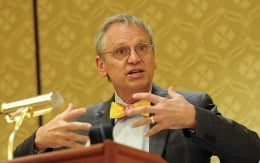
United States Congressman Earl Blumenauer spoke during a rare appearance at an influential Metro committee last week, doling out some tough love over the groups’ inability to come together around a regional vision for transportation investments. It was a rare showing of straight talk that speaks to a larger issue facing metro Portland’s elected officials and transportation leaders:
To achieve a new vision of transportation it will take big and bold projects that the entire region supports… But what projects fit that bill? And are regional leaders capable of agreeing to a single priority over pet projects in their own backyards?
Metro’s 17-member Joint Policy Advisory Committee on Transportation (JPACT) is staffed by bigwigs like Portland Mayor Sam Adams, TriMet GM Neil McFarlane, and many other agency directors, Metro staffers, mayors, and commissioners from around the region. The group recently submitted five projects to the U.S. Department of Transportation’s TIGER III grant program.
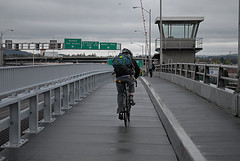

Multnomah County confirmed today that the biking and walking path on the Morrison Bridge will re-open permanently on December 5th. The path has been closed since early June while contractors work to replace the bridge’s steel grating due to safety concerns.
The project was supposed to be completed by mid-September but has been delayed due what The Oregonian refers to as a “messy environmental and bureaucratic fight.”

Bike. Walk. Vote. — Portland’s only political action committee that focuses solely on how candidates stack up on biking and walking issues — is about to awaken after a hiatus in the last election.
The group is planning a re-launch party on December 4th in Southeast Portland and they’ve already got Oregon House Representative Jules Bailey and Multnomah County Chair Jeff Cogen lined up as speakers.
Bike. Walk. Vote. was first active in the 2004 elections. Between 2004 and 2008, they helped turn out sympathetic voters and endorsed bike and walk-friendly candidates. The group worked on races in the city of Portland, Multnomah County, and in Salem.
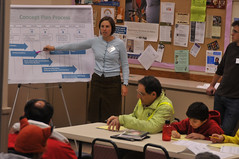
Below are some of the many opportunities to get involved and make a difference on transportation projects and issues throughout our region this week…
Adult Bike Riding Class, Part I
PBOT is sponsoring classes to get adults riding bikes. Do you know healthy adults that would like to ride, but never learned how as a child, or are concerned about riding after many years off their bike? Come to Harvey Scott School, 6700 NE Prescott from 3:00 – 4:30 and learn, with confidence. More info.
Portland Plan Public Hearing
5:30 – 9:00 pm, Parkrose High School (12003 NE Shaver St)
The Portland Plan is a road map for what the city will prioritize in the next 20 years. Rather than a geographic plan, it’s more of a business plan or management plan. According to Planning and Sustainability Commission member Chris Smith, “The Portland Plan will create the strategy that drives the update of the Comprehensive Plan (which includes the Transportation System Plan). The “Comp Plan” will be finished in about two years, but if you want to see a policy in the Comp Plan you better look for the strategy that supports it in the Portland Plan.”
Year: 2007
Brand: Giant
Model: Women’s
Color:light blue/silver
Size:14″
Stolen in Portland, OR 97239
Stolen:2011-11-15
Stolen From: home driveway, was attached to the car, SW 23rd and Kanan
Neighborhood: Hillsdale
Owner: Sarah Rosenberg
OwnerEmail: sarah.r.rosenberg@gmail.com
Reward: $150
Description: Women’s bike, with basket, rear black pannier, attachment in front that holds a light up over the basket, and “Bar Mitts” hand covers over the handlebars. – was attached to a bar that allowed it to be attached to a car bike rack
Police record with: Portland PD
Police reference#: T11008395
This registrant has documented proof of ownership of this bike
Year: 2007
Brand: GT
Color:Xl
Size:Florescent green accents
Stolen in Portland, OR
Stolen:2011-11-14
Stolen From: Psu campus, in front of rec center.
Neighborhood: Downtown
Owner: Kara Huff
OwnerEmail: Fallingshadows@live.com
Reward: good Karma
Description: Very unique bike with bright green accents. Wide gel seats. Brand new sorters, shimano black. Stickers (i ride a vehicle for change, put the fun between your legs). Two cup holders (one black one silver), black rack. Had a bike bag on the straight up style handle bars and some flowers.
Police record with: Portland pd
This registrant does not have proof of ownership of this bike