
— This post was written by Strong Towns PDX.
Portland has long been a leader in encouraging more density and better land use through repealing parking minimums, allowing plexes on most single-family zoned lots, and adopting single-stair reforms. All of these reforms allow for more units on the same land, which allows Portland to welcome more neighbors at all wages, ages, and stages of life.
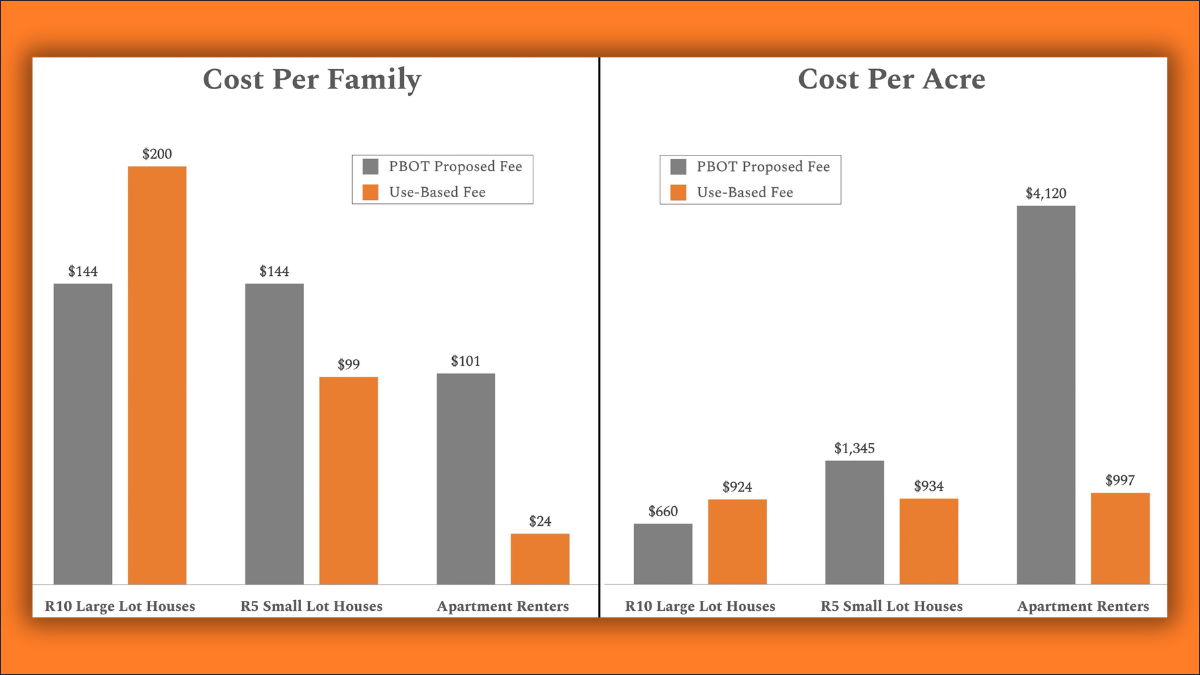
The proposed Transportation Utility Fee (TUF) of $12 per month for single-family lots, and $8.50 per month for apartment dwellers means apartment dwellers will pay 600% more on a per-acre basis than homeowners on R10-zoned lots (93% of the parcels in Northwest Heights and 81% of the parcels in Arnold Creek), and 300% compared to those on R5-zoned lots (99% of the parcels in Sabin and 97% of the parcels in Alameda), which becomes apparent when examining the fee on a per-acre basis (see chart below).
Considering apartment dwellers are also more likely to ride transit, walk, and ride a bike to meet their daily needs, leading to even less road maintenance costs, the current TUF proposal is even more regressive than has been acknowledged.
The Quick Fix
We propose scaling the Residential component (70%) of the $46 million in TUF funds based on acreage of the parcel that the dwelling occupies (see orange bars). This “Use-Based Fee” incentivizes living in an apartment or plex. This is supported by Federal Highway Administration (FHWA), as street maintenance also scales based on the size of parcels (see: Transportation Utility Fees).
We estimate to obtain a revenue-neutral $32.2 million, the City could charge:
- $2/month per-door fee, regardless of parcel size
- $0.20/month per 100 square-feet of parcel size
For example:
- An apartment dweller in a 20 unit building on a 5,000 sqft lot would pay $2.50/mo ($2 base fee + ($0.20 * (5000 / 100)) / 20 units), rather than $8.50/mo.
- A household on a 5,000 sqft lot would pay $12/mo, the same as under the proposed TUF.
- A household on a 10,000 sqft lot would pay $22/mo ($2 base fee + ($0.20 * (10,000 / 100))), which better approximates the additional cost of serving larger lots.
A Use-Based TUF is much less regressive on a per-acre basis, costing both apartment dwellers and homeowners on smaller lots less than the proposed fee schedule . Larger lots, while paying somewhat more, still pay less on a per-acre basis.
Contact City Council
If you want a fairer Transportation Utility Fee for Portlanders, email your City Council via the Strong Towns PDX website.

Thanks for reading.
BikePortland has served this community with independent community journalism since 2005. We rely on subscriptions from readers like you to survive. Your financial support is vital in keeping this valuable resource alive and well.
Please subscribe today to strengthen and expand our work.
How would this increase the cost and complexity of administering the fee in the first place? Would trying to make it ‘more fair’ for single family homeowners burn a bunch of a political capital and sour people on the idea of a TUF? I understand the argument but this strikes me as a “perfect as the enemy of good” situation.
Well there is still the (initial) complexity of the City figuring out how many doors (ie addresses) an apartment complex or multifamily has. The current residential tax the City has is based on Water meter use, so regardless there is going to be a cost to figure out how to tax the individual doors in either scenario. But once City figures out the # of doors, the proposed unit / square footage cost should be pretty simple.
Then there would be the issue of an ADU paying the same rate at the the main house…
I hear that. But it seems really tough to inventory and then track and monitor the square footage of each apartment/condo.
Your claim that the “current residential tax the City has is based on Water meter use” indicates a complete misunderstanding of the concept of taxes and “utility fees.”
The city charges for costs of providing water and sewer services (including massive infrastructure costs) based on your personal water consumption. That’s your Portland water/sewer bill. It is not a “residential tax.” The city does receive a share of the property taxes collected by the county on all residential, commercial, industrial properties. The property taxes have nothing to do with water meter use. Even a vacant lot is assessed and the owner pays property taxes.
In my reading, your response to zuckerdog serves to emphasize their point. It seems obvious that the current proposed TUF is a “utility fee” primarily so that it can be enacted by a vote of the council. Whether or not this is technically (or should be described as) a tax or a fee does not seem very relevant outside the legalities of how it can be implemented.
I could be wrong, but I think in zuckerdog’s original comment “based on Water meter use” indicated that the city already collects money (technically incorrectly called ‘residential tax’ by zuckerdog) on the water/sewer bill for each utility service (‘water meter’). The proposed TUF, in my understanding, would appear on this bill. It seems feasible to implement because there are already a bunch of arcane fees on there. As you say, the city charges an amount “based on your personal water consumption”, but your bill certainly does not go to 0 if you don’t run any water through your meter in a billing period. The remaining amount (the y-intercept on a plot of bill amount vs. change in meter reading in a billing cycle) seems a lot like a ‘residential tax’. I think zuckerdog’s point was that it’s easier to add a constant amount to the water bill than come up with a different value for every water meter, which might be more equitable or desirable, as this article argues.
Sounds like a one-time setup, so shouldn’t be that bad. Could also be used for the commercial side which would greatly simplify overall implementation.
This. We should look to expand this to commercial as well.
Under the current TUF proposal, an Amazon warehouse with a bunch of LEDs and virtually no heating would pay less than the brewery, which consumes a lot more electricity/gas. Meanwhile Amazon is the one tearing up roads with their delivery vehicles.
Expanding this “Per-Acre” TUF to Commercial entities, rather than relying on electric/gas utility consumption, would ensure that Amazon/big box retail stores pay their fair share.
So a ~million dollar single household condo/plex unit in bougie inner Portland* would pay less than a small outer E PDX house# that has a very low assessed value?
* For example: https://www.redfin.com/OR/Portland/116-SE-28th-Ave-97214/home/143049915
# large lots due to legacy county planning
That bougie location is one usually better served with transit and is more bikeable/walkable, and has the density to reduce the average per-resident cost of transport infrastructure, vs the small houses on large lots in transit-poor neighborhoods where it’s dangerous to walk or bike, so everyone drives. Low density sprawl is expensive to build and maintain. Making the bougies pay more on principle doesn’t change that math.
So not only does this small outer E PDX home suffer through more car centric pollution, noise, reliance and maintenance of a rapidly depreciating vehicle asset, difficulty walking and biking through no fault of their own and then they also get to pay more to help subsidize the rich bougie inner resident’s bike and public transportation infrastructure? Is this even pretending to be equitable? You do know what a “regressive tax” means, right?
While I agree that East Portland needs investments in sidewalks, we need to be honest: this TUF does not provide that. At best it prevents PBOT staff from being laid off. It will not build a single foot of sidewalks.
The current TUF fee is regressive in that East Portland residents who live in apartments end up subsidizing other parts of the city that live on larger lots. This proposal simply ensures those residents who live in apartments shouldn’t pay more than those single-family residents on a per-acre basis. Inner city residents living on large lots would 300% less the East Portlander living in an apartment complex on a per-acre basis. That doesn’t seem fair to me.
We need a system that shifts more of the burden of taxes onto land, rather than people’s incomes. This “Quick Fix” to the TUF is a simple method of ensuring those who live in smaller dwellings, who tend to drive less and therefore “consume” less of the transportation system, are treated fairly.
Low-income residents would still be exempt from paying a fee or will pay a discounted rate, as is the case with water bills.
We need a system that taxes the living f**** out of upper income people like you and me so that we no longer use our economic privilege to dominate local government (and screw over low income people).
So many questions on this trope/constituency: a few:
What’s your definition of upper income?Does it matter what the taxation is spent on or is the primary goal redistribution? Do you worry about people fleeing for lower tax jurisdictions?
I”ll give it a chance but theres a number of fallacies cited by this constituency: a few:
In times of old income taxes were high in America but captial gains tax was not–rich people still got a pass.Europe, with its high tax rates appears to be living on fumes. Young people work in strangely outdated and unproductive occupations, spend vast amounts of time training for jobs that seem to be disappearing by the day.In Europe there is very little startup activity and thus salaries in relation to the rest of the world have plummeted, Home ownership in Europe is extremely expensive relative to incomes deeply frustrating its youth. The market is inflated because home loans are so cheap because interest rates are so low in order to stimulate the moribund economy.
They’re not the model we should aspire to.
“Tax the rich” is an equity statement, not an efficiency statement, and conflating the two leads to bad policy. It doesn’t distinguish between consumption and investment. A wealthy person sitting on a large lot doing nothing productive with it is very different from a wealthy person building a 20-unit apartment building. “Tax the rich” hits both identically.
The OECD data is unambiguous here: the US already has the most progressive tax brackets in the developed world and achieves roughly half the inequality reduction of peer nations. What those countries do differently isn’t tax structure—it’s transfer generosity. Scandinavian countries fund generous universal transfers through broad-based taxes, not by soaking the rich with steep brackets.
The practical version for the TUF: price driving through expanded parking fees (targets the actual externality), keep the TUF flat (simple, legally tested), redistribute through a universal per-person credit that makes the effective rate progressive without means testing. Full analysis: https://wonk.blog/tuf
Taxing land? isn’t that what property taxes are for? Taxing land isn’t automatically progressive. In my area the apartments, condos are much newer and on less land than the much more run down old houses on larger lots.
This mix hardly has any relation to how much people drive, in fact many of those living in condos actually drive more vs the older people living in the run down homes.
Besides it’s not just about who drives more it’s about generally who is benefiting – and we all are, when those in newer condos get food delivered, packages etc. etc. even if they aren’t driving they are benefiting.
I don’t see acres as a good fare way to adjust at all, even if on average there is a correlation with lot size infrastructure on average it’s clear that doesn’t hold across many areas, maybe even Portland as a whole and it certainly isn’t fair at all for many.
My argument is that the subsidy would really work the other way, on a per-resident basis. Non-car options work better in dense areas because the per-capita cost is less. It doesn’t make sense to build as many options in sprawl, so we end up with cars as the only option. Fewer residents, same road costs. Why charge less?
I have no numbers to back up this argument, fwiw.
This is the right objection and nobody in this thread has answered it well. The lot-size proposal would literally charge East Portland residents more for being displaced to car-dependent areas they didn’t choose.
The fix isn’t to scale the fee—it’s to handle equity through a separate universal credit. Keep the TUF flat so everyone pays the same. Then give every Portland adult a per-person annual credit. The credit is worth proportionally more to lower-income households, making the effective rate progressive without penalizing anyone for where they live. An East Portland family gets the same credit as an Irvington homeowner, but it offsets a larger share of their costs. No means testing, no enrollment barriers, no arts-tax collection nightmare. https://wonk.blog/tuf
Tax poor families* who cannot afford to live in bougie oh-so-well-resourced inner-PDX for the sin of living in transportation, food, healthcare, childcare and education deserts?
*often multi-generational/multi-family immigrants living in a single shitty substandard household with an amoral **** of a landlord
It’s hilarious to see an urbanist™ defend a policy that purports to be less regressive with an implicitly classist argument against progressiveness. Making the bougies pay more can help fund the transportation and housing needed to help reverse sprawl.
Private developers (rich people) have utterly failed to build even a fraction of the needed housing for the non-rich in PDX (developers/the rich love scarcity). So instead of kissing scarcity-loving real-estate gazillionaire ass (Strongtowns/Portland:NW/BikeLoudPDX) let’s tax the rich (including many NIMBY millionaires in inner PDX) and leverage that funding 6:1 via bonding to build billions in no-profit social housing.
I’m not sure where you get the idea that we’re not in favor of taxing rich people. This does exactly that!
In fact, if you have multiple families living in the same home then the cost would be split amongst the multiple households. Households living together in R5 zoning would pay the same under the current and “Quick Fix” proposal.
Most wealthy homeowners don’t live with other folks, so they end up pay full freight.
Social housing is great! I’m totally all in favor. This “Quick Fix” proposal would make it cheaper for those living in social housing apartments compared to the proposal by PBOT.
Do you really not understand that multi-generational low-income households tend to have a single lease with at most one or two people on it? Will you even understand the distinction after I make it obvious?
Nonsense. Urbanists support social housing for upwardly mobile college-educated young people and the middling class while I support social housing that explicitly targets people who cannot in any way afford market housing (see social democracies everywhere for examples).
You’re actually making the case for a universal per-person credit without realizing it. A multi-generational household with five adults on a single lease gets five credits under a universal system. It doesn’t matter whose name is on the lease, how many families share the unit, or what the landlord’s billing arrangement is. Every adult gets the same amount. That household comes out significantly ahead.
A lot-size fee, by contrast, treats that five-adult household as a single unit on a single parcel and charges them one fee—which is exactly the problem you’re identifying.
As for social housing: the distinction you’re drawing between housing “for the middle class” and housing “for people who can’t afford market housing” is a targeting debate—i.e., means testing by another name. The entire lesson of the comparative welfare state literature is that universal programs serve the poorest more effectively than targeted ones, because targeted programs create enrollment barriers, stigma, and political vulnerability. Programs exclusively for the poor become poor programs.
More fundamentally, social housing is an in-kind benefit, and in-kind benefits create deadweight loss. A $1,000/month housing subsidy restricted to housing is worth less to the recipient than $1,000 in cash, because the recipient might prefer to allocate some of that to transportation, childcare, food, or education. The gap between what the subsidy costs and what it’s worth to the person receiving it is pure waste. This is exactly why economists across the political spectrum increasingly favor direct cash transfers over in-kind programs—they let people allocate resources according to their own needs rather than a policymaker’s assumptions about what poor people should spend money on.
The “universalism” dogma (Marxist-coded) in a zero-sum capitalist system is just a left-wing fashion statement. Once we tax the rich to oblivion, I’ll support universalism. Until then means testing is just another word for redistribution from the rich to the poor — and this is something that I will always support.
This is remarkable. You’ve just called universalism “Marxist-coded” while defending means testing as redistribution. Let’s unpack how backwards this is.
Universalism is the foundation of every successful social democratic welfare state you claim to admire. The Nordic countries don’t means-test their way to equality—they provide universal healthcare, universal childcare, universal education, and broad-based cash transfers funded by broad-based taxes. That’s universalism. Means testing is the American approach—and it’s the reason our safety net is full of holes, stigma, enrollment barriers, and benefit cliffs that trap people in poverty.
“Means testing is just another word for redistribution from the rich to the poor” is empirically false. Means testing is a word for bureaucratic gatekeeping that systematically excludes the poorest and most vulnerable people—the undocumented, the informally employed, the people who can’t navigate paperwork in English, the people who don’t file taxes. A universal credit reaches every one of them by default.
You also just described the economy as “zero-sum,” which is the single most fundamental error in economics. Economies are not zero-sum. Value is created, not merely redistributed. A dollar spent building housing creates more value than a dollar spent administering a means test to determine who deserves housing. This isn’t ideology—it’s arithmetic.
Just want to say that these posts are excellent, but rationality is a tough sell here. Keep it up.
Quick quiz. Which system is more redistributive?
System A: a 30% tax rate with no UBI. System B: a 40% flat tax rate with a $10,000 universal basic income.
Let’s check.
A person earning $20,000 a year. System A: pays $6,000 in tax. Takes home $14,000. Effective rate: 30%. System B: pays $8,000 in tax, receives $10,000 UBI. Takes home $22,000. Effective rate: negative 10%.
A person earning $1,000,000 a year. System A: pays $300,000 in tax. Takes home $700,000. Effective rate: 30%. System B: pays $400,000 in tax, receives $10,000 UBI. Takes home $610,000. Effective rate: 39%.
System B—the one with the flat tax and universal transfer—takes $90,000 more from the millionaire and gives $8,000 more to the poor person. It is unambiguously more redistributive. The poor person’s effective rate went from 30% to negative 10%. The millionaire’s went from 30% to 39%.
You called this framework “Marxist-coded” and a “fashion statement.” It literally redistributes more from rich to poor than the progressive-sounding alternative. You are rejecting the more socialist outcome because it doesn’t use the socialist vocabulary.
Here’s the general formula for the effective tax rate under a flat marginal rate t with a universal credit U:
e of x equals t minus U over x
where x is income. At low incomes, U over x is large, so the effective rate is deeply negative—you receive more than you pay. As income rises, U over x shrinks toward zero, and the effective rate asymptotically approaches t.
For t equals 40% and U equals $10,000: At $12,000 income the effective rate is negative 43%. At $25,000 the effective rate is 0%—that’s the breakeven. At $100,000 the effective rate is 30%. At $1,000,000 the effective rate is 39%.
The first derivative is U over x squared, which is always positive—the rate is always increasing, meaning always progressive. The second derivative is negative 2U over x cubed, which is always negative—the progressivity is steepest at low incomes where it matters most.
This is a monotonically increasing, concave function. It is more progressive than any finite set of tax brackets, because it’s progressive at every single point on the income distribution, not just at arbitrary thresholds. And it achieves this with a single flat marginal rate and a single universal credit. No brackets. No phase-outs. No cliffs. No means tests.
I’ve graphed this here: https://clayshentrup.medium.com/tax-brackets-3e986bc478fb
With respect, framing this as “taxing rich people” reveals that the proposal is equity-motivated, not efficiency-motivated, even though it’s presented in the language of land use efficiency. Those are different problems requiring different tools.
“Tax the rich” doesn’t differentiate between consumption and investment. A wealthy person hoarding a large lot unproductively should be taxed more (that’s land rent extraction). A wealthy person building a 20-unit apartment building should be encouraged, not penalized. A lot-size fee hits both. A Pigouvian fee on parking and driving hits neither—it prices the actual externality.
If your goal is equity, the most effective tool is a universal transfer, not a graduated fee. OECD data shows transfer generosity is the dominant predictor of inequality reduction across developed nations—tax bracket progressivity has approximately zero correlation. The way to make the TUF progressive is through a universal credit on the redistribution side, not by scaling the fee. https://wonk.blog/tuf
I can’t tell if the naivete around the mobility of the rich is a schtick or so actually threatening to this viewpoint it is just openly ignored.
Regardless, it should not be a concern of private developers or frankly private citizens to do anything that creates incentives for the last marginal person who wants to live in Portland. Just deciding to go live in a place does not confer special treatment, unless that’s the next insane experiment we’re going to run here, which wouldn’t be remotely surprising.
Thank you for telling on yourself.
Social housing is an in-kind benefit, and in-kind benefits create deadweight loss by definition. A $1,000/month housing subsidy restricted to housing is worth less to the recipient than $1,000 in cash, because they might prefer to allocate some of that to transportation, childcare, food, or education. The gap between what the subsidy costs to provide and what it’s worth to the person receiving it is pure waste.
This is why economists across the political spectrum increasingly favor direct cash transfers over in-kind programs—they let people allocate resources according to their own needs rather than a policymaker’s assumptions about what poor people should spend money on. The Scandinavian social democracies you’re invoking have been moving in exactly this direction for decades.
Exactly. Why should I have to spend my $1,000 on housing when I can spend it on crack and live in a box?
In other words it is not entirely crazy to want to put limits on how people spend the money we tax others to give them, especially if you want to sustain public support for an expensive policy. Economic efficiency isn’t everything.
Fair objection, and worth taking seriously. Two things.
First, the empirical evidence on unconditional cash transfers consistently shows that recipients don’t blow the money. GiveDirectly’s randomized controlled trials across multiple countries found no increase in spending on alcohol or tobacco. People overwhelmingly spend cash on food, housing, education, and small business investment. The “crack and a box” scenario is a thought experiment that doesn’t match observed behavior.
Second, even if a small percentage of recipients did spend unwisely, the question is whether the aggregate deadweight loss from restricting everyone’s choices (to prevent the few from making bad ones) exceeds the loss from those bad choices. Administering in-kind programs costs real money—bureaucrats, compliance, verification, waitlists. That overhead comes out of the same pot. If 95% of recipients would allocate cash better than a bureaucrat allocates in-kind benefits, and 5% wouldn’t, the math still favors cash.
But I take your political point: public support matters. The TUF context actually helps here because the universal credit is small enough ($100/year) that the “spending it on crack” objection doesn’t really apply—nobody’s lifestyle is changing on $100. It’s just an offset that makes the effective rate progressive.
“public support matters”
It’s everything. Decriminalizing drug use is probably the only sane drug policy from an economics standpoint, but a botched implementation and a lot of visible failures so poisoned the public against it that the legislature was cheered for repealing a policy passed by wide margins on a ballot measure just 18 months prior.
No doubt, we need more housing in high-amenity neighborhoods. The “Quick Fix” proposed is to make it so folks who are living in apartments can save money, regardless of where they live.
I don’t think it’s fair that an apartment renter in East Portland will end up paying 600% more on a per-acre basis than a wealthy R-10 Irvington homeowner, despite that East Portland resident being more likely to need to own a car. The whole reason that renter has to live so far away is because that Irvington homeowner is sitting on the property paying artificially low property taxes, forcing everyone farther away!
We shouldn’t subsidize those who are forcing all of us to live so far away from one another.
Once we get past whatever housing backlog we have, there will be much less incentive to build new high density housing because we won’t need that much unless the city and country start to grow again (both are currently shrinking). And in 10 years when the baby boomers really start to die en masse (sorry boomers, but demographics don’t play), there will be a loosening of the housing constriction we are currently living with. Millennials will start inheriting houses and more housing stock will suddenly become available.
I am not at all sure that the future of housing is the same as it used to be. 20 years ago, housing in Portland seemed like a safe bet. It no longer seems that way to me.
They should pay the same as anyone else. Just lke the arts tax.
They should pay more since they benefit more.
I want a fee that’s based on usage (mileage) and estimated wear due to vehicle (GVW, number of axles, type of tires), though like everyone else I guess I’m resigned to the impracticality of it. It’s too bad because it seems like the people who cause the most damage to the streets should be most responsible to pay for them. Feels pretty regressive to pay $12/month when my usage does practically no wear to the roads. I get it, I use them and it costs money to build them etc., and I’m willing to pay my fair share. But can we start by having the people who really profit from them put up the bulk of the cost? I wouldn’t ask my water bill to be the same as my neighbor if I use twice as much water as them..
No let’s suspend gas taxes because gas is now “too expensive.” That’s basically just shooting yourself in the foot and later asking why you can’t walk..
Anything that is based on mileage or weight would have to come from the state. Honestly I think that car registration fees should be based on the size, weight, and powertrain of vehicles.
Size = how much road capacity is used. In rush hour traffic, you can fit ~2 small hatchbacks in the space of 1 F150.
Weight = wear and tear on the roads
Powertrain = pollution & externalities
Mileage is tricky because people commute to and from Washington.
I agree that we need a Weight-Mile tax! However, the city can’t issue that kind of fee, only the county can.
However, I’m sure we can all agree that the land we consume *does* impact our transportation system. If you and I live in an apartment complex, we use land very efficiently, lowering the costs of the transportation system for everyone else. However, if you and I live on 10,000 SF lots, we substantially raise the cost of maintaining the transportation system.
This proposed “Quick Fix” enshrines that those who are living more efficiently aren’t forced to subsidize those who live on much larger lots.
I disagree that efficient use of the land somehow equates to efficient use of the surrounding transportation infrastructure. Yes there is more road surrounding a large lot, but if there is less traffic that road, then it will need less frequent maintenance as well. Anyway, property owners are already responsible for maintenance of rights-of-way on their properties, specifically sidewalks. I’m still unconvinced that TUF is at all reasonable, and the city should find a way to leverage an actual user fee.
It’s not impractical, it’s unpopular. Most drivers literally refuse to pay their fair share based on the amount of actual use and wear and tear they’re personally responsible for. They have been conditioned to expect their driving to be subsidized, and any attempt to toll it or create a mileage & weight based tax will be swiftly met with a voter referendum.
The transportation utility fee is a continuation and increase in subsidized driving.
I would encourage you to check out the work of Lars Doucet, particularly Land is a Big Deal: https://landisabigdeal.com/ .
Much of our subsidy of driving comes from not properly pricing the value of land, creating an enormous subsidy for the inner suburbs. This impacts every aspect of municipal finances, not just the transportation system!
So you really are not as interested in simply raising money on a flat fee or a sliding fee rising with income? You’re more interested in social engineering and declaring social values based on where someone happens to live?
No one has the time for that. We’re told PBOT is in an existential crisis and you want to make judgements on where/how people live rather than what we earn?
Oh certainly, they’d like to have their grubby hands in where you live, what you earn, how much you save, where you invest, how much those investments return, how much you inherit, etc. If you have more than someone who decided on a whim to move here without anything to support themselves with or even a service to provide, a behavior that 100 years ago would have guaranteed certain death, you must contribute more so they can not have discomfort or inconvenience.
Basing a fee on density is a pretty decent (even if oversimplified) proxy for “usage” of the street (assuming that driving is what we are talking about).
I agree there’s a problem here, but I don’t understand scaling by acreage. Why that? Seems like it is conflating density with how intensively someone uses our transportation system.
Absolutely. This “fix” is almost as ridiculous as assessing a flat transportation fee.
It should be usage based.
I would encourage both of you to check out for this list of where the least emissions per capita are in the US. Pretty much the whole Northeast has less per-capita emissions than Oregon.
That is because emissions per capita scales inversely to density (e.g. dwelling units/acre). More dense land use leads to fewer emissions because you end up driving less. The intensity of land use has direct effects on our transportation system.
This “Quick Fix” acknowledges this fact, rather than ignore it.
This is a transportation utility fee, not an emissions per unit GDP fee.
I’ll add “carbon tax” as my contribution to the the long list of policies that readers want that this fee is not.
This is a gross oversimplification and lie by omission. When affluent hyper-consumption is included, GHG emissions per capita in rich nations tend to scale with newly-developed urban density (e.g. gentrification*).
https://www.semanticscholar.org/paper/Contradictions-of-the-Climate%E2%80%90Friendly-City%3A-New-on-Rice-Cohen/b6940ef9a423f22a3e755460fdfba329dd5276c8
A map of consumption-based NYC GHG emissions from the SC2 consortium is attached.
You’re conflating two different things. Yes, wealthy people consume more and therefore have higher total emissions. That’s an argument for taxing consumption (Pigouvian taxes on carbon, driving, parking) and redistributing universally (cash transfers). It’s not an argument against density.
The paper you’re citing shows that rich people in dense neighborhoods have high consumption-based emissions. But that’s because they’re rich, not because they’re dense. The counterfactual is: would that same wealthy person emit more or less if they lived in a sprawling suburb with a longer commute and a bigger house to heat? The answer is unambiguously more. Density reduces emissions at every income level—the wealth effect and the density effect are independent variables and you’re treating them as one.
This is exactly why “tax the rich” is too blunt. You want to tax the specific externality (carbon, VMT, parking) so that both rich and poor face the correct price signal, then redistribute the revenue universally so the net effect is progressive. That’s the framework: https://wonk.blog/tuf
Thank you for reiterating the point I was making.
PS: I know that urbanists don’t believe this but it’s possible to have density without gentrification.
“it’s possible to have density without gentrification.”
In this country, we call that “projects”.
I wasn’t reiterating your point—I was correcting it. You posted a consumption-based emissions map to argue that density doesn’t reduce emissions. I explained why that map actually shows the wealth effect, not the density effect, and that these are independent variables. Those are opposite claims.
As for density without gentrification: of course. Tokyo is one of the densest cities on earth with relatively affordable housing, because they build enough of it. The mechanism is simple—allow supply to meet demand and prices stabilize. That requires removing zoning barriers, not taxing income to fund government-built housing that locks people into bureaucratically assigned units.
I would argue these are two sides to the same coin!
If you live in a single-family home, you are impacting the transportation system by forcing everything to be farther apart (not to mention on the environment). If you live in an apartment, you make a positive impact on the transportation system less by consuming less land, and are more likely to take transit, walk, or bike.
This proposed “Quick Fix” enshrines that those who are living more efficiently aren’t forced to subsidize those who live on much larger lots.
I’m struggling with the assumptions this proposal makes, as well as the generalization that apartment and small lot tenants are subsidizing those of us who live in single-family houses. A full lot can permit different efficiencies not in your equation. You can grow your own food, raise chickens for eggs, install solar panels to generate electricity, and grow tree canopies to help cool the surrounding area.
It may be true as a generalization that apartment dwellers are less likely to drive or own a car, or it may be a logical sounding fallacy, along the lines of building additional freeway lanes will ease congestion. I can offer personal anecdotes as counter-arguments. I live in a house, and easily 90% of my weekly travel and commuting is by bike. Conversely, cruise the parking lots of just about any of the apartment complexes east of 82nd and you’ll see a lot – maybe a majority – of big trucks and muscle cars, and that’s equally true for apartments that are directly on transit lines on Division, Powell, Burnside, Stark, and Glisan. I’d argue that in my part of town, a lot of folks live in apartments partly because of the gas-guzzling cars they choose to drive.
This is such a gross generalization. I have neighbors that have 4 SUV’s and live in a very walkable part of Portland. So there!
Raising chickens, adding solar panels, and growing your own veg are all, in fact, much LESS efficient ways of living than just building apartments near transit with a grocery store in walking distance. Preserving our single family neighborhoods just leads to forests and farms being cut down to serve the demand for more “affordable” housing.
There is no refuting that more efficient land-use will lead to decrease in emissions per-capita. Unlike freeway expansion, building more homes in transit and amenity-rich neighborhoods is will not only create “induced demand” for more transit & biking, it will fill our cities coffers with more tax revenue. This “Quick Fix” proposal says YES to more neighbors, YES to more efficient land use, and YES to decreasing our transportation emissions.
It’s a blunt tool that attempts to do what property taxes already do. If your footprint is smaller, you already pay less into the system.
(Nearly) everyone knows the solution to transportation funding is a combination of tolling and replacing (or supplementing) the gas tax with a VMT fee weighted to vehicle weight. Such a structure would go much further in disincentivizing driving AND creating a stable source of transportation funding. Whatever form any kind of Transportation Utility Fee takes is a stopgap bandaid that doesn’t address the real problem, temporarily take’s a little of the pressure off – which will probably further delay a real solution – and like the Art tax, we’ll be stuck with it in perpetuity.
I’m in total agreement that we need a Weight-Based RUC / congestion pricing scheme. You know as much as anyone that Legislators will pay dearly come election time to push for such a system, and it’s not something the.
Barring charging out-of-state automobiles a $2 toll to exit off of I-5/I-84/I-205 into Portland (and $0.50 with plates outside of Portland), City Council feels stuck and is reaching for the TUF as an easy out, despite the majority of drivers originating outside of Portland, as noted by Joe Cortright: https://cityobservatory.org/how-should-portland-pay-for-streets-2026/
WRT to your comment of that property taxes already address the impact of your “footprint”, it’s much more complicated than that. A good overview of how uneven the property tax system, (and why our suburbs are heavily subsidized by the downtown), is best explained by the visuals offered by Joe Minicozzi of Urban3: https://www.youtube.com/watch?v=SmQomKCfYZY
I’m familiar with Joe Cortright’s article and I’m in pretty much 100% agreement. It’s worth noting that he’s absolutely opposed to the user fee you seem to be in favor of.
There are much better, more equitable ways to fund transportation and the city councilors supporting the transportation utility fee know it.
That said, I’d be reluctantly in favor of the fee under 2 conditions:
1 – it’s written into the fee that it absolutely cannot be increased without voter approval.
2 – it has a hard sunset date. It’s true that supporting a VMT and tolling are currently political suicide at the state legislature. It’s also true that they have to be part of long range survival of ODOT (and PBOT). So pick a date. 4 years? The city gets to collect a transportation utility fee for 4 years, with their feet to the fire to lobby the state to come up with something more stable before the fee sunsets.
I think you’re on the right track with your 2 conditions, but anything “absolute” that can be written into legislation can be removed just as easily. If you want something with teeth, you have to amend the charter, which would require a public vote to do or undo.
I am quite sure no one on council has the appetite for that.
And yes, property taxes are more complicated. But since the Strong Towns PDX proposal is founded on generalizations about lot size and car use, it’s also a fair generalization to equate lot size with property tax.
The problem with this logic is that if it successfully disincentives driving it also successfully reduces transportation funding. Like, I agree that there should be weight/use taxes for car as a means of reducing how often people use them, but I also think that the TUF makes a lot of sense as a sustainable and mode-neutral funding source.
It also seems incredibly obvious to me that the assumptions baked into this proposal are on average correct. People living in houses on large lots are on average likelier driving more for their errands, even if you personally (who I happen to know bikes far more than the average person in portland) do not drive much, and people in apartments are on average likelier to drive less (and apartment complexes with parking lots would be charged more in this proposal).
Perhaps a better rule of thumb would be those who live further out use the transportation network more, and should thus be assessed a higher fee. That’s probably a more accurate generalization than comparing lot size.
I’m not proposing that, because that’s not a TUF, but if we’re going for “average correctness”, that’s a better way to go.
If a VMT results in less people driving less miles, it makes sense that the transportation network would cost less to maintain, so I’m fine with a corresponding revenue reduction.
You’re the closest person in this thread to the right answer. The TUF shouldn’t try to be a progressive fee or a property tax proxy—it should be a simple revenue instrument paired with better pricing of the actual externality.
The city can’t do VMT, but it can do expanded demand-responsive parking pricing, which is a very close cousin of congestion pricing. It captures non-resident vehicles (which Cortright has shown cause most of Portland’s road damage), the service nexus is legally bulletproof, and it provides the behavioral signal you’re looking for. Your sunset idea is also right—design the TUF to be superseded by state VMT pricing when it arrives.
The missing piece in your framework: handle the equity side through a universal per-person credit rather than trying to carve exemptions into the fee. A flat fee plus a lump-sum transfer produces progressive effective rates automatically, with no means testing and no arts-tax-style collection nightmare. https://wonk.blog/tuf
This is only true in a high growth regime. There is strong evidence we are no longer in such regime for the short term (Multnomah County population has been falling, and this year the US as a whole experienced its first drop in population ever). There are demographic reasons to think some of this change may be permanent.
Without population growth, increasing density in one area means depopulating another. That’s just not something we’re seeing much of outside rural towns (where it’s been happening for generations). Maybe in the future we’ll depopulate Lake Oswego so people can live in inner Portland high rises, but outside of the Strong Towns crew, I’m not seeing much appetite for that.
I refute it — the emissions gains of more efficient landuse may or may not outweigh the cost of all the reconstruction that the project would entail, especially in the era of EVs and clean electricity (which we’re not in yet, but we all see coming).
And if emissions reduction is the project, given a finite pot of money to spend, is rebuilding the city really the most efficient way to use that money to reduce emissions? I think that case is highly speculative and unproven. I take that back. I think that case is daft.
So, I am supposed to live in a box with one wall of windows and 4 shared walls/floors/ceiling and rely on transit so that other people can go to the farms and the forests?
I am supposed to pay well more in taxes because it is apparently incumbent on current residents to lay out a gilded welcome mat for people who don’t yet live here?
I am supposed to feel immense guilt over my emissions when we are already one of the lowest per capita emission states, mostly because we’re absolutely dependent on everyone else to produce our goods and provide our energy, but still?
No thanks.
This is an ecological fallacy. It may be true in aggregate that single-family home residents drive more, but you’re proposing to charge individuals based on a statistical average of their housing type rather than their actual behavior. I live in a large craftsman house, work remotely, and bike as much as possible. My household barely drives. Under your proposal I’d pay more than an apartment dweller who commutes by car every day. You’re taxing a proxy instead of the thing you actually want to discourage.
This is precisely why economists prefer Pigouvian pricing over proxy-based fees. If the problem is driving, price driving. Portland can do this right now through expanded demand-responsive parking pricing—no state authorization needed, legally bulletproof nexus to transportation infrastructure, and it captures non-resident vehicles that the TUF misses entirely. A lot-size fee will never incentivize me to drive less because I already barely drive. A parking fee will incentivize the people who actually are driving to consider alternatives. That’s the whole point of pricing externalities at the source rather than through demographic correlates.
In generalized terms (b/c of course we can find anecdotes to the contrary): Density and how intensely someone uses our transportation system (i.e. “drives” by the way I mean that) are in fact directly correlated.
Personal driving isn’t the only way the transportation system is used. Commerce vehicles do much of the damage to the streets and lets not forget that this “fee” is supposed to be a lifeline to PBOT so basic maintenance can be maintained. The amounts of the “fee” are too small to shape housing policy by itself so this plan, well thought out as it is seems more to be a virtue signalling sin tax that penalizes how people live.
And one that completely ignores the fact that the ecocidal hyper-consumption of the upper-middle and upper classes dwarfs the climate impact of families that cannot afford a luxury apartment unit in racist/classist inner Portland.
Thank you for the article, I love StrongTowns.
Here’s the catch, and I repeat it over, and over, and over, but it never really sinks in. I’ll take another shot:
Much of Portland west of the Willamette lacks the basic infrastructure that is supposed to come with paying city taxes: a stormwater system, buses, sidewalks, bike lanes. The areas west of the Tualatin Mts don’t have those amenities, despite having been annexed from Multnomah County to Portland over the course of the 20th century.
These residences have been paying city taxes for 40, 50, 60, 70 years — and longer — including the Big Pipe bond, yet the the City of Portland has neglected to bring basic infrastructure up to city standards. And this policy of turning a blind eye gives residents little choice but to drive cars. That’s Portland policy.
As an example of the missing infrastructure, here’s a photo of the intersection of Shattuck Rd and Beaverton-Hillsdale Hwy — I guess pedestrians are supposed to walk in the ditch?
I support the TUF, but gosh, it doesn’t seem fair to bring a graduated fee structure to an area the city has neglected for a century. These are already historically underserved communities, rubbing salt in their wounds might not be the best idea.
Such a good point, Lisa. The strongtowns’ argument is motivated by a desire to shift the tax burden to someone else. But the system ain’t fair to begin with. Some people pay more and get less, and other people pay less and get more. Reminds me of Larry David at the dry cleaner:
“Sometimes you get something, and sometimes you lose something.”
Can we all get behind an idea for revenue generation w/o debating it to death?
SW Portland is tough because it doesn’t have a lot of the kinds of infrastructure readers of Bike Portland like but it absolutely has a tremendous amount of infrastructure. It’s been a while since I looked at the specifics, but as an example, Hillsdale has one of the highest ratios of road pavement area to homes in the entire city. Since water and sewer follow the roads, it’s likely the same situation for those.
You have cherry-picked Hillsdale as your example. Hillsdale is a town center, with a highway running through it (BHH to merges into Capital Highway), and it sits at the crest of several watersheds, including the heads of Fanno and Stephens Creeks.
So yeah, there is a lot of pavement around Cap Hwy and the shopping centers to either side, and a bunch of pipes/culverts under BHH and Cap Hwy to carry the creeks across them.
Jeez, go ahead, pick an area with highways and shopping malls and use pavement/homes as a relevant ratio.
I get the complaints, though I don’t see how they’re “the” catch. There are myriad catches, which is why this is hard, but the perfect shouldn’t be the enemy of the good.
This isn’t a fee about stormwater systems or buses, so why bring those up?
This is a fee about transportation, so I think expecting measurable outcomes city-wide re: sidewalks and bike lanes seems like a fair expectation to me. *All* of Portland should have sidewalks in the next 10 years. The eternal foot-dragging on this is maddening.
Also, please tell me how wrong I am that, of all those residences that have been paying city taxes for 40, 50, 60, 70 years, a majority of them chose the west side because they wanted to live out of “the city” and planned on relying on their cars to “get into town”. Since this is a transportation feed and not a stormwater system or bus fee, it seems not unreasonable to pay for that reliance, even if it’s an urban design that never should have been allowed in the first place.
Keviniano, I support the Transportation Utility Fee, and I think it should be simple. So, no, I don’t like the “quick fix” of this article. The TUF, as is, is good. Several commenters seem to want the TUF to be some sort of vice tax on driving, it’s not. The underlying principle of TUF is that roads are a utility that everyone uses, even it is only because the groceries they buy at the store are delivered by truck.
(I’m all for vice taxes on driving heavy cars, studded tires, etc — but this is a utility tax the purpose of which is to put PBOT on more stable funding. That’s it.)
That ain’t happening, nor does it need to happen.
My “catch” is political. Folks don’t like paying high taxes and fees when they aren’t receiving the services they are paying for.
A vice tax on driving? Or just tailored in a simple way that asks the people who put more strain on our streets to pay more, so the people who are putting less strain on them don’t have to (further) subsidize their driving?
This happens a lot, people make up a self-serving narrative, and really grind it in until the ruts are deep, but basically don’t know what they are talking about.
Hey, here’s an idea, why don’t you show me that you are correct?
As it is, wouldn’t you know, and of course, yours truly has written (with Don Baack) a history of transportation and land use in southwest Portland.
Irritating, isn’t it?
Here’s the link, enjoy:
https://storymaps.arcgis.com/stories/c3c604888e184abd825ed5ca6a51a930
One thing I’m noticing is that locals who use an agenda from a national organization, whether it is the Portland DSA or, unfortunately PDX StrongTowns (unfortunate because I really like Charles Marohn), don’t seem to know much about Portland.
It’s convenient to grab a national agenda, parrot the words, have an instant slate of beliefs … but I keep finding that the borrowed agenda often masks an embarrassing ignorance of how Portland does (and sometimes doesn’t) work.
I recently watched a committee meeting in which Millicent Williams had to explain to Sameer Kanal that PBOT didn’t restrict it’s hiring to the district in which it was doing a project. In other words, just because a project is in, say, District 3, PBOT does not require that the workers live in D3. Ahem. And then she offered to send him PBOT’s hiring policy.
(I guess Kanal has never written a PCEF transportation grant, because the PCEF application asks a lot of questions about hiring, and if PBOT is a partner, well, you have to describe PBOT hiring.)
Well, thats some unfortunate news to hear about Sameer Kanal’s understanding of how PBOT works. Maybe if he internalizes that people need easier freedom of movement throughout the whole city for work and the best way is cycling or public transportation he will start trying to make those transportation aspects better. Fingers crossed!
I appreciate the deep dive on SW’s development, but it does elide the question of why it developed as it did, anyway. If the answer being posed is “SW developed primarily for easy vehicular access to downtown”, the question being posed ought to be along the lines of “why did SW develop at all?”.
Yes; it was more accessible for development than, say, the area around Sunset TC in Cedar Hills is now, post-26’s automobile-ization (neologism alert) and the MAX tunnel. Yes, it’s unlikely that people developing the area would’ve foreseen the myriad issues it brings to attention now: non-car accessibility, environmental hazards e.g., land subsidence, and of course climate change (exacerbated by car dependency). I would note, though, that the congestion inevitably brought about by car dependency was known, already, as early as the 20’s in places like NYC.
Ultimately, it’s all a byproduct of two related, now mostly-outdated forces: the push to “decongest” cities advocated by even a figure (for his time) as progressive as Lewis Mumfoord, and the dependency of that push upon mass car ownership. I certainly respect the activities of all local advocates to try to get PBOT to treat the region fairly, but I think it’s also fair to say that, for the most part, a lot of people living in car dependent places–like SW, certainly, but truthfully, almost all of Portland–don’t think twice about things like missing sidewalks. My point in all this is just to ask that if access to things like sidewalks is an important point, why are you living in SW?
I agree that you shouldn’t have to live in particular areas of a metro of Portland’s scale to have access to sidewalks. Especially given that it’s well-paid its dues at this point, it’d only be fair. However, I’d also say that development in environments both as notably fragile as SW’s, and simultaneously geographically tangential to the heart of regional development (i.e., central Portland) at all is inherently in error, and that trying to make it work after the fact is prolonging that mistake, instead of fixing it.
How much of SW’s development–its people, its jobs, its amenities–would’ve been more efficiently kept in Portland, or Beaverton, or Clackamas, etc.? It’s all hypothetical at this point, of course, and I don’t mean to appear to pick on SW in particular; there’s a lot of development in Metro Portland that is just the sort of low-productivity, high-cost sprawl that wouldn’t even be considered without cars. However, as the region as a whole struggles, neglecting areas like SW is going to be low-hanging fruit for a long while.
Thank you for reading, aquatico, and for writing the long thoughtful comment. I am enjoying this discussion and comment thread, it lays bare so many of the slivers of Portland’s political scene.
What prompted me to write the comment and to link to the Hi-Lo Trail transportation piece is that so many false narratives get bandied about as gospel truth in Portland policy discussions. I reached advocate Nirvana a few weeks ago when I listened to the Labor and Workplace Development committee meeting on SIPP (Sidewalk Improvement and Pavement Program) during which the City presented a slide that stated that SIPP was directed toward “the city’s most historically underserved neighborhoods in Districts 1 and 4.” Later PBOT Director Millicent Williams repeated the phrase.
That was a huge moment for me. I have been trying for seven years to get the city to even acknowledge that it had a problem in the southwest. I wrote a provocative BP piece a few years ago in which I called parts of southwest “historically underserved.” Boy did that rouse a bunch of commenters. How dare I? Those words are reserved for east Portland, damn it. “Historically underserved” is an oh-so-sensitive euphemism for “Black.”
The fact is that the city didn’t annex east Portland until the 1980s and 90s. And by about 2010, Portland had started spending enormous amounts of money in the area to make its streets safer. “Underserved” doesn’t seem to me to be an accurate description of that recent history, but it fits neatly with a strong desire among many Portlanders to make everything about identity and race. My understanding is that east Portland was mostly white when its big stroads were built. Earl Blumenauer grew up there, so did Steph Routh. That car-centric street design was considered modern and desired.
The reason for investing in east Portland streets (roughly half a billion dollars so far—my back of the napkin calculation) is because that’s where the bulk of the high crash corridors and intersections are. That’s the reason to do it, and Portland has been pursuing the goal for about 15 years. Hopefully the sustained effort will make the area safer.
As far as southwest goes, I would like Portland’s narrative to shift a little more and for the city to acknowledge that it spent a century annexing land for which it couldn’t afford—or didn’t have the political will—to provide infrastructure. And it has spent decades turning a blind eye toward, and coming up with various excuses for, not addressing the problem.
I think the Hi-LO Trail piece shows something Portlanders tend to forget—there is stuff west of the Portland border! Those trains were on their way to Garden Home, Hillsboro, the Willamette Valley. It was agricultural, and fertile grazing land for the Swiss and German dairy families who immigrated to the Hillsdale area. They sold off their land bit by bit, Alpenrose is the last to go, but many of the original families still live in the area. And today, many southwesters work at Nike, Intel and OHSU. So I think it misses a lot to think of the area as having built up as a downtown Portland bedroom community. It has its own history.
Southwest does need a lot of help! That being said, should a SW resident living in an apartment pay 600% more on a per-acre basis than a resident living on a 10,000 SF lot?
This TUF will not build a single mile of sidewalk, it won’t even really pay for road upkeep. This is a tax/fee to ensure PBOT employees keep their jobs. We should make sure that those who make our transportation system less efficient by living on larger lots pay more into the basic salaries/wages to keep our employees.
The missing sidewalk conversation (frustratingly) is not on the table at this point.
Why is “per acre” the interesting value here? Since it’s intended to be a flat utility fee, capturing direct and indirect costs/benefits, “per person” seems much more appropriate.
I think you want to make this tax something it isn’t intended to be.
Exactly right. Per-acre is trying to smuggle a land value tax into a utility fee, and it will likely fail legally under Measure 5/50 since lot area correlates heavily with land value. The fee should stay flat and per-unit because that’s what’s legally tested across 31 Oregon cities.
The equity problem is real, but the solution is a separate instrument: a universal per-person annual credit funded by the TUF surplus. Flat fee + lump-sum credit = progressive effective rate, automatically, with zero means testing. The efficiency work should be done through expanded parking pricing, which prices the actual externality (driving) rather than a proxy (lot size) that doesn’t actually cause road damage. https://wonk.blog/tuf
RJ, it’s bigger than that. SW doesn’t need help, the City of Portland needs help. A lot of help.
You are right, I agree, TUF won’t build sidewalks. And yes, density is critical to efficient use of energy. But TUF isn’t about building a denser city, it’s about keeping PBOT, and Portland, on its feet. Staunching the bleeding.
Did you see the landslide in my neighborhood? The west entrance to the city’s largest employer? (OHSU). This isn’t my neighborhood’s problem, it’s Portland’s problem.
That landslide photo is also a reminder that not all acreage is equal. SW is filled with large lots without large potential for more density, because much of those lots are ravines, steep slopes, natural areas etc.
A flat 10,000 sf lot may potentially house several units, but a steep one can’t approach that.
A mile of twisting, steep ROW in SW costs a lot more to build and maintain than a flat mile in SE. Some people choose to live in a hilly neighborhood that is prone to landslides and requires more de-icing and snowplowing and tree clearing. Should those people pay more of a transportation fee?
Yes in regard to the costs. I lived on one for years and the City never once de-iced or plowed, and fallen trees and landslides were the property owner’s responsibility. There were also public streets where maintenance was the property owners’ responsibility, not the City’s. Other streets in SW may have been regularly iced and plowed. Some SW streets serve only the residents on them, others serve hundreds or thousands of people who don’t live on or near them, so any maintenance costs are benefitting others.
But my main point wasn’t that people in SW should pay less (which I don’t believe) but that not all acreage is equal–which your comment also shows.
makes sense, thanks
And a good reminder that the roads in SW are significantly more expensive per capita and per mile to build and maintain. If anything, SW residents should be paying more per acre.
The landslide was probably caused by a faulty drain on the uphill side of Fairmount. It looks like the stormwater undermined the road instead of running through a culvert. I had a photo of the perma-puddle, but deleted it recently.
The person living in an apartment in SW has equally bad access to active transportation and, hence, relatively equal impact on the system from their own travel behaviors. Acreage has nothing to do with travel behavior here.
For people who live in East Portland, charging them more because they don’t live in dense places is tone deaf. Do you know why a lot of people live in East Portland? Because they were driven out of inner-Portland when higher income earners moved in. Now you want to charge them more because of where they now live?
There are massive equity problems with this proposal that need to be acknowledged. I think they’re worse than the current proposal based on the arguments you’re making.
This is on the nose and is why painting with a broad brush with tax policy works poorly even if it sounds good for a certain group of people. The fairness argument becomes even worse once you start to dig even a little bit.
There is a LOT of property in SW Portland that is undevelopable due to environmental overlays as a result of the many creeks and wetlands that are part of the topography. The same things that Urban Forestry likes to point out when touting the tree coverage of the west side, or natural habitat for the many animals still inside the city limits, happens because there is a lot of land, owned by people, where building structures is somewhere between expensive and impossible. This preservation of open space is balanced by charging slightly less for wastewater treatment due to the amount of water that doesn’t make it into the stormwater system based on the trees, wetlands, creeks, and open spaces available for on-site drainage to occur.
Charging people more for “owning” that land will encourage them to undermine those protections. It could be working harder to develop the land and using this fee as a mechanism to force the conversation or letting it go entirely which is one of the greatest threats to the tree canopy due to the ivy strangling so many trees throughout the city. The bottom line is charging a transportation fee for land that doesn’t generate any transportation network usage provides the incentives to change that and not understanding that “more density everywhere” may create a result that is bad for society will bring it about more quickly.
While I support the TUF, attempting to conflate lot size with intensity of transportation usage is overly simplistic. Once you add some nuance it could easily devolve into a horribly complex system that no one truly understands and is hard to approve let alone retain past the next election. It also won’t win any fans when the people paying the most in these fees have the least in terms of basic infrastructure like sidewalks (or even curbs to trigger street sweeping) or bike lanes/greenways. Given that this fee is not nearly enough to bridge the massive transportation funding gap perhaps the best course of action is working through the other ways to do so that are tied more tightly to actual usage instead of the existence of a dwelling.
There’s almost 18″ between the white line and the ditch – plenty of room for peds! – PBOT
Joking aside, the city will need to convince SW residents that this fee will actually help get them to those bus stops there on B-H Hwy… and not just get routed somewhere else like has been done for past century. I’m hearing “the TUF and SIPP will fix this!” in some quarters in the same tone that kids are promised a pony.
Hey there. “in some quarters,” LOL. Did you listen to the Labor and Workforce Development committee meeting on SIPP? It’s not that long, SIPP is up first, Priya Dhanapal and Millicent Williams are there — I’m curious what you think. I’m taking a victory lap, really basking in it, because Williams talked about “under-served areas of D1 and D4.” What a difference a few years and a new system of government make.
https://www.portland.gov/council/agenda/labor-and-workforce-development-committee/2026/1/29#toc-
thursday-january-29-2026-12-00-pm
SW transpo advocates are a pretty cleared-eyed bunch, so no, I haven’t heard anything about ponies or noticed wool in anybody’s eyes. Folks are working it.
“some quarters” are city and council staff. I am familiar with one or two issues which could be addressed, now, regardless of SIPP. The magic wand of SIPP has been brought out, and the inference is that NO action is needed now, because eventually these areas will have a sidewalk.
And perhaps they will!
But most will be waiting a long, long time for the concrete to get poured, and many may never see any due to terrain and stormwater. D1 will get sidewalks in Cully and Parkrose and D4 Hillsdale and Gabriel Park before somewhere like Fairmount does. And maybe they should! Meantime, do the people walking Fairmount, or who would like to walk to work at OHSU, deserve no relief, now, just because some frabjous day there will be a sidewalk?
I am looking forward to having more sidewalks. I also am anticipating the perfect of SIPP to be an enemy of the good now from time to time, and I think that’s a reasonable thing to watch for and push back on.
thanks for the link! I’ll watch and see if it mellows my mood a bit on how fast they intend to move when the money comes in…
“I support the TUF”
Why support a tax when you get very little in return? This kind of thinking (and voting) is driving taxpayers out of Portland.
Help me understand how this not just a property tax with extra steps.
One reason is that they are calling it a fee so they don’t have to have anyone but the council vote on it. Also, they will be able to fiddle with the amounts all they want later on as its just a fee.
We all know it’s a tax, but the Democratic Corporatists on the Council for some reason only care about the money potentially raised and not the ethics of it all.
The issue with property taxes is that they aren’t actually based on land value, it’s based on a magical “assessment” (which is super un-scientific process, btw!)
What this gets at is how efficiently we use our land. If you and I live next to one another in an apartment in the urban core, we aren’t forcing locations to be far apart from one another. In fact, in some cases, we probably allow businesses to flourish right below us! So our impact on the “transportation system” is minimal.
However, if you and I live on 10,000 SF parcels, we force everyone to be further apart. We should pay more because we are forcing more people and businesses to be farther apart.
Efficient land use is important for our overall solvency as a city, and to the cost-of living of residents. If there are lots of apartments available where you can live without a car, you’re saving tens of thousands of dollars a year, and you’re saving the city tens of thousands of dollars a year.
However, if it’s all single-family homes, and everyone ends up having to own a vehicle to meet basic needs, that means everyone pays up tens of thousands of dollars a year for car ownership, PLUS the city has to generate revenue (somehow) to maintain those roads and infrastructure.
This isn’t a property tax, this is a fee based on how efficient the land your living on is being used.
“This isn’t a property tax, this is a fee based on how efficient the land your living on is being used.”
And here I was thinking this was supposed to be as transportation utility fee.
Wheels has got it right. The people living in apartments need a street grid (and viable bike infrastructure) to reach amenities they lack at home. They need goods that arrive by truck, etc. If PBOT is viable it will be easier to get particular things that we want, whether it’s a pothole repair or a planter replaced on SE Salmon. I’m ok with denser areas generating more revenue because I’m one of the oddballs saying ‘tax me and build stuff’.
I’m also for property tax reform and progressive tax rates. It’s not a total contradiction. If we load a long-term social engineering project on the TUF we might get neither.
I’m also calling out the canard that if rich people leave there will be no nice things and Portland will be the new Detroit. Rich people in general have adopted and perfected the science of paying as little tax as possible. Why is the Nike campus in unincorporated Washington County but surrounded and served by the streets of Beaverton?
You’re ignoring the most basic facts of municipal finance: the current transportation system is bankrupt *because* of of the inefficiency of our land-use.
No amount of money is going to “fix” a transportation system that is so deep in the hole. We have a $6B maintenance backlog that is never going to be filled. The current TUF proposal doesn’t even address the maintenance backlog, it just keeps PBOT from firing staff.
The Strong Towns proposal is saying: let’s recognize that the land consumed by each parcel forces the city to provide more infrastructure than can be afforded by the adjacent property owners, and forces our destinations apart.
Let’s take the example of a residential street with 2 travel lanes and 2 parking lanes looking at being repaved every 25-30 years at a cost of $2-5M/lane-mile (in today’s dollars). That means you’re looking at a cost of $8-20M/mile for the cost of repaving the street (4 lanes total).
If every lot on the street is 10,000 SF (100×100 lot), each household is looking at paying $210-$526/month. At 5,000 SF (50×100 lot), each household is on the hook for $105-$263/month. At 2,500 SF (25×100), that’s a more reasonable $52.5-$131.5/month. If every household lived at a modest 20 units per 10,000 SF lot (imagine the 3-4 story walk-ups you see around Portland), you’re looking at an affordable $10.50-$26.3/month per household.
I’m sure we can agree that we want a solvent transportation system. Barring charging most households over $100/month, efficient use of land is the only way to get there.
“the current transportation system is bankrupt *because* of of the inefficiency of our land-use.”
Its bankrupt because past councils have taken money meant for PBOT such as the ULF and used it for other things. The modern Council is on record as wanting to use PCEF money to renovate the MODA center because there is a rumor that its not how the new owner likes it.
The Council does not need a new stream of money in perpetuity as both old and new councils have demonstrated an inability to leave money going where its been earmarked to go.
“No amount of money is going to “fix” a transportation system that is so deep in the hole. We have a $6B maintenance backlog that is never going to be filled. The current TUF proposal doesn’t even address the maintenance backlog, it just keeps PBOT from firing staff.”
Agree 100%! Excellent and blessedly concise analysis.
However, its not the money that is going to fix PBOT, its going to be a conscious decision by us/the Council on what PBOT’s mission is going to be going forward and what funding is actually required to do that. There are a lot of moving parts in the Portland Government that seem to not be producing results compared to the amount of money funneled into them. Before we start proposing long term money streams I personally would like an audit to see where the money is going now. So much money seems to be going in and not very many results coming out. If only to prove they’ve done all they could, the Council needs to have a complete forensic audit of the whole of governemnt. Set the boring single fee TUF to sunset in two years to give time to see whats happening and then with the info from the audit start thinking as you are.
Funneling money into a broken system won’t work, no matter how well formulated or how just you might think it is. More money hasn’t meant better results and it won’t mean better results.
Pay as you go luxury police pensions, for example.
Agree.
Disagree.
Changing landuse in an already built city is either very expensive or very slow (probably both). It is possible that, after rebuilding everything, our transportation system would be “solvent”, but it is also quite possible that, given the human nature at the core of our governance system, we’d still want more than we’re willing to pay for.
I don’t actually know what the right answer is — that’s an impossibly more complex question than battling toy tax regimes. But, if we’re playing, I’ll see your landuse tax and raise you a carbon tax.
For a per household or per individual tax, I would rather see a modest reduction based on income rather than a proxy for either income or transportation use. The introduction of even a minor level of complexity to calculating the tax will probably hurt public acceptance.
For any tax like this, the city has to commit to not sending people who don’t pay the tax to third party collection agencies. That is where the real harm can happen.
We’re a bunch of volunteers and managed to come up with realistic costs within a few hours. All of this data is readily available through PortlandMaps.com
We already have systems to bill people with MUCH more complicated metrics. Land doesn’t change month by month like water use.
I believe you that it may not be complex to calculate. But, conceptually, it is complicated in how lot size is fairly correlated with transportation fees. A small taste of this is in these comments. It invites endless comparisons of who pays more and examples of unfair case by case discrepancies. If this were a larger fee, then it may be worth it. But if the difference in what people pay is already relatively small, it is not worth the complexity of how the public will perceive it and having to explain why this is better than other approaches.
Why does the luxury high-rise condo in the Pearl pay less than the dilapidated 6-plex?
Or the dilapidated single family house that enjoys 1/6 the utility of that 6-plex?
The apartment dwellers I know pay more than that on Starbucks every other day.
Seems really dumb to fight about this. PBOT is running out of $$ so how about we just get them a few dollars and not fight over pennies?
Its not really a fight, the Council has kind of demonstrated they care more about unethical billionares than transportation or even people/public powered transportation. I’m pretty sure that they’ll implement the fee without caring too much about the various discussions going on about it.
Its fun in an academic sense to discuss options and equitable ways to raise money, but in the end we’re getting a fee and most likely it’s going to be blunt and it will be raised in the future.
PDX electeds and many, if not most, urbanists will choose just about any other half-baked regressive mechanism than a genuinely progressive income tax-based mechanism.
Well, you’re not thinking about how PBOT really wants to run this show. Sure, it’s only $12/month now. But that will go up as soon as they reach another “fiscal crisis.”
We need to enshrine this pattern of placing the burden onto land *now* rather than 5-10 years down the road when that $12/month becomes $30/month due to inflation. PBOT’s own Fixing Our Streets projected projects list was halved due to inflation in less than 5 years. We should expect the same.
In that time, we should also work to push more of our taxes onto land, more broadly, to start to bend the inflation curve.
Good point; while we’re at it let’s fight inflation by making sure there’s no pandemics, forever wars or any other global economic shocks.
Stop electing liberals problem solved.
Death by a thousand cuts. That’s the Portland doom loop in a nutshell.
BS they have a 100 million dollar prosper Portland budget that is wasted on welfare candy for rich developers no more fees needed.
I find it interesting that the city is trying to charge a transportation fee based on residency rather than on trip generation. If trips were the focus, I dare say businesses, schools, shopping centers, grocery stores, government agencies (including PBOT) and hotels would be charged using businesses’ SEC codes, capturing some of the city’s many visitors and outside employees who would be charged the same as most residents.
Besides most apartment buildings being on corner lots, i.e. fronting two or more streets, they also have a lot of individual users. I don’t know if this is so great
Ideally, this TUF would be based on trips generated by the land use. In reality, some renters and condo owners create more trips than some single-family property owners. We can’t be perfect. I think the current proposal is good enough for getting close to fair. Maybe the city proposal could adjust it a dollar at most per month, but given that transit, bike, and walk also use the transportation system and the city is investing a lot in developing and maintaining those systems, the current proposal seems plenty fair.
If we are going to penalize large lot owners then we should allow upzoning by right.
Car free families must be exempt from this stupid new tax. We dont cause any of the wear and tear on the roads that car drivers do but we are paying the same amount as a family with 4 cars. Motorists do all the damage they should be the ones paying and it should be based on the number of cars registered to each household or apartment, not square footage of the property.
I sold my last personal car 30 years ago but I still use the streets. I really don’t need to give away this argument to anyone who cares to roll down their car window.
You may use the streets but how much damage do you do to the streets that require road maintenance? That is what we are talking about here, road maintenance costs resulting from car damage.
Look at how long multi use paths last when cars don’t drive on them.
Point is, non drivers are not the ones tearing up the roads so why should we pay the same amount as families with 4 cars?
We pay way too many taxes already and services keep decreasing and the city keeps asking for more money. Enough is enough.
Congrats on not owning a car but are you telling me you never buy anything delivered by trucks that use the same streets?
Depends; the one on the west side of the Willamette between south waterfront and the Sellwood bridge sucks ass. Tree roots (we need trees shading MUPs) cause a fair bit of damage.
You aren’t; you don’t have to pay registration or gas tax.
I get deliveries from trucks that are already registered, and taxed in multiple ways.
Why would I need to double pay for them? Those costs are already being passed on to the consumer.
I pay for our roads through state, federal, and property taxes.
I don’t have a car so there is no reason that I should also pay gas and registration tax’s which by the way do not cover the complete costs of car usage on our roads, which is why all the taxes I mentioned that I have to pay, go to supplement paying for the damage cars create. This is also the reason I am now being asked to pay nearly $150 more a year on this stupid new tax
I come to bike portland to see urbanists deny the negative externalities of class-based hyperconsumption while pointing their strongtown/libertarian finger at families who are too damn poor to live in bougie inner PDX.
I come to Bike Portland to see people defend car usage and deny the externalities of automobiles on our society and somehow roll it into a class argument
I vehemently agree that car/truck users absolutely suck. However, the absolute worst car/truck users are those who live in well-resourced central urban neighborhoods and somehow continue to use car/trucks (including uber/lyft and having crap personally-delivered using heavy vans/trucks).
If you want fewer low-income people driving on Portland’s periphery then you should support the tax increases for upper-middle/upper class Portlanders needed to fund decent housing+amenities for low- and very-low-income families. And yet here you are whinging about $12 because you are a oh-so-precious and saintly car-free person.
All the exemptions violate state law section 20 and 32 of the Oregon constitution which makes it illegal unconstitutional and unenforcable.
Acreage is the wrong metric. It measures land, not transportation use—no connection to miles driven, congestion, or road wear. Using it as a proxy risks overcorrecting based on assumptions rather than actual behavior.
This drifts from the purpose of the fee. A transportation utility fee should reflect system use, or at least approximate it simply and transparently. Acreage pushes it further away from that goal.
Not every fee needs to be progressive. Gas taxes aren’t, and they’re widely accepted because they roughly track usage. Trying to force progressivity through weak proxies dilutes the purpose of the fee.
Keep it simple—or make it real. If Portland wants a straightforward funding tool, a flat per-person or per-household fee is clearer and more honest. If it wants true fairness, that points toward mileage-based charging at the state level—not layering speculative land-use proxies into a city bill.
Use the right tool for land use goals. If the objective is to shape density, do that through zoning or property tax policy—not indirectly through a transportation fee.
“A transportation utility fee should reflect system use, or at least approximate it simply and transparently. Acreage pushes it further away from that goal.”
Yes! This is what it’s all about.
The author of this opinion piece completely ignores the decades of research on travel behavior from tens of thousands of trip generation studies by traffic engineers and planners, analysis of census journey-to-work, travel diaries, and sociological studies.
Acreage is not as good an indicator of transportation system usage as other variables.
We fund our transportation system through a variety of taxes and fees already. Other cities have already implemented “transportation utility fees.” I don’t like paying anymore than I do, but recognize the necessity of paying more, so I support Portland’s implementation of one.
Portland’s real problem isn’t the math on this TUF—it’s the fantasy that more taxes will magically fix the doom loop. This guest opinion missed the memo.
When you leave the People’s Republic of Portland, keep your fingers clear of the swinging door.
Yep lots of people leaving especially those paying the bills.
Ah yes Robert, the classic “if you don’t agree, leave” argument—nothing says open-minded like telling people to get out instead of engaging their point.
If Portland’s ideas are so strong, they should be able to stand up to criticism without defaulting to sarcasm and gatekeeping. Dismissing people isn’t a rebuttal—it’s just intellectual laziness dressed up as civic pride.
You don’t have to agree with concerns about taxes or economic direction, but pretending those concerns aren’t valid (or that the only solution is exile) is exactly the kind of attitude that keeps real problems from getting solved. Portland now exudes illiberalism due to people like you.
My comment was irritable and sarcastic. I’m not for pushing rich people out of Portland (most of my customers are upper middle class, as far as I can make out, so that would be self defeating). However the services that I think we need most are affordable to people of modest means if they are supported by the whole population. A class of high consumers who resist spending on public goods are a burden on the city, not a resource. If they individually choose to leave, along with the claque that is supporting them, life goes on.
Yes, life will go on, but with less money for everything we want to do.
I’ve been exposed to a notion that people do not autonomously get rich from their sole efforts in a sterile environment. They work in places where skilled people, resources and infrastructure somehow exist. Leadership and management are quite potent but that little red hen business is just a fable.
I completely agree, and that is one reason that I am so alarmed by our increasingly useless schools.
To the extent that money can help solve societal problems, having less of it means we’re going to solve fewer problems.
Maybe after this transportation fee that’s charged to property(as proposed, as advocated for in this piece, or however) passes, then next Portland can pursue a housing fee charged to transportation.
People could debate which type of transportation mode that people use is the best indicator of what size lot or type of dwelling they live in.
A few of these comments are pretty wild. It seems like a few people are unfamiliar with the fact that land use policy is transportation policy, with the fact that households in higher-density areas drive fewer VMT on average than households in large-lot neighborhoods, or with the fact that the city’s poverty rate is concentrated in the Central City (19% vs 11% elsewhere).
Land use does affect travel behavior, and denser areas often do have lower household VMT on average. But that still doesn’t make acreage a good billing metric. Acreage measures land, not actual transportation use. It also ignores service and delivery traffic that supports dense living, and it doesn’t map cleanly to infrastructure cost inside Portland, where close-in areas mix different housing types and outer areas still have major sidewalk gaps. That makes it a useful planning correlation, maybe, but a weak way to calculate a household fee.
That bears repeating (so I just did).
And I don’t get the impression that people (like me) who agree with you are agreeing because they don’t understand that land use policy is also transportation policy.
This is the issue. A fee that is based on a metric that is “on average” will be very unpopular, because there will be too many people that feel that it is “unfair” and “doesn’t make sense.” And, they will be able to point to many examples.
SD, this article and thread are neither here nor there, the train has already left the station: the stakeholders testimony session, check; the open houses, check; online surveys tabulated, check; out of committee (I can’t find any notes, but I think it passed unanimously); heading to the full council soon (April, I think).
The TUF appears to have broad support.
Every tax in Portland seems to have broad support except for gas taxes, parking fees, and road tolls
Fixing Our Streets 10 cent gas tax always passes easily. The problem is that as we convert from carbon to electricity, FOS monies diminish, hence the TUF.
Baloney no one i know supports it not everyone in Portland is liberal like you act like.
I realize that PDX urbanists don’t think much about low-income people so I’ve included a handy dandy image link that depicts household income by Portland neighborhood.
Do you see all those red-orange neighborhoods in E PDX and N PDX?
Those are PDX neighborhoods where immigrant and POC households are overrepresented due to the economic displacement favored by urbanists/YIMBYs. I’m so very sorry that reality does not conform to the “poor people don’t live on the poorly-resourced periphery” rationalization for urbanist policy.
If you were more familiar with the socioeconomics of PDX poverty you would also realize that one of the reason a few central urban neighborhoods show up as red-orange on that image is because houseless people tend to want to live near central-PDX resources* AND because very-low-income housing is also concentrated in those neighborhoods for historical-classist reasons. If it were up to me we would be taxing the living fuck out of the home owner class and building towering very-low-income housing blocks in twee richmond, twee kerns, twee irvington, twee sabin etc to right this historic injustice (e.g. the true Inner Eastside for All).
* and should be allowed to live there without sweeps and harassment
You’ve posted a map showing that low-income households are concentrated in E and N Portland. Now think about what your preferred policies actually do to them.
A progressive income tax: these households disproportionately include people who work informal jobs, have irregular income, or don’t file taxes at all. The progressive income tax literally cannot reach them—and when it does, the compliance burden falls hardest on people least equipped to navigate it.
Social housing: an in-kind benefit that locks recipients into a specific unit in a specific location. A family that would rather spend $800/month on a cheaper apartment closer to their job and use the remaining $200 on childcare doesn’t get that option. The bureaucracy decides where they live. That’s not empowerment, it’s paternalism with a waitlist.
Now consider a universal per-person credit. Every adult in those red-orange neighborhoods gets the same dollar amount as every adult in Alameda. No application. No income verification. No proving you’re poor enough. No interaction with any system that might scrutinize your immigration status. The family with five adults on one lease gets five credits. The credit is worth a larger share of their total burden than it is for a wealthy household, making the effective rate progressive automatically.
You keep posting maps of where poor people live as though that’s an argument against the people in this thread. It’s actually an argument for the mechanism that reaches those people most directly and with the least friction. That mechanism is universal cash transfers, not progressive brackets and not in-kind programs. https://wonk.blog/tuf
Portland doesn’t need another “fix” that still ends in higher bills — it needs a reality check.
Portland is already in an economic recession. Families are stretched, small businesses are hanging on, and the last thing people need is another monthly fee — whether it’s $8, $12, or “restructured.”
Calling this proposal “less regressive” misses the bigger issue: it’s still a new tax disguised as a utility fee.
Portlanders have been asked again and again to pay more while core services struggle and accountability feels nonexistent. At some point, the answer can’t keep being “just tweak the formula and charge people differently.”
The answer is:
No new taxes right now
Fix spending priorities first
Restore trust before asking for more
If City Hall wants buy-in, it needs to show it can manage what it already has, not roll out new fees during a downturn.
Portland doesn’t need a redesigned burden. It needs relief.
https://www.oregonlive.com/business/2026/02/we-are-in-a-recession-portland-economist-warns.html
What programs should PBOT cut? How do you define “core services”?
Anything that involves maintaining the City’s assets is the core service.
Anything, or anyone, not involved in that during these tough times should be let go.
This is definitely a well thought out opinion. I personally am fine with the proposed tax even as an apartment dweller who doesn’t own a car.
It is definitely difficult to find a perfect solution that feels fair in every way, however I think of it like taxes that go toward schools. I don’t have kids nor do I plan to have them, but I still think we should pay for schools to exist as a society. In the same way, I think we need road maintenance to keep the system we have from further deteriorating.
Yes, but the truth is our existing taxes already pay for the roads and PBOTs services, this is them asking for more money from us non drivers who are not causing the problems.
The city wastes 100 million being a welfare agency for rich developers we don’t need any more fees dude.
All of this presupposes that the TUF is actually a good/useful thing to implement. It’s pretty obvious that PBOT wants this to keep doing more of the same stuff that got us here in the first place (car based transportation bankrupting the city).
We should toll all the people who drive in from Washington State for a start
This is obviously better than the TUF as it is currently proposed.
Like putting lipstick on a pig. This is not an improvement. No TUF is all that people should be clamoring for.
We are already overburdened with taxes.
There’s nothing that says the City Council wouldn’t steal money from it like all the other things that were supposed to go to specific uses.
Oh, and the claim, and I use that very loosely, the claim that there is $6 billion in maintenance is very dubious at best. What does PBOT want to do pave the 2100 miles of streets in gold or something?
Also, they could have been doing this maintenance for years. It doesn’t cost a great deal of money to send some crews out filling potholes on our streets. Do they think they have to have the $6 billion in the bank before they start doing something? Balderdash!
We should be telling the Peacocks we are worn out and going broke because of all the taxes we have to pay. How many people will go hungry to pay this fee? How many will have to not heat their homes? Out of one side of their mouths, they cry about housing affordability, and then they want to make Portland even less affordable than it already is.
NO MORE TAXES we’ve had it up to here!!!!
It’s high time apartment dwellers pay their fair share towards the transportation network.
Don’t hold back, MORG, tell us what you really think about your non-owner-class neighbors.
MORG said everyone should pay for transportation infrastructure. You read that as class hatred toward renters. This is the pattern in every one of your comments: someone makes a statement about universal contribution or pricing, and you interpret it as an attack on the poor. Then you propose alternatives—progressive income taxes, means-tested social housing—that empirically do worse at reaching the poor than the universal mechanisms you’re attacking.
The person who actually wants apartment dwellers to pay less is the one proposing a universal credit that makes their effective rate near-zero or negative. That’s not MORG. That’s me. https://wonk.blog/tuf
The instinct here is right—the flat fee is regressive—but scaling by lot size has problems. The market already prices density into housing costs; an apartment dweller is already paying 1/20th the land cost of a single-family homeowner on the same parcel. A density-scaled TUF double-counts that benefit. And lot size doesn’t cause road damage—driving does. It’s a cost-allocation fix masquerading as an efficiency fix, and it’s legally vulnerable under Measure 5/50 since lot area correlates heavily with land value.
A better structure: keep the fee flat (legally tested, simple) but pair it with a universal per-person credit. A flat marginal rate plus a lump-sum transfer produces progressive effective rates automatically—no means testing, no arts-tax-style collection nightmare. The credit can run through the same infrastructure the city already uses for the Arts Tax, and it more than offsets that $35/year, effectively repealing it without touching it.
Then do the efficiency work through expanded demand-responsive parking pricing, which is the closest thing to congestion pricing the city can implement today. It prices actual driving behavior, captures non-resident vehicles (which Cortright has shown cause most of Portland’s road damage), and the service nexus is legally bulletproof.
I discussed this framework with Councilor Mitch Green this morning. Full analysis here: https://wonk.blog/tuf