

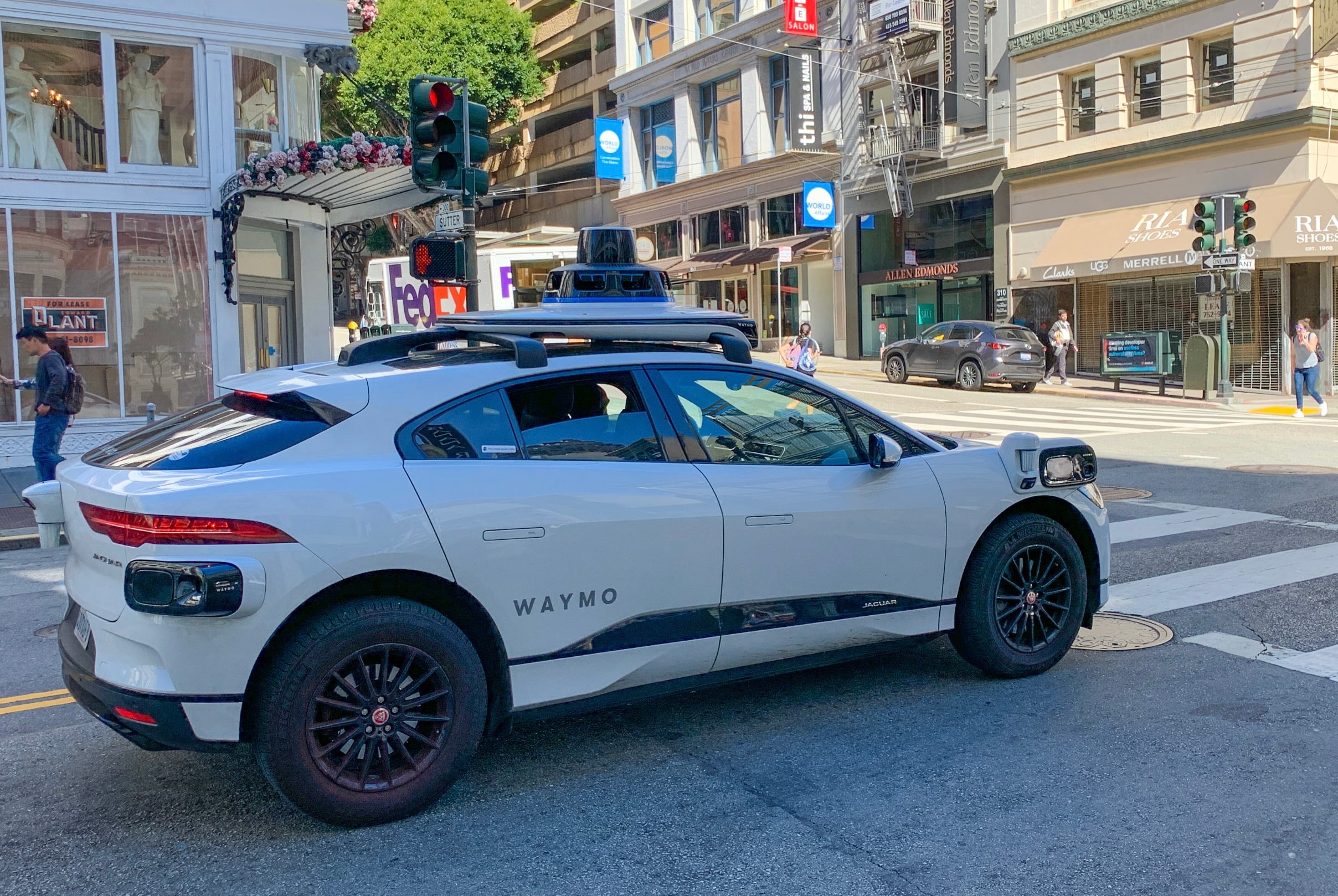
One week ago, City Councilor Mitch Green broke the news that autonomous vehicle company Waymo wanted to operate on Portland streets. Sharing a link to a story about a Waymo robotaxi hitting and hurting a child near a school in in Southern California, Green wrote on Bluesky: “You should know that Waymo wants to come to Portland. You should know I don’t support that.”
Two days later the Waymo news was confirmed by Willamette Week and now there’s a bipartisan bill up for debate in the Oregon Legislature that aims to smooth the road to full deployment of robotaxis statewide.
This news could lead to a collision between Portland city councilors, Alphabet (the corporate parent of Google who owns Waymo), city staffers, and state lawmakers.
Councilor Green is opposed to robotaxis based mostly on labor-related issues. He’s worried robotaxis would make life even harder for existing rideshare drivers. Beyond that, he says data privacy is also a concern. Green has said he’s open to learning more about how robotaxis would impact traffic safety and congestion.
Portland Bureau of Transportation Director Millicent Williams is also taking a cautious approach thus far. Thanks to reporting in the Willamette Week, we know that Williams has expressed to city leaders via internal emails that AVs may bring safety benefits, but, “They may also have significant impacts on our local transportation system. They may add additional miles driven on our streets, cause curb zone conflicts during pickups and drop-offs, present challenges for first responders, and more.”
Down in Salem, State Representative Susan McLain, a Democrat and chair of the House Transportation Committee, has introduced a bill with Republican House Rep Shelly Boshart Davis that appears to have been written by AV lobbyists (since November 2025, lobbying firm Google Client Services, LLC has donated $2,500 each to bill sponsors Senator Mark Meek and Rep. Hai Pham, as well as $2,500 to Rep. Ben Bowman, $1,000 to Sen. Floyd Prozanski, $1,500 to Senate President Rob Wagner, and $10,000 to Governor Tina Kotek).
House Bill 4085 would lay a legal groundwork for the operation of self-driving vehicles in Oregon. Typically during a short legislative session, lawmakers only consider bills that are non-controversial, have been vetted in a previous session, and/or have no fiscal impact. While lawmakers have considered AV-related bills in the past, HB 4085 goes further than anything before it.
One of the provisions in HB 4085 that’s raising eyebrows is section 13 which states:
“A local government or local service district may not: (a) Prohibit the operation of an autonomous vehicle or on-demand autonomous vehicle network; (b) Impose a tax, fee, performance standard or other requirement specific only to the operation of an autonomous vehicle or on-demand autonomous vehicle network.”
That “specific only” part means that taxes and fees can be charged to AV network operators, but only if similar types of fees are levied to other competing types of taxi companies. This exception would allow Portland to levy a fee on any potential robotaxi trips because we already charge a service fee for Uber and Lyft rides.
But other provisions in the bill could kneecap the ability of local policymakers to regulate robotaxis as they see fit. Given that PBOT Director Williams recently said, AVs, “Will have the greatest impacts on local jurisdictions and it makes sense that the city of Portland would want to ensure that we could maintain an AV regulatory framework to meet our needs and to be able to mitigate any negative local impacts,” I doubt she’ll be too happy about HB 4085.
In a statement to BikePortland this morning, Councilor Green made his stance on HB 4085 clear:
“I oppose this bill’s effort to preempt our ability to locally regulate autonomous vehicles. It’s particularly appalling that the Oregon State Legislature would even consider introducing new factors that contribute to VMT, congestion and potential road safety issues after their catastrophic failure to deliver a transportation bill, which has undermined the viability of our transit agencies and the ability for municipalities to deliver basic, routine upkeep of our transportation assets.”
Fortunately for the City of Portland, they are not new to the AV question. Back in 2016 PBOT was tapped by a US DOT “Smart Cities” initiative to be one of the testing grounds for AV fleets. That let to the Smart Autonomous Vehicle Initiative (SAVI), a plan that set some ground rules for what many thought at the time would be the imminent deployment of robotaxis. One outcome of the SAVI effort was Transportation Rule Number 14.34, “Connected and Autonomous Vehicles.” That rule requires AV operators to have a permit, pay fees, and so on. (Last month, Director Williams said that rule is now outdated and needs to be amended.)
In April 2017, Portland city leaders were falling over themselves to welcome these driverless cars to our streets. “To the inventors, investors and innovators, I’m here to say that Portland is open for business,” proclaimed former Mayor Ted Wheeler. “By working with private industry, we can make sure that cutting edge technology expands access to public transit and reduces pollution and congestion.”
That was a different era in Portland politics, and the general public is likely much more skeptical of AV companies today. Councilor Green is likely to find support for his concerns among his colleagues, especially Councilor Steve Novick. Novick made headlines back in 2014 when Uber tried to bully its rideshare vehicles into Portland without permission.
12 years later, we might be on the cusp of yet another showdown about the impacts of corporate transportation on our streets.
— If you’d like to weigh in on HB 4085, there’s a public hearing scheduled for Monday, February 9th at 8:00 am in the House Committee on Transportation.

Thanks for reading.
BikePortland has served this community with independent community journalism since 2005. We rely on subscriptions from readers like you to survive. Your financial support is vital in keeping this valuable resource alive and well.
Please subscribe today to strengthen and expand our work.
Safety being an afterthought is infuriating. As a daily cyclist, someone who’s ridden in an AV, and–most importantly–having looked at the now-robust Waymo safety stats, it’s a cut-and-dry case: if we prioritize road safety for passengers and vulnerable road users, we should race to embrace AVs. 80-90% fewer crashes!
Good on the state, shame on Green.
Hi Garrett,
Trust is a big issue for me. I don’t trust a corporation to have my best interest at heart. It’s that simple to me. And I am very worried about ceding control of these public spaces to a product owned by a corporation and that’s run by an algorithm and where we have murky accountability laws. I can feel the temptation for why these things make sense, but I am personally not convinced and not enthusiastic about them.
Totally get it, really. Maybe a better way to think about it and a good suggestion for improving the marketing here is to frame it as a public health issue.
“We have the opportunity in the face of a novel plague of human inattention, cognitive decline through hyper-aging demographics to inoculate ourselves from the risks we are well aware of. Though only 127 million doses have been administered so far, the data suggests a roughly 90% rate of decline of injury and death from coming into contact with the plague inside a vehicle, and about the same for those outside a vehicle. We get you’re uncomfortable at this stage because it feels like this solution has only been worked on for a few months, but it has been in the development stage for many many years. It is important that we realize we are in this together and for everyone to trust the science.”
Goes down easy, and at least by getting in a Waymo you’re not signing up to have your heart fucked up for the rest of your life.
I was more or less with you til the word “heart.” Whaaaat?
I don’t think that helps the marketing at all. “Science” is science – it demands rigorous questioning – but “The Science” insists that a hypothesis can never be questioned, which is antithetical to science.
Ah, you get it.
Thanks for the comment, Jonathan. I hear those concerns. However, the (1) growing number of peer-reviewed studies showing an order-of-magnitude safety improvement combined with (2) the safety crisis we all experience on the streets make a pretty good case for proactive, forward-thinking public policy, though… as compared to Green’s apparent instinct to go full luddite from his bully pulpit.
NIH: “We find that when benchmarked against zip code-calibrated human baselines, the Waymo Driver significantly improves safety towards other road users.”
Traffic Injury Prevention: “Data was examined over 56.7 million RO miles through the end of January 2025, resulting in a statistically significant lower crashed vehicle rate for all crashes compared to the benchmarks in Any-Injury-Reported and Airbag Deployment, and Suspected Serious Injury+ crashes”
Garrett,
It’s still not conclusive whether or not widespread use of robotaxis would be a net safety benefit. A few studies doesn’t persuade me. And if only safety data were the only issue at play here! There are many many other things that we need to consider when making an opinion about these things. And like I said, at the end of the day, they are operated by companies with profit motives and extremely dubious histories of putting that profit before people. I’m not against the tech, I’m against the outcomes and the companies behind the tech. And there are tons of negative externalities that come into this as well, like increased VMT, storage space for the vehicles, taking urgency away from transit investments, environmental toxins from tires and brake dust and batteries, creation of more billionaires, and so on and so forth.
“…they are operated by companies with profit motives and extremely dubious histories of putting that profit before people“
You’ve just described every car corporation I know. Is there any car corporation that give a dang about any humans external to a vehicle? Pretty much all your concerns are the same as I have with any and all car/vehicles already unleashed on the roads…and sidewalks…and MUPs….and anywhere they can be crashed into. Those are already all over the place and relentlessly killing people.
What makes Waymo so much worse than the present that it requires a sudden flurry of activity from the Council? Are they going to see how much money they can squeeze out of it for another Vienna junket? How much money Waymo will contribute to street repair (that we’ve given up on)?
Also describes the airlines, who are rapacious as fuck and yet air travel is incredibly safe.
What we need is effective regulation. It’s reasonable for policy makers to say “not yet”, but I still want to hear your vision for how we are going to get this right when it comes. Because it is coming, whether we like it or not.
I’m flattered. I would allow Waymo and charge by the mile per car. They are eminently suitable for such a tax as they are by nature constantly tracked. Such a tax is best left to the state to collect and manage and allocated by percentage to the municipalities where the mileage took place minus the state’s share.
This is why I believe this is a state concern and not a local one. They would already fall under all local taxi laws and regulations, but being robotic shouldn’t affect their taxation more than a human driven taxi.
All fair points! And that’s why we need _thoughtful_ engagement by our public servants. I’m not seeing that from Green; instead it seems like blindness to the realities and externalities of the status quo.
Companies cannot lose money by offering free rides. Of course they are for profit and here is the best part, Uber and Lyft can coexist with AVs and the consumer has a choice. I am not sure why Robotaxis are a problem. I want Google and Tesla AVs on the streets of Portland in addition to Uber and Lyft.
They will be paying their fair share of taxes and fees. This is nothing new. Not enough people use it and service would scale down. Why recreate the wheel here? California and Texas have vetted this and these services are on the road already!
Not to mention Arizona. I spend quite a bit of time in Phoenix and Waymo is my go-to ride service; I only use Lyft or Uber if a Waymo isn’t available. Clean modern cars, smooth driving, no issues. And as a cyclist I have never had a negative interaction with one… although it’s still pretty wierd when you try to make eye contact with the driver to ensure you’ve been seen, and there is no driver!
“I am not sure why Robotaxis are a problem”
They are a problem in this community because they remind people of private cars, which everyone knows are the devil’s spawn (even if most of us drive one). In other words, it’s an emotional response.
People will come around, just as they have to the motorized bicycles that have taken over a large part of bicycling, even if some bicyclists still unitonically call drivers lazy.
When profits depend on safety, a corporation becomes safety obsessed. Take a look at the airline industry. Airlines provide the safest form of transportation and they employ thousands of safety obsessed professionals. In transportation, consumer demand forces a company to make the safest choices.
For Waymo, safety is literally an existential issue.
Not surprising that the senior author is someone who works for Waymo LLC and they published in a crap journal.
Jonathan,
This whole debate feels like another example of Portland’s default posture lately: paralyzed, reactive, and weirdly incapable of managing change. We can and should have serious conversations about labor impacts, safety, VMT, curb management, and local control, but instead we’re acting like the mere presence of new technology is the problem.
What’s frustrating is that Portland used to do this work. SAVI, AV rules, permits, fees. The framework already exists. It’s just outdated because City Hall hasn’t kept up. Same story as always. We under-manage, then complain when the state or private sector fills the vacuum. When a city can “discover” $40 million sitting idle in a housing account, it’s hard to take claims of careful stewardship seriously. If Portland wants local control over robotaxis, it needs competent, proactive governance, not reflexive opposition and doom-loop politics that scare off innovation while failing to deliver basics like housing, transit funding, or street maintenance.
We don’t have to roll out the red carpet for Waymo. But pretending we can freeze time, or regulate effectively without actually governing, isn’t a strategy.
And now it’s not 40 million dollars the city of Portland “found” sitting idle in an account, it’s 106 million!! . Can’t make this stuff up. Will there be any repercussions for this incompetence?
https://www.kptv.com/video/2026/02/07/estimated-106-million-unbudgeted-housing-funds-identified-portland-city-administrator-says/
How are the accountability laws murky? Waymo rides have insurance like any other car and driver on the road. https://support.google.com/waymo/answer/15510171?hl=en
If anything, accountability is clearer because everything is recorded, so it’s much easier to figure out what happened and who is at fault.
Was this comment written by an AV?
Waymo is not doing what they are doing for altruistic road safety purposes, they are doing what they are doing for labor replacement.
I trust the safety stats Waymo posts about as much as I trust any other industry propaganda organ: it’s probably true, but it also likely lacks the context needed to draw a useful conclusion. Anyone can publish stats about their own company that makes that company look great.
Not just corporations but governments and especially individuals. City of Portland is notorious for cherry picking data and massaging it to reflect what they want it to say.
For sure, I didn’t mean to phrase that in a way to imply it wasn’t a universal practice.
100% – the way some people in the comments are going all in on Waymo taking over taxi labor based on some specious safety reports cooked by a corporation feels like a mirror of how people can so easily give up freedoms for dubious narratives around crime based on data that can be so easily manipulated.
So when I have to run from some dude on the Springwater, I’m manipulating that data? Which never happened before wise and progressive Mayor Hales declared the unending “housing emergency”
Ditto being scared because some wacko is doing wacko stuff on the road with ever increasing frequency?
Nah, the proof will be clear to all of us as soon as an appreciable number of these are on the road.
Who ever said “you” were manipulating data? The point I’m making is not whether or not increased crime is “real,” but rather that it is often packaged into a narrative that puts people into a reactionary fear state.
I would rather humans have the job than a robot.
Shame on the state, good on Green.
I am always struck by the simplistic way that people think about robo-taxis. Most address this question of thinking that one human driver trip will be replaced by an autonomous driver trip. What is ignored is that robot-taxis substantially increase the number of cars traveling on the road. Requiring a human to be present in a car has always been an important natural limit to the number of cars on the road. This space limit has already been stretched by most trips being only one human per car and the ballooning size of cars and trucks. With robot-taxis, the limit becomes much more fluid. It relies on the market, on regulation, on small city governments pushing back against deep pocketed corporations.
David Zipper and others have written extensively on the over promise and failings of autonomous vehicles. So far, the claims that they are safer are dubious. The regulatory framework to truly handle them at scale is non existent, and we have already seen Tesla and Waymo make them more aggressive by tweaking features. The vast majority of imagined improvements for AVs could be achieved by better regulation of human drivers and vehicles.
Finally, it is unlikely that robot-taxis will be taxed to the extent that they pay for their negative externalities. Importantly, expect that every pedestrian and bike infrastructure improvement project will now have to go up against a Waymo lobbyist with direct access to to the legislature or city hall in addition to all of the usual car-centric cranks.
Portland should not be an early adopter of a shiny new object that is essentially tripling down on antihuman car-centric planning. And giving up our largest public spaces, i.e. roads, to the control of corporations that will be motivated to fill as much of that space as they can with their cars and have an appetite for more and more space and speed with as little liability as they can get away with.
COTW: “giving up our largest public spaces, i.e. roads, to the control of corporations….”
David Zipper is absolutely a thinker everyone in this space should be following. He is active on Bluesky.
Him being on bluesky isn’t a recommendation.
Really? Why not? He shares links to research, papers, and studies he has done or recommends. He’s an academic, not a crank.
Where should he be?
“Robo-taxis substantially increase the number of cars on the road”
[citation needed] there are over a million cars on the road annually in the Portland metro area. Adding a few hundred to a few thousand cars is not a substantial increase.
Portland is not even remotely an early adopter here. Waymo AVs have been on the public roads in California, Arizona, and other states for over a decade—the first public drives were in 2015.
I think the idea is that empty cars will basically loop around popular areas waiting for customers, adding to overall congestion.
A few thousand cars is not a substantial increase? What the hell are you talking about?
“I think the idea is that empty cars will basically loop around popular areas waiting for customers”
I googled it. It looks like they generally park somewhere to wait, or head back to the depot when demand is low.
That’s still congestion though, right? Like, where are they parking?
“where are they parking?”
I don’t know, I didn’t dig that deeply. But I do hear lots of people here saying congestion is good because it slows drivers down, and less parking is good because it deters driving.
You may not agree with those things, but that is the party line.
We don’t know exactly how many cars Waymo would deploy in Portland, but there are about 800 cars deployed in San Francisco according to the disclosures from this summer. If there are millions of private cars and trucks on the road, that’s a less than 1% increase in vehicle traffic.
It costs Waymo money to deploy and maintain the cars. They don’t have an incentive to flood Portland with too many empty/idle cars that people aren’t using. It’s basic supply and demand.
Exactly, to make money, robo-taxis have to compete for fares in limited areas and beat competition for time to pick-up. When I was last in SF, I was in a Waymo that had two Waymo’s behind it and two Waymo’s in front- in addition to uber, lyft and personal cars.
People will twist their brains into pedantic knots to dilute the problems caused by cars. In the larger scheme- cars are a failure of innovation. Taking human drivers out of the mix does not transmute the turd.
Oh come on. The Council and City can’t regulate expired license plates or illegal parking and they have the egotistical gall to think they can regulate autonomous vehicles separate from the state?? If AV’s cause problems on the streets it will because they will actually follow the rules of the road. If that causes chaos, then so be it.
One more thing. If Green is so upset by an AV hitting that kid, where’s his anger at all the Portlanders killed by cars? Let’s regulate vehicular killings out of existence before we turn our attention to the next shiny distraction.
I’m pretty sure Mitch Green is upset by the Portlanders who are killed by cars. I believe the name for this rhetorical device is “begging the question”. Mitch Green, like all of us, is presumably capable of holding multiple opinions about multiple issues.
And this may be obvious, but it’s easier for a local government to regulate a permit for a taxi company that it is for them to enforce regulations on the entire geographical area of said city.
Yes, easier things are much more appealing to this council than providing resources and the ability for the community to thrive through meaningful employment, comfortable car free lives and safe roads where maniacs aren’t killing us.
Results matter and I know this is the sticking point in most of our disagreements. If Green and the Council actually were upset about our bloody streets I assume they would do something about it. That they haven’t tells me the council doesn’t care in a meaningful way or that they’re incompetent and none of them should be re-elected.
Green and the rest are in actual power here. They are not innocent bystanders.
How do you feel about these examples of Mitch Green trying to do something about making the streets safer for those not in a vehicle?
Not all of those are “results” per se, but I think they are meaningful results – particularly the sidewalk bond.
I haven’t been blown away by any progress from the Portland City Council, but I think you’re being a bit uncharitable to Green. He has been a fairly consistent voice pushing for sensible and practical transportation policy. I don’t disagree that results matter, but it is disingenuous to bring up a bunch of things Green and the council are considering as evidence that they aren’t doing anything about another topic. City Councils have to deal with much more than just deaths caused by the transportation network.
I’m singling out Green as he was prominently mentioned in Jonathan’s article. I am not thrilled by the results or even the motivation of any of the council to positively affect our transportation woes.
Great, but like you said in your original post that “If Green is so upset by an AV hitting that kid, where’s his anger at all the Portlanders killed by cars?”, and then “If Green and the Council actually were upset about our bloody streets I assume they would do something about it”. I am presenting you with evidence that Green does in fact care about this stuff through direct reporting on his policy making decisions and public statements.
Could things be better? Of course. They can always be better. Are the issues urgent? Of course they are. But I don’t think begging the question about “why isn’t he doing this” when he is doing at least something is good discourse, and I think that all legislators are capable of doing policy in multiple fields at once.
We have legislators bringing in a bill written by the AV industry. This is preemptive regulatory capture. It’s now on the agenda in a short session. Nothing to see here folks, just a normal way of doing business.
Yes. Actually, this is exactly how business is done here. I don’t like that aspect whatsoever, but you’re not paying attention if you think this fast track only is happening for Waymo.
I don’t know what kickback the council is angling for, but it will be interesting once they actually start negotiating what the council asks for that is unique to Portland.
Thanks. If other sweetheart deals are done, I’m not surprised by that, but it doesn’t make me feel better about this business of taking Waymo’s money before slipping their particular bill into the pile.
Is the $10K that Kotek got a little money or a lot of money? Were no first class seats to Istanbul available?
If it helps, it doesn’t make me feel better either.
Just makes it harder to swallow they won’t craft legislation for the good of most, but are just fine with what is good for the few. I’m fine with Waymo coming since I think it will help people that have been left behind by lack of access to public transit, but not thrilled the way it’s getting fast tracked in front of other concerns.
Cannot wait for Susan McClain to retire.
Green can’t say he’s against automobiles, afterall the majority of his voters have and use autos so one can’t be anti-car and get ahead as a politician very well.
He can go after AVs because the voting masses don’t own them.
So, like any politician who wants to be voted back in he knows what side of the bread the butter is on.
Wait.. so you’re saying that the Oregon Legislature will do a good job of regulating AVs?
No, that’s not what I’m saying, but touché. That’s a fair touch 🙂
I don’t see why the Council defaults to being unique from the rest of Oregon unless the idea panders to their ego or they really want another taxed revenue stream. A statewide set of regulations will be okay (and not a good job)and be a fine start so I don’t see the councils urgency when they have plenty to concern themselves with. Like a forensic audit of the whole city government. They just found another 20 million to pay for it.
Unlike most here, I have not seen the council successfully walk and chew gum.
Twenty million does seem like an amount of money that somebody would keep track of. Maybe there was some reserve or contingency that did not require funds after all, I don’t know. I’m no bookkeeper.
It hasn’t been that long since ODOT had to stand someone up to explain their guesswork was out by a billion dollars but on the short side. That event disappeared into the news cycle fog in about three days.
I remember and you’re right, it just went away and barely brought up since. Its just so frustrating. I know with aviation when there’s an accident with an airframe there’s a safety stand down to double-check all similar aircraft and for the pilots and ground crews to evaluate their procedures. We really need a financial stand down to know just what is going on so we can appropriately support (or be against) future requests for funding.
I’d like more public transit, please.
If only public transit had the lobbying power that Waymo does to buy a bill!
If only public transportation were directly connected to local government so they could make it as good or bad as that want. Oh wait, that’s exactly what’s happened and they’ve picked the “as bad” part.
The Governor appoints the seven-member Board of Directors for Trimet.
What Waymo is asking for is very easy.
If Waymo we’re asking for a percentage of every paycheck issued in Portland area, as TriMet is, then I think they would have considerable difficulty.
Except that’s literally what Waymo is asking for. The roads are a public resource, maintained and funded by our tax dollars. Taxes on car drivers don’t come even close to paying for all the negative effects of cars on our roads and the environment. Somehow everyone is fine with socialism for car companies and big tech, but we turn up our noses at even bare minimum funding for safe and efficient public transit.
No it’s not. They’re asking for the state to prohibit cities from imposing fees and regulation on them that don’t apply to others. The are literally not asking for the state to raise taxes to give them money.
Asking politicians to raise taxes is hard, and if they did that, Waymo would probably not get very far, even with the most skilled lobbyists.
Sure, and 120 years ago he would have been worried about the farriers and nobody is wishing we would have listened to those folks.
Spend five second searching, “uber driver hits pedestrian” and there are limitless articles.
This is an interesting vibe prognostication. It does seem likely though that Portlanders, a group known for missing the forest for the trees, would be more skeptical of AV options coming to their city than a councilor who goes around current day Portland and comes away with fois gras and AVs as issues that need attention right now.
I dunno, I often find myself wishing that working class people had more political power to articulate their economic interests. I think Uber/Lyft represent a significant step down in living conditions for cabbies, and that has negative social consequences.
Sure, Uber drivers hit pedestrians too. There are specific regulations to deal with this sort of thing. I think it’s reasonable for a city councilor to express desire to regulate AVs as they see fit, given the relatively sparse regulations they have now.
This is a comment that seems to be obviously made in bad faith. Mitch Green was at the rally last Saturday and is clearly doing more than just posturing about AVs and foie gras.
Portland already has high unemployment, but sure, lets keep getting it to go up so all of that money goes to a giant corporation instead if a driver atleast getting some of that money and keeping it in the community.
Silicon valley with $18t of wealth really needs more of it.
It is kinda hilarious that you make this comment and blumdrew made a similar one last week about the job market being terrible in Portland necessitating a move to Seattle.
Do you ever actually wonder why the unemployment rate in Portland is high? By virtue of mentioning it, it does appear that you understand the connection between needing businesses to operate and the employment of people at those businesses, but it seems like the intellectual urge fades there. If you don’t currently own and operate a business in the city, I strongly suggest you think of something you’d really enjoy doing every day and then research what that would entail to start as a business here. It is fascinating to just see what it costs to register an LLC with Oregon, then the specific licenses necessary in the city and the costs for those. What is rent, insurance, and the really fun one, LABOR, after all of those are added to just the costs of buying materials and producing the good/service, do you even make enough to cover your existing bills let alone be compensated profit for your efforts?
I ride in Uber’s all the time, and it appears that the vast majority absolutely hate it. I’d rather ride with a computer making binary decisions than someone who despises their job and my safety hangs in the balance. And unless we are in favor of taxing remittances at 75%, I am not remotely convinced by the argument that we’re keeping much of the money in the community anyway.
Hey, I run a small business. You’re right: it totally sucks. But: all work sucks, and I do like being my own boss. The cost of registering an LLC is only $100/year in Oregon. For my particular business, I don’t need additional licenses. It’s substantially higher in other places. I looked into doing it in PA in 2017 and it was like $500-600 before I made a single dollar. Barrier to entry in Texas was low as well, but I had to register with Sales Tax and they’ve continued to hound me over bs years after I closed the business and sent my last filings. My genuine impression is that this is one of the easier states to start a small business. When I have needed something from the city or state, it’s been fairly easy and I’ve found the people I connected with generally friendly, professional, and helpful. Not so in Texas. Don’t even get me started on Chicago, sheesh.
Human labor is, for sure, very expensive, and the cost of it limits business growth and job opportunities. I don’t know what the solution is there. I’m working through a plan for myself there, but I don’t think we’re solving the cost of living crisis without a UBI or some other top-level socialist intervention, which is outside the scope of this conversation.
I’m firmly in the camp that all cars are bad and most drivers are not good enough at driving, and yet, STILL, I would take Uber/Door Dash/whatever over fully autonomous solutions. You have to own a car and get a license to get into that level of the gig economy, but that’s still a considerably lower barrier of entry than, say, a college degree and a professional network, and it does seem to me that a lot of young people are doing these jobs and I don’t know what else they would be doing if we just replace all of that work with remote operators in the Philippines.
Whether it passes or not, I’m amazed that $20k worth of campaign donations can buy sponsors for legislation that will cost at least that much just to draft. Maybe we’re looking at lobbying the wrong way.
How much does Sarah Iannarone get paid and how many legislators could be bought with that money?
I thought we were done being the test crash dummies? Oregon legislature gets paid so little, $2k is a decent chunk of change in comparison. To be fair that is belly lint change for the Waymo dev ops teams, who will never be held accountable for any of the deaths that are coming.
We already are crash test dummies out on Portland’s streets with angry, distracted, speeding drivers forcing me into dangerous situations on my bike.
OTH, I can appreciate the opportunity to request a hundred waymos to 4301 S. Macadam Ave.
I’m not necessarily against AVs but bill HB 4085 needs some serious work to allow regulation at the local level. However, I am against any more taxes that will be passed on to the consumer. But I agree it sounds like the bill was written by AV lobbyists and that should be concerning which should raise further scrutiny.
Witness more destruction of democracy by capitalist vultures. Please, good people, remember capitalists and corporations are not here to benefit you or society.
In the really early days of AVs, I was very excited about their deployment in urban spaces. That was when I naïvely thought they would be engineered and managed using a solid “safe systems” approach, akin to how the aviation industry (at its best) works. In that world, safe AVs would have had a positive effect on the streets, modeling safe behavior and slowing traffic on our high-crash corridors.
But that was a loooong time ago, and it’s clear to me now that the AV industry is rife with charlatans who are happy to use unwilling pedestrians in their opaque experiments. Any deployment needs capable and vigilant regulation and monitoring to ensure that these technologies achieve outcomes in terms of safety, environmental impacts, and generally make urban spaces better, not worse.
I don’t see the State of Oregon, the City of Portland, or any other entity in the state having anywhere near the necessary capabilities now or in the foreseeable future.
So no. Just no.
Disclosure: Waymo has supported my work as a sponsor of PRN in the past, but I am under no obligation to promote or support their activities.
As a person who hasn’t driven a car in probably 3 years, I’d rather share the road with or be driven by a waymo than 95+% of human drivers – and that number is only going to go up.
I do think we must regulate these vehicles and we should demand that the technology and services are monitored, priced, shared, and accessible.
Until our council has appetite to price the existing dangerous and damaging trips of private drivers, I have little patience for selective opposition to some car trips.
Nearly every person I have spoken to in LA who rides a bike comments about how pleasant it is to ride around these cars.
There is an AV threat, it’s the lazy and corner-cutting approach being pursued by Tesla and Elon Musk. Transportation advocates would be wise to encourage the option that does, by all means, seem interested in safety and fleet operation.
I get what you are saying here, Tony, but aren’t you concerned that a fleet of AVs wandering around town, looking for riders, is going to clog the streets and balloon VMT? The state is supposed to be working on *reducing* VMT, not increasing it via AV miles.
If we could say that AVs will replace SOVs, for example, on a mile-for-mile basis, then I can see a case for them. But clearly that’s not happening anywhere they have been introduced.
“Waymo has supported my work as a sponsor of PRN in the past…”
Waymo has contributed far less than 1% of our revenue.
Don’t taxi, Uber, and Lift drivers already “wander” around town clogging our streets?
It’s debated, but there are multiple lines of evidence that AVs increase VMT. One of the reasons is more time empty. One of the primary concerns is that different companies would compete by time to pick up, which would require more vehicles than there is demand. Ultimately companies would want to have as many circulating vehicles as possible and can tolerate more empty time than gig workers. Companies can temporarily flood the city with unsustainable numbers to get market share and then decrease numbers and increase prices as competition wanes.
One way around this would be for the state to require that all autonomous vehicles use LiDAR. That makes the cars expensive enough that they’re not gonna flood the streets with them. It also precludes Tesla from flooding the streets with stupid Robo taxis.
But supporting that would require accepting the technology, and we have not seen a willingness to do that from transportation advocates
That would be awesome except for the fact that idiots like Mark Meek can be easily bought and sold by AV companies looking to cut costs once the venture capitalists stop sloshing infinite money at them and start demanding returns.
This is a fantastic idea. I’m not really worried about Waymo because they are much safer due to the LIDAR. We need to prevent Tesla from launching a fleet of vision-only driverless vehicles. This should be regulated at the Federal level, but we know that isn’t going to happen any time soon.
“We need to prevent Tesla from launching a fleet of vision-only driverless vehicles”
Too late. The technology is available to any Tesla owner who subscribes, though it is true that it still requires the presence of an untrained safety driver behind the wheel.
Portlanders love clogged streets.
Heck, if the people doing the clogging are on bikes that’s outright celebrated
I’m certainly not predicting that this will happen, but it seems at least plausible to me that a fleet of electric robotaxis on the streets will limit their “patrols” to arterials and probably stick to driving the speed limit while doing so. If they were able to keep traffic on Holgate under 30 mph, that’d certainly be an improvement.
My answer to this is that if there is latent demand for safe PRICED trips by car because transit or bike options suck, then we should let Waymo fill that demand. We do just about zero to discourage “everyday” car trips so fuck it. It’s not about vmt, it’s about political bandwagoning, posturing, Luddite mentality, and car culture.
Again I see your point but I’m not sure we should go directly to “fuck it.” Decision points, such as whether or not to introduce AVs, present a rare opportunity to shape the conversation.
I agree that AVs could have many benefits, with safety paramount among them. But let’s talk about the transportation landscape we want to have and continue to work toward it, not just throw in the towel and let these companies do whatever we want. I certainly don’t think Salem should be telling every city and town and county in Oregon that it MUST let in AVs. That’s crazy.
“let’s talk about the transportation landscape we want to have”
I think this could be a productive conversation. I hope someone on Council who can see beyond the loss of exploitative McJobs will lead it.
This is a totally defeatist mentality. I agree 100% that we aren’t doing enough to discourage everyday car trips, but your solution to that is to…. give up completely and encourage even more everyday car trips? Have you considered that maybe one of the main reasons that transit and bike options suck, is because there are so many cars taking up space in our city?
That’s not my position. I also don’t think we know how things will shake out. I am very familiar with David Zipper’s opinions. I have met him several times.
Something I don’t see mentioned is that cars in motion clog our roads, cars at rest clog our cities. It is possible (not for sure) that AV cars will be on the road more (per ‘useful’ trip) than a comparable ride-hail or personal trip. It is also very likely that a waymo will be utilized for ‘useful’ purposes for much more of it’s total time than any privately owned vehicle.
What this means is that a single fleet owned Waymo may reduce the total number of vehicles IN the city – because a single Waymo can be in service 20 hours a day or whatever. This theoretically could be possible with a shared fleet like cabs, but is unlikely to maintain the scale due to labor costs (a whole other convo – which I also have informed thoughts on – I was a labor organizer before I became a transportation wonk).
I don’t like cars in traffic. I prefer a robot driver in the city to a human because I do believe it’s inherently safer based on my experience. I dislike cars intensely and my work is centered on the damage that car STORAGE has done to cities and society.
I think Waymo-model AV has a strong potential to reduce the space we use storing cars. I also think that priced trips absolutely reduce overall car trips. So my support is to price as many trips as possible and to throw my support behind an AV model that doesn’t seem completely evil.
One of the few scenarios where a scaled adoption of AV tech that accommodates all income earners (I’m hoping we consider that as a goal) would be integrating it into public transit in a phased, semi-flexible route, approach to augment a transit network as last mile shuttles like in some countries overseas.
What most people here are simply assuming without explicitly admitting is adopting a tech bro, door-to-door SOV lifestyle, which does tend (as it has where it has been implemented in SF, for example) to increase congestion, parking, length of trip, and replace public transit, undermining the current transportation system for a few VIPs. That is what has happened so far, not the utopia AV companies are trying to sell.
A Waymo car might be statistically less likely to kill you, but that is just the tip of a very complex iceberg we know very little about. There may certainly be a place for AVs in the transportation system. There is the potential for AVs to not increase congestion, parking and replace public transit, depending on how they are used. Unfortunately, “potential” does not take the place of the existing evidence, and deciding policy on a hunch is almost always a very bad idea.
If you want a place to be more walkable, making cars more convenient, ubiquitous and largely managed by companies that have no incentive to reduce street capacity/speed, will do exactly the opposite. The problem is not people driving per se, it’s the inherent lack of any other choices in most US cities.
Waymo seems to be trying harder than some companies to operate in a safe way, but the bill doesn’t just ban the city from regulating waymo it applies to any robotaxi. What if some other company decides that they want to gain a competitive advantage by programming their vehicles to speed, or drive on sidewalks etc? One of their competitors in the space has a history of allowing illegal activity in their autonomous modes.
It actually doesn’t say the city can’t regulate vehicles ,at least not from the reporting I’ve read. It says they can’t add fee fees that they don’t apply to other services.
The city can clearly enforce traffic rules and they should on both human driven and robot driven cars.
My whole point here is that I’d much rather have the robots than what we have now. Human drivers are shit. They’re not gonna get better, ever. I would welcome an open arms, the city, enforcing traffic rules, strictly on every single vehicle on the road.
I wonder if the city can under the current state law do this. For example currently when a vehicle runs a red light at a camera enforced intersection my understanding is that the city has to pay someone to look at the footage and determine that the offense happened and then the owner is sent a letter saying is this a picture of you driving the vehicle and if they say no that isn’t me actively piloting the vehicle and they decline to identify the driver then no one is actually ticketed. I am not sure what currently would happen if there simply was no driver, but I have read that in some of the places where trials for autonomous vehicles have been taking place that the process of issuing a ticket is enough of a hassle that the cops have simply given up on trying to do any enforcement.
Starting in July, in California, it will be possible for the police to submit citation information to the DMV, who will take action against Waymo (or whatever company). This strikes me as a very workable alternative to a traditional ticket, and is something Oregon should consider as well.
This would also make it easier for the state to spot trends, and will hopefully lead to permanent improvements in driving behavior system-wide, something that doesn’t work so well with traffic fines issued against human individuals.
Then they’re going to get sued, and lose.
A lawsuit is something that happens after a person is hurt. To put it another way, a person has to be hurt before they can effect change. If they are dead, no change for them.
I don’t call legislators “Solons” but I’d like it if some smart experienced people say down and discussed this bill, looked at itsl parts, and listened to what people had to say about it. Is that going in the short session?
“A lawsuit is something that happens after a person is hurt.”
It is, but the prospect of one is forward-looking and acts as a deterrent. We can see this woven through nearly every aspect of society.
I’ve been saying we should be preparing for the arrival of AVs for a while now (as recently as this week other commenters were scoffing at that idea). We would be in a much better position if we were prepared and had a coherent policy framework already in place.
It’s odd that Green’s main opposition to AV’s is the labor aspect.
Protecting those totally Mom and Pop ride share App companies is one of his priorities?
Is he also opposed to better public mass transit options for the same reason?
He probably needs another junket to investigate it.
The labor issue here is the drivers, which is obvious from his statement.
And clearly he is not against mass transit. I’m not sure how you could glean that from these statements.
He is protecting App drivers from AV technology which will put Uber slave labor out of business in time.
So will good transit.
Do you think the Rideshare App model is good for workers?
Mitch Green thinks so.
Its not that he thinks rideshare apps are good for the drivers.
But that we all need money to survive and we already have high unemployment.
Availability of crappy jobs is more important than traffic safety? That’s an interesting prioritization.
This is such a purposefully wrong way to read Mitch Green’s statements on this topic. The labor issue is that Uber drivers already get paid way too little and have nothing in the way of job protections. Unregulated AV taxi company is probably going to make that worse, so he wants to regulate the AV taxi company. Also, calling gig work “slave labor” is a bit rich, unless you want to talk about the concept of wage slavery, which I gather that you do not.
We get it, you hate Mitch Green. Doesn’t mean you need to say stupid things!
LOL, gig work… You must have used UBER last about 5 years ago.
The drivers now are almost all full time, drive insane hours to make very little money.
I don’t hate Mitch Green, he is just a terrible council person who has spent a year trying to find his office and spends most of his time on performative nonsense.
Not to mention the blatant grifting of taking a taxpayer paid trip to Europe with 6 months of taking office.
Can you even explain what he went for and how it helped the citizens he represents??
I mean yeah, I don’t use Uber. I suppose I was a little inexact with my use of “gig” there, but I more meant it in reference to app-based gigged work than literal part time gig work. And I don’t use Uber in no small part because the drivers get treated like crap (I also can’t afford it). But that’s besides, the point: there is still a pertinent labor issue at hand here.
“I don’t hate Mitch Green, I just think he sucks at his job and spends all his time doing performative nonsense”. Not exactly convincing me that you don’t hate him.
Its not at all a surprise that a socialists main opoosition is the labor aspact.
And come on, you think its about protecting the ride share companies? Not the drivers? Especially when we already have high unemployment in the city?
More mass transit would also lead to more jobs.
I think you are arguing in bad faith here.
Who do you think drove people around before the rideshare App companies did?
Taxi drivers made MORE money than Uber drivers.
Where is Mitch’s concern for those workers?
I think you don’t understand the issue enough to argue about it at all.
I’ve been away from Portland for years, but where I live, Lyft and Uber have almost completely supplanted taxi services. A quick search for taxis in Portland brings up results with low ratings. I can’t imagine the taxi companies there have much ability to compete against the horrible rideshare companies, let alone regain a substantial amount of lost market share. Maybe that, and the rideshare companies’ legislative sway, is why people like Green don’t bother talking about taxi drivers even while being aware that taxi drivers made more. Just take a look at the last few decades of labor trends and ask yourself if companies like Waymo are going to reverse any power loss labor has suffered, and you can maybe get a clue as to why Green talks the way he does in this context.
Uber and Lyft were already here when he was elected, in case you didn’t know.
One thing that both Oregon and NC have in common is how our relatively-conservative state legislators are constantly trying to regulate the actions of its notoriously-liberal largest city (Portland & Charlotte), and how often each of those cities successfully finds work-arounds to evade state legislation.
I don’t have strong feelings one way or the other about robotaxis, but I deeply and profoundly resent state legislators preempting how local governments manage their streets and their communities at the behest of corporate lobbyists.
What makes you think the City Council is immune to corporate wiles?
Nothing, but this is entirely irrelevant to the specifics of the state preempting local control over a local issue. If the state preempts to protect corporate interests, that’s bad. If the city bends to corporate interests, that’s also bad. He’s just saying the first thing is bad, and I’d presume he would agree the second thing is bad too.
Yup. Plus, generally local policymakers are within closer reach than state lawmakers, so in general corporate capture at the state level is significantly worse than at the local level in terms of impact and anyone’s ability to reverse it.
That’s a no from me dawg. I don’t have a problem with AVs, I think they are probably safer on average, HOWEVER…when you have language like “A local government or local service district may not: (a) Prohibit the operation of an autonomous vehicle or on-demand autonomous vehicle network; (b) Impose a tax, fee, performance standard or other requirement specific only to the operation of an autonomous vehicle or on-demand autonomous vehicle network.” …that is a gigantic red flag.
It sure does remind me of the constant fights cities get into with ODOT, where ODOT says that a street has to be X, Y, and Z to support traffic flow, objections, concerns, and lives of the local residents be damned.
Plus, the federal government is clearly not going regulate AVs correctly at this time. So it falls on states and yes, cities, to do it instead.
“Safety” is currently being discussed based on:
1) self-reporting from Waymo and other AV companies, which is not necessarily accurate and comprehensive.
2) focusing ONLY on collision data, and ignoring other public health and environmental issues, including air pollution, chemical runoff, noise pollution, etc, all of which increase with more automotive use. Currently, one of the few limits on the number of automotives on our roads is the number of human drivers; once that limit is removed, expect way more traffic and pollution, with direct implications for public health. (Shout out to *Life After Cars* for so much great data on how bad electric vehicles and their combustion engine cousins are for public health and the environment.)
3) a moment in which we have not *yet* experienced cyberattacks on autonomous vehicles. Yes, you know how hackers get into everything? Can you imagine what happens when entire networks of AVs get hacked? How safe will that be? If this sounds a little far-fetched, consider that there have already been incidents when network overload or network failures have caused problems with AVs. More to come!!
If you want the safest streets, reduce the number of automobiles. Those things kill people!!!
Cars are inherently evil. Car drivers are good people, some of my best friends are car drivers, but car driving eventually makes people lazy and make the wrong decisions.
You sound like you’ve never ridden in a Waymo or seen them regularly in a city. Even people who live in San Francisco—the second highest density city in the US, which has *dramatically* better public transit and bike friendliness than Portland—love Waymo.
There are legitimate reasons it is outpacing trips by Uber and Lyft. One of the big reasons is because people really do feel like it’s safer. Anyone who has ridden in one will tell you that if anything, they drive far more conservatively than a human driver does. The safety data from Waymo is completely in tune with most people’s experience and probably not a lie. (Not to mention the fact that you’re not in danger of being assaulted or harassed by a stranger, as either the driver or passenger.)
Note how the legislation says only that it disallows fees or taxes that exclusively target AVs. This leaves the door open to local per-mile taxes or fees on all rideshares and taxis. We can and should just apply equal taxation regardless of whether a “car for hire” trip is driven by a human or not, and then use the funds to improve public transportation and infrastructure that is friendly to cyclists and pedestrians.
Also, if there is a cyberattack, they’re not going to target a few thousand Waymos when 80%+ of commuters drive a regular passenger car. They’re going to attack critical infrastructure like water sanitation, defense, and the power grid. If one AV company fails due to cybersecurity, the country will be just fine. SF didn’t shut down because Waymos all stalled out. You’re fearmongering here.
The fact that the legislature could move so quickly in a “bipartisan” manner to roll out the red carpet for a corporation, but can’t be bothered to do anything about the state’s transportation and TriMet budget crisis speaks volumes of where their priorities lie.
I would guess it has more to do with the fact that the AV regulation wouldn’t cost the state any money, while plugging a very large, recurring hole in the budget would require either new revenue OR re-directing existing budget. New taxes are politically unpopular, and taking money away from, say, State Parks or Education would be very unpopular.
I’m on two not-for-profit boards. We are *way* more cautious and tentative when it comes to spending money than we are about policy changes.
Ultimately, this is a losing fight. Just as Uber is essentially everywhere, AVs will be too, including Portland. It may not be this year or next, but they’re coming. You can only maintain the status quo for so long.
And it’s going to be fine. I predict that many of you, probably a majority, will like them once they’re here and the novelty of putting traffic cones on their hoods wears off, and those of you who actually do care about safety realize they really are a significant improvement over regular cars.
I remember when Uber came to town and the rage that inspired. Understandable as it was even more blatantly a boys toys type of operation back then. All those loudly opposed to rideshare glossed over just how bad the taxi service was back then and didn’t want to be taking away money from the protected fleets who provided bad service, long waits and low pay for the drivers.
Now a few years later and we have the same arguments wanting to protect Uber from competition.
If local government had our best interests at heart we’d enjoy an extensive and robust public transportation system with interconnected bike lanes that reaches all through the metro.
Local government don’t have our best interests at heart by the evidence in front of all our eyes so why not give Waymo a chance?
If a corporation wants to provide good, safe and efficient transportation service that I pay for to help me go completely car free, that’s fine with me. I would rather local government would provide that for me, but they are not.
The Portland local government does try to do some of what you suggest. I think it’s failures have less to do with the government itself and more to do with the actual politics of funding those things. Most people drive their cars for all trips, maybe except for a bus/train/bike commute to avoid parking headaches. In this sort of environment, it’s difficult to adequately fund transit or build bike lanes because people do not see how those interact with their daily lives.
This isn’t even the question at hand. The question is if the state should preempt Portland’s authority to regulate AVs as they see fit, not if the city should pass a specific AV regulation.
40,000+ households in Portland (~14%) already do fine without access to a car. It is within your power to join them now.
“I think it’s failures have less to do with the government itself and more to do with the actual politics of funding those things. “
You’ll have to explain further how you think actual politics is somehow different than doing government work. The two are inseparable . Government doesn’t exist all on its own. People engaging in politics make it happen. Those people, for the sake of argument we can call them “politicians “ are elected and make decisions on how to manage resources that they collect from the ones that have money taken from them to provide for the common good. We can call them “taxpayers” for short.
“The question is if the state should preempt Portland’s authority to regulate AVs as they see fit, not if the city should pass a specific AV regulation.”
I disagree. The question seems to be if Portland should regulate Waymo more than any other taxi service. I don’t think it should. I believe we already have all the taxi rules and regulation for Waymo to operate.
I’m curious what else you think is needed for them. If your concern is for them as a taxi company, we already have all we need. If you think they need to be regulated in some other fashion, how so and what are some of your ideas? I thought per mile taxing would work especially well for them.
40,000+ households in Portland (~14%) already do fine without access to a car. It is within your power to join them now
LOL, nothing like some ableism mansplaining to round out my Friday. This is a ridiculous statement— (hmmm, two short hyphens do become one long hyphen) Just do it regardless of your situation.LOL!!
If people want to increase those car free numbers we should be trying to make it easier for those who have a difficult time with mobility. One way is to increase public transit services. Well, we’re going backwards on that. Another is to make point to point transportation more available which is what Waymo is wanting to do.
Governance (as in who is elected to be in the government) and revenues/expenditures/budgeting are all part of the same whole, but most a given elected official only has so much power over the budget side. No city council has the power to address TriMet’s budget issues, since TriMet is a state entity (that could be taken over by the regional government I suppose).
I think Waymo, as a company operating a taxi without a driver, should be subject to slightly different regulations than other cab companies stemming from the lack of a driver. I presume it takes more intervention with Waymo when things go wrong, and I’d like a fee-funded solution to that. I’m recalling a time when first responders in SF had to deal with a Waymo butting in on an emergency response scene. I’m thinking along the lines of a fund set up to deal with the company, so we don’t create a bunch of unpaid work for city staff having to deal with issues. That’s a novel thing to have to deal with.
I cannot comment on your literal ability to change aspects of your life to live without a car. But I do know that people living with disabilities tend to be much more reliant on public transit, and much less likely to be drivers. And that for a lot of people, the reasons for driving are more tied with social norms than physical reality. If your situation is the later, then I’m sincerely sorry that I wasn’t more mindful of that. I am really trying to get at the fact that 95% of people I know (that live in cities with reasonable public transit) could ditch their car permanently. It just would mean they’d have to give up skiing, they’d have to plan trips a bit further in advance, and they’d have to be beholden to the occasionally middling service their city has.
I think we agree on funding transit more.
My car free periods were glorious and remembering that gives me optimism for the future. I would like more people to embrace urbanism and go car free as well and I agree 100% that public transportation should be well funded and extensive. Singapore is such a great example. If the council went there on a junket I think they’d actually learn something.
They wouldn’t even have to ditch skiing, don’t put that idea out there! Not only is there often a bus you can ride, but you can still rent a car for special occasions.
Have you ever tried skiing with the bus? Someone here posted about their experience a while back, and said it worked, but it didn’t sound appealing to me.
86% of portlanders are not unable to go car free. Nobody did an ableism.
I am not one the 86% who can for an undetermined as of yet length of time. The comment was addressed to me, it was an ableism, he corrected it and I appreciate that. I would very much like to get better and I agree that the vast majority can go car free and even more of those who can’t could get rid of their POV with better point to point transportation. It’s all fine.
But 86% of households are willing to pay a lot to not go car free, which tells you the alternatives just aren’t very good. Even with TriMet spending 1% of the region’s payroll, they still can’t provide a service that most people choose to use.
I don’t think that’s really TriMet’s fault; I think it’s that the type of service they are set up to provide, vehicles that go where TriMet wants when they want is just inherently unappealing in a world that has experienced point-to-point transportation that travels when the passenger is ready (and is warm, dry, clean, and largely free of scary people).
Waymo will provide many of the benefits people derive from driving, without many of the most serious drawbacks. I can see why a lot of TriMet supporters are alarmed, even if (or because) many of TriMet’s customers will be better off.
“But 86% of households are willing to pay a lot to not go car free, which tells you the alternatives just aren’t very good.”
What that tells me is that a lot of people are so heavily indoctrinated that driving everywhere is just what you do that it doesn’t occur to them that they don’t have to do that even in places where it’s totally doable, especially since the majority of Portlanders seem to have moved here from car-centric places. Combine that with a few prominent news stories about scary people on the bus, and most people won’t even consider any alternatives. Uber and Lyft can’t possibly be safer than public transportation, in addition to being way more expensive, but most Americans just think “car = good” and that seems to apply to automated vehicles, too. I honestly wasn’t expecting to see so many arguments from this POV on a bike-oriented website.
(I’m also concerned about how these things interact with, say, cats wandering in the street, or squirrels, which are both a real issue in my neighborhood, and there don’t seem to be much if any data to indicate it’s even been looked into whether or not they’re better at seeing animals in the road.)
Perhaps the rest of the world has been brainwashed, and only you can see the way things really are.
Or maybe people just like the comfort and convenience of a car, which is cheaper to operate for many trips than bus fare, is warm and dry and has great music, and works late at night or when going places that are hard to get to buy bus. And no weirdos.
I rarely drive, but it’s no mystery to me why people choose it over the alternatives. And if you don’t understand that, is hard to figure out how to influence people’s behavior.
PS Google will give you info about Waymo and animals… Here’s one unvetted link: https://www.reddit.com/r/waymo/comments/1hiesyi/waymo_stops_for_small_critters/
No, it’s not. There’s a gigantic Wikipedia page that tracks the legal arrangements of ridesharing in jurisdictions all over the world.
We have a choice about letting AVs operate in Portland and Oregon generally. I for one want to have a say in whether – or how – it happens, not succumb to some false inevitability.
Sorry, I meant everywhere in America. And even that’s not strictly true, for example they don’t operate on Mackinac Island.
My post wasn’t about what should happen, it is about what will happen: One way or another, AVs are coming to Portland streets, and I think everyone knows it.
Do you believe that Tesla’s vision-only system is good enough for city-wide deployment? Should we consider requiring LIDAR on these fleets, or are we just going to let the private market do whatever they feel is “safe enough”?
“Do you believe that Tesla’s vision-only system is good enough for city-wide deployment?”
I don’t. But I don’t think we should be making rules based on technological facets, but instead on performance. If Tesla is able to design their vehicles to operate safely using vision only, then more power to them. I don’t believe they have acheived this yet.
But I would want any such claims to be independently evaluated. I don’t trust Elon Musk on this particular question any more than you do.
(And it is probably worth noting that their vision-only system is already deployed citywide, in the hands of any Tesla owner who has subscribed to “self-driving”, or who is using one of their occasional free trials.)
Automated taxis?!
We don’t even have a monorail yet!
Play takes place on any Portland privatized road area.
[Ed 209]: Greetings all valued potential consumers within auditory range! This is your friendly Ed 209 here to request no sudden movements as that may result in liability on your part. While there appears to be an unexpected humanlike presence my LIDAR has sensed in my sensitive undercarriage region, please be informed panicking will only serve to escalate the currently nominal situation.
[bystander]: Hey! put a cone on it quick!
[bystander 2]: You! I’m not getting arrested.
[Ed 209]: Remember any experience is data that continually serves to improve the AI algorithm periodically, making this the safest form of ground transportation ever invented! This potential contact event will serve to make all of you safer in the future OS update! Remember it is illegal to interfere with an Ed unit on duty. Now initiating Keep Summer Safe mode. All non OCP members maintain a 15 foot perimeter.
[bystander]: Oh shit! It’s going to murder that person underneath it! What do we do???
{Ed 209]: Pease remain calm and do not approach the vehicle for your own safety. You will receive a reply within 48 hours when submitting any current or past suggestions to the OCP customer service department. Have a nice day!
[bystander 2]: 911 is telling me it’s strictly a civil encounter. What does that mean?
[bystander 1]: Since some roads were partially privatized, the police aren’t allowed to interfere with the Eds.
[bystander 2]: Oh. Right, I forgot.
The problem with car dependency is not that cars are driven by people. It’s that people are entirely reliant on cars. Ah dang, don’t have a choice any more. Gotta get home somehow.
Both bystanders open their OCP apps and hail separate AVs.
The absolute last thing our city needs is more cars on the road. And as a cyclist and transit user, I can already imagine how much my busses will get delayed and stuck in traffic when these cars inevitably glitch out and block the road. How many times do we need to get fooled by big tech before we learn our lesson? Their playbook is always the same: offer a product that is too good to be true, grow the userbase massively, displace and eliminate jobs, buy off politicians to deregulate, then enshittify the service by jacking up the costs and reaping ridiculous profits, while suffering no consequences for the harm your product inevitably does to society.
Please, do not allow these surveillance nightmares on wheels into our city. Our roads are already crumbling and dangerous because of cars. We need public transit and cycling investment, not handouts to the techno-feudalist elite.
Would this represent more cars, or different (safer, cleaner, and more law abiding) cars? Would they capture trips that would otherwise be made by transit, walking, or bike riding?
Maybe, but then I’d expect most of those trips to have already been captured by Uber.
I’ve ridden in them and they are way more aware and give more berth to cyclists than most drivers. The stats around safety are staggering. The less people we have driving dangerous killing machines, the better.
Do you think that the plan we are discussing is to replace bad human drivers with AVs? Do you think we are talking about AV taxis going back and forth from the suburbs to replace commuter traffic? Or even most trips over 5 miles?
The stats around safety are staggeringly not impressive in context. Maybe in one of the industry created “studies” they do ok. But, any measurement of safety is relative. If we were discussing mandated AVs for drivers that routinely break the law, we would be making progress. But, that’s not what we are talking about. RIP KitKat.
A dramatic reduction in serious crashes seems impressive to me. What is the “context” that leads you to discount that? Do you think Waymo is lying about the data and no one else who has worked with it has noticed?
Misleading officials about a single event was enough to completely kill Cruise. Is Waymo risking their entire existence by systematically lying on a much larger scale?
Industry sponsored “research” is notoriously problematic. See cigarettes, fossil fuels, alcohol, meat, dairy, pharma, etc. The examples are endless. They are not risking their existence. What Cruise did was to lie about a single event when under scrutiny.
Yes. Cruise lied, and it killed them.
There are other sources for data about incidents involving AVs that are available to the public in San Francisco and other places that can be (and have been) used to corroborate crash rates.
So far, at least, everyone, including plenty of people not being paid by Waymo, who has looked at the question has concluded the AV are significantly safer than those driven by humans.
If you find any research that shows something different, please post it here.
This is typical tech-zealotry; wrong question, wrong data.
What is the safety benefit of adding hundreds of autonomous taxis to a transportation system that is already bloated with cars?
Better yet, compare the safety and negative externalities of a mixed all-the-bad drivers plus autonomous taxis to a system of bike-walk-micro-mobilty, and transit plus compact residential and service planning.
“What is the safety benefit of adding hundreds of autonomous taxis to a transportation system that is already bloated with cars?”
The benefit is that some safer driving will displace some more dangerous driving, and also that the presence of more vehicles obeying the speed limit (for example) will slow down all traffic, as people here often point out.
“Cars” aren’t the problem, dangerous driving and climate emissions are the problem (not the entirety of it, but a big chunk of it).
Comparing a likely future scenario (AVs mixed with conventional cars) with a fantasy scenario is not particularly useful. However, like you, I would prefer the fantasy. I don’t think that’s an actual choice.
If anything, AVs would make the fantasy scenario more plausible by making the streets safer and creating a more attractive alternative to private car ownership.
Ah yes… the fantasy of livable cities with safe transportation, which exists all over the world, compared to the fantasy of a mega corporation that operates based on altruism and prioritizes the well being of people over profits, which does not exist anywhere in the world.
Drivers are already complaining about traffic, parking, and travel times; I don’t think throwing more cars on the road and in parking garages is the solution when we have so much room for transportation improvement in regards to buses, e-bikes, bike lanes, and greenways. Personally, I see a future of transportation that doesn’t include cars as the primary mode of transportation, I’m sure AVs will make their way in but we don’t need to usher them in – especially not before we have off ramps in place for people who rely on ride-sharing to pay rent and buy groceries.
More importantly, the past year has continued to emphasize the importance of local, representative democratic governance to protect us from federal and corporate overreach. Personally, it sets off alarm bells that the state would attempt to preemptively prevent cities/towns/counties from regulating local transportation issues regarding relatively new technology.
Safety is vital in considerations of transportation and I don’t trust Waymo, or any Silicon Valley corporation to prioritize my safety the way I do. Their job is to make money and expand markets, my city councilors’ job is to represent constituents’ interests. If I must to trust my safety to a random corp or Mitch Green, I obviously pick Mitch Green. I want safer roads as much as the next cyclist, but adding more points of failure that can easily kill me doesn’t make me feel safer.
Interesting that it only cost Waymo $17,500 to wriggle into this shortened session and potentially kneecap regulations for an entire emerging industry in an entire state… Doesn’t make me trust them; who else could they pay off to make profits and avoid regulation?
The discussion around AV-taxis jumbles a ton of things together that should be dissected out.
Portland would be incredibly smart to continue pushing our urban spaces to be dense, bikeable, walkable and transit friendly even though it is a grind. Ultimately, it is this hard work that is going to make transportation affordable and enjoyable for Portlanders. Transportation can actually enrich the environment that surrounds it, if we choose. While other cities commit to AV gridlock, Portland continue on a path to being uniquely nice to experience. This has been and will be our wealth.
“Ultimately, it is this hard work that is going to make transportation affordable and enjoyable for Portlanders. “
Do you have a time frame in mind? It seems we’ve been going backwards for a long time since the trolley days of yore.
http://pdxhistory.com/html/streetcars.html
“Transportation can actually enrich the environment that surrounds it, if we choose“
We have chosen with where our tax dollars go and how they are spent. We have chosen poorly to the point where a private AV company is looking more appealing than what the city/state will offer.
We have been going backwards, but we have reached near saturation with car transportation and their highly predictable failures are more apparent than ever. As a result, we have significant shifts in public opinion and elected officials demonstrating what can be done in cities across the world when other modes are prioritized. We shouldn’t overlook the positive work of current councilors and state legislators that we haven’t had before.
Despite common opinion, the dominance of cars did not happen organically. The major shifts happened due to legislative capture. Waymo knows this, which is why we see them targeting some of the most disgraceful weak-minded legislators. This playbook was well described in this podcast, which is a great listen.
“The Creation of America’s Car Culture”
http://sites.libsyn.com/132228/the-creation-of-americas-car-culture
This
Anyone remember The Boring Company, a bold new way forward for future technology and people to zip through tubes revolutionizing transportation? ->
An expensive, small, typical tunnel for cars, largely bankrolled by public taxes.
Honestly, the child hit by Waymo case sounds like it was a well-mitigated emergency response. Do we really think a human driver would have braked as fast?
And as long as we are being inflammatory in our rhetoric, no Waymo has ever raped a passenger.
I’m reminded of the concept of “blitz scaling”; in the 2010s, rideshare companies used their VC $$$ to undercharge for rides compared to taxi competitors, then jacked up prices once they cornered the market. Could we maybe see something similar w/r/t to safety, especially as there will come technical limitations to the software as modeshare increases?
“Could we maybe see something similar w/r/t to safety”
You mean like what has happened in San Francisco?
The service has only just started. Get back to me in 10 years when it’s considered “normal” and regulation is beyond the pale.
Maybe I would trust Google on the road if they would stop crashing at home. They havent produced anything of value since 2017, they have been in full enshittification/corporate self-raiding mode, declaring insurance losses on every finger they cut off. Everything is broken, interfaces drawing over themselves, malware everywhere because 3rd party advertisers are allowed to inject scripts with root access and no filtering, search is arbitrarily useless after suddenly changing overnight in 2017, from 95% to 2% helpful instantly because they needed to train their algorithms, and never caught the landmine left behind by wrongly fired senior engineers that overrides the definition of bad=good, as a software engineer I can tell you its literally just a single 1 or 0 somewhere. They told me to prove its me and sign in from a “recognized place”: the middle of the ocean, I didnt fly there and I dont own a boat. AI is a copy *of a copy* of something invented in the 1970s that was made into a shit sabdwich with google’s worthless pile of poison they call data, all of it gamed to hell and built on top of bad=good. Gmail leaked passwords… How many times? They make you click invisible ads and mine bitcoin for them, trashing CPU performance and making it wear out 1000x faster. Dont get me started on android, cant even access our own files any more without disabling security, and thats supposed to be safer? Literally every move they make since 2017 is contemptably stupid.
When the people who buy ads from google take them to court for fraudulently delivering said ads to the void, as they have been to court for repeatedly, nothing happens. Internal documents revealed recently show they target toddlers, young children specifically, to get them hooked on gambling in ways that wont be detected by parents. There is no type of predation they will not eagerly profit from. Everyone should know who Peter Thiel is by now, who he works with, and that mass-scale disaster profiteering through total destruction of democratic capitolism is the whole game. I dont need to mention the other special crime these people share, out last weekend. Malevolence aside, the sheer reckless incompetence and scale of damage is unmatched in our modern age, the burning of data centers in late 2017 after forcing nearly all of humanity’s digital eggs into one basket is akin to the burning of the great library of Alexandria. So much of humanity’s greatness was lost. The shame from this 1 event should be so great that they never should have survived to become what they are now.
Choosing to support criminals who offer nothing in return is a choice, and an inexcusable one: that is why I call for a boycott of all companies who advertise with google or partner with them in any way. This boycott could not be more urgent, as Google leverages their illicit funding in politics to escape justice, erode our freedoms and our right to vote with our dollar. The FCC and cell companies conspire to restrict the devices that work, arbitrarily banning vastly superior brands. I will be screaming at the top of my lungs at anyone who dares to call themself a democrat and/or patriot while doing anything to aid and abett this malicious anti-American crime ring with zero value to the public. People should know better and Im done being nice about it, Google can operate in this city over my dead body. Their leaders need jail, their workers need school, their assets need redistribution to people who care about enabling American workers and innovators with the best technology our taxes already paid their scientists to develop, instead of holding us down. I am, in fact, entitled to use the internet that taxpayers created, the government requires me to use, and has since been repeatedly labeled as essential public infrastructure. I am entitled to reject trash and choose quality, and so are you, stand with me.