
BikeCraft is back! Get ready for a bike-inspired holiday gift faire

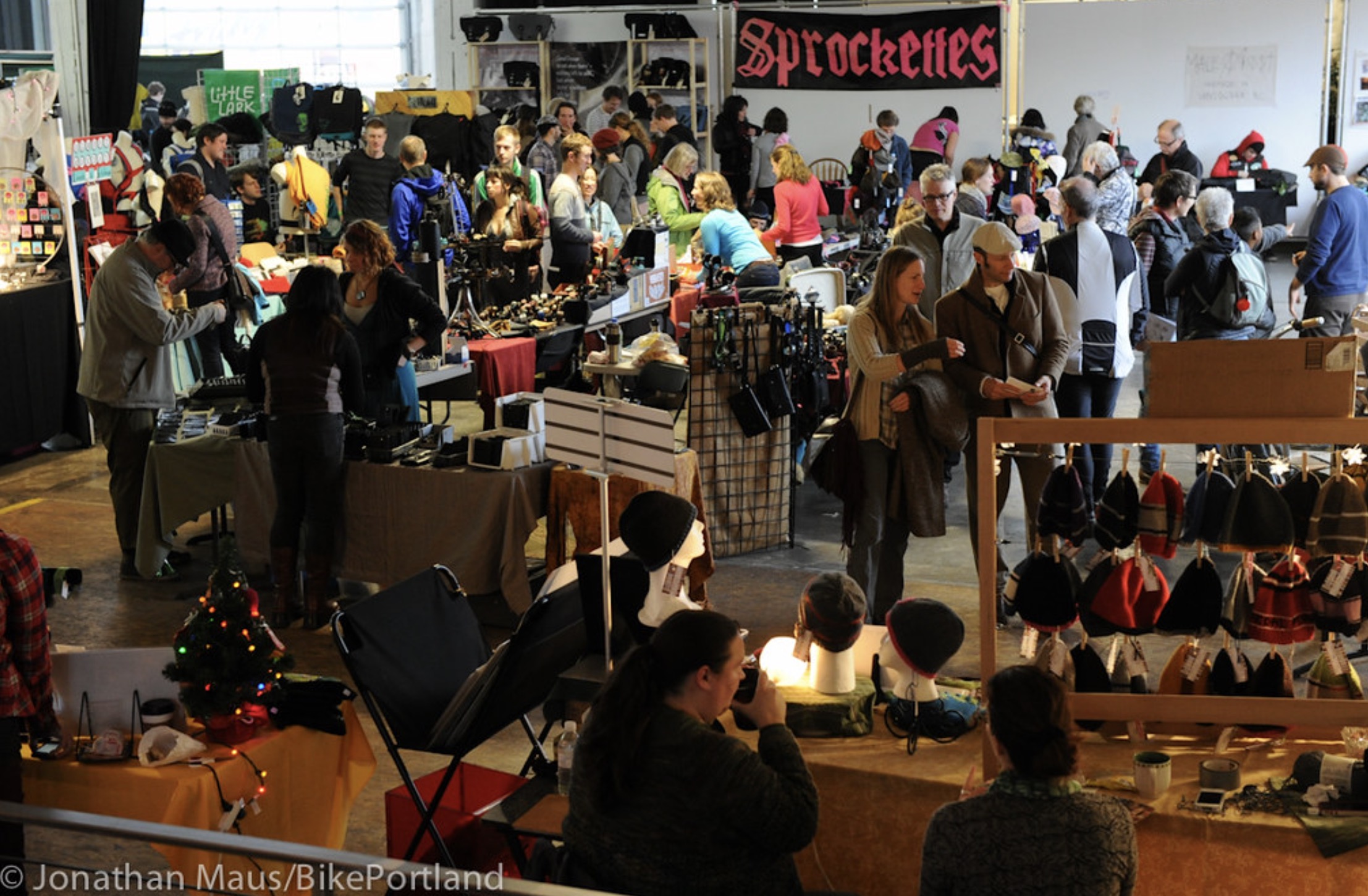
Pretty nice crowd at the 2012 edition.

I’m excited to announce that BikePortland will once again host BikeCraft. After a five-year hiatus for the event, the 16th edition of this bike-inspired holiday gift faire will happen at Migration Brewing on N Williams Avenue from 2:00 to 8:00 pm.

Before I go any further, please indulge my need to reminisce…
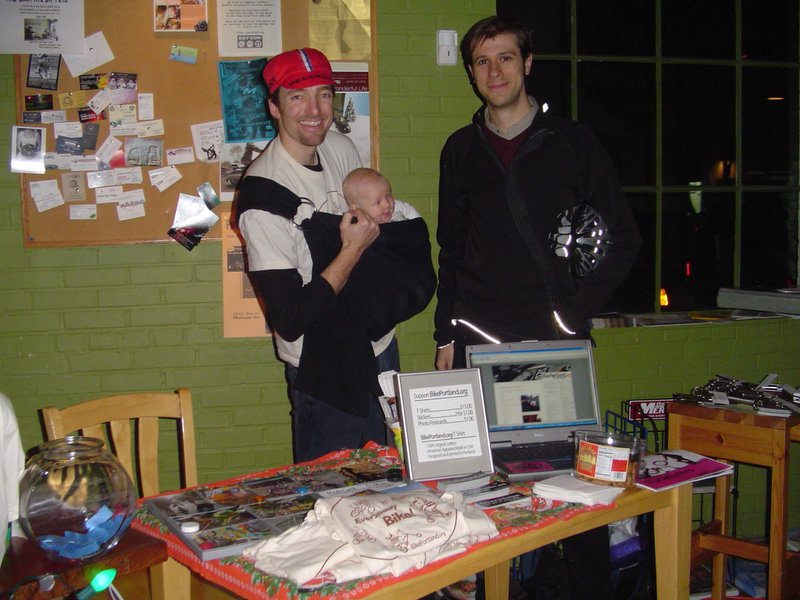
Me and a friend (hi Michael!) welcoming folks to the first BikeCraft in December 2005. That little baby in my sling has graduated college and lives on her own now.

It wasn’t long after I launched BikePortland in early 2005 that I realized our city was full of makers and artisans whose creations were inspired by bikes and the people who ride them. I was so inspired by the people I was meeting in the community and the websites I was finding (this was long before social media existing, so you would actually scour the Internet for things you liked and then create “blog rolls” of your favorites) that I wondered: What if we put all this amazing creative bicycling energy under one roof, for one night? Imagine what it would say about Portland’s bike culture if we could have our own holiday market!

So I found a large coffee shop in a central location willing to host us for free, and put out the call. I didn’t charge vendors and it was free to get in and I no idea if anyone would show up. And despite it being a very cold and icy night, hundreds came through the door. I recall being so happy to see all the bike people in one room. All kinds of cool products and crafts emerged that night — people sold things I’d never even seen before, some folks made new things just for the event, and others sold out of everything they brought. We had a poetry reading, a freakbike weapons demonstration by Dingo the Clown, and I talked so much for so long, my voice was hoarse by the end of the night.

I’m convinced there was no other city on the globe in 2005 that could have hosted such an event.

After that first magical night in 2005, I organized it the next five years and it grew a lot. We moved into bigger venues and it became a huge thing. The quality and variety of items was astounding. I’m talking really cool bags, hats, racks, artwork, jewelry, saddle covers, fenders, mud flaps, fashion, terrariums (!), sculptures, clocks, and so much more — and it was all either made out of bike parts or inspired by cycling. In 2011 I sold the event to some local guys who wanted to do even cooler things with it (including an e-commerce element that I had always dreamed about but never pulled off). Those new owners did it for five years. The event took a year off (2016) and then my friends Elly Blue and Joe Biel of Microcosm Publishing took it over in 2017 and ran the event for three years until its last run in 2019.

This year will be the 16th edition of BikeCraft and we’re bringing it back to the grassroots with a small list of vendors and a small venue to test the waters. If it goes well, we will consider changes next year.

Finally, I want to give credit to my friend Max for the BikeCraft rebirth. She’s the one who urged me to do it and convinced me over weeks of conversations at Bike Happy Hour — and has done all the organizing. Max (aka “Lady Max”) is the maker behind Flat Tire Creations and she’s gathered a group of vendors that should make for a really fun night of shopping and socializing.

So mark your calendars for December 17th and stay tuned for the full list of vendors and more details in the coming days and weeks.


— Browse the BikeCraft story archive for photos and flavors from past events.
City asks for patience as bike lanes fill with leaves

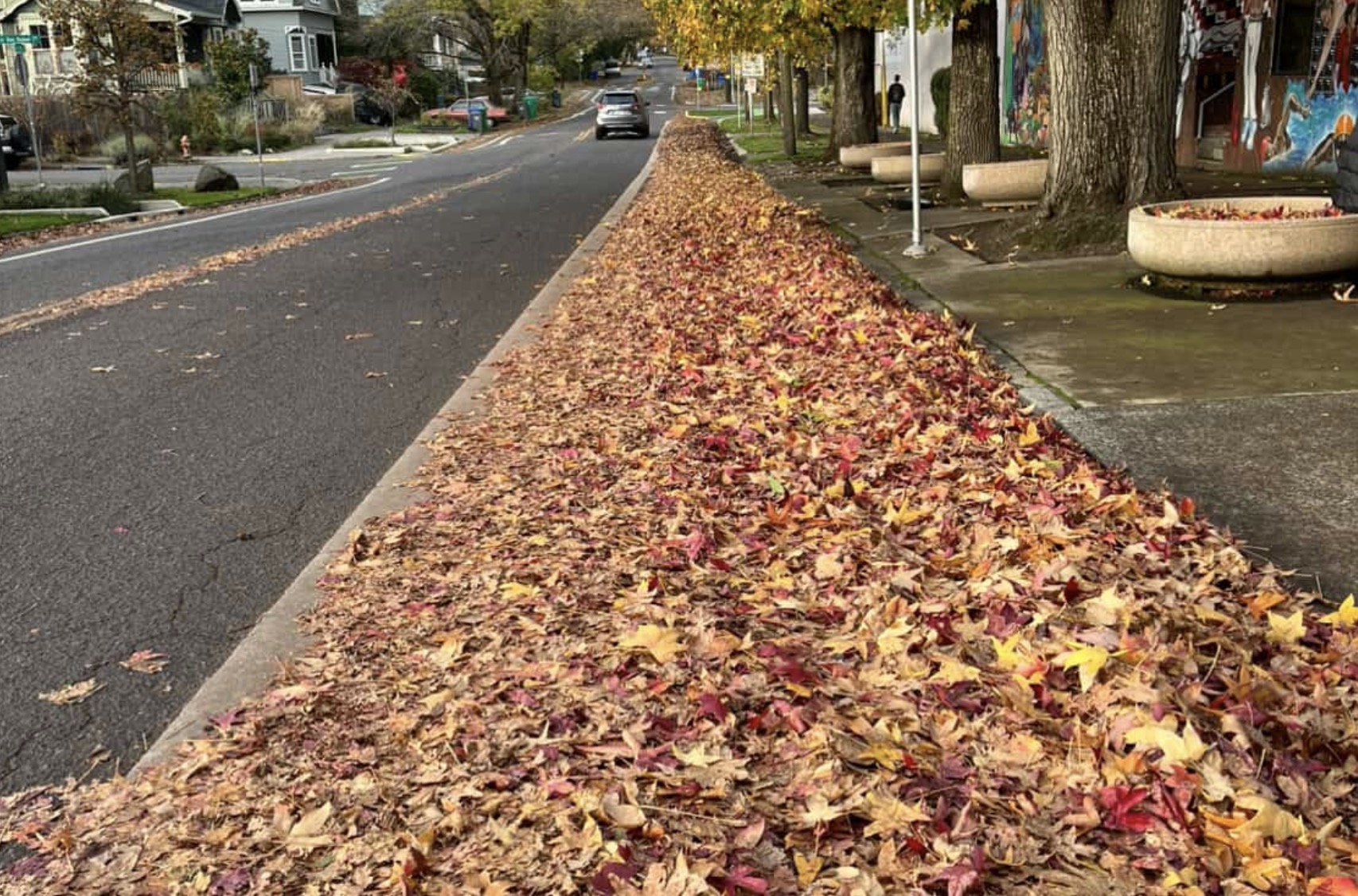
NE 7th Avenue right now, after workers blew leaves into the bike lane. (Photo sent in by a reader)

Welcome to being-pissed-off-about-leaves-in-bike-lanes season. Last night I sympathized with my former colleague (now Portland Mercury reporter) Taylor Griggs after learning she took a nasty spill on leaves while using the bike lane on Northeast 7th Avenue (see below). At the same time, I happened to be watching Portland’s bicycle coordinator share an update on bike lane maintenance.

Portland Bureau of Transportation Bicycle Coordinator Roger Geller shared a brief presentation on this very popular topic at the monthly meeting of the Bicycle Advisory Committee (BAC) last night. He gave an update on the $10 million bike lane sweeping initiative PBOT has been working on. As I reported back in February, PBOT won a grant from the Portland Clean Energy Benefits Fund (PCEF) that gives them $2 million per year for five years to keep bike lanes clean.

That funding is being used to purchase two big-ticket items: a new bike lane cleaning team and tools to do the work. Specifically, those tools include: a new fleet of battery-powered, bike lane-sized sweepers and leaf blowers for those hard to reach places.

I have written a lot about the perils of poorly maintained (and leaf-filled) bike lanes. That didn’t stop me from wiping out in one just now, falling on my face and scraping up my knee pretty badly. This is a truly hazardous situation, @pbotinfo.bsky.social. When are you going to do something?

Taylor Griggs (@taylorgriggs.bsky.social) 2025-11-18T23:12:21.288Z

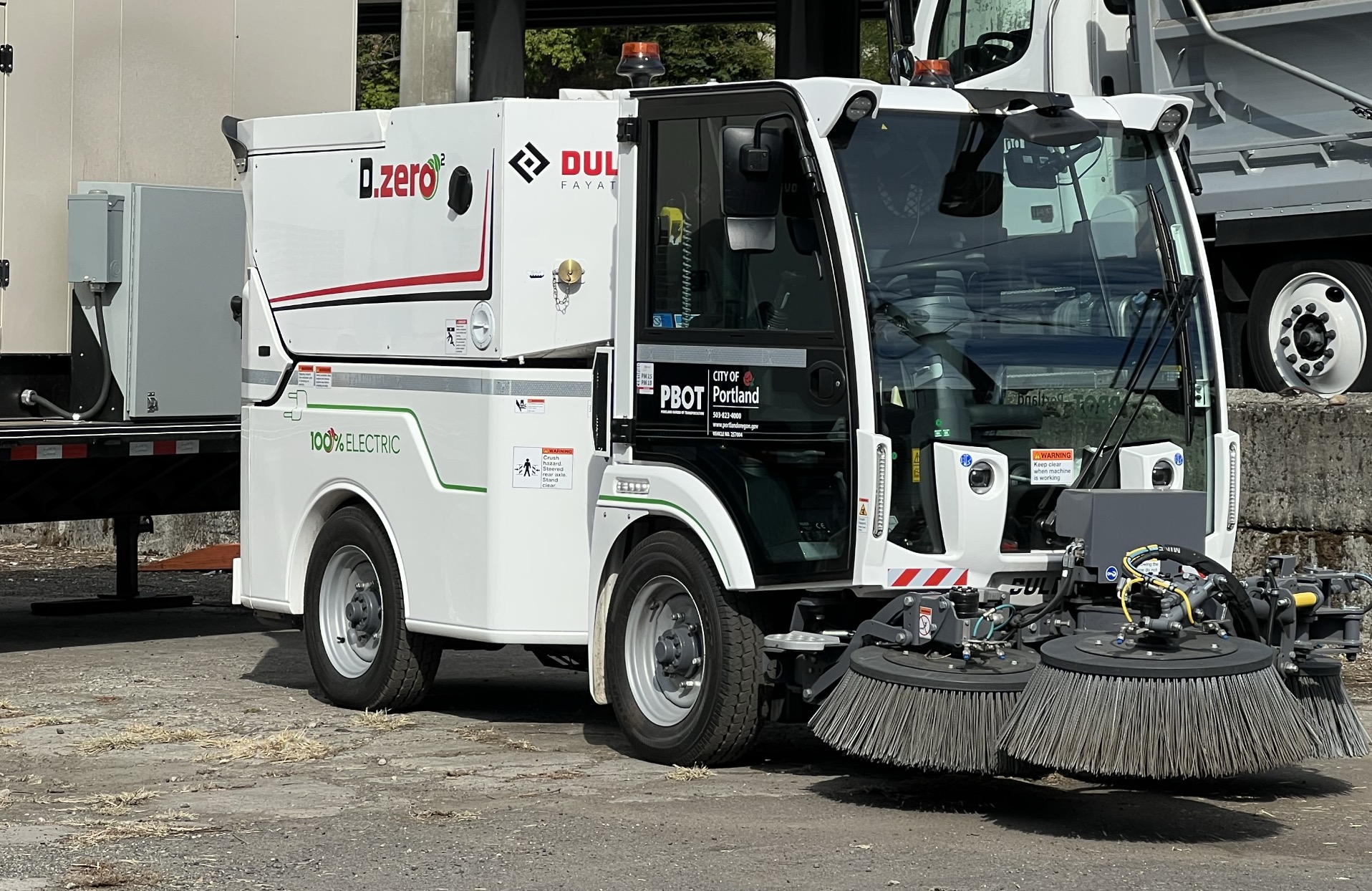
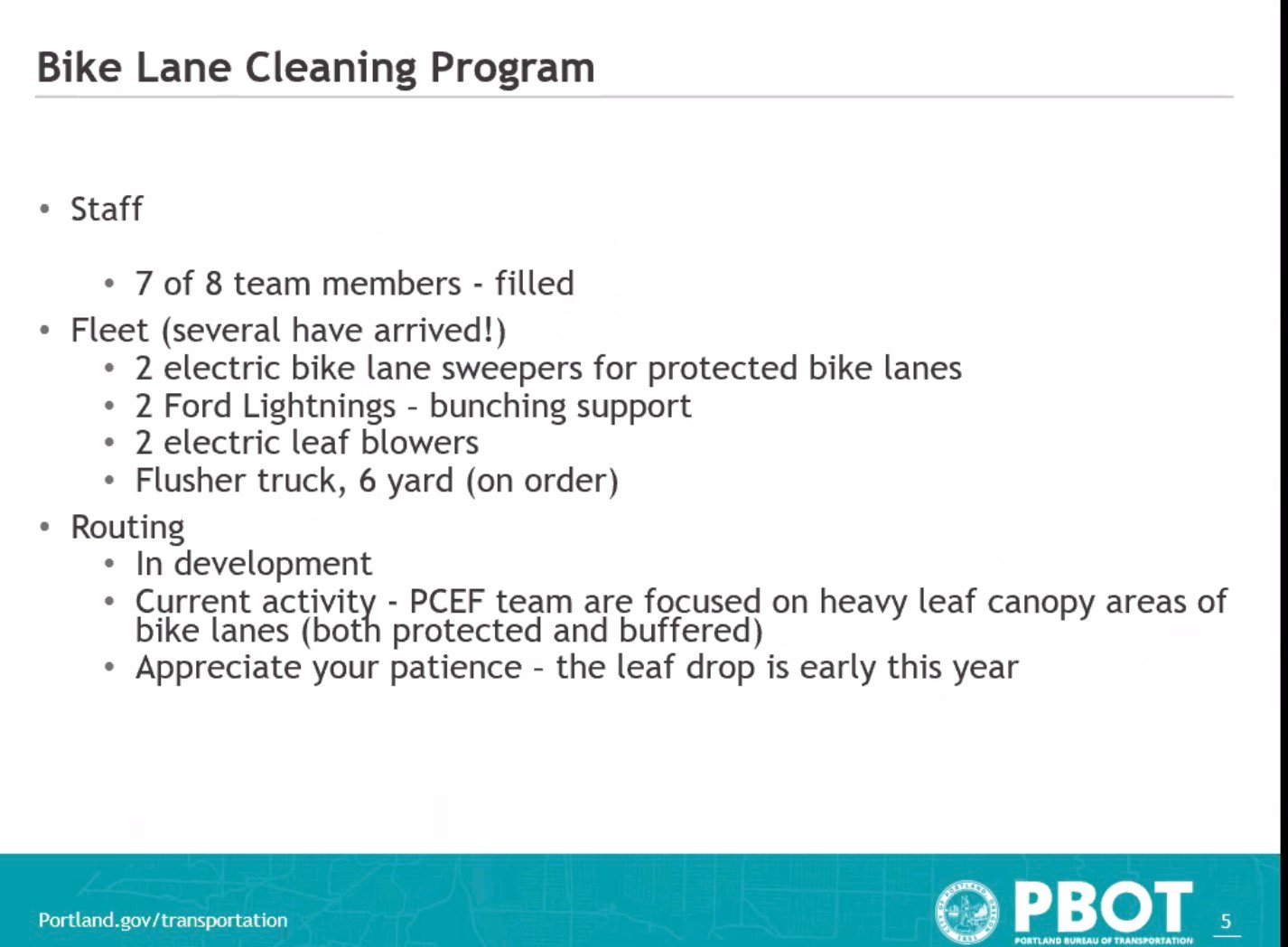
Last night Geller said PBOT has hired seven of the eight new staffers. And so far, two of the new e-sweepers — designed specifically to fit inside protected bike lanes — are already here. I’ve seen both of them parked in PBOT’s Stanton Yard, a maintenance vehicle facility on the corner of N Graham and N Mississippi. The cute little sweepers are dwarfed by a massive diesel generator (which I hope isn’t their final solution for charging these babies). According to a slide shown at the BAC meeting last night, in addition to those two e-sweepers, PBOT has purchased two Ford Lighting pickups for all the hand sweeping and more detailed clean-up work a mechanical sweeper can’t do (aka “bunching support”).

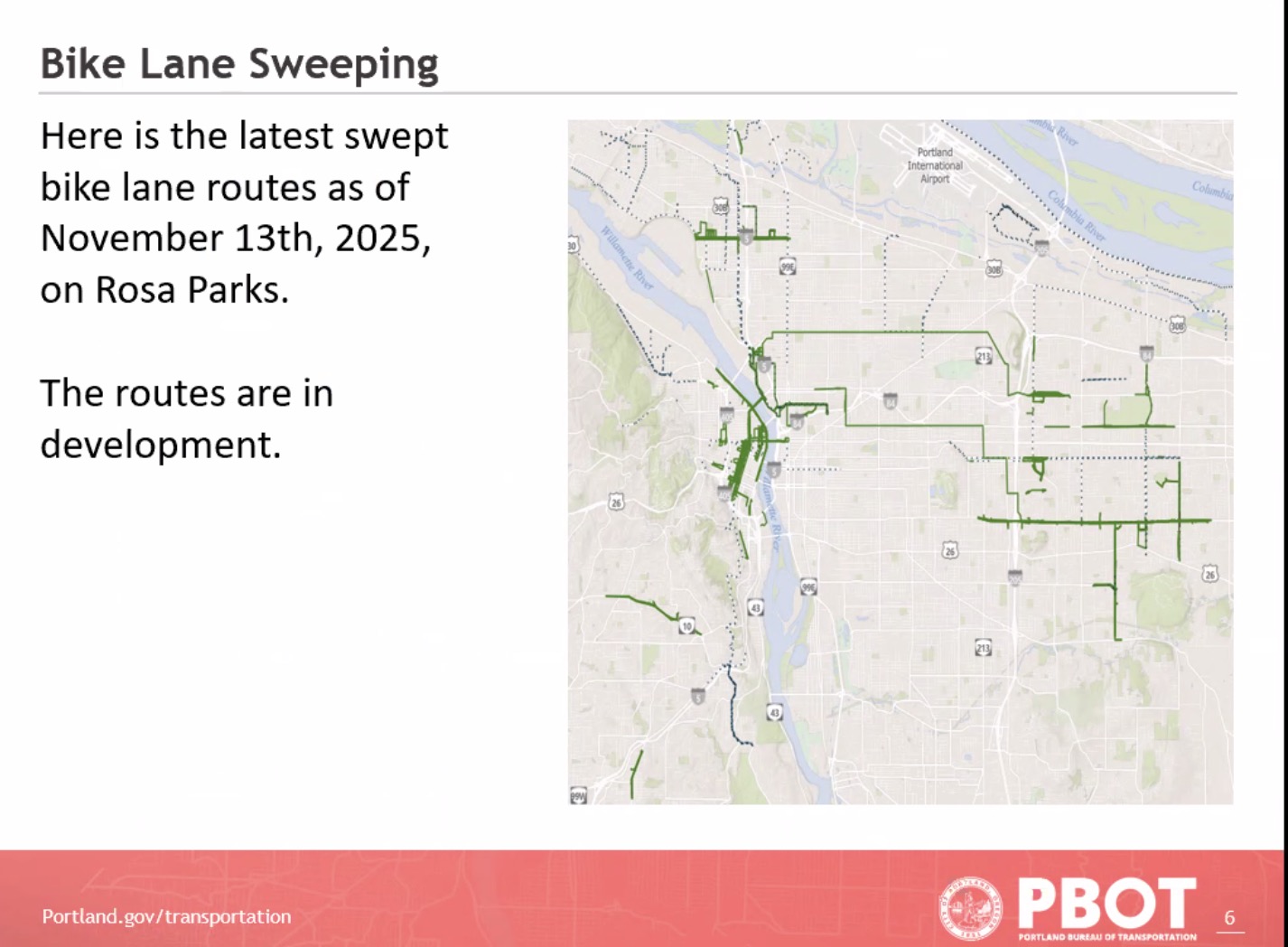
So far, the PCEF-funded team has been working on areas with heavy leaf canopy. A map of future sweeping routes is still in the works. A public-facing map and a leaf pick-up request dashboard is also being worked on, but not yet ready for launch. Another slide shown last night included a map of the latest spots that have been swept (see above)

None of these updates are likely to make many Portlanders feel better about the current state of bike lanes — and the vast volume of leaves that have overtaken many of them. “Appreciate your patience, the leaf drop was early this year,” the slide reads.

So for now, take extra caution through the leaves, don’t turn sharply in corners, and hope for the best. If there’s a particularly bad spot, you should report it to 311 so city crews get it on their list.

Opinion: Oregon faces dead end if Republicans lead transportation conversation

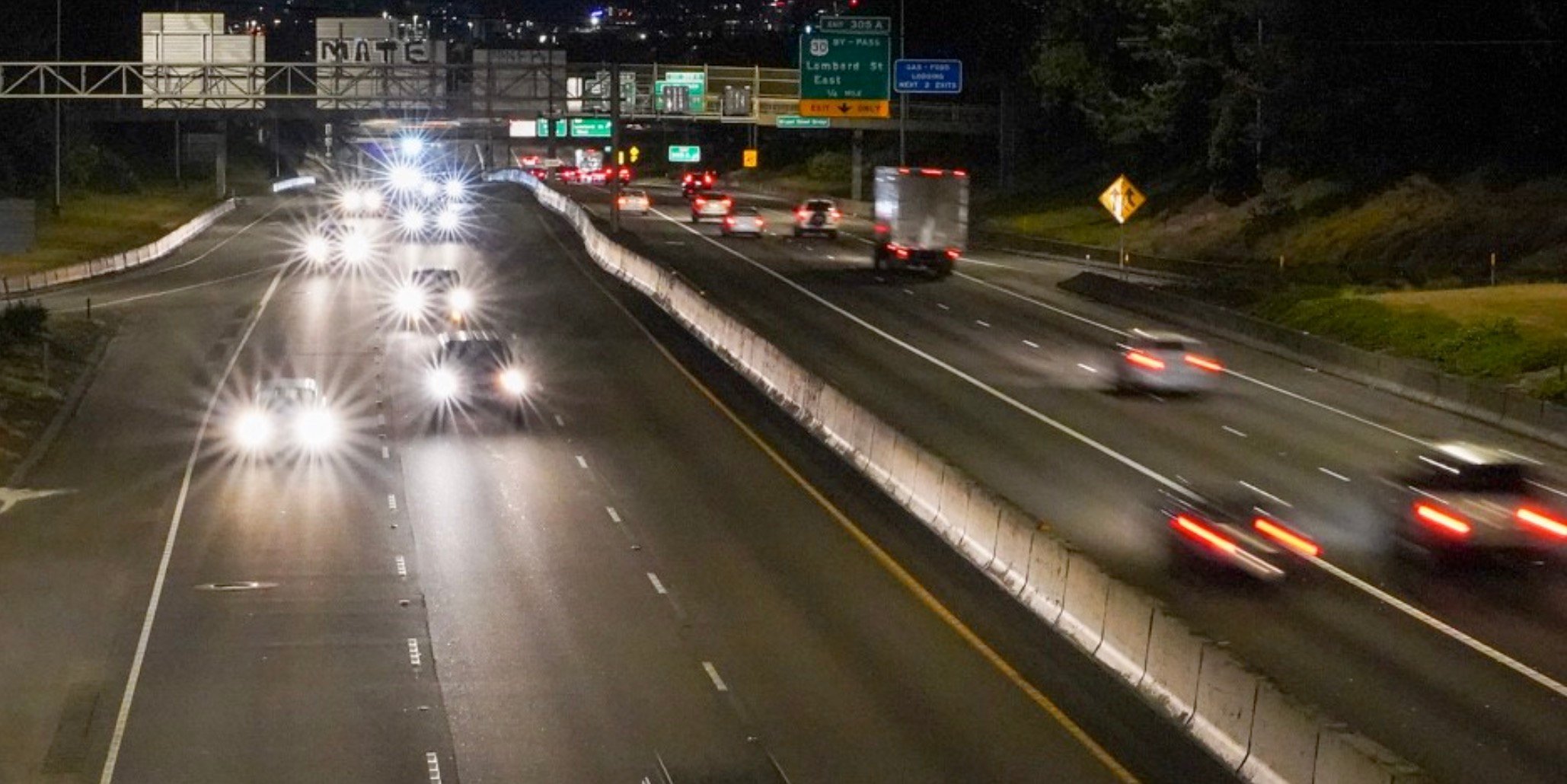
There’s more to transportation than freeways. (Photo: Jonathan Maus/BikePortland)

A group led by Oregon Republicans wants to claw back new revenue for transportation recently passed by the legislature. Operating under the banner of No Tax Oregon, volunteers have already collected over half the 75,000 or so signatures they need to put key elements of House Bill 3991 on the ballot. The pitch is easy: Sign here if you don’t want to pay more taxes.

While signing is easy, operating the Oregon Department of Transportation without the additional $430 million the bill is expected to raise each year, might not be. ODOT says the $4.3 billion the bill raises over 10 years is everything and nothing. It’s everything they have to keep the agency afloat, but it’s nothing more than a stop-gap measure to stave off massive layoffs and do the minimum amount of road maintenance necessary to keep roads clear and people alive. 

Republicans don’t believe that. They think ODOT can manage its 8,000 miles of roads and 3,000 bridges with existing revenues if the agency cuts everything that’s not a “core function.” The problem is, reasonable people disagree what a “core function” is. For example, Democrats believe transit and safe routes to school are a core function of ODOT. Republicans do not.

During this past session, Republicans put forward a bill that would have made radical shifts in state transportation policy. The Republican’s proposal would have required ODOT to completely ignore transportation’s impact on greenhouse gas emissions (despite transportation being the top contributor to them) and its impacts on Oregonians who’ve been historically left out of transportation conversations and harmed the most by the product of them. Their bill would have zeroed-out state funding for bicycle infrastructure, rail maintenance and construction, the Safe Routes to School program, transit service and expansion, and more. The bill even went so far as to repeal Oregon’s vaunted “Bicycle Bill” that was signed in 1971 and is known as the country’s first-ever complete streets law because of how it mandates a minimum investment in bicycling and walking facilities.

The radical Republican proposal would have rolled back the clock at ODOT to the 1960s and turned it into an even more outdated, freeway-first agency. It’s almost impossible to work across the aisle on such a politically toxic and tone deaf proposal — one that ultimately failed to make it out of committee because it was considered a non-starter by Democrats and everyone else who lives in the real world and understands transportation policy.

Even if you agree ODOT should focus solely on maintenance of existing roads and projects that benefit only car drivers, it’s unthinkable that revenue would stay frozen while inflation and project costs have risen dramatically since 2017, which was the last time Oregon updated its transportation law. Many of the Republicans leading the anti-ODOT, anti-tax crusade live and work in agriculture-based districts, where costs of basics like labor, fertilizer and land have risen about 40% since 2017. Do they really think transportation costs are magically immune to similar increases?

Based on Republicans’ actions during the session and their push to repeal HB 3991, it’s clear their stance on transportation policy isn’t about policy at all. It’s about politics and power. Democrats have it, Republicans want it.

Republican Senator Bruce Starr and House Representative Ed Diehl are spearheading the effort to repeal the funding elements of HB 3991. They claim Democrats “rammed through” the transportation bill without working across the aisle and they believe Oregonians should not have to pay for transportation services. Starr, Diehl, and other leading Republicans see the transportation legislation — and the process it took to pass it — as an illustration of everything that’s wrong with how Democrats govern; but it also says a lot about them.

Beyond not wanting to pay their fair share to use roads and bridges, a central allegation of “No Tax” petition backers is that Democrats didn’t collaborate with Republicans during the session. But similar to their policy and funding proposals, the claim doesn’t hold up. Democrats likely spent too much time currying favor with Republicans. Public hearings and legislative committee debates didn’t even begin until five weeks left in the session.

Why the hold up? Because Democrat party leaders were in (not so) secret meetings with Republicans trying to hash out a bipartisan package. And Sen. Starr, who now shamelessly laments the lack of bipartisanship on social media and media interviews, was one of the people in the room. Not only was Starr involved in early policy negotiations, but he was named by Democratic party leaders as point person on an important ODOT accountability initiative.

Republicans want Oregonians to believe that Governor Kotek and the Democrats are acting like dictators. They’ve even adopted a “No Queens” battle cry. But beyond the aforementioned facts about how Republicans were intimately involved in early negotiations, the clearest example of Republican party influence is HB 3991 itself. Far from the behemoth it’s being made out to be, the bill is an anemic, heavily-compromised, bare-bones package of tax and fee increases that will cost the average Oregonian about $144 more per year than they pay today. HB 3991 also raises just 35% of the revenue Democrats initially sought.

The bill is so small in fact, that Democrats lost significant support from the large coalition of progressive transportation advocacy groups they typically count on. In the end, because Democratic party leaders mistakenly assumed Republicans would negotiate in good faith, the only Oregonians who love the transportation bill are the ones whose jobs it saved. On the flip side, Republicans have launched a massive, misleading PR campaign to excite their base in advance of next year’s general election — a campaign that blames complicated problems on a progressive government bogeyman they would rather destroy than debate.

If early returns are any indication, No Tax Oregon will likely succeed in their signature-gathering effort and ODOT’s future will be on the ballot next November. If we don’t see more Democrats and other progressive leaders stand up, shape the narrative in their favor, and expose bad-faith Republicans, Oregon’s transportation future will be a dead end.