

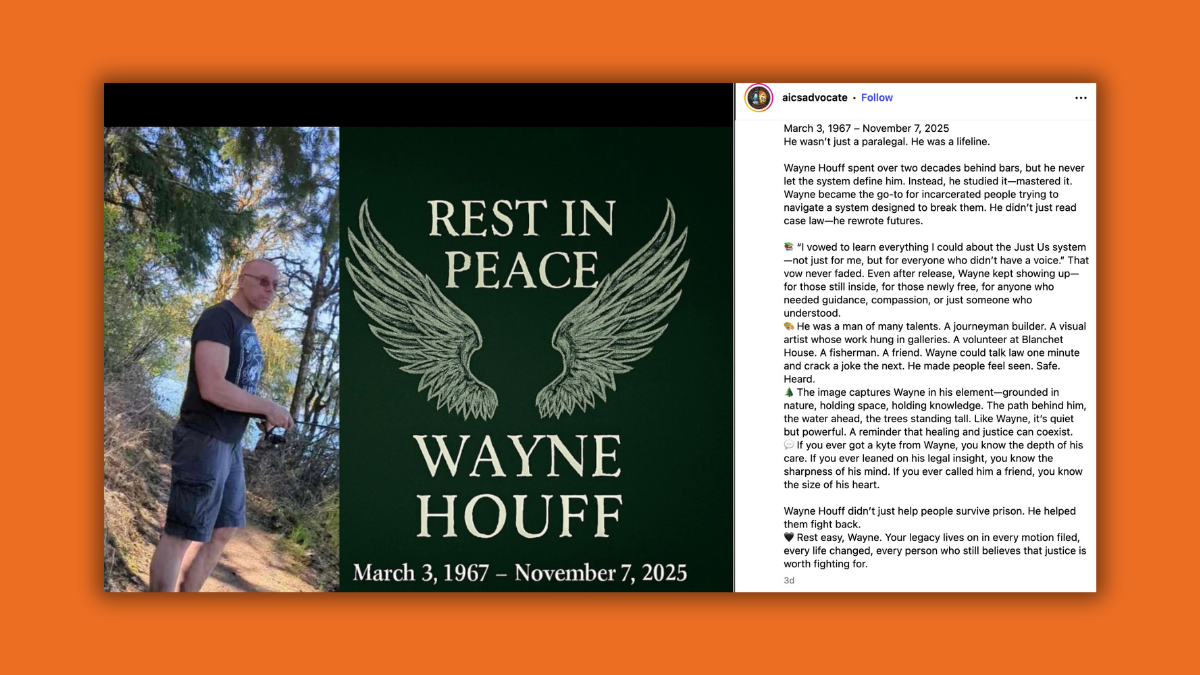
The person who was killed in a collision with an Amtrak train last Friday has been identified as 58-year-old Wayne Houff.
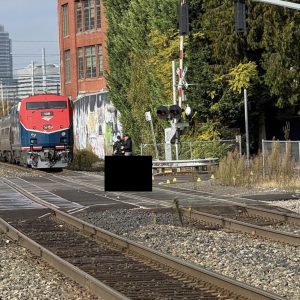
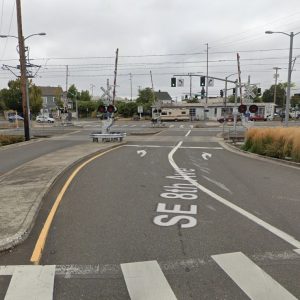
The full investigation hasn’t been released, but it appears Houff was riding a Lime electric scooter southbound on SE 11th south of Division and was attempting to cross one of the four sets of rail tracks prior to being hit.
According to friends and co-workers, Houff was a paralegal who dedicated his life to helping people navigate the criminal justice system. He served over 20 years in prison and a friend and colleague of his who contacted BikePortland said he rode a scooter because his incarceration made him ineligible for a driver’s license.
The nonprofit Adults in Custody posted a memorial to Houff on Instagram. “He never let the system define him,” it says. “Instead, he studied it—mastered it. Wayne became the go-to for incarcerated people trying to navigate a system designed to break them. He didn’t just read case law—he rewrote futures.”
Here’s more from AIC:

“I vowed to learn everything I could about the Just Us system—not just for me, but for everyone who didn’t have a voice.” That vow never faded. Even after release, Wayne kept showing up—for those still inside, for those newly free, for anyone who needed guidance, compassion, or just someone who understood.
He was a man of many talents. A journeyman builder. A visual artist whose work hung in galleries. A volunteer at Blanchet House. A fisherman. A friend. Wayne could talk law one minute and crack a joke the next. He made people feel seen. Safe. Heard.”
Houff was engaged to be married and I’ve heard his fiancé will attend Sunday’s World Day of Remembrance event. More on that event, here.
UPDATE: Houff was also a felon who spent time in prison after being convicted of four counts of sexual assault in 1998. Learn more about his case here.

Thanks for reading.
BikePortland has served this community with independent community journalism since 2005. We rely on subscriptions from readers like you to survive. Your financial support is vital in keeping this valuable resource alive and well.
Please subscribe today to strengthen and expand our work.
Rest in peace Wayne. Thanks for your good works to the community.
Is the train operator okay?
But seriously, your formulation just doesn’t work: people die when cars, trucks, and trains run into them. Yes, a human is operating the car, truck, or train, but you really need a better formulation – maybe two sentences (main killed by train and train driven by a human who was tested and not under the influence etc).
yeah thanks. i’ll look at that again.
Fred, you’ve actually circled right around to the point. Yes, a human being is operating the train, and that person often ends up carrying a pretty heavy emotional load afterward.
People sometimes talk about these incidents as if the train is some sentient beast charging around on its own. In reality, there’s a driver up front who usually had no chance to stop in time and then lives with the memory forever. The research on PTSD among rail operators is pretty stark. They see things most of us couldn’t handle for a day.
So it isn’t just a wording issue. It’s simply acknowledging that there are two traumas here: the heartbreaking loss of the person who died and the driver who will replay that moment every night long after everyone else has moved on. A clearer picture, just not a cheerier one.
It’s not just the UP driver in the cab (there might have been more than one), but also the switch operators along the tracks, the Amtrak conductor and the other train staff, plus the numerous passengers – they might not have seen the incident and thus suffer as badly as the unfortunate driver – but they certainly are aware of the incident and the subsequent police investigation and trip delay.
Thank you! For thinking about the people still alive who have to live with this horror. Fuck Wayne for being selfish.
what was he in prison for?
How is that relevant?
Society deemed his debt was paid.
The article says the train accident victim was riding a scooter because he lost his drivers license due to his criminal past. I thought that was relevant to the story. It made me wonder if he had his license revoked for a traffic-related offense, perhaps involving a vulnerable road user.
is it usual for ex-prisoners to be denied a drivers’ license, regardless of the offense?
Multiple convictions for driving crimes can result in 10-year or lifetime suspensions.
Yes. License suspension/ revocation is tied to crimes or violations related to traffic and some other issues, not being sentenced to prison.
Note: I am deleting all comments that reference Houff’s criminal case. I think it’s reasonable for people to want to know about it, but at this time I don’t feel comfortable with BikePortland hosting that information. So feel free to search around the web to learn more, but I won’t be publishing anything about it here. At least for now. I reserve the right to change my mind in the future and am open to feedback.
Well, given that you referred to him in the headline as “beloved”, I think his victims and their families might disagree very painfully with that description; so the nature of his crimes is relevant. Particularly if, rather than accepting his responsibility, he appealed his conviction, which seems to be the case.
The article references that he was “beloved Portland paralegal” and “He made people feel seen. Safe. Heard.” His SA victim is now in her early 30s. He certainly did not make her feel safe. He violated her in the worst way when she was four years old. That debt is never “paid”. Justice can never be achieved. I suggest you edit the description of this man or take down the article.
Hi Jessica,
Thanks for the comment. I have edited the headline and added a note and link about his conviction at the end of the article.
what matt said.
I really hope we can get some improvements to these crossings soon, even incremental. We can’t afford to lose another Portland hero.
These are just some proposed easy low-cost solutions to the well known alarm-fatigue issues here, that are supported in federal guidance, and there are probably more.
Or …. we could just install gates for ped/bike traffic as was originally proposed.
Build more gates, sure, but people will go around them for exactly the same reason they ignore all the other warnings. It’s not they don’t know, it’s that they don’t want to wait once they think the coast is clear.
People protected by motorized metal cages get a fancy gate even though they can also avoid it. Vulnerable human beings walking or rolling get nothing with predictable carnage as a result.
$5000 pedestrian gate >>>>>>> a violent deaths of our neighbors
“Vulnerable human beings get nothing”
Nothing except loud alarms, flashing lights, and plenty of other obvious signs that a train is coming. A pedestrian does not need to walk around a gate to know the crossing is “live”. It’s utterly obvious.
I highly doubt a gate would have any measurable impact on safety at all in this location, which is probably why there isn’t one.
Agreed, we can and should do whatever we canto reduce points of conflict or better manage them, but at the end of the day, we also have to respect the rules of the road.
Today, myself and several other people on bikes were queue’d up waiting for the train, it cleared the area, and the signal persistedg for 10-20 seconds. Three people passed me while the bells were ringing and I was contemplating this loss. The bells stopped, I left, and I actually managed to catch up to and pass the one that took the same route. He risked his lifetoavoid waiting a few seconds, and wasn’t actually any quicker than a woman on a dutch bike who was just late completing errands.
As far as I can tell at this time, the two most recent deaths at these crossings happened in the street, not in the circuitous pedestrian pathways. Some of the pathways do have spring loaded gates already that prevent them from being usable for most people, which might be a key reason people are taking to the streets instead.
Those gates are a safety feature, designed to make pedestrians pause a second and face the trains as they manage the gates.
Either you want safety features, or they are too inconvenient. You seem to be arguing both sides.
Maus’ original post appeared to indicate that the body was knocked from the sidewalk crossing.
Regardless there is no gate at this location:
https://maps.app.goo.gl/qqfyQhCjVBgsnJQx9
#1 is particularly needed. Bicyclists and pedestrians currently tend to ignore the bells and gates after a train has passed because they take so long to stop/open.
#2 and #3: there’s a conflict. We’ve had two recent fatal crashes so that’s the current topic. I am sorry for those people and would not want them to die that way. At another time we’ll be experiencing frequent and overlapping horn signals which are jarring and can be unclear when more than one train is nearby, on multiple crossings. Horn signals are omitted at some locations for that reason.
If the level crossing infrastructure is killing people maybe it should be closed and replaced with something that has the strong logic of being quick and convenient since we know that humans do not always observe, do not always make safe choices, and are known to stumble, lose their way, or be intoxicated. I have a personal bias for high(er) speed train construction, maybe some grade crossing projects could be designed and funded in a way that is compatible with future train modernization. Also, if we were going to design a wider system of bike infrastructure it would be preferable to avoid train tracks entirely.
Apparently a certain number of level crossings are required for the movement of hazardous materials, particularly in industrial areas (or on roads leading to and from industrial areas). Also, nearly every street is in Portland (and pretty much everywhere else too) a “local bikeway” even when it isn’t marked as such.
The fact that Portland has so many level crossings near downtown is a testament to the historic importance of railroads and the port to the long-term prosperity of the city, particularly the export of foodstuffs from the American interior, from about 1850 to the 1970s; there are still huge railroad yards and grain terminals nearby, and even a company that makes railroad freight cars north of downtown.
Thanks for the background. I’m not suggesting eliminating all level crossings, and maybe they can be controlled to limit use to only those who truly need them. I’m pro railroads as a really efficient way to move goods and people. I think there’s an opportunity to support human scale infrastructure, facilitate trains, and avoid killing people.
I don’t want to wait on trains. Train operators don’t want to slow down for arbitrary safety measures. Train tracks aren’t great for bikes and any dedicated bike infrastructure would best avoid them as much as possible. Certainly if we’re putting resources into bike infrastructure that’s a good time to get derelict tracks out of there.
I live in a community that has only 3 surface crossings (out of at least 30), two of which are scheduled to be replaced with expensive overpasses in the next 5 years. The final crossing, right downtown, we’ve told will never be replaced with an overpass or tunnel due to the movement of hazardous materials. It’s also a point that the railroad pickup trucks, fitted with special wheels, can access the tracks. The other 27 crossings are either bridges or underpasses, put in over the last 140 years – railroads came here in the 1840s – nearby High Point is called that because it’s at the highest point along the main railroad line.
Having no surface crossings doesn’t stop pedestrians from accessing the tracks, as much of the track private right-of-way isn’t fenced, so periodically pedestrians get hit (i.e. killed). They access the tracks to cross them even when there’s nearby under- or over-crossings, just like many pedestrians cross stroads away from nearby crosswalks and flashing beacons – it seems to be a force of nature for pedestrians to cross wherever they please.
So the next level of prevention is to erect huge fences and barriers, which I’ve seen in many cities like Washington DC, Atlanta, and Seattle, with very few surface crossings – effectively the railroad becomes another river, a bit like the UP mainline along I-84.
Train horns would make the Clinton Max stop essentially unusable, and would completely suck for those staying at the Clinton Triangle TASS shelter.
The several comments about how these train crashes have impacts on people besides the person who gets hit are a reminder that money spent reducing their likelihood doesn’t just benefit the people who may become future casualties.
The same principle applies to pedestrian and bike infrastructure. Spending money to say, reduce right hook collisions of cars with bikes benefits drivers as well as bike riders (not to say the impacts of hitting someone are equivalent to being hit).
Unfortunately my mother was a victim of Wayne when she was a child. Although he may have made a turn in his life it is important to remember the harm he first brought to many individuals including children.