🚨 Please note: For the latest on the future of BikePortland, please read this update from founder and publisher Jonathan Maus.

‘High Cost of Free Parking’ now in paperback

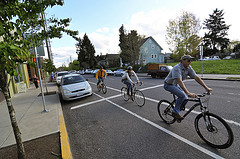
Buffered Bike Lane with a bike symbol and arrow pointing forward

The most important and respected book on parking policy and urban development is being re-published in paperback with a new preface and afterword by author Donald Shoup. See details below…

The High Cost of Free Parking
The book that started the parking revolution is now available in paperback with a new preface and afterword from the author.

CHICAGO— The book that started cities rethinking free parking is back. The High Cost of Free Parking by Donald Shoup, FAICP, is now available in paperback with a new preface and afterword by the author highlighting parking policy improvements since the book was first published in 2005.

Published by the American Planning Association, The High Cost of Free Parking was the first book on the economics and politics of parking. In the book, Shoup shows how so-called “free” parking is devastating U.S. cities— from the cost of subsidizing off-street parking to increasing traffic congestion and distorting urban landscapes.

Sparing no one when attacking what he calls “wrong-headed” parking policies, Shoup is a UCLA professor who has spent 35 years studying the impact our cars have when we aren’t driving them. He reports that in 2002, the subsidy for off-street parking was between $127 billion and $374 billion, more than the U.S. spent on Medicare that year.

To correct these parking policy problems Shoup advocates three things:

Setting the right price for curb parking. Cities can use performance pricing to vary meter rates according to proximity, time of day, and day of week to achieve about an 85 percent occupancy rate. This would mean one to two curb spaces would remain vacant throughout the day on a given block. Washington, D.C. and Seattle, Washington, are testing performance parking policies, and San Francisco has implemented SFpark that automatically monitors parking demand and adjusts prices monthly.

Return parking revenue to pay for local public services. Shoup argues that drivers will be more willing to pay higher meter rates if cities return the money directly to the metered district (not into the city’s general fund). The money can be used to increase local public services in the district. Pasadena, Redwood City, San Diego, and Ventura, California, return some or all of the meter revenue to pay for added public services in the metered districts. So do Austin, Texas, and Washington, D.C.

Remove minimum parking requirements. According to Shoup, most cities erroneously view their parking problems result from a shortage of spaces, not from underpricing. He estimates that required off-street parking accounts for one-third of the cost of a typical new office building. Shoup suggests allowing in-lieu fees by allowing developers to pay a fee in lieu of providing the required number of parking spaces. Another option is for cities to reduce the demand for parking through transit incentives. Since 2005, Shoup estimates that at least 129 cities have removed off-street parking requirements in their downtowns.

Shoup writes that everyone pays for subsidized parking in countless unseen ways. Most commercial buildings are required to provide a parking lot bigger than the building itself. Restaurants are usually required to provide a lot three times larger than the building. As a result, even customers who come without a car pay for parking indirectly in higher costs for goods or services.

These parking policies not only distort urban landscapes but also present a host of consequences including higher housing prices, extreme automobile dependence, extravagant energy use, rapid urban sprawl, social inequity, economic stagnation and environmental degradation.

Americans take free parking for granted, which helps explain its ubiquity and its sheer magnitude as a land use. Shoup estimates there are between three and four parking spaces for every car in the U.S., or between 705 million and 940 million spaces. If all of U.S. parking spaces were combined into one surface lot, it would require as much land as the state of Connecticut.

Shoup writes with humor. He makes his points using excerpts from songs, TV programs, and newspaper stories with parking references. New York Press called the hardcover edition “beach reading.” Shoup’s work to reform parking policies has even inspired a devoted Facebook group who has dubbed themselves the “Shoupistas.”

Panel will discuss Portland as bike manufacturing hub

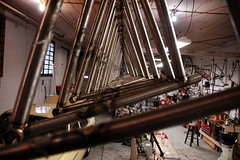
In the shop with Joseph Ahearne

Bikes sit in the shop of
a local bike maker.
(Photo © J. Maus)

A panel discussion set for tomorrow night in Northwest Portland will deal with the topic of turning Portland into a manufacturing hub for bicycles and other “21st century active transportation products.”

The panel will be moderated by Portland architect Rick Potestio and will feature Rob Forbes, founder of Design Within Reach and PUBLIC Bikes. Joining Forbes will be the co-founder of Beloved Cycles, Matt Stein; United Bicycle Institute founder Ron Sutphin; and Cameron Larson with Chris King Precision Components.

The discussion is being billed as an “informal discussion between people interested in seeing Portland become a center for the manufacture of 21st century active transportation products” (a category which they define as including shoes, bikes, skateboards, streetcars, and even electric cars).

Read more

grey torker singlespeed 2011

Buffered Bike Lane with a bike symbol and arrow pointing forward

Year: 2011
Brand: torker
Model: singlespeed
Color:grey
Serial: 005a10h00756
Stolen in Portland, OR 97212
Stolen:2011-06-21
Stolen From: Ne Schuyler
Neighborhood: ne
Owner: Tristan Russell
OwnerEmail: tristansnorider@yahoo.com
Description: Grey singlespeed. flat handlebars. Slightly bent forks
This registrant has documented proof of ownership of this bike

Pedalpalooza Daily: Tuesday, June 21st

Three Bridges opening celebration

Explore Johnson Creek alongside
the Springwater Corridor
tonight at 6pm.
(Photo © J. Maus)

Are you a fan of the Yehuda Moon comic strip? How about unicycle basketball? Roller skating? Perhaps you just like exploring the urban gem of Johnson Creek that runs along the Springwater Corridor? Whatever you fancy, Pedalpalooza rolls on today with a tasty menu of rides that are sure to please.

Check out today’s schedule below…

11:00am Get on the Schwinn to Win!
Meet at Project Grow, 2156 N Williams Ave
Let’s enjoy a leisurely ride around the Boise-Eliot neighborhood on our Schwinns. Ride all ages, we may take a pit stop to the GC (Grand Central Bakery) to grab some hot cocoa. Mmm Mmm. Then back to Project Grow to make art. It’s going to be cricket awesome. Please sign up by email so we know around how many people to expect. jerickson at portcitydevelopment daht oh are gee

Read more

Blue Masi 74

Buffered Bike Lane with a bike symbol and arrow pointing forward

Year: 74
Brand: Masi
Color:Blue
Size:57
Stolen in Portland, OR 97217
Stolen:2011-04-15
Stolen From: N. Prescott St, cut my lock of my deck.
Neighborhood: Overlook, nopo
Owner: Jason Lanning
OwnerEmail: jlanning7@gmail.com
Reward: Hand shake and a cold beer.
Description: Metallic blue Masi, old leather brooks saddle, black deep v-velocity wheels, all campo parts, mustache handle bars, blk seat stem, fixed, shimano clip-ins, new tires, one brake lever,mileage tracker, bike planet front light.
Police reference#: 11018295
This registrant does not have proof of ownership of this bike

green columbia twosome 1970

Buffered Bike Lane with a bike symbol and arrow pointing forward

Year: 1970
Brand: columbia
Model: twosome
Color:green
Size:tandem
Stolen in Portland, OR 97206
Stolen:2011-06-20
Stolen From: Large park near Hawthorne SE PDX
Owner: glenn porter
OwnerEmail: glennporter@hotmail.com
Reward: handsome
Description: Tandem Green 1970s basket bell NOLA tag
Police record with: Portland Police
Police reference#: T11004250
This registrant has documented proof of ownership of this bike

Commissioner Fritz wants changes to SW Ankeny proposal

Buffered Bike Lane with a bike symbol and arrow pointing forward
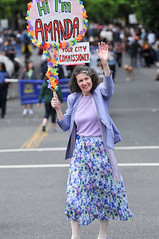
City Commissioner Amanda Fritz

Commissioner Fritz.
(Photo © J. Maus)

Portland City Commissioner Amanda Fritz has further explained her concerns with the existing carfree SW Ankeny proposal. Last week we shared how Fritz threw a wrench in PBOT’s plans to convert one block of Ankeny between 2nd and 3rd Avenues downtown into a sidewalk cafe — making it a carfree street.

The ordinance came up last week but failed to pass unanimously (which was required due it having an “emergency” clause) with Fritz being the only no vote. At the meeting, she heard testimony from a representative of Sisters of the Road, a non-profit that helps Portland’s homeless. We reported that Fritz’s concerns were based on how the proposal would impact access to the street by citizens who were not paying customers of the businesses.

Read more

red raliegh grand prix

Buffered Bike Lane with a bike symbol and arrow pointing forward

Brand: raliegh
Model: grand prix
Color:red
Stolen in Portland, OR 97214
Stolen:2011-06-20
Stolen From: Found partially vandalized
Neighborhood: Produce Row
Owner: Luciano Bailey
OwnerEmail: rideon1@hotmail.com
Description: Red Raliegh Grand Prix lock and helmet still attached