
City reverses course, will maintain 25% bike mode share goal

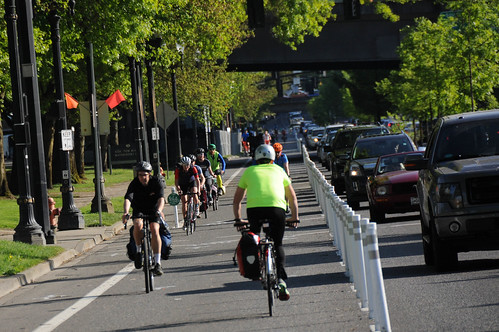
Better Naito observations -39.jpg

We can do this Portland.
(Photo: J. Maus/BikePortland)

A funny thing happened on the way to the City of Portland’s Transportation System Plan update: The Bureau of Transportation proposed to downgrade their goal for the percentage of commute trips made by bicycle users from 25 to 15 percent.

Huh? Aren’t we a “Platinum” bike-friendly city? Shouldn’t we embrace this challenge and not cower away from it?

That “target mode share” is a key performance measure that helps city planners set priorities. The “25 percent by 2035” mantra has been a rallying principle for bike advocates since it was formally adopted as the goal for all bicycle trips (not just work trips) in the Bike Plan and subsequently in the Climate Action Plan. Drafters of the TSP update initially copy-pasted the number. Then the city’s Planning Commission asked PBOT to analyze a new “work from home” mode share target which had never been used before. This spurred a new analysis of the biking mode share targets and PBOT began to feel the 25 percent goal was unattainable and proposed the downgrade as a result of a new “evidenced-based approach” that would be more “realistic and achievable.”

But many bike policy insiders and advocates cringed at the idea. Regardless of the details and policy underpinnings, on the surface it seemed like a capitulation — especially for an agency that continues to struggle with complacency and stagnation.

We’re happy to report that they’ve reversed course and the 25 percent goal is back. That might be because PBOT’s own advisory committee opposed the change.
Read more

‘Albina Vision’ would restore historic Rose Quarter neighborhood, put biking and walking first

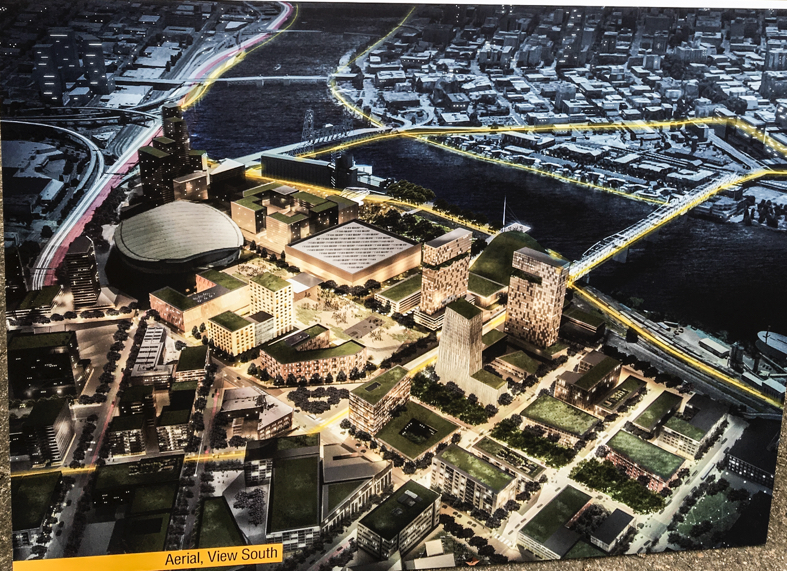
Aerial view of Albina Vision looking south (scroll down for more detailed view).
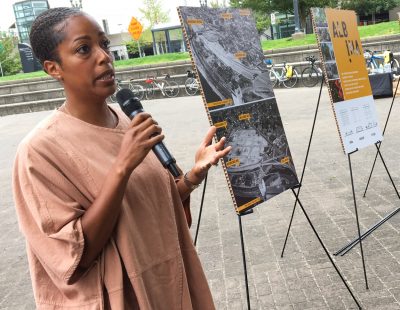
Rukaiyah Adams sharing the Albina Vision on Friday at the plaza in front of Memorial Coliseum.
(Photo: J. Maus/BikePortland)

In the early 1950s, the Rose Quarter was a neighborhood of homes, churches and stores. It was a thriving part of our city where many people lived and worked. But by 1958 all the houses were razed to make way for the Memorial Coliseum and eventually the Moda Center. Within the same decade hundreds more homes would see the same fate as city planners gave Legacy Emanuel Hospital and Interstate 5 priority over housing and businesses. These “urban renewal” projects in the Albina corridor had a devastating impact to the community and many of the scars — on human lives and infrastructure — remain unhealed.

A bold new plan unveiled for the first time on Friday seeks to restore that neighborhood — and ideally, the community that went along with it. The “Albina Vision” would develop the 30-acre Rose Quarter with housing and businesses that respects history and embraces the future.

On Friday two of the project’s main backers — Rukaiyah Adams, chief investment officer with the Meyer Memorial Trust and Zari Santner, a former Portland Parks Bureau director — laid out their vision to a crowd of about 70 electeds, planners, advocates and government staffers during a stop on the annual Policymakers Ride.

Read more

The Monday Roundup: Froome’s double, drivers trapped in Florida, cycling ‘magic’, and more

Welcome to the week.

Here are the most noteworthy stories we came across over the past seven days…

Pothole leads to payout: The City of Los Angeles will pay a man $6.5 million to settle a lawsuit that blamed them for a pothole that caused him to crash his bicycle and sustain serious injuries.

Smarter bikes = safer bikes: A Michigan tech company wants to build software into bikes and bike parts that allows them to “talk” to computer systems inside cars in order to warn of the presence of bicycle riders (and vice versa presumably). Trek is a partner in the venture.

Froome does the double: Professional road racer Chris Froome cemented his legacy as an all-time great by winning the Vuelta de Espana and the Tour de France in the same season.

Bikes save the day: Look what transportation mode people are turning to in Houston when all else has failed.

Read more