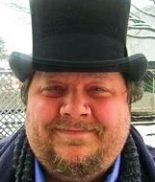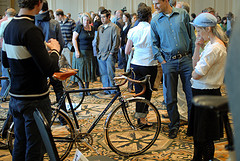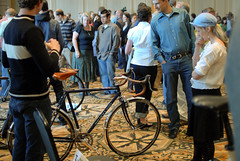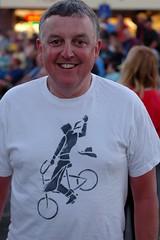
Jonathan Nicholas in Heppner,
Oregon during Cycle Oregon 2007.
(Photo © J. Maus)
The following is a transcript of the speech given by Jonathan Nicholas at the City Club of Portland on May 1st, 2009.
Nicholas was a columnist at The Oregonian for 26 years and is now the Vice President of Branding and Corporate Communications at The ODS Companies. He is also known as the founder of Cycle Oregon.
This speech makes a poignant and compelling case for embracing bicycles as way to a healthier and more vibrant city. It was given as part of a panel discussion at the City Club’s Friday Forum event called “It’s All About the Bike”. My full report and photos of that event is here.
I grew up in a place called Merthyr Tydfil. Say that to an audience in England and you get a murmur of profound condolence.
That’s because Merthyr Tydfil is widely known as the ugliest town in Britain. That’s not because of a plague of in-fill condos with postmodern eaves. That’s because of what lay buried 1500-feet beneath our homes — some of the richest coal seams in the world. Trust me, 200 years of coal mining — with absolutely no notion of environmental consequence — leave scars far more brutal than any Oregon clearcut.
By the time I was a teen-ager, all that coal was running out. That meant the quilt of our community was about to fall apart. It wasn’t just economic dislocation that followed. It was social collapse. Massive unemployment. Rampant rates of divorce. Battered women. Teen-age pregnancy. Drug abuse. Alcoholism. Abandoned kids.
That was what led me to Cycle Oregon.
In the 1980s, as a rookie columnist at The Oregonian, I rushed at the opportunity to roam through rural Oregon. I grew up on Hopalong Cassidy and The Cisco Kid. So to me Baker City looked far more alluring than Paris or Rome. And as I wandered from Baker to Burns, Seneca to Sweet Home, what I found were timber towns, scores of them, where the economic foundation was about to collapse.
I knew exactly what would follow.
And so, with a handful of Portland pals, including Jay [Graves, owner of the Bike Gallery] — we hatched a plan – a very small plan – to help those towns.
When we started Cycle Oregon, I didn’t even owe a bicycle. Hadn’t ridden one for 30 years.
For me, Cycle Oregon wasn’t about the bike. It was about people in need having no access to capital. It was about transferring some wealth. It was about taking some people from Beaverton and having them buy some pizza and beer in Burns.
In building a bicycle bridge from urban to rural Oregon, we hoped, we might give the communities of rural Oregon a chance to survive. Here we are, more than 20 years later, and I’m still saying it’s not about the bike. Yes, I’m engaged still with my original partner, the Pied Piper of Pedaling, but for me I still don’t really care about bicycling.
What I care about is what bikes can bring.
Late last year, I ended a 26-year stint at The Oregonian. I did so not because newspapers are dying – their platform is changing, but not their purpose. I changed jobs because I wanted to do something other than just write about what I think is the greatest threat facing our country.
It’s no secret that we exist in a profoundly sick society. Countless millions of us are all-but-addicted to prescription drugs our grandparents would have considered science fiction. And the vast majority of our maladies are self-inflicted.
By drinking. By smoking. By over-eating. Mostly, of course, by being sedentary. Lashed as we are to our La-Z-Boys, we’re locked in a downward spiral of dependence we simply can no longer afford.
The U.S. spends more than $2 trillion on health care every year…yet nearly 45 million Americans, including some 9 million children, lack health insurance.
Meanwhile, health insurance premiums continue to rise far faster than wages. For those who still have wages.
These staggering costs do more than cripple our pocketbooks. They stifle business growth and inhibit job creation. And all this unfurls against a backdrop of grocery store aisles stuffed with diet dog food and magazines merrily touting the benefits of stomach stapling.
The solution to all this is not more health care. It’s less health care. Much less.
Understand, please, what we’re talking about here today is not the need for a Spandex revolution… the last thing our city needs is more middle aged men wearing tight pants. What we need is a lifestyle revolution.
You’re going to be hearing a lot soon about a new concept called “active transportation.” It’s a multi-pronged assault on everything from congestion and climate change to air quality and obesity.
“Active transportation” may sound obtuse. It’s really nothing more than an integrated matrix within which people can comfortably do something as old-fashioned as walk and ride, taking bikes and mass transit, to everywhere they work and play.
The vision that Jay and Mia have outlined for us all here today is a simply astonishing opportunity, one so cost-effective we would be insane not to embrace it. What’s stopping us nothing more than those old bedfellows; inertia and stupidity. Laced with a massive helping of political self-interest.
Which brings me directly to our departments of transportation.
For far too long, at the federal, state and city levels, these agencies have simply been too much been in thrall to the motor car, too convinced that the answer to most any problem is to pour more concrete. This must end.
Let me be absolutely clear here. We’re not anti-car. We each own them, use them, love them for all the things they do so well. But we use them judiciously. Judicious use does not involve taking the Chevy to Burger King to get a double whopper with bacon, cheddar and ranch.
What exactly is an “active transportation” corridor? Imagine a 4-mile trail along the Banfield freeway connecting East Portland to the Eastbank Esplanade. Imagine, all the way from Gateway to the Rose Garden, feeder routes through the neighborhoods funneling walkers and cyclists. Imagine the thousands who would use such a corridor daily, freeing so much of the adjacent motorized transportation corridor for freight and other essential services.
But it’s not just a trail here, a greenway there. What we’re advocating here today is nothing less than the retrofitting of our entire urban environment, including taking back sections of our most valuable civic assets – the public rights of way – and repurposing them. Yes, on Northeast Broadway, from 33rd Avenue all the way to Portland State, that might mean taking away an entire lane of traffic.
Taking it away and using it for a higher, for a healthier, purpose.
The astonishing thing about this vision is that the pieces are all in place. In the White House we have a president, God bless him, who thinks science is something other than an environmental ruse.
In Congress, we have committee chairman who understand the value in leveraging transportation investments to enhance public health.
Here in our region we have as astonishing array of talent; Royce Pollard in Vancouver, Lynn Peterson in Clackamas County, Dick Schouten in Washington County, Ted Wheeler at Multnomah County, David Bragdon at Metro.
All the pieces are in place for Portland to lead as a model of the sustainable city for the 21st century. And at a cost far less than anyone might ever have imagined.
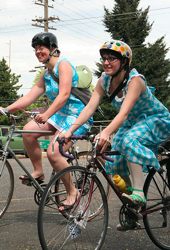
This year in our City of Roses, there will be more than 4,000 bicycle-related events. That’s almost a dozen per day. Already we have a $100 million bicycle-related industrial cluster hosting more than 1,500 green jobs. And we’ve only just begun.
If you’re wary of Jay’s passion for turning Portland into the Amsterdam of America – worried about all those red lights in The Pearl – think instead about Copenhagen. The Danes figure that every mile they bicycle shaves $1 from their health care costs.
Portland can be a world leader as lean, clean and green by making cycling a fundamental pillar of its fully integrated transportation system. That will not happen as a result of geography, climate or historical happenstance. It will happen only if we carefully plan, and fully fund, this path. If we do this right, then very soon:
● People in Portland will be making more than a quarter of all city trips by bike.
● Our neighborhoods will be a dynamic mosaic of mixed-use communities, where people of all ages can work and learn, buy and sell, play and pray, all within easy pedaling distance of home.
● And our citizens will be so fit and so healthy that employers will be clamoring to locate here.
The challenge we lay before you today is indeed considerable. So, too, is our responsibility.
It falls now to us to honor this remarkable corner of our planet, to craft a city worthy of its surroundings,
to nurture our neighbors, and to nourish these places we share, and call home.
Thank you.
— You can listen to an MP3 of this event, which also includes speeches by Mia Birk and Jay Graves, here.