
🚨 Please note: BikePortland is currently on hiatus and only publishing guest articles. Learn more here. Thank you. - Jonathan 🙏

Bike There! map and Google Earth

Buffered Bike Lane with a bike symbol and arrow pointing forward

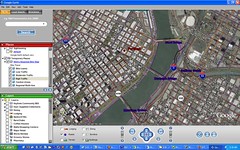
Portland bike routes on Google EarthI’ve just learned of an exciting development in Portland’s quest for an interactive bike route map. It looks as though Metro is trying to partner up with Google and their new Google Earth program. No official partnership yet, but Metro is actively experimenting with the technology (check the screenshot on the left).

The idea is to meld the popular Bike There! map with Google Earth so you can easily view and navigate the safest, most ideal bike route in a 3-D, satellite view of the city! Once this is finalized and fully functioning, you’ll be able to type in where you want to go and the program will select the most bike-friendly route automatically. Then, you can do 3-D flyover of the route before heading out.

As of last night, Metro has made it possible to play with this technology on their website. Here’s how to get started:

  • Download the free Google Earth beta application onto your PC (Google says it is working on the Mac version)
  • Then download this .kmz file of Metro’s Bike There! Map.
  • Open Google Earth on your computer, and then from within GoogleEarth, go to file > open and open the Metro file.
  • Use the dashboard in Google Earth to fly over the region and have a bird’s eye view of the bike routes.

Note: the trip planner is not yet available. Metro is still exploring the use of this technology. They would love to know what you think. Please leave your feedback in the comments.

It’s not us vs. them

Buffered Bike Lane with a bike symbol and arrow pointing forward

In the last several days there has been a flurry of discussion in the bike community about safety on our streets. I have been inspired by the outpouring of energy and dialogue around this issue. There is much more to be said and done, and I have no doubt that because of all of your comments, emails and input our streets will be safer for all of us.

I want to just remind everyone that we will get much further toward positive change if we resist the temptation to generalize and label each other. The bottom line is that not all people who drive cars are evil and hell-bent on hogging the roads for themselves. And vice versa, people that drive must not fall into the trap of labeling and generalizing all cyclists as being of a certain attitude or worldview.

There are rogue cyclists that ride with complete disregard for the law, and there are drivers who are not aware of cyclists or who simply don’t respect them at all. There are bad apples in every bunch. We (the good apples) need to lead the way and continue this dialogue based on mutual respect and consideration for each other. It is vitally important to the safety of cyclists that this dialogue does not devolve into “us vs. them.”

This bike community is making a difference already. Ideas and energy are being injected into our leaders downtown in no small part because of your input. I hope you’ll stay tuned for more opportunities to make our community a better place to ride and live. Thank you.

Willamette Week letter blames cyclists

Buffered Bike Lane with a bike symbol and arrow pointing forward

This week’s Willamette Week features an interesting letter from a cyclist named Frank DiMarco. His letter was written in response the Aug. 3rd column that named “Self-Absorbed Motorists” as the “Rogue of the Week.”

In his letter, “Share the Lane, Share the Blame” DiMarco says that cyclists would be safer if we only rode on certain, low-traffic streets. He then goes on to place blame on “Bicyclists With Agendas” for “forcing the issue of sharing a busy street.”

While I agree that it behooves cyclists to know the safest routes, I respectfully disagree that a cyclist can be “blamed” for being killed simply because of their choice of streets. Bottom line is that we (cyclists and motorists) need to work together to share the roads. Like it or not, people that choose a bicycle as their primary mode of transportation have just as much right to the roads as motor vehicles. The sooner we figure out how to co-exist, the better.