
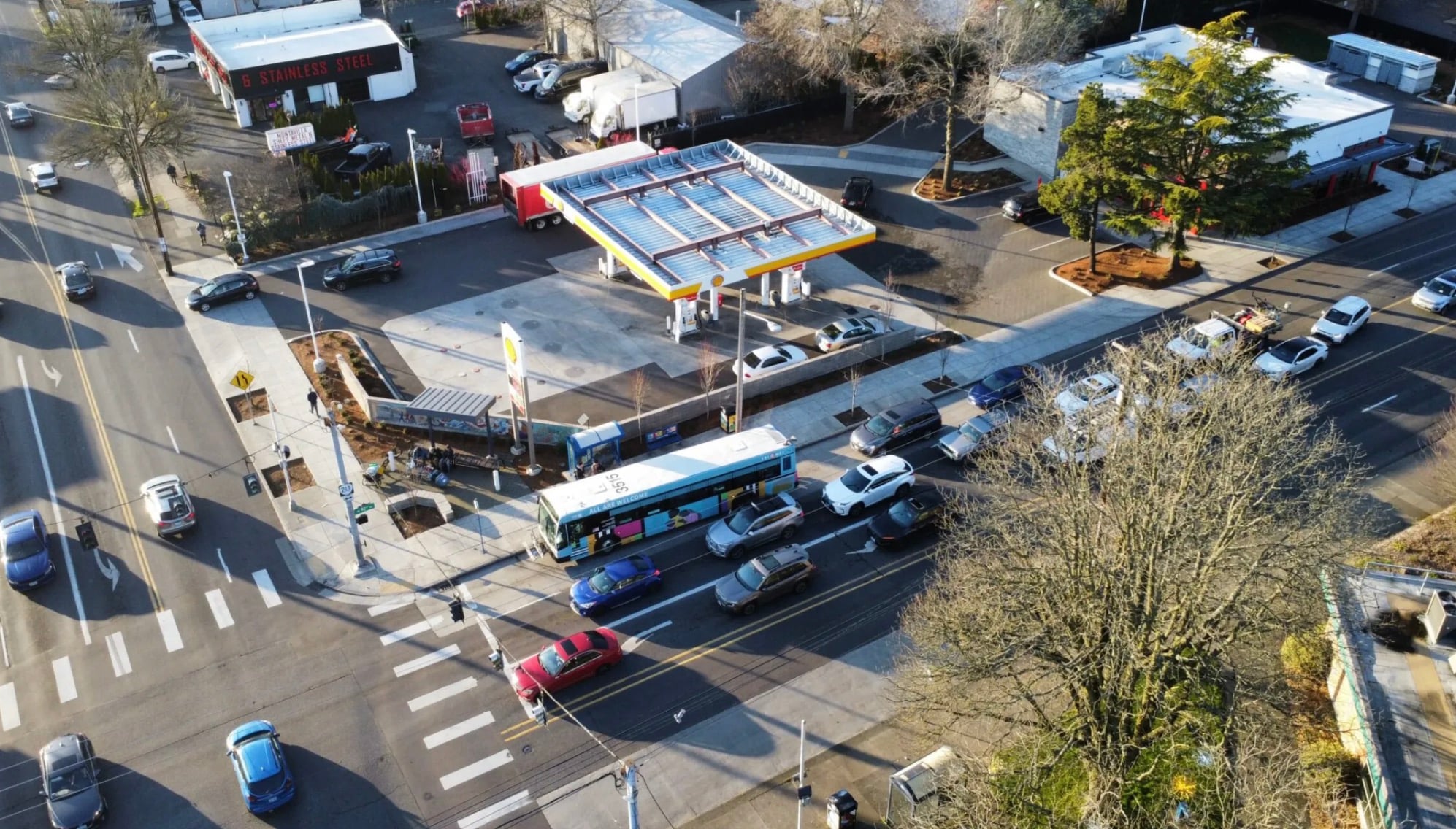
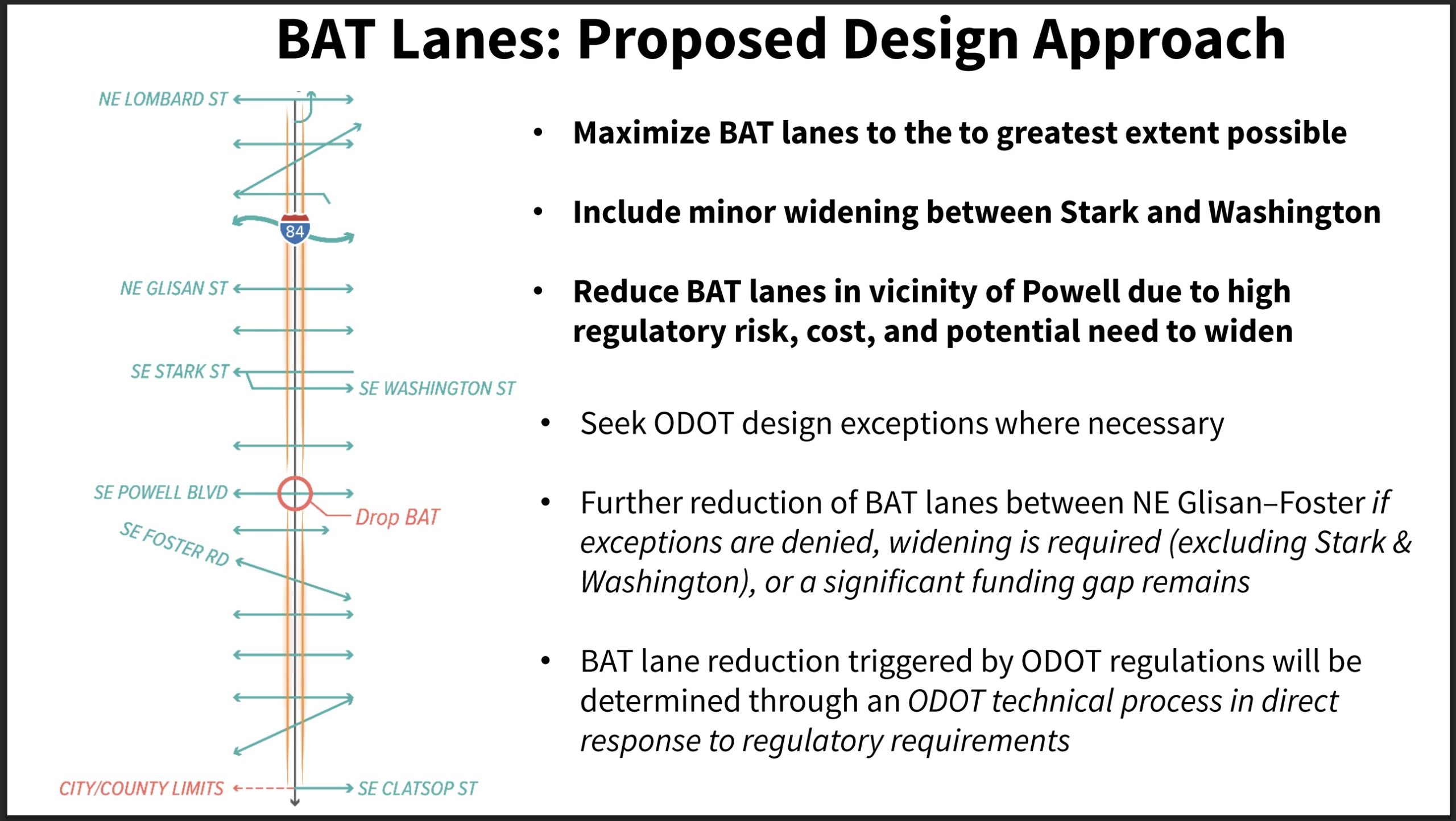
People who understand that excellent transit service is key to thriving 82nd Avenue corridor are celebrating a big win. That’s because at the project’s Policy & Budget Committee meeting on Friday, TriMet announced their intention to build semi-dedicated bus lanes on nearly the entire scope of their 82nd Avenue Transit Project — between Southeast Clatsop Street (Clackamas County line) and Northeast Lombard. One very notable compromise made official on Friday was the plan to drop the bus lanes at the Southeast Powell Blvd.
While the absence of bus lanes at Powell is a surrender to the status quo, getting semi-dedicated space for bus operators on what one committee member called “Oregon’s greatest main street,” is no small thing.
Back in October, project staff recommended just three miles of bus lanes as they faced threats of lawsuits from business owners and other serious concerns over how a major change in roadway space allocation on such a busy corridor might impact the project scope, budget, and timeline.
But on Friday, the same project officials who recommended three miles of “business access and transit” or “BAT” lanes (known as the “Some BAT” option) changed their recommendation to seven miles of BAT lanes (known as the “More BAT” option). PBOT Director Millicent Williams said during Friday’s meeting, “With this approach, the 82nd Avenue corridor will be the city’s largest investment in transit priority treatments with a cumulative 14 miles of BAT lanes. That is something to celebrate.”

The $320 million project has always come with major transit upgrades including longer buses, station improvements and signal upgrades. But given that 82nd Avenue carries the state’s busiest bus line and that many of the community leaders and elected officials around the table want a transformational transit upgrade, TriMet officials agreed to consider going even further by turning two of the former state highway’s four lanes into BAT lanes.
When they opted for a paltry three miles of BAT lanes in October, many Portlanders — including several Metro councilors and even TriMet board members — opposed the recommendation. The pushback forced project staff to reconsider their opinions and it put added scrutiny onto the final decision.
TriMet was put in the difficult position of having to balance needs of many groups including: business owners (who equate any loss of driving space with a loss in business), Metro (whose regional plans call for safe, thriving main streets served by transit), the Oregon Department of Transportation (who opposes the BAT lanes on diversion and congestion grounds), the Federal Transit Administration (who wants to make sure their money is well-spent), the City of Portland (whose adopted plans call for great transit and a reduction in driving), drivers (who repel any change to the status quo), and thousands Portlanders who want better transit.

ODOT’s concerns took front and center after a meeting last month revealed their influence over the project. Since their Highway 26/Powell Blvd crosses 82nd, they have authority to veto changes they believe would negatively impact how the roadway functions. ODOT made it clear on Friday they do not want BAT lanes in the project because of how they might cause drivers to avoid the corridor and clog nearby roadways. ODOT Region 1 Policy and Development Manager Chris Ford told the Policy and Budget Committee on Friday that, “A lot of the caution that you hear from ODOT around is because we need to make sure that the system is working really well for all modes.” Ford said ODOT’s position is no BAT lanes because less space for drivers, “limits the overall system,” and, “Because it squeezes a system that already doesn’t have a lot of capacity and isn’t going to get a lot more added to it.” Ford acknowledged that while BAT lanes might add capacity to the system overall (if more people take transit), “It also just takes some (capacity) away.”
As for just how much the BAT lanes will be dropped at Powell is still being negotiated by ODOT, PBOT and TriMet. One source told me it will likely be 2-3 blocks on either side of the street.
The biggest fear from TriMet staff (and likely why they came out with the unpopular initial recommendation) is that BAT lanes require design changes that make the project significantly more expensive (adding about $8 million to the overall cost) and could slow down their timeline. TriMet has a tight window to finalize the additional funding needed to implement the BAT lanes and an economic impact study. They plan to apply for a $150 million FTA “Small Starts” grant this coming September, which means they need a rock-solid funding plan secured by August.
At Friday’s meeting, TriMet project staff and GM Desue emphasized that just because they’ve settled on the “More BAT” option, it doesn’t mean the bus lanes are a done deal. ODOT permitting and funding could still poke holes in these plans.
Because the new lanes could make significant changes to auto capacity at busy locations (like the stretch between SE Foster and NE Glisan and at the SE Stark and Washington couplet), TriMet will need to be granted “design exceptions” (DE) from ODOT in order to move forward. Both the DE and funding talks have begun, but GM Desue and TriMet staff issued clear warnings at the meeting that if either don’t resolve positively, BAT lanes might be dropped at more locations.
82nd Avenue Transit Project Manager Jesse Stemmler made it clear that the design decision made Friday needs to “retain some level of flexibility.” “Further reduction of BAT lanes may be needed,” he warned, “either in the case that design exceptions are denied, or widening is required, or a significant funding gap remains.”
TriMet Interim Director of Major Projects Michael Kiser dampened the celebratory mood when he explained the possibility of cutting project elements to save money and underscored the seriousness of keeping the project on time and on budget. Kiser explained that if the FTA feels the project has too much funding and/or design risks, they would require TriMet to have more money in a contingency fund before authorizing any grant funding.
“We could end up in September or August with too many risks, requiring too much contingency, so more of our funds would have to go towards contingency,” Kiser said. “And we’d have to look for additional cuts within the budget.”
Given what committee members said Friday, any further reduction of BAT lanes would be controversial. Metro Councilor Duncan Hwang said he believes a slightly longer commute (about one to two minutes) is well worth the added safety and reliability that dedicated bus service will provide. He also pointed out that 172 units of affordable housing near 82nd and Division have just 42 car parking spots between them. “These are TOD [transit-oriented development] projects,” Hwang said. “And we’ve made that decision that we’re going to build housing for people and not for cars.”
“So, how are our community members that are in these housing units are going to get around? It’s going to be by transit,” he continued. “And that was by design.”
Committee member (and wheelchair user who sits on the TriMet Community Advisory Committee) Franklin Ouchida echoed Hwang’s sentiment. “Those people [who live in affordable housing and don’t have cars] are going to have to get around. They’re not going to be able to afford an Uber ride everywhere they go. So [this project is] going to be revolutionary and a way to break the the idea of car-dependency, as well as having a viable community there.”
If all goes according to plan, TriMet will begin construction next year and the project would open for service in 2029.
— Read TriMet’s announcement of this decision.