
Imagine the irony of a transit agency not building dedicated bus lanes because they’re worried about how it might impact car traffic on nearby state-owned highways. That’s the position TriMet is in as the agency ponders a decision on dedicated bus lanes in their 82nd Avenue Transit Project.
As BikePortland has been covering for months now, a key decision about the extent of “Business Access and Transit,” or “BAT,” lanes on a 10-mile stretch of 82nd Avenue has been become fraught. TriMet faces threats of lawsuits from business owners who say the lanes would drive car-using customers away, while BAT lane boosters (which include advocacy groups, politicians and more than one TriMet board member) say they won’t stand for even one block to be built without them. In the middle of the controversy are TriMet project staff who’ve felt heartburn over increased costs of a design option known as “More BAT” — which would build semi-dedicated bus lanes on nearly the entire scope of the 82nd Avenue project — might delay and/or otherwise jeopardize the project timeline.
While we’ve understood “More BAT” would come with more costs since this story first heated up back in September, now TriMet has shared another hurdle for dedicated bus lanes to clear. In documents shared ahead of a key project committee meeting tomorrow (Friday, January 16th), TriMet has laid out seven “areas of concern” that have been identified by the Oregon Department of Transportation (ODOT).

This entire project is possible because ODOT transferred jurisdiction of 82nd to the City of Portland Bureau of Transportation, so why is ODOT still sticking their neck in PBOT’s business? Because 82nd Avenue is 3,400 feet away from Interstate 205, it crosses Powell Blvd/Highway 26, and the northern part of the project touches ODOT’s Highway 30, also known as Northeast Lombard. ODOT worries that if more space on 82nd is dedicated to bus travel, less of it will be available for car users, and the resulting diversion could cause congestion and crashes on/near their facilities.
As many of you know, transportation departments live and die by highway design manuals (both state and federal) that tell engineers and planners how to respond to various levels of auto traffic. Models based on lane characteristics, current and predicted traffic volume, distance between signals, and so on spit out numbers that tell engineers whether a design will succeed or fail (in the eyes of the manual). If engineers and planners willingly choose a design the formula says would fail — one that exceeds the target volume-to-capacity ratio, or v/c — they must receive permission from ODOT through a “design exception” in order to move forward.
According to a presentation ODOT will share at the 82nd Avenue Transit Project Policy & Budget Committee meeting Friday, they found seven locations where this might become an issue. ODOT says five of those seven locations require some sort of mitigation (such as a change in the design) or must receive a design exception.
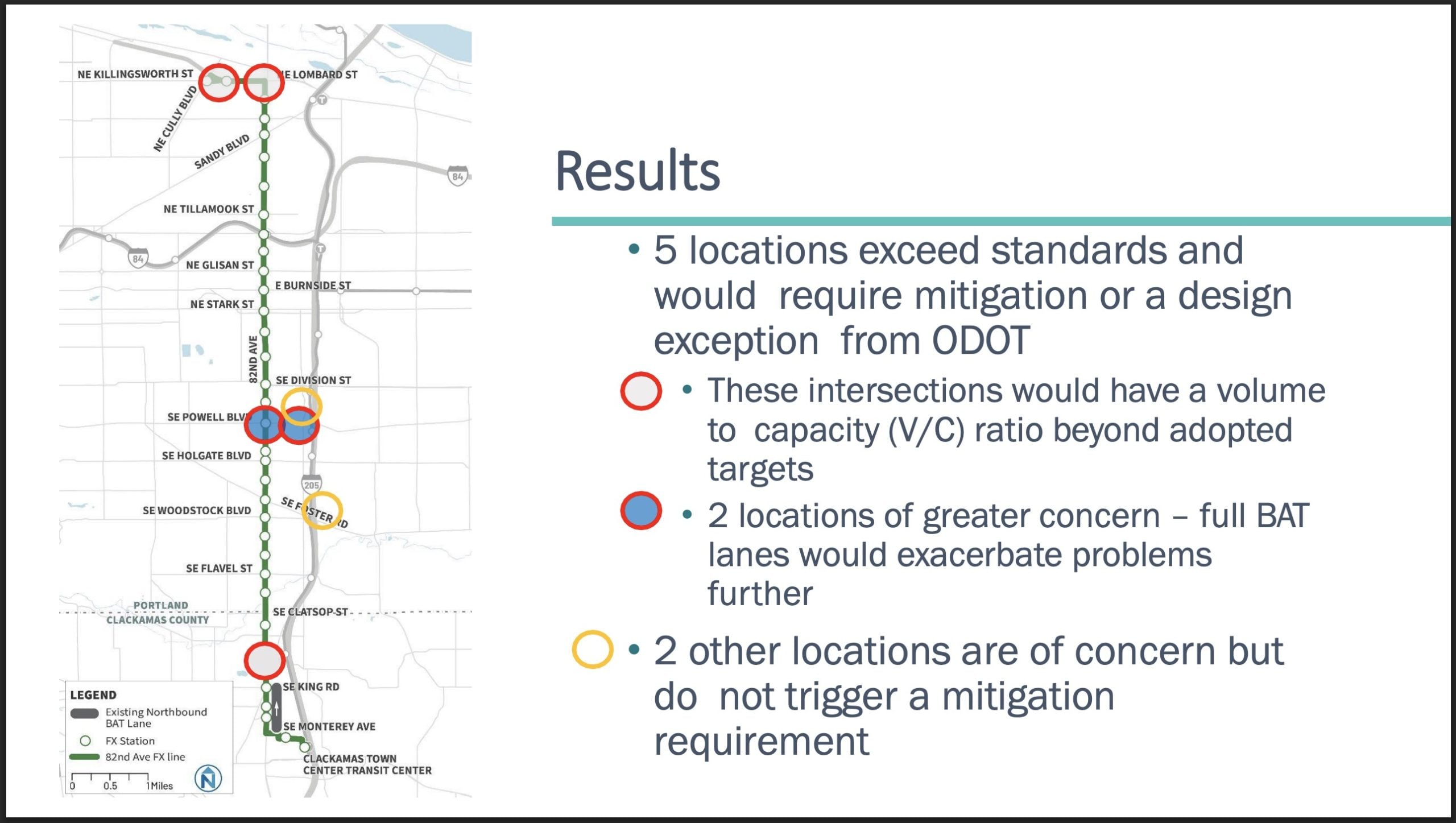
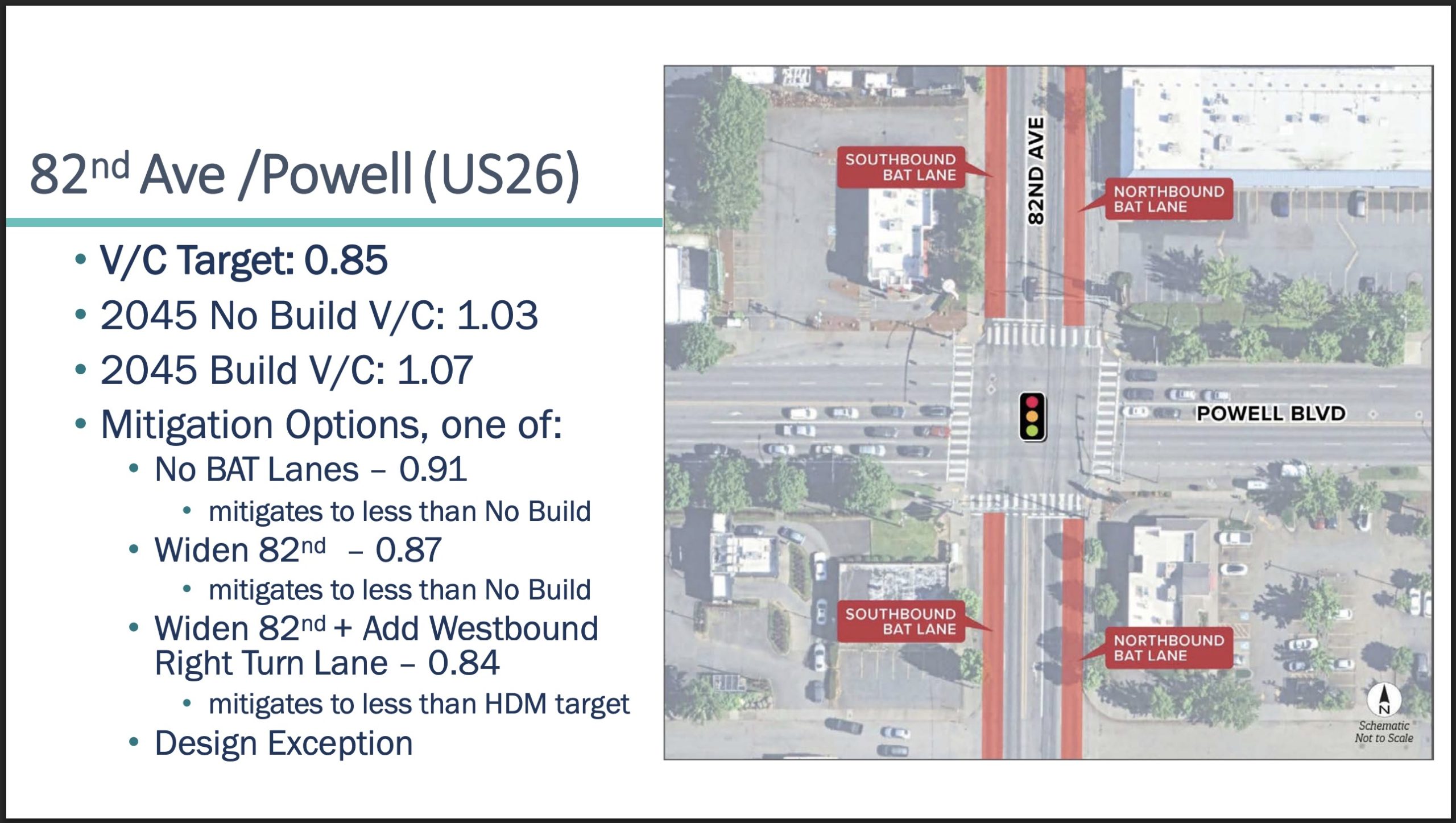
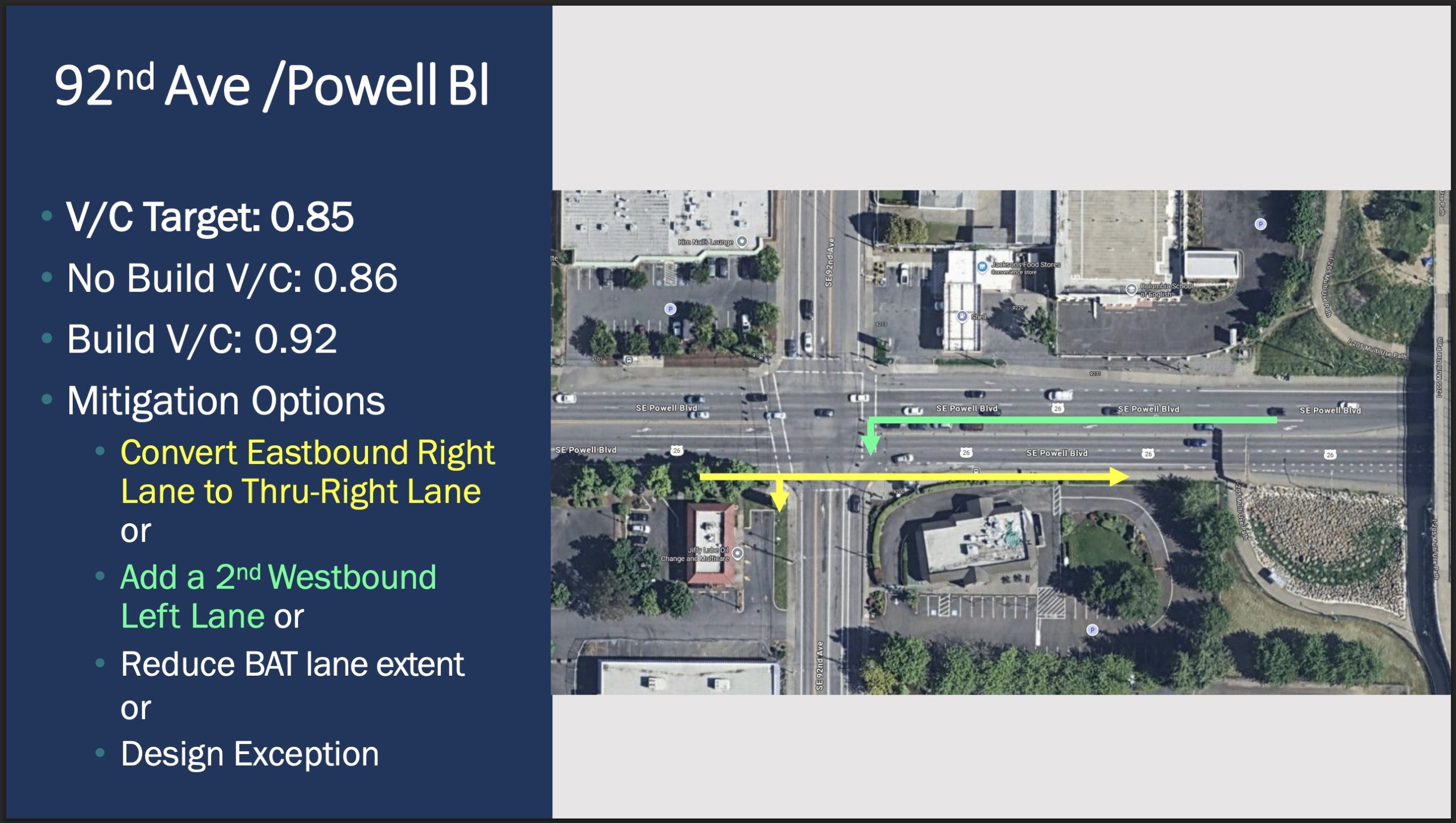
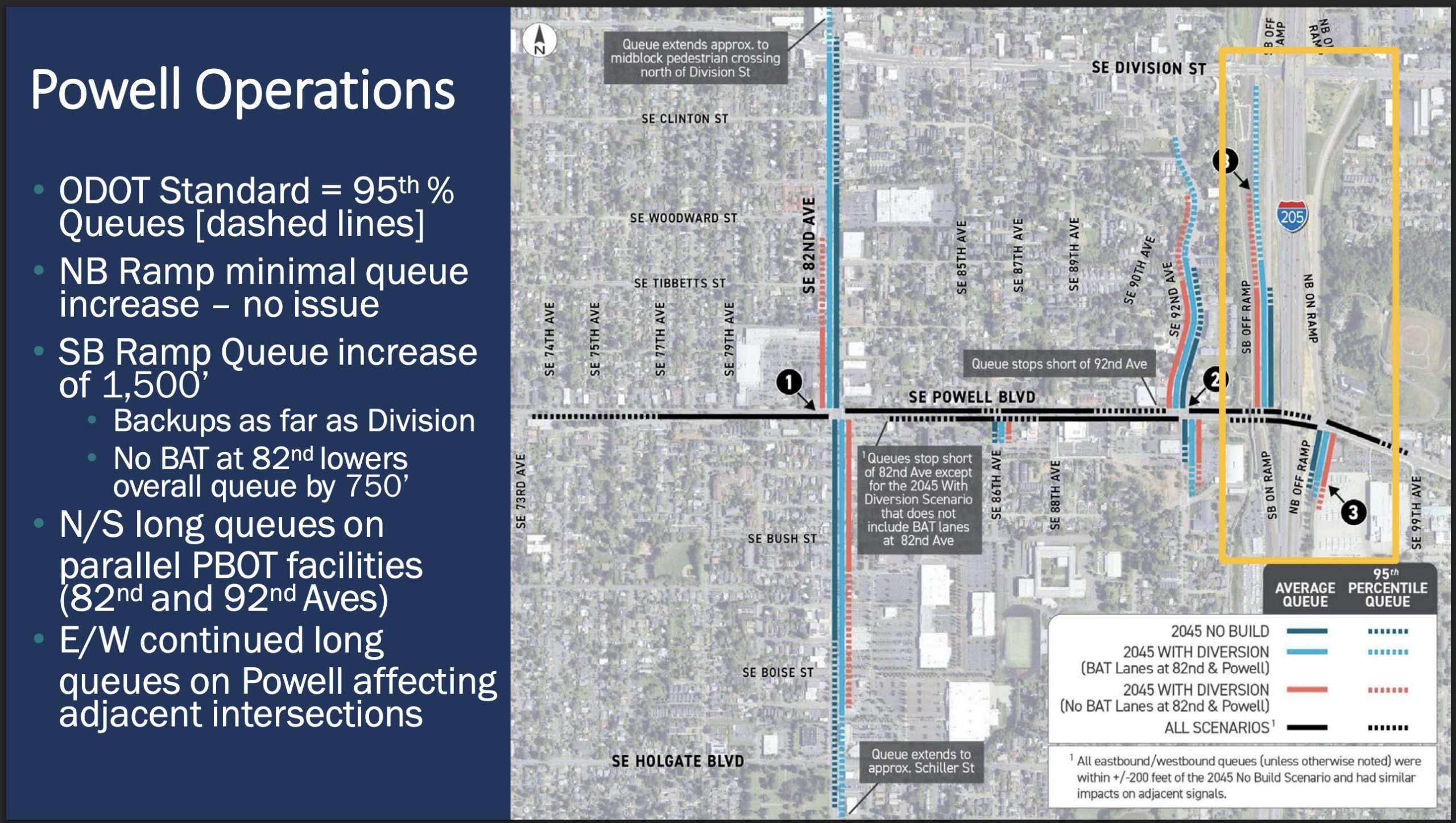
We got a hint of these challenges at the December TriMet Board of Directors meeting when TriMet Interim Director of Major Projects Michael Kiser mentioned congestion from diversion at specific intersections under the “More Bat” scenario and said, “Maybe we pull the BAT lanes back in those areas.”
Now we know more precisely which areas he was talking about. Below is the list of locations ODOT has flagged for more scrutiny along with their assessment of what must happen if “More BAT” moves forward (see slides above or the full presentation for more):
• 82nd Ave at Powell Bl: Requires mitigation or DE (this is the most acute concern from ODOT and the location the project team wants to drop the BAT lane)
• 82nd Ave at Lombard St: Requires DE or mitigation
• Cully Bl at Lombard St: Requires DE or mitigation
• 82nd Ave at Johnson Creek Bl: Requires DE or mitigation
• SE Powell Blvd at SE 92nd Ave: Requires mitigation or DE
• I-205 SB off-ramp to Powel: No mitigation or DE required but extensive queues
• I-205 NB on-ramp at SE Foster Rd: No mitigation or DE required
Keep in mind that “mitigation” would always lead to higher project costs (something TriMet has already flagged as a concern) and that needing a “DE” or design exception requires a leap of faith because ODOT could ultimately deny it. While these are clearly risks to doing “More BAT,” it’s important to remember that TriMet’s own studies show “More BAT” provides the most overall transit benefit and would provide improvements in pedestrian safety and comfort because the lanes would create buffer between humans on the sidewalk and people driving cars.
The project team will share more about these ODOT traffic studies and concerns at the Policy & Budget meeting tomorrow. TriMet says no final decision will be made about bus lanes at that meeting and that the Policy & Budget Committee will make a final recommendation on BAT lanes at their meeting on February 13th.
Find out how to take part in tomorrow’s meeting on TriMet’s website.