By Sarah Risser
After Portland committed to Vision Zero in 2016, things only got worse. The statistics have gotten better recently, but if we want to reach zero we must acknowledge current shortcomings to our approach and be laser-focused on the true risks.
First, let’s rewind…
For nearly a decade, road fatalities in Portland climbed (aside from small downticks in 2018 and 2022) until culminating in a three-decade, panic-inducing high in 2023 when 69 people were killed. Vision Zero was on the hot seat. People wanted to know when the carnage would stop. To outraged cries of “Vision Zero isn’t working,” City of Portland staff held firm. “It is working,” they’d say. Where the city invested in safety, fatalities were down. Not everyone was convinced.
Are we trying to make a dangerous system safer, or reduce the danger itself? They are not the same thing.
– Sarah Risser
Then, to everyone’s relief, fatalities dropped in 2024. And in 2025, they dropped sharply. The narrative flipped. PBOT issued a statement declaring progress, and many road-safety advocates put 2023 firmly in their rear-view mirror with a sigh of relief. But the two-year decline could simply reflect a post-Covid surge correction, rather than a structural shift. Moreover, Portland’s trends have closely mirrored national trends: a surge after Covid followed by a decline. This suggests larger forces are at play.
And still, the core question remains: Why are Portland’s roads so deadly?
Portland’s Vision Zero staff have quietly answered this question with a disclaimer on the first page of every Vision Zero Action Plan, Update, and Addendum: ‘Achieving Vision Zero goals depends upon available funding… Optimal performance depends on funding.’
Portland is cash-strapped, and its budget reflects its core values. Until the city consistently prioritizes human life through sustained investment, road fatalities will persist. Based on this, everyone should immediately moderate their expectations. I could end here, but there’s more to say.
Funding is only part of the problem
The program lacks authority as evidenced by its notable silence on politically sensitive issues that directly impact safety. There are many examples including but not limited to: not speaking up for dedicated bus lanes on 82nd Avenue or against high-speed police chases, refraining from weighing in on the possible widespread adoption of Autonomous Vehicles (AVs), and watching in silence as traffic-calming concrete planters are removed. A program tasked with eliminating deaths can’t sidestep policies that shape risk simply because they are controversial. To fully succeed, Vision Zero needs the courage and authority to engage in politically controversial policies and the unwavering support of Mayor Keith Wilson and City Administrator Raymond Lee when it does.
In September of 2025, City Councilor Tiffany Koyama Lane introduced a resolution to reaffirm Portland’s commitment to Vision Zero and created a cross-bureau task force (which has yet to meet) to build momentum for the program. This work should be applauded.
Ensuring city council is fully behind Vision Zero is important; however, the most successful cities had a mayor who provided inspiration and championed Vision Zero. Hoboken, New Jersey offers a compelling and well-known case: Former two-term mayor Ravi Bhalla was inspired to act after he was forced to push his child’s stroller dangerously close to traffic. Bhalla worked tirelessly to daylight intersections, reduce speed limits, and upgrade infrastructure. Similarly, in Paris, former Mayor Anne Hidalgo transformed the city by taking space away from motor vehicles and giving it to bikers and walkers. The result has been a much quieter, cleaner — and safer — city. Having a Mayor who cares about road safety and is motivated to consistently prioritize safety over motor vehicles and throughput is extremely important to the success of the program.
Limits of the Safe Systems approach
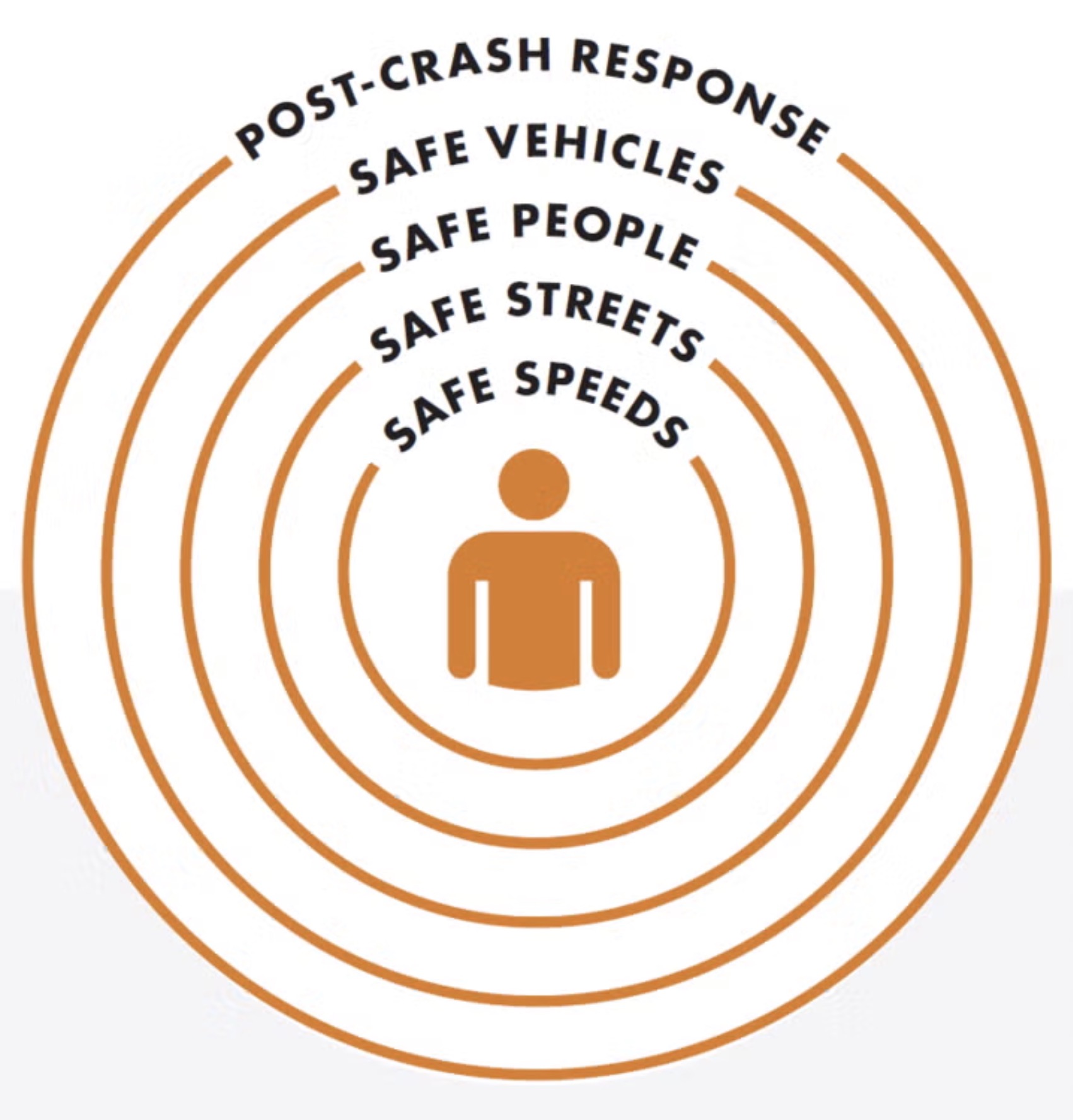
The adoption of the Safe Systems approach by the City of Portland represented an important paradigm shift and step forward from the more top-down “Three Es” of Education, Engineering and Enforcement. Safe Systems incorporates public health principles which formally acknowledge that humans make mistakes and aims to reduce the consequences of human error by ensuring multiple systems — people, cars, speeds, streets, and post-crash care — are safe and work to reinforce each other. This ensures that if one system fails, other systems will compensate.
But the Safe Systems approach isn’t perfect. Its ‘Safe People’ pillar calls for shared responsibility among road users, directly contradicting the central tenet of Safe Systems: that humans will make mistakes and these mistakes should be anticipated. The focus on shared responsibility also enables potential back-sliding into a victim-blaming mentality and confusion over what is ultimately responsible for harm. For example, Portland’s unhoused population, as well as distracted or inebriated pedestrians, are often cited as part of the problem. They are not. These groups do not contribute to road traffic violence. They are at risk of being harmed by road-traffic violence.
More importantly, the Safe Systems approach doesn’t clarify the cause of fatalities and serious injuries — the ‘pathological agent’ — nor does it provide a framework for prioritizing interventions.
Vision Zero needs more clarity on what actually causes harm
Recent work by Jessie Singer and David Ederer informs how Vision Zero programs can become more effective. In the video Singer produced for the nonprofit Families for Safe Streets, she argues that the safety science principles used in the workplace should be applied to road-traffic safety. Singer suggests applying “The Hierarchy of Controls” framework used in the workplace to prioritize interventions by effectiveness. Within this framework, the most effective intervention is physical elimination of the hazard (kinetic energy and the cars that convey it) with the least effective being personal protective equipment and education.
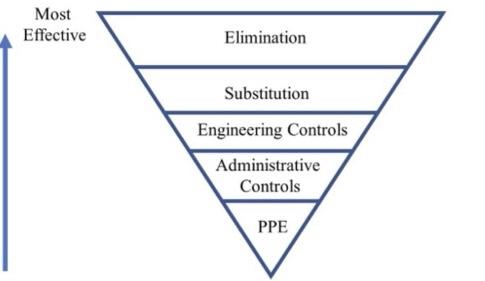
Ederer reframes road-traffic safety with an epidemiological lens where the agent of harm, kinetic energy, is transmitted by motor vehicles to inflict harm on relatively fragile human bodies. He presents the Safe Systems Pyramid which encourages interventions that have a widespread public health benefit and require little individual effort.
Both Singer and Ederer’s contributions call for clarity and focus on what needs to be controlled — the agent (kinetic energy) and vector (vehicles) — and how to prioritize interventions.
Vision Zero won’t succeed until it is empowered to clearly and unapologetically name the problem: kinetic energy, transmitted at dangerous levels by motor vehicles. Until the city fully commits to reducing that energy by lowering speeds even further and reducing the number of, and collective reliance on cars, fatalities will persist.
By skirting around the cause of harm, Portland’s Vision Zero program is too deferential to motor vehicles, which are not only the vector of death on our streets, but bring a host of negative externalities that extend far beyond traffic safety.
Are we trying to make a dangerous system safer, or reduce the danger itself? They are not the same thing. We need to reduce danger at its source. If we continue to focus on increasing safety while allowing more and more kinetic energy and large vehicles onto our streets, we will keep getting the same results.
— Sarah Risser is a member of Families for Safe Streets and a dedicated road safety advocate.