
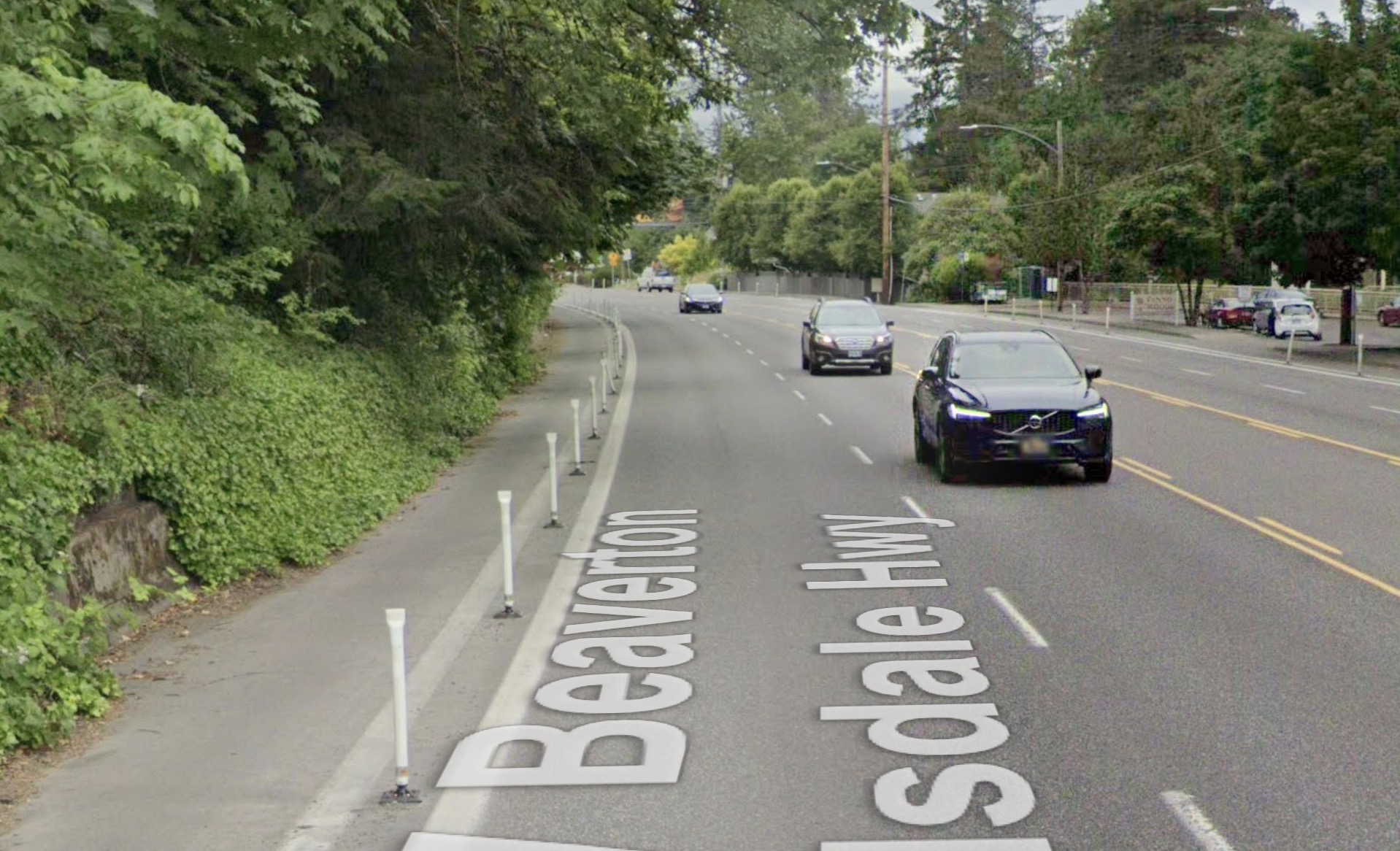
Most Portland neighborhoods would jump at the chance to upgrade their bike lanes. But the coalition that represents 32 neighborhoods in District 4 is different. At their meeting Wednesday night, the District 4 Coalition (D4C) plans to finalize a letter to Portland Bureau of Transportation Director Millicent Williams that outlines their opposition to $760,000 of planned bike lane projects in Southwest Portland.
These projects are part of the bike lane hardening effort I reported on in August 2024. With marching orders from a city traffic engineer directive, PBOT is going through a list of protected bike lanes citywide that were initially built with just paint and/or plastic wands and replacing them with concrete curbs. The idea is permanent curbs offer a more pleasing aesthetic, provide a stronger safety benefit, and will require less maintenance (the wands are frequently uprooted). PBOT is also responding to some bike advocates who see paint and plastic as a poor substitute for more robust materials.
In a draft version of the letter about the projects in Southwest, D4C Land Use and Transportation Co-Chair Nicole Zimmerman (who’s also a candidate for City Council District 3) says they oppose planned hardening projects at three locations: Beaverton-Hillsdale Highway between SW 39th and SW 65th, SW Capitol Hwy between SW Valona and Stephenson, and Bertha Blvd between Vermont and 13th (see map below).
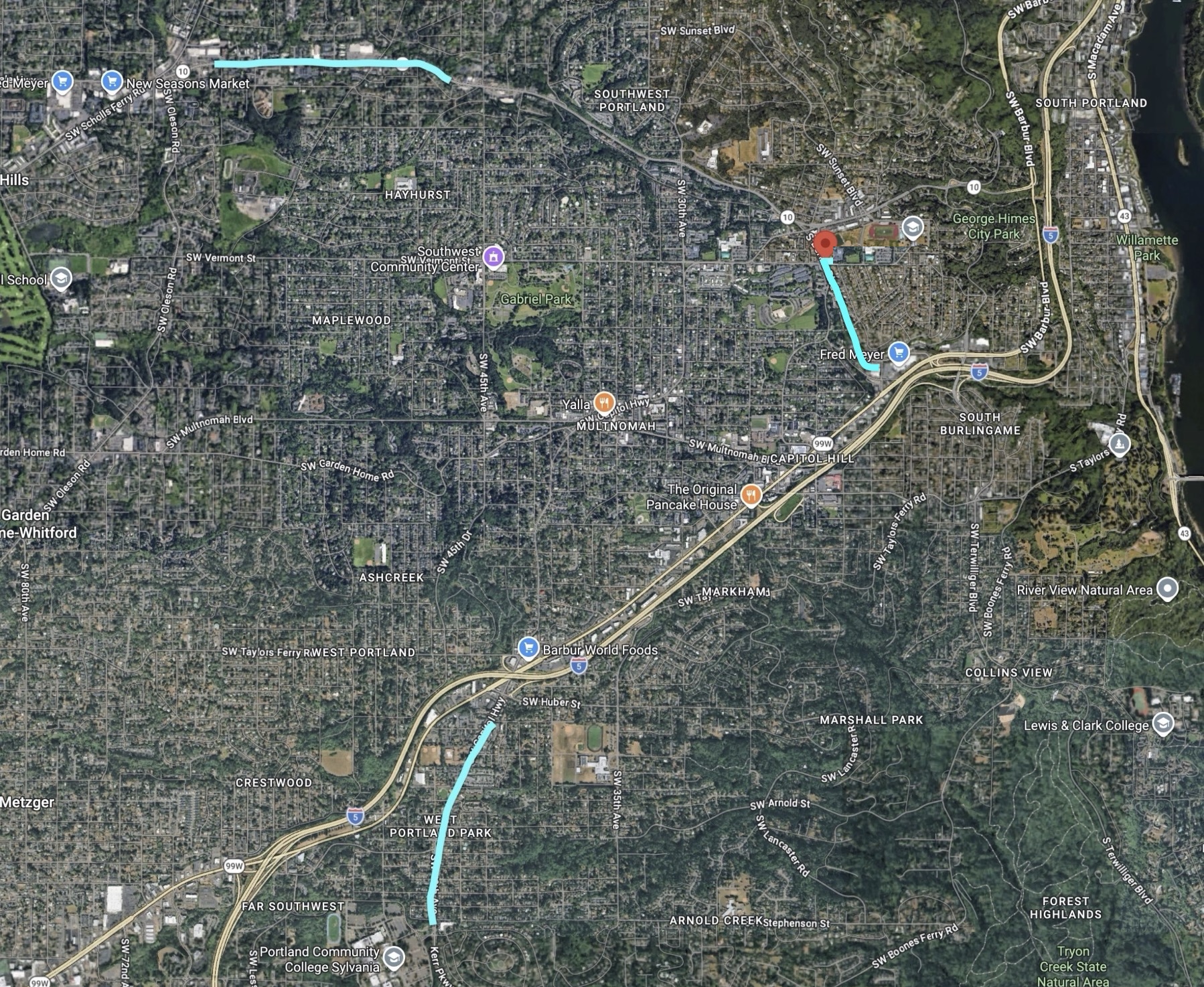

Below is an excerpt from the letter that lays out the reasons for their objections (emphasis theirs):
- No practical value. B-H Hwy., the proposed segment of Capitol Hwy., and Bertha Blvd. are among the lowest performing bike routes in all of SW Portland. This can be attributed largely to their lack of connectivity with the fractured bike network in SW. Any cyclist using these facilities must be confident riding on busy streets in the travel lane to reach and leave these bike lane segments. Providing an A+ bike facility on these isolated sections will not entice more cyclists to use them. Progress must be measured not by the miles of protected bike lanes but by the number of people traveling by bike.
- This is not maintenance. Converting them into physically separated facilities is an improvement project – not simple maintenance. If maintenance is an issue, the wands could simply be removed or just not replaced. If removed, there would continue to be very good, painted buffered bike lanes, which could again be swept with conventional equipment. Reliance on the small bike lane sweeper has resulted in infrequent sweeping and B-H and Capitol Hwys. are typically plagued by gravel, glass, leaves, and weeds.
- Chronically inadequate funding. Funding for capital projects to enhance pedestrian and bicycle safety is severely constrained. For perspective, D4 can expect about $2.3 million from FOS3 for the next 4 years. Other pots of funding are available, but the cost of the B-H Highway project will make it among the most expensive projects proposed in D4 and SW over the next four years.
- Higher priority needs and lack of community support. Given all the high-priority network and safety improvements, many of which have languished for decades, PBOT should not spend $490,000 on this project followed by the Capitol Hwy. project totaling around $757,000 and an undetermined amount for Bertha Blvd. when the bike lane hardening lacks community support and The BH Hwy. and Capitol Hwy. projects are not identified in the TSP or SWIM. Until bike routes are completed and not disjointed, it is premature to spend scared funds for first-class facilities on random segments.
If this sounds familiar, it’s because BikePortland reported on a Southwest-based cycling advocate who shared many of these same concerns back in fall of 2024. I reached out to that person, former PBOT Bicycle Advisory Committee member and veteran bike advocate Keith Liden, and he confirmed he was the inspiration for the D4C position. “Yes, my fingerprints are all over it,” Liden shared with me via email last week.
“We feel it makes no sense to spend scarce dollars to ‘gold plate’ isolated sections on routes with serious gaps,” Liden said. “Hardening these bike lanes will do nothing to attract less confident/inexperienced riders, while the current users will still be fine with painted buffers.” Liden wants PBOT to offer a more complete route before spending money to improve isolated sections.
Kiel Johnson with nonprofit BikeLoud PDX disagrees with Liden and has sent a message of his own to PBOT, urging them to move forward. In an email sent Thursday, February 19th, Johnson wrote that Beaverton-Hillsdale Highway currently feels like a freeway due to its design, and changes are needed to attract more riders. “Paint and plastic wands are not protection,” Johnson wrote. “Physical barriers—concrete curbs, continuous raised protection, and median refuge islands—would reduce conflict points, prevent encroachment into bike space, and narrow the effective roadway in a way that calms traffic without eliminating access.”
The D4C coalition wants PBOT to allow them to help review and evaluate the projects to find, “an acceptable approach for improving and maintaining these facilities at reduced cost and to redirect the remaining funds to improvements that support more pressing priorities in District 4 and identified in our adopted plans.” Liden and others in Southwest feel PBOT’s project selections are too “top-down” and they want a more collaborative process to determine future bikeway investments.
Learn more about PBOT’s bike lane upgrades on their website.
The D4C Land Use and Transportation Committee meets tomorrow (Weds., 2/25) from 6:30 to 8:30 pm via Zoom.