
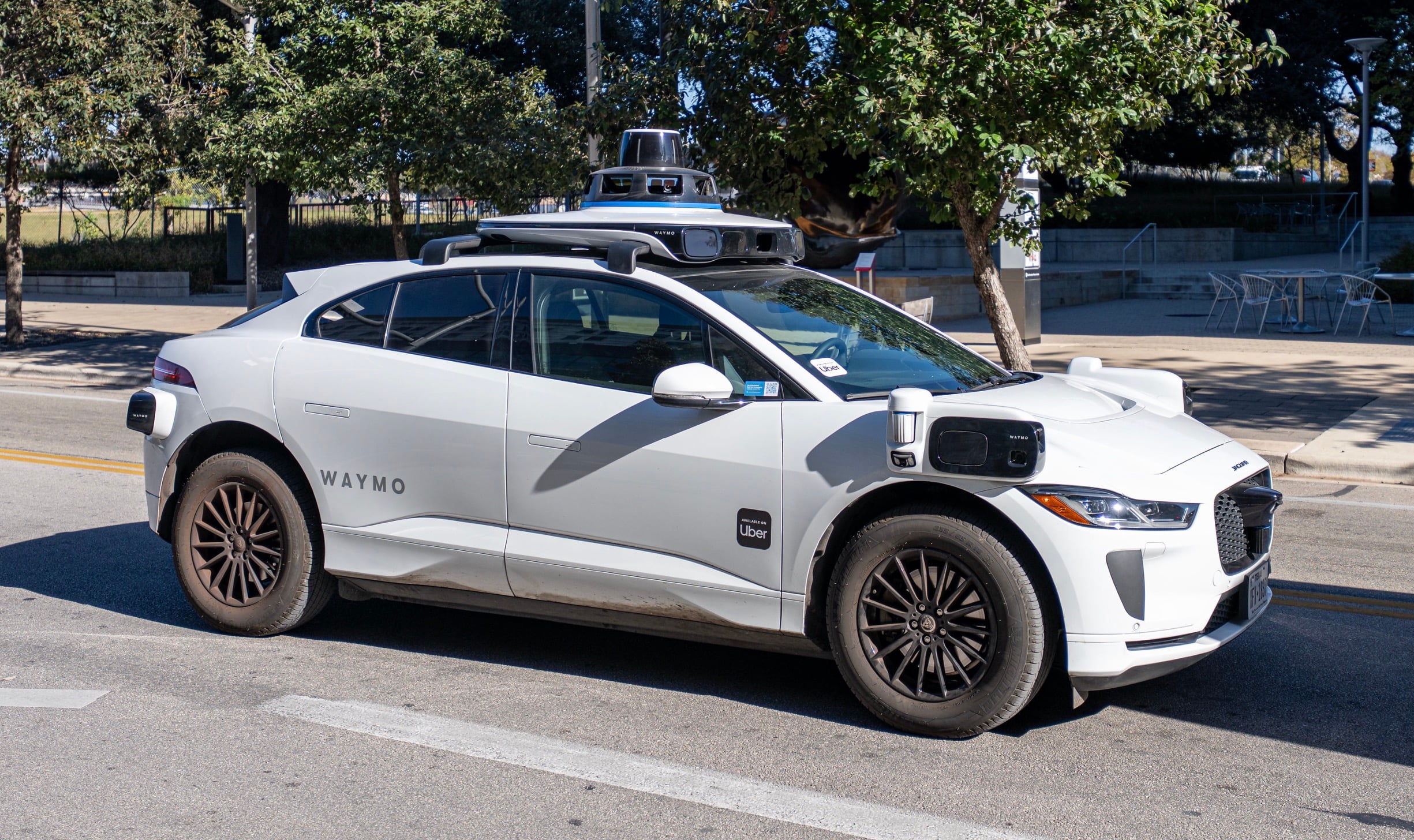
Seemingly overnight, local policymakers and elected officials are scrambling to respond to a question that could have massive ramifications to the quality of life on our streets: Should we allow autonomous vehicle (a.k.a. robotaxi) companies to launch fleets in Oregon cities without a fully-baked regulatory framework?
Waymo (owned by Google’s parent company, Alphabet) currently operates in Phoenix, San Francisco, Los Angeles, Austin, Atlanta and Miami. Since the company declared its interest in Portland last spring, local and state officials have been in talks with the company about what that might look like.
For a handful of state lawmakers — led by Republican House Representative Shelly Boshart Davis and Democrat Susan McLain — those talks led to the current short session of the Oregon Legislature where they’ve introduced a bill that would pave the way for Waymo and make it impossible for cities to keep robotaxi fleets in check. For the City of Portland Bureau of Transportation, those talks resulted in an effort to update city administrative rules and launch a process to develop a comprehensive regulatory framework — work they say deserves more time.
Those two very different responses to Waymo’s desires were on full display at separate hearings this morning when House Bill 4085 received its first public hearing at the House Committee on Transportation and Portland city councilors got a debrief on the topic at the Transportation & Infrastructure Committee.

The bill would open the floodgates for Waymo to operate robotaxis in Portland by establishing a state-managed permit program (run through the DMV), exempting them from standard equipment requirements, and by stripping city governments of the ability to effectively regulate the corporations that operate them. Backers of the bill take Waymo on their word that AVs are safer, believe they’re a much-needed mobility option, and say it’s time for Oregon to lay out the welcome in order to show our business-friendly bona fides.
At the legislative hearing this morning, Boshart Davis shared excitement for AV technology and framed it as an issue of keeping up with the times. “There’s a reason that we still don’t use the Pony Express to deliver the mail,” she said. Boshart Davis touted AVs’, “economic and tourism upsides” and said doing business with companies like Waymo would lead to much-needed investments in our state that will go elsewhere if we don’t act fast.
But when asked by House Rep. Paul Evans a very simple question about who’d be on the hook in the event of a collision, Boshart Davis went silent. When she finally answered, she said she’d have to ask law enforcement officials that question (watch a video of that exchange below).
When Evans asked if Boshart Davis is worried that Waymo uses teams in the Philipines to provide operational support for Waymo fleets, she didn’t answer directly and instead replied: “I think that we have to look at it as a risk-benefit conversation, like we do almost every piece of legislation that comes our way.”
Folks spoke up in support and opposition to the bill at this morning’s hearing (the official record of testimony is 60 people in opposition versus just 14 in support). Many backers said robotaxis would be a boon for disabled folks who don’t have reliable transit options. But others pointed out that there’s nothing in HB 4085 that would require Waymo to be wheelchair accessible. And several ridershare drivers who showed up to oppose the bill pointed out that helping people with special needs is a major part of their job that AVs simply cannot do.
A Waymo spokesperson at the meeting said they will provide a referral to riders in need of assistance, but Cassie Wilson, a wheelchair user who’s also the legislative manager for nonprofit 1000 Friends of Oregon, said other services are either unusable or unreliable. “Why shouldn’t AV networks be responsible for contributing to accessible vehicle capacity like other rideshare providers?,” Wilson asked lawmakers during testimony. “Especially if you’re all priding this innovation on accessibility, this is just another transportation service that people like me cannot actually use.”
Another concern expressed to lawmakers at today’s hearing was about the impact of robotaxi fleets on road maintenance costs. League of Oregon Cities Legislative Director Nicole Stingh said her group wants a bill that requires AV taxis to pay a road fee. “Autonomous vehicles will be electric vehicles only. That means cities are not receiving gas tax for those cars,” she testified. (HB 4085 doesn’t mandate any new fees for AVs, but would allow cities to create new fees as long as fees are already levied to rideshare companies.)
The person with the most experience at the hearing today was Jeffrey Tumlin, who served as executive director for the San Francisco Municipal Transportation Authority from 2019 to 2024 — just as Waymo and other companies hit the streets. A frequent Waymo user himself, Tumlin said he believes in the technology; but opposes the bill because he’s seen how state preemption of cities has failed in San Francisco.
“Our experience in San Francisco has not been positive,” Tumlin told lawmakers. “As the primary global beta test site, we continue to experience significant safety and operational problems from AVs on our roads.” Tumlin listed many problems with AVs in San Francisco, including how they tend to drop-off and pick-up in bike lanes and their inability to handle folks with wheelchairs or other medical equipment. “From a disability accessibility standpoint, we are finding that AVs are creating a net negative in that they are continuing to erode our regulated Yellow Cab system that has been our primary means of serving people with disabilities.”
In California and Texas, Waymo successfully worked with state lawmakers to pass local preemption laws — much like the one they are pushing in Oregon.
After the hearing, I asked Tumlin in a video press conference what it was like trying to work with Waymo. He said the City of San Francisco receives no data from Waymo and that the company, “has been mostly unwilling to partner with the city on critical issues.” “They are not a collaborator,” Tumlin added.
The absence of data from Waymo, Tumlin said, has been a big problem. “It makes it very difficult for city officials to do their job — which is to figure out, ‘How do we rework the rest of the transportation system in order to respond to this rather significant change, particularly when it comes to critical impacts like pick-up and drop-off, interactions with first responders, interaction with human traffic control officers, and the very different outcomes that AVs produce for people with disabilities.”
Tumlin warned that Waymo and the AV industry in general takes a much too simplistic view of safety. While boosters cite collision statistics compared to human drivers, Tumlin said that’s the wrong question to ask. “The relevant question is, will autonomous vehicles make it less likely for people to die as a result of traffic violence in cities? And from what we can see so far, the answer is no,” he said. Tumlin acknowledged that robotaxis are good and not running into things, but problems arise when the cars get confused and “brick” themselves, “which then creates unintended safety consequences for other users.” Tumlin cited several examples of robotaxis run amok, including running right through police crime scenes and work zones.
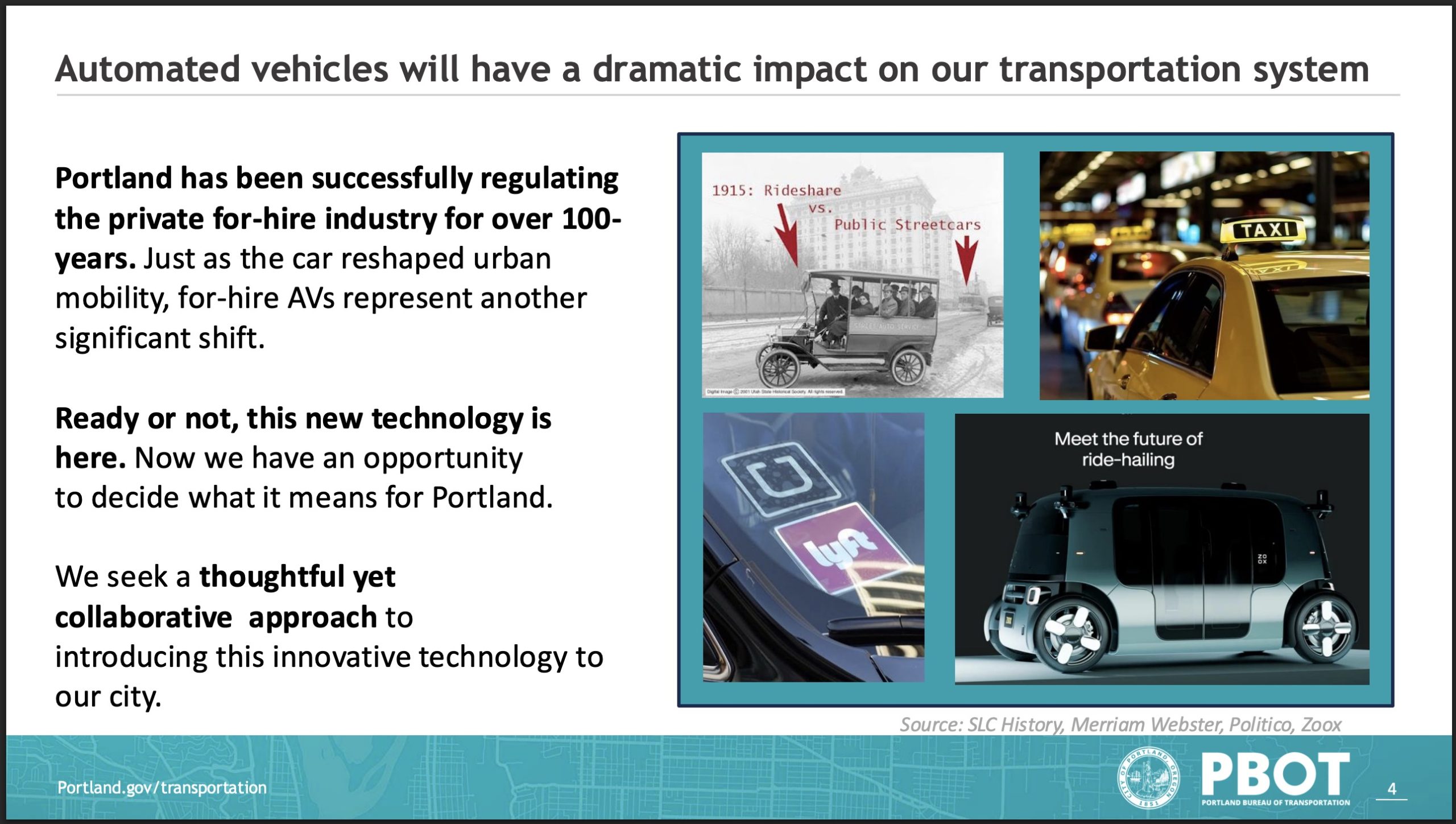
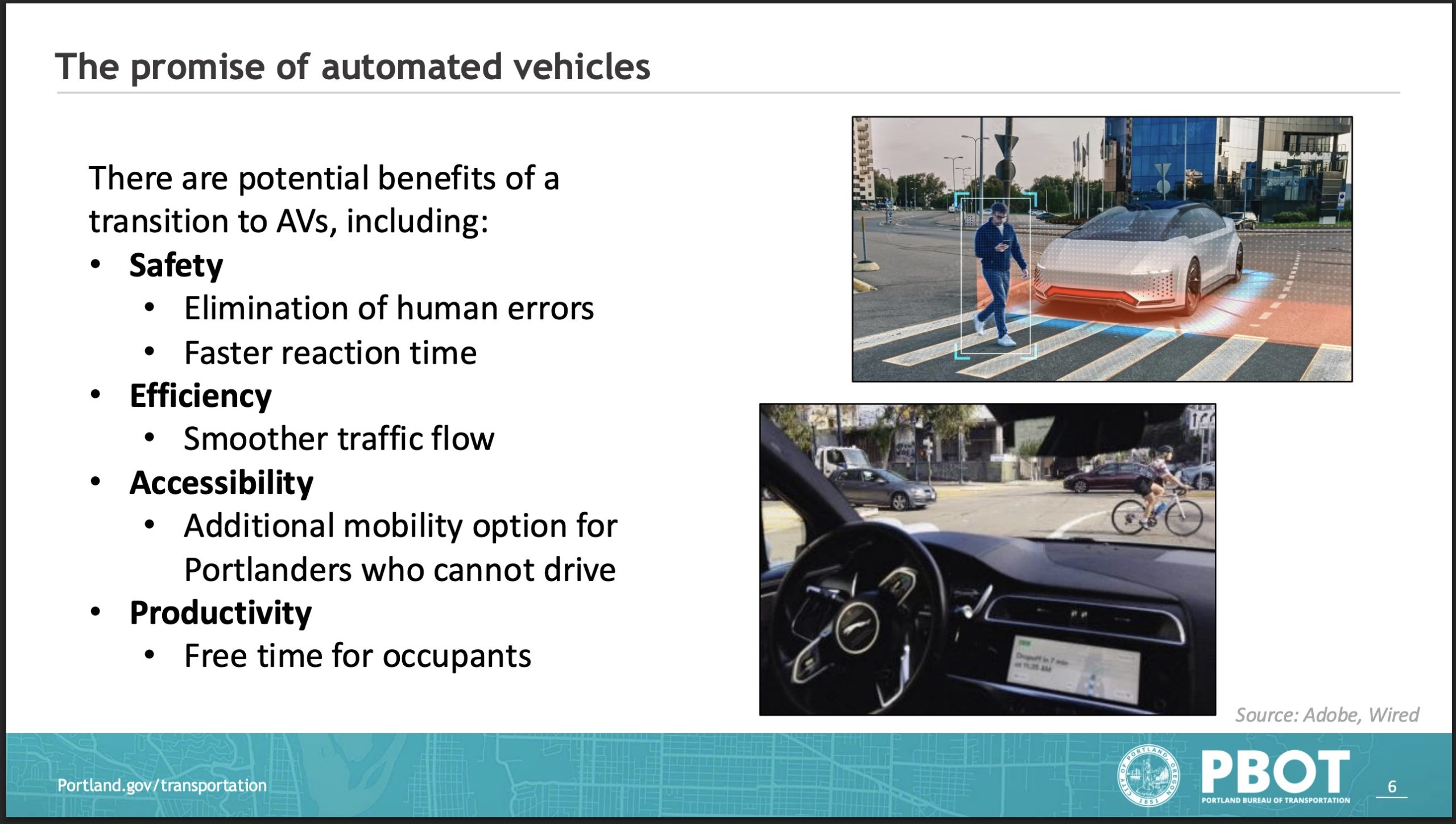
Like Tumlin, PBOT and City of Portland leaders see a lot of potential in the future of AVs to improve road safety and increase mobility options. PBOT Mobility Innovation Manager Jacob Sherman said he believes AVs are the “next big thing” that will ultimately replace rideshare companies like Uber and Lyft. But Sherman said Portland opposes HB 4085 and believes the conversation should move to the 2027 legislative session. In a letter to House committee members today, PBOT Director Millicent Williams laid out a detailed opposition to the bill.
Four of the five councilors who spoke at the council committee hearing today also expressed opposition to the bill. Councilor Tiffany Koyama Lane said she’s worried about mass surveillance and how Waymo might use the data and video their cars record. Councilor Angelita Morillo didn’t mince words with opinion: “My position right now is that we completely halt them altogether,” she said. “To me, the net negatives outweigh all the positives.”
Transportation and Infrastructure Committee Chair Olivia Clark likened robotaxis to, “the AI of transportation.” “For me, it’s kind of disturbing all the change that’s coming. I’m resistant to change and not really into this,” she added.
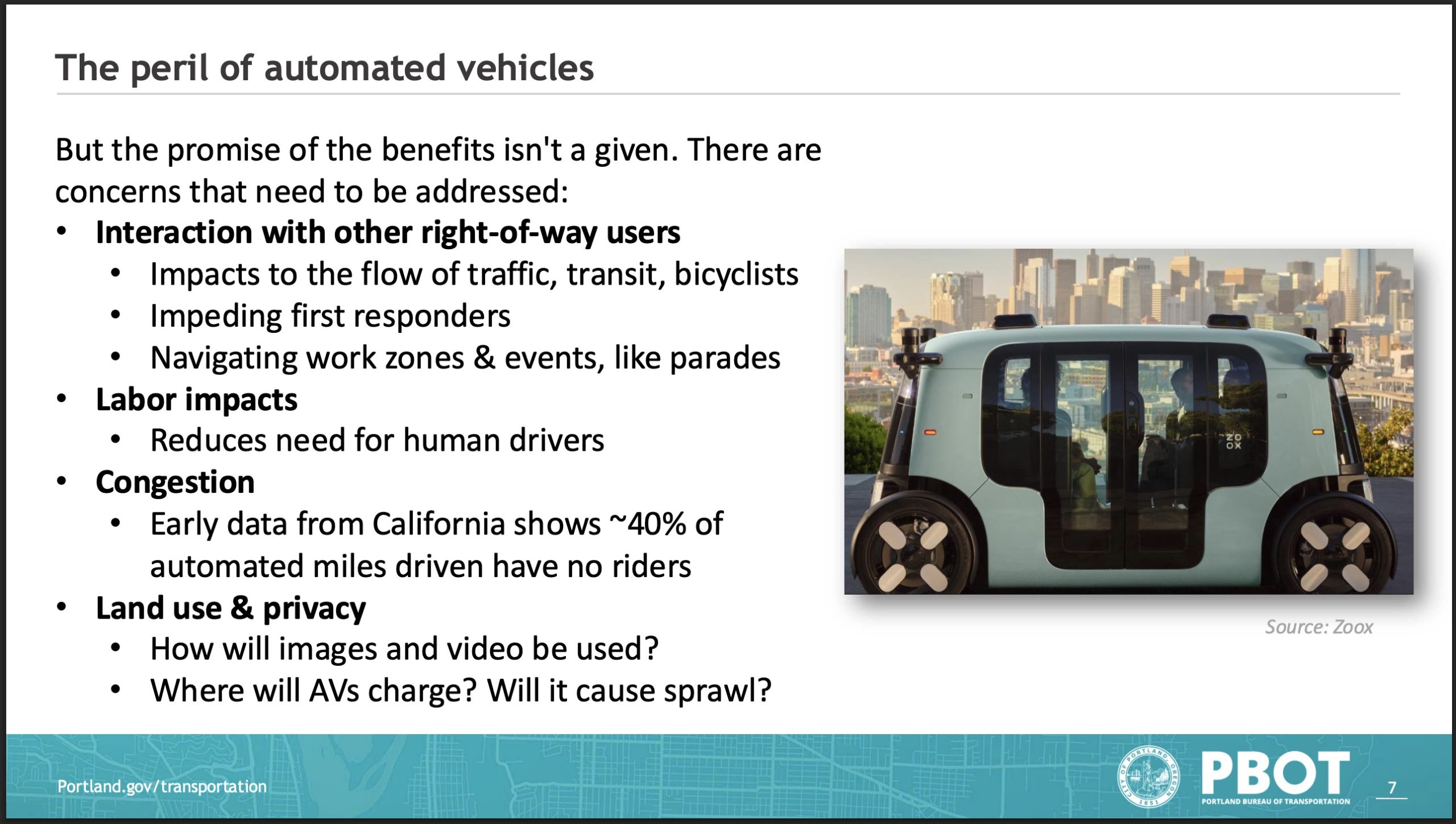
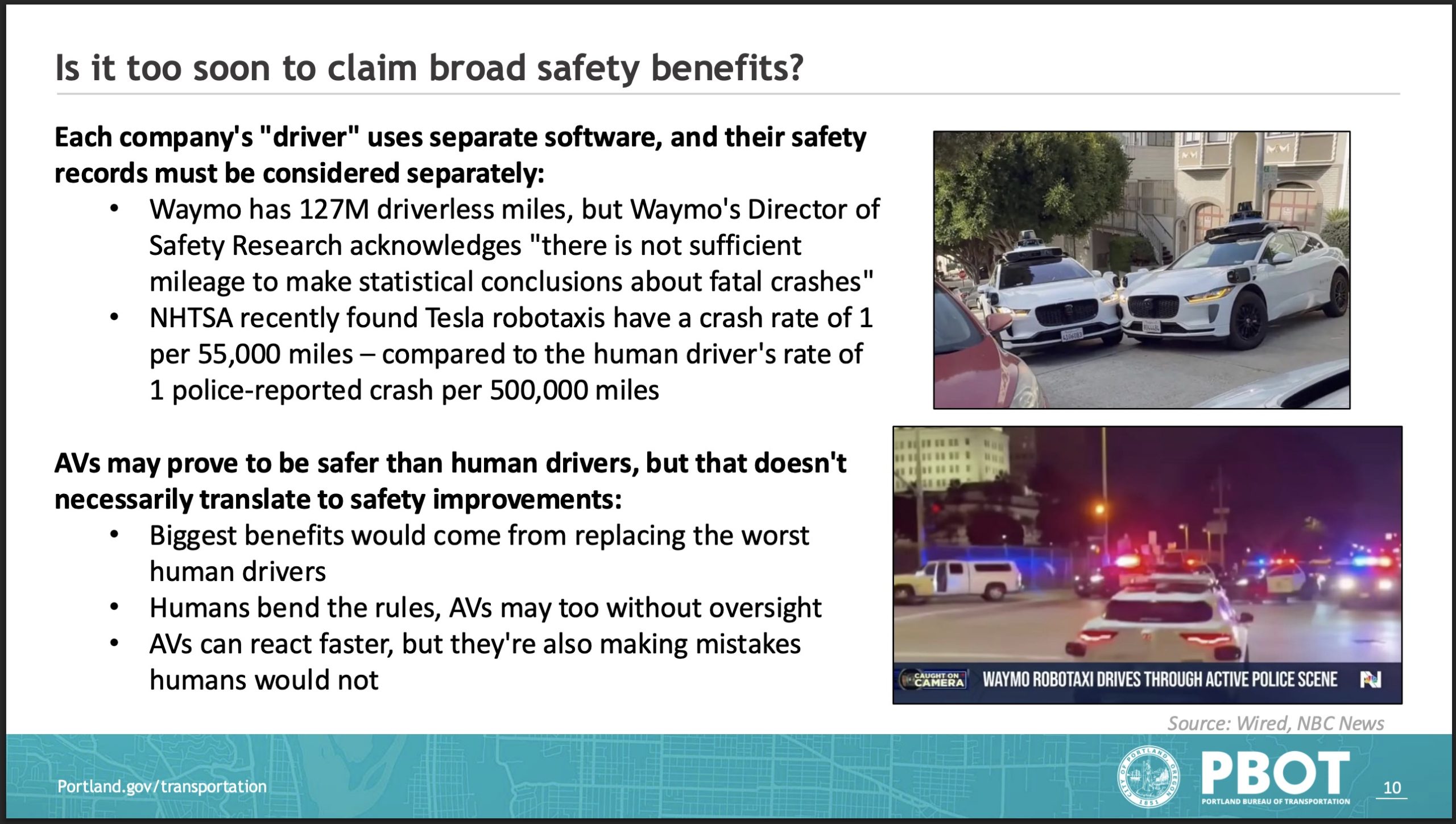
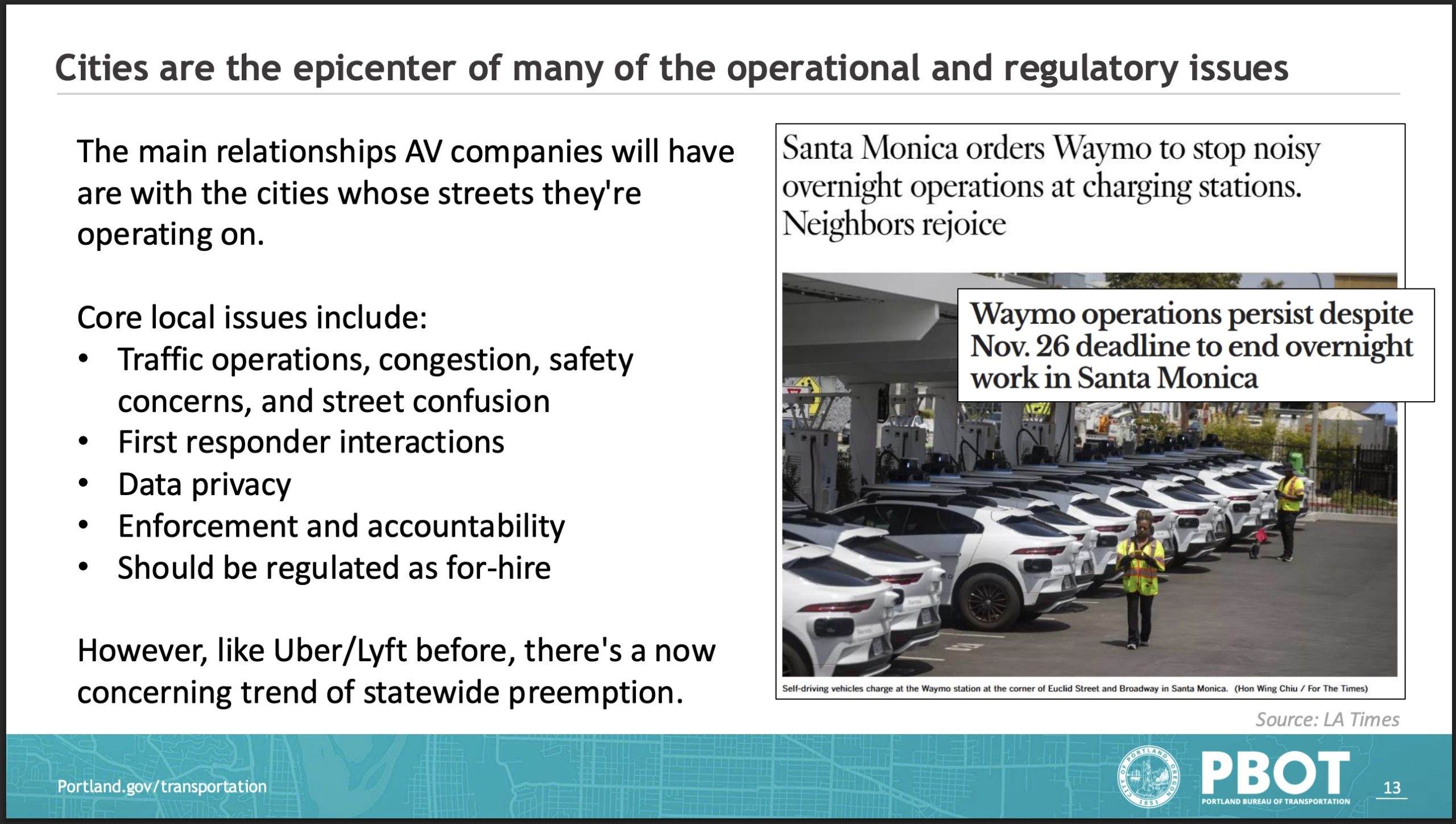
Another issue that got a lot of attention at these meetings today was traffic law enforcement. HB 4085 doesn’t address this issue directly and it’s clear city officials see that as a major shortcoming. (PBOT’s letter states: “Proposed legislation remains unclear on how local officials would issue traffic citations to AV companies for cars without an onboard operator, or without a licensed driver to link an infraction to in the system.)
At the legislative hearing, bill co-sponsor Rep. Boshart Davis was asked by Rep. Paul Evans (see video below): “In the event of a collision, who goes to jail?” Boshart Davis remained silent for several seconds and appeared to have no answer. Her eventual reply was that she’d have to ask law enforcement that question.

In California, Waymo is not accountable to local traffic laws. “There’s no way to issue a traffic citation to an AV,” Tumlin told me today, “because the vehicle code requires that a traffic citation be issued to the operator of the vehicle, and that is considered to be a human. So to my knowledge, there is no law enforcement anywhere in California that believes that they have the ability to issue citations to AVs.”
While Waymo vehicles are great at following speed limits and stopping at stop signs, Tumlin said they violate many other traffic laws.
“We’re concerned that AVs could get 100s of traffic tickets,” PBOT’s Sherman told councilors today. “As we know for human drivers, when you do that, you get your license suspended or revoked.” “We feel like we need some level of accountability where if we say, ‘This is the 47th time this AV is picking someone up in a bicycle lane’,” Sherman continued. “Maybe this doesn’t make sense right now because they’re not following the rules of the road.”
Whether it makes sense right now could be decided by Oregon lawmakers very soon. House Committee on Transportation Co-Chair Rep. McLain says she intends to bring the bill — which has eight sponsors, none of whom represent voters in Portland — up for a vote next week. If it passes this committee, it’ll head to the Senate Committee on Transportation. At least there we’ll have someone who represents Portland be able to weigh in.