
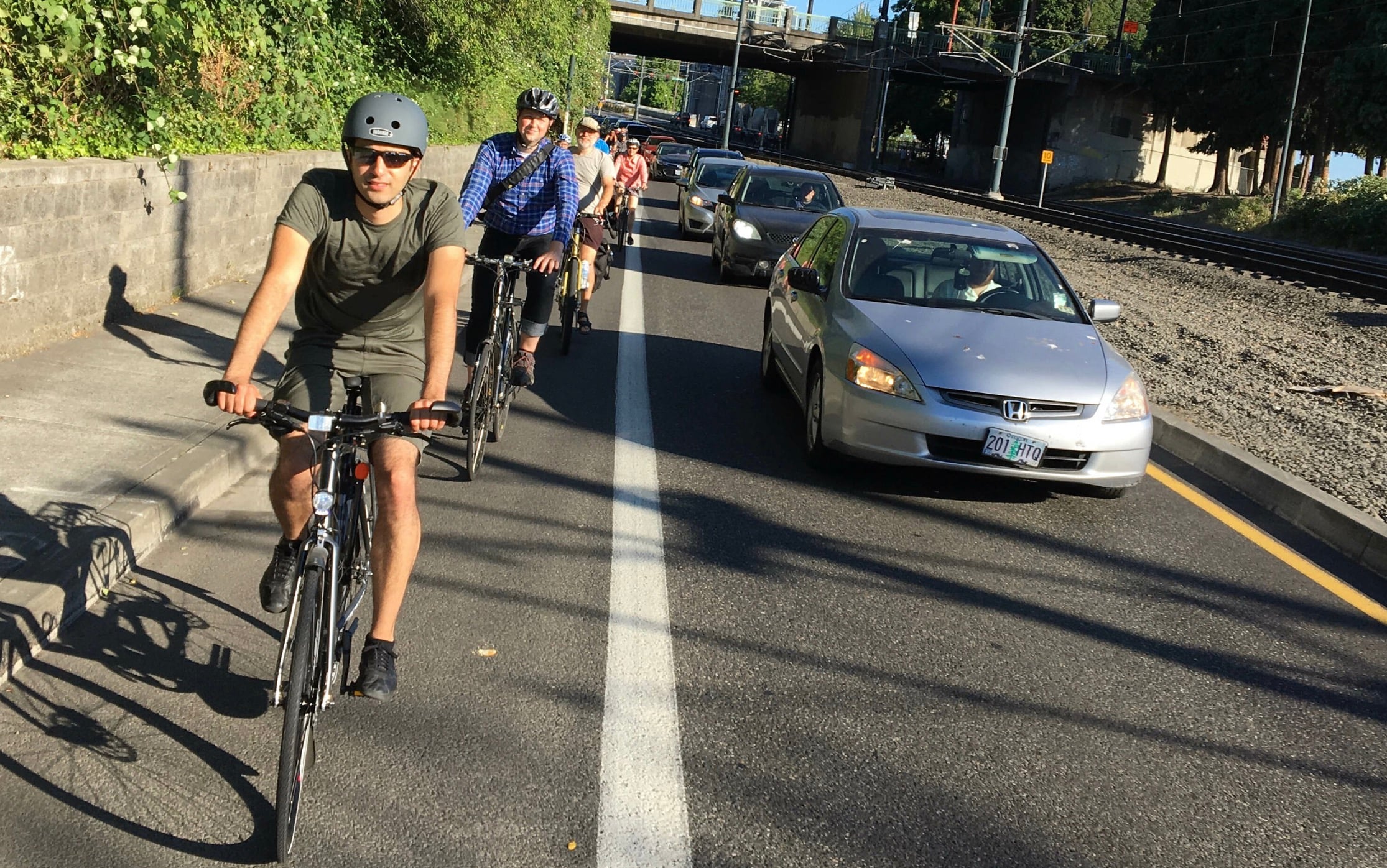
Could paying organizers to blanket neighborhoods with groups rides and a marketing campaign that spreads the good word about bicycling spur a Portland cycling renaissance? That’s a key question some advocates, insiders, and at least one Portland city council member are seriously pondering this week as ideas swirl around City Hall for how best to spend a $15 million chunk of climate tax revenue.
This funding is being debated as the Bureau of Planning and Sustainability goes through its annual adjustment of the Portland Clean Energy Community Benefits Fund (PCEF) Climate Investment Plan (CIP). The PCEF Committee has recommended an adjustment that would transfer $15 million from electric vehicle subsidies to home energy retrofits. But that change isn’t final and councilors see an opportunity to chart a different path for that funding. You might recall my story last month about how City Councilor Mitch Green wants to use the $15 million to backfill TriMet’s budget and rescue them from “doom loop” of service cuts.
Now Councilor Steve Novick, who has a history of pushing for higher transportation spending from the PCEF tax, has come forward with an idea of his own. This issue was first discussed at the City Council Climate, Resilience, and Land Use Committee on January 15th and a more robust conversation is planned for the next meeting on January 29th.
One of the ideas Novick supports is based on an intriguing plan to boost bicycle ridership first covered by BikePortland in November 2024. It’s an idea championed by noted bike planner Roger Geller, who’s led the Portland Bureau of Transportation’s bicycle program for over 30 years. Here’s the gist: Geller and Novick believe that since the bike network has improved dramatically in the past decade while ridership has cratered, what’s needed now is a grassroots effort to get people to actually use it.
In 2024 Geller told the city’s bicycle advisory committee: “You can’t watch anything on TV during the football season without seeing five Bud Light ads over the course of an hour right? That’s the level of campaigning that I want to do for biking. That’s what I think we need.”
The idea came and went for most of us, but Geller has never stopped thinking about it. Now with the opportunity for funding presented by PCEF, the plan’s moment in the spotlight has arrived.
At last week’s Climate Committee meeting (which Novick co-chairs), Bicycle Advisory Committee Chair Jim Middaugh hinted at the plan: “We have a world-class system that gets people on their bikes. There is clearly opportunities for more investment to make that system better, but we can also make the most of it today by encouraging people to bike.”
Due to his role as BAC chair, Middaugh has certainly been privy to renewed interest in Geller’s plan from Councilor Novick. One element of the plan — that appears to be just one part of a more fleshed-out and formalized version of Geller’s 2024 memo — was posted on the BikeLoud Slack channel by bike bus advocate Rob Galanakis a few days ago. It reads:
This effort will see PBOT contract with an organization who will enlist coaches who will be responsible for lead rides and encourage participation. Each coach would be responsible for an area that encompasses 1 square mile or approximately 4,500 households.
Coaches would:
- Lead regularly scheduled, advertised rides in neighborhoods throughout a project target area. Rides would reliably leave daily from set locations at set times.
- Promote the rides throughout their assigned area of the project target area. Promotion would be in the form of door-to-door canvassing, putting up flyers in neighborhood destinations and attending events and public meetings.
- Depending on scale, the effort could reach up to 181,000 of Portland’s 304,000 households in the following neighborhoods: Central City, Interstate Corridor, Lents-Foster, Montavilla, Hollywood, MLK-Alberta, Belmont-Hawthorne-Division, Woodstock and Sellwood-Moreland-Brooklyn.
As you can see, the plan would be akin to a get-out-the-vote campaign, but for cycling. And this is just one element of the bike marketing plan. If what Novick’s cooking up tracks with Geller’s 2024 vision, it would also include a few high-visibility network improvements, a professional marketing campaign, and demonstrations of political support. I hope to share the full plan soon so you can see the whole enchilada and make your judgments based on that. But for now, what are your general thoughts about this approach?
Councilor Novick sounds like he wants to give it a try. “I tend to agree with Roger that since infrastructure has improved somewhat over the last decade but ridership has plummeted, we should at least consider some non-infrastructure ideas,” he told me yesterday.
Novick says we can expect an in-depth discussion about this and other ideas for how best to spend the $15 million, at the Climate Committee meeting next week (January 29th). Stay tuned.