
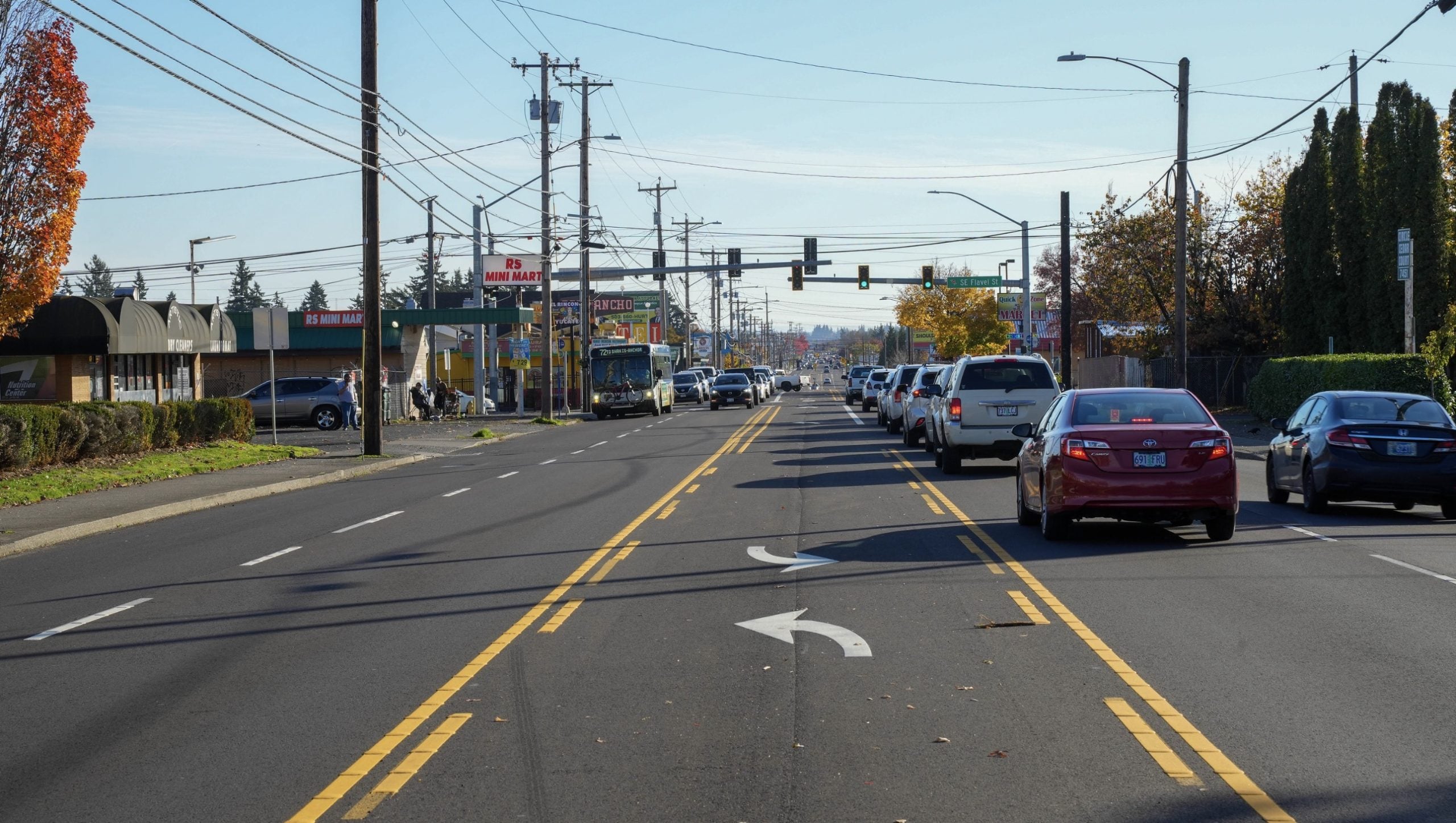
The debate over bus lanes on 82nd Avenue evolved considerably at the meeting of TriMet’s Policy and Budget Committee last Friday.
Before that meeting, a coalition of business owners strongly opposed plans for new “business access and transit” (BAT) lanes and leaders of several key advocacy groups were pushing TriMet to adopt the “More BAT” design option that would build semi-dedicated bus lanes on nearly the entire project corridor between Clackamas and Northeast Portland.
But as the project timeline inches forward and tension builds like the crowd inside a Line 72 bus during rush hour, a compromise now feels inevitable. The agenda for Friday’s meeting was to discuss the contentious bus lane issue one last time before members make a recommendation at their meeting next month.
TriMet GM Sam Desue starting things off with an unexpected twist: He read from a letter signed by a surprising alliance of advocacy groups.

“My own recommendation would be to pull BAT lanes away from Powell. There are a lot of problems that get generated around there.”
– Chris Ford, ODOT
“We all want this project to create a transit-rich corridor,” the letter read. “We believe it is possible to deliver BAT lanes while ensuring that the people and businesses who make 82nd Avenue special can continue to thrive.” What made the letter surprising is that it was co-signed by Oregon Walks, APANO (Asian Pacific American Network of Oregon), Unite Oregon, Verde and the Portland Metro Chamber. Yes, the same Portland Metro Chamber whose members threatened lawsuits over the bus lanes just a few months ago was now collaborating with groups whose members strongly support better transit on 82nd Avenue. What brought them together? A shared demand that TriMet completes a third-party economic impact study on how the BAT lanes will effect businesses.
But getting business owners to look past their transit fears was just one hurdle the BAT lanes faced. The other, even more serious challenge for the project, is getting it approved by the Oregon Department of Transportation (ODOT). As the pre-eminent road authority, ODOT has veto power over any project that crosses and/or impacts one of its roads. In the case of the 82nd Avenue Transit Project, the plans impact ODOT’s Powell Blvd (Highway 26), NE Lombard (Highway 30 Bypass), and access to Interstate 205.
At issue are traffic models used by ODOT that assume folks who currently drive cars on 82nd Ave would use other roads if a bus lane existed. In ODOT’s world, car traffic is a constant and diversion from a major arterial like 82nd could cause congestion on state-owned facilities. And while to you and I congestion just means a trip takes a bit longer, to ODOT it’s a five-alarm fire.
“I know there are a lot of different safety issues on this corridor, including vulnerable users and transit riders,” said ODOT Region 1 Policy and Development Manager Chris Ford at the meeting Friday. “But the thing that we also wanted to consider was if there would be diversion to off-ramps from I-205 where you would get rear-end collisions which tend to be serious and fatal.”
According to TriMet’s analysis, about 15-25% of the peak-hour car traffic on 82nd would be diverted onto other roads (depending on the extent of BAT lanes installed). Prior to Friday’s meeting, ODOT ran a detailed analysis on how those additional car users might impact their facilities.
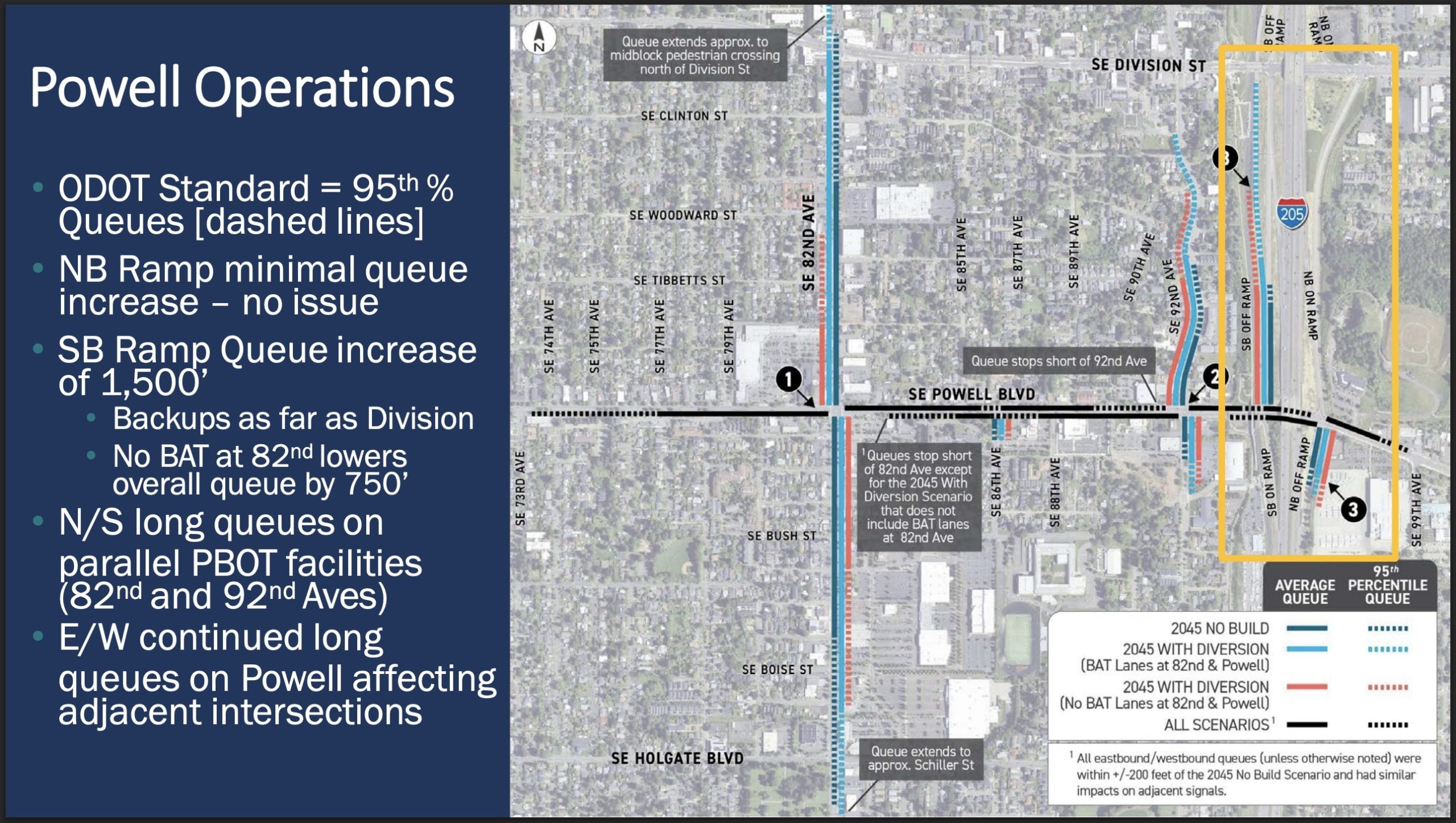
ODOT’s biggest concern is along Powell Blvd at 82nd and 92nd avenues (see above). If BAT lanes are installed at 82nd and Powell, Ford said car drivers would queue up all the way north to SE Division and south to SE Holgate. And the entire section of Powell between 82nd and I-205 would be a clogged-up mess. He laid out three mitigation options: drop the BAT lanes at this intersection altogether, widen 82nd Avenue to handle more car traffic and create a new bus turn lane, or roll the dice and see if ODOT would grant TriMet and the City of Portland a “design exception” which is essentially a get-out-of-jail-free card for traffic engineers.
While options were presented, it was clear that only one is likely to be politically and practically feasible. Widening 82nd would add costs and time to the project, as well as making it even more dangerous to cross. And the design exception process (managed by ODOT) would take at least 6-8 months to complete and thus could jeopardize the project timeline (an all-important consideration given that it’s federally funded and the feds do not mess around with timelines).
So that leaves just one option: drop the BAT lane.
“ODOT’s preference would be no BAT lanes [at 82nd and Powell],” Ford shared with committee members. “My own recommendation would be to pull BAT lanes away from Powell. There are a lot of problems that get generated around there.” Then Ford added as a note of caution, “If the project wanted to move forward with pursuing a design exception that you know ahead of time what your ‘Plan B’ would be.”
Throughout the meeting there was an evident tension from TriMet project staff. They know BAT lanes deliver more of what the community wants out of this project, but they also don’t want to do anything that jeopardizes the project from being completed on time and on budget.
82nd Avenue Transit Project Manager Jesse Stemmler summed it up like this: “Our aim as a project is to deliver the most BAT lanes possible while addressing the risk, the challenges, and those concerns that we’ve heard.” Asked about impacts of dropping BAT lanes, Stemmler estimated that bus riders would lose about 30-40 seconds in travel time savings if BAT lanes were dropped at Powell. (Stemmler also wanted to make it clear on Friday that the base project — even without BAT lanes — will be a massive improvement for transit on 82nd Avenue.)
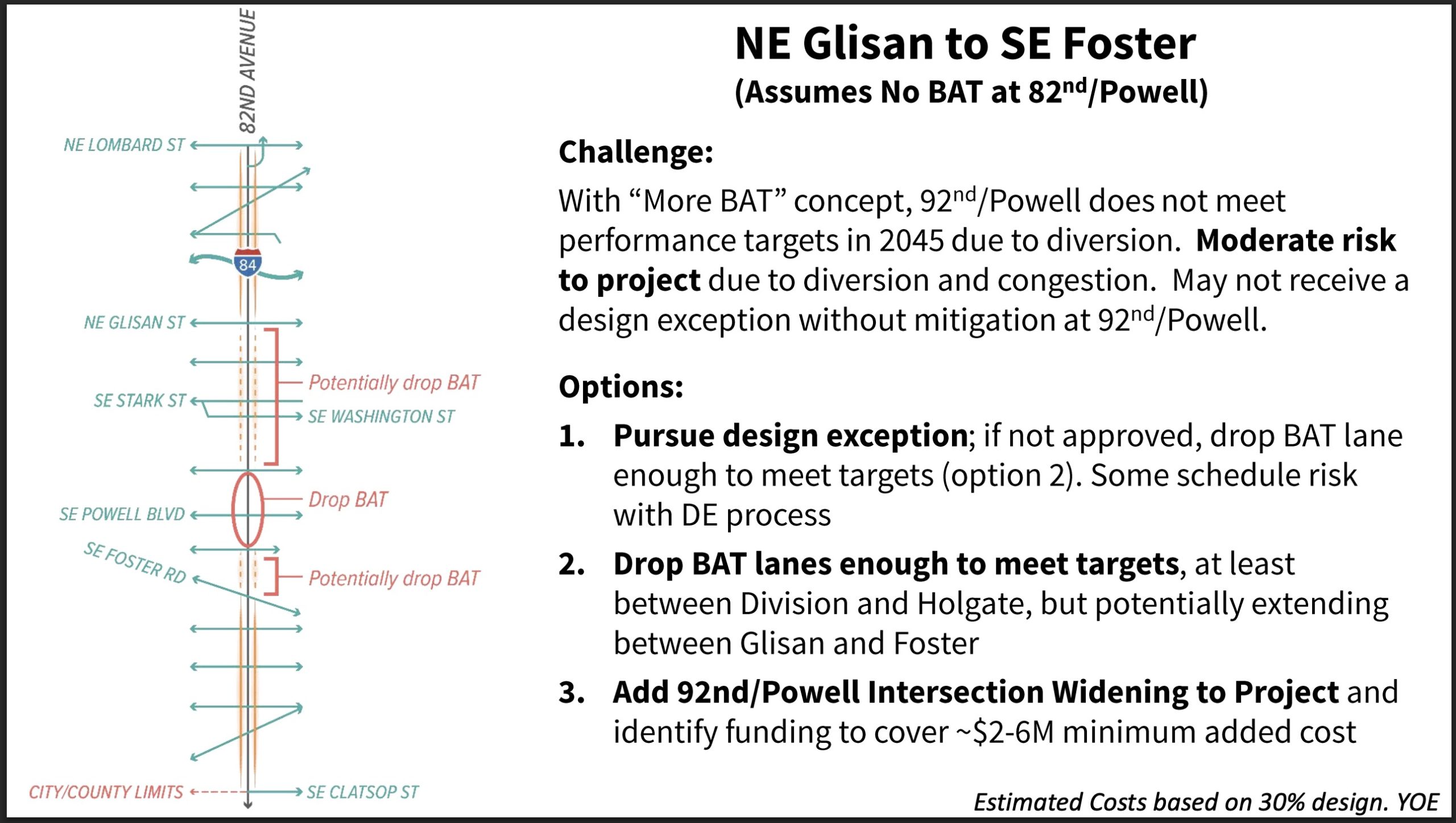
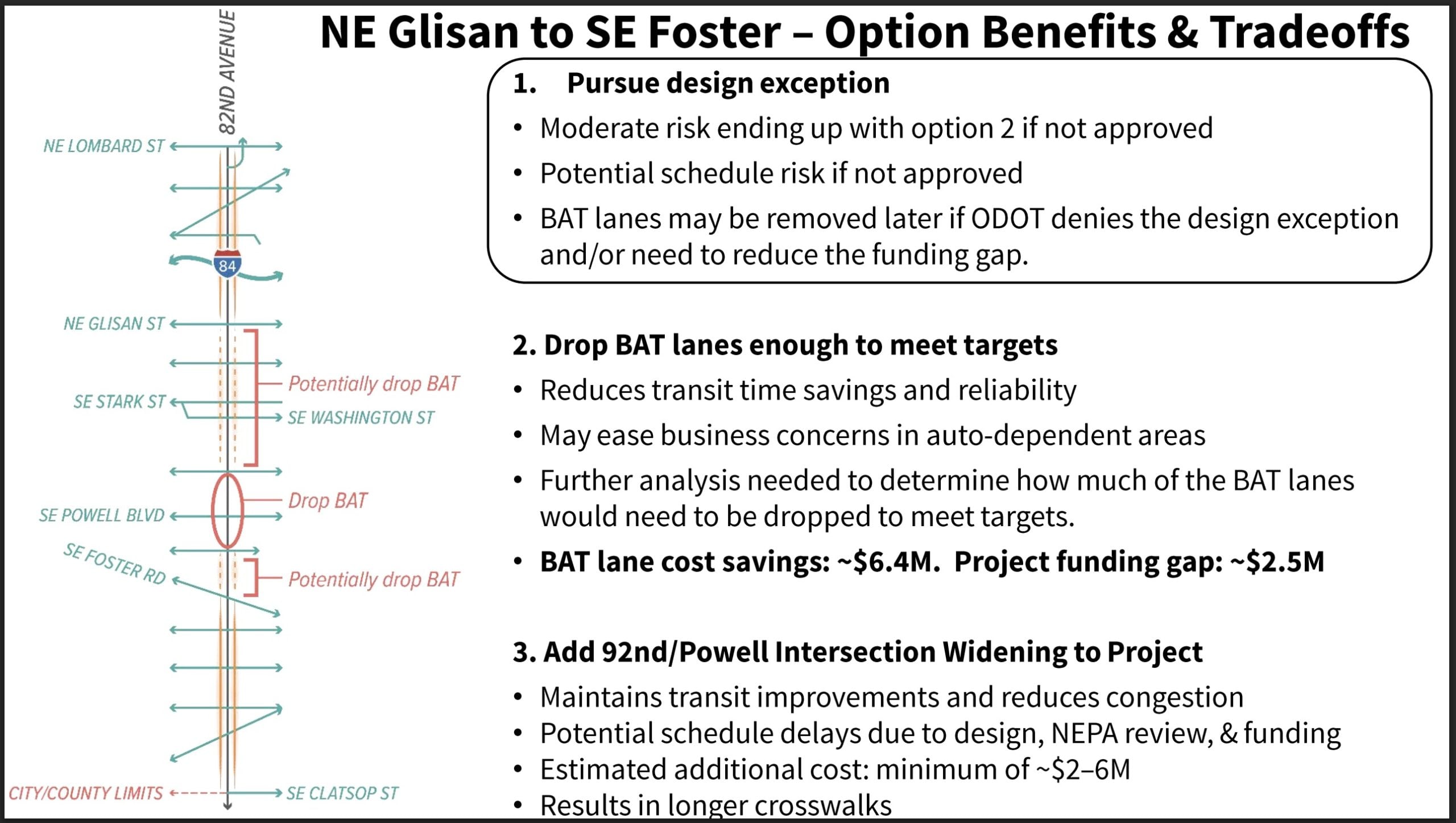
Stemmler explained that the staff recommendation he’ll present at next month’s Policy and Budget Committee meeting will be to drop the BAT lanes at Powell Blvd, pursue a design exception at 92nd (where ODOT said they can live with the impacts to I-205 ramps) and commit to a slight widening of 82nd at Stark and Washington (to accommodate side-by-side left turn lanes). Stemmler also said they’ll recommend pursuing another design exception for two other section between NE Glisan and Foster (see slides below) and would consider dropping BAT lanes north and south of Powell if that exception doesn’t get approved by ODOT.
While momentum favors dropping BAT lanes at one (or more) location(s), not all officials around this project are ready to throw in the towel. At one point, committee member and Metro Councilor Christine Lewis made it clear she doesn’t want TriMet to give up on full BAT lanes, but the response from project staff sent a powerful message.
“I’m wondering if there’s an opportunity to continue to do research and planning on [BAT lanes on] 82nd and Powell… I would like to study BAT lanes here at this intersection in particular because it is such a prominent and and difficult intersection,” Lewis commented.
To which TriMet Interim Director of Major Projects Michael Kiser responded, “More study of Powell is pursuing a design exception which is over a six-month process. Within the next few months we are going to start our risk and readiness review with FTA. If they [Federal Transit Administration] see that there’s uncertainty in scope/schedule/budget and decisions amongst partners, that’s a red flag for them.”
Lewis and her fellow Metro Councilor Duncan Hwang still seem willing to go to bat for BAT lanes. “I’d love for the project team to continue to study full BAT the entire length,” Hwang said Friday. “I think we’re in a place of, how do we study the whole thing while still being able to make cuts strategically if we have to, but not closing doors [on BAT lanes] now.”
For her part, Portland Bureau of Transportation Director (and Policy and Budget Committee member) Millicent Williams seems more willing to compromise than Lewis or Hwang. “The City of Portland will be happy to support as much BAT as is possible,” Williams said. “She prefers a “Goldilocks” option of “more than some [BAT], but less than more [BAT]”.
A few months ago this debate was about “Some BAT” (just three miles of BAT lanes with the busy, central portion of 82nd BAT-free) or “More BAT” (BAT lanes along the entire project corridor). On Friday the front lines shifted slightly in a BAT-ward direction; but the debate is far from over.
The Policy and Budget Committee will make a recommendation at their next meeting February 13th.