Like many people who’ve biked in Portland for a few years, Lisa Timmerman could sense an uptick in careless and dangerous driving. In December 2023 Timmerman replied to a BikePortland Instagram story that she’d just returned to bike commuting after the pandemic and, while grateful for new infrastructure around town, she said, “I feel fearful in a way I didn’t just three years ago. Even in just a short commute, I’ve had to modify my route due to too many careless and aggressive run-ins on ‘protected’ bikeways.”
Six months later, Timmerman’s fears came to life.
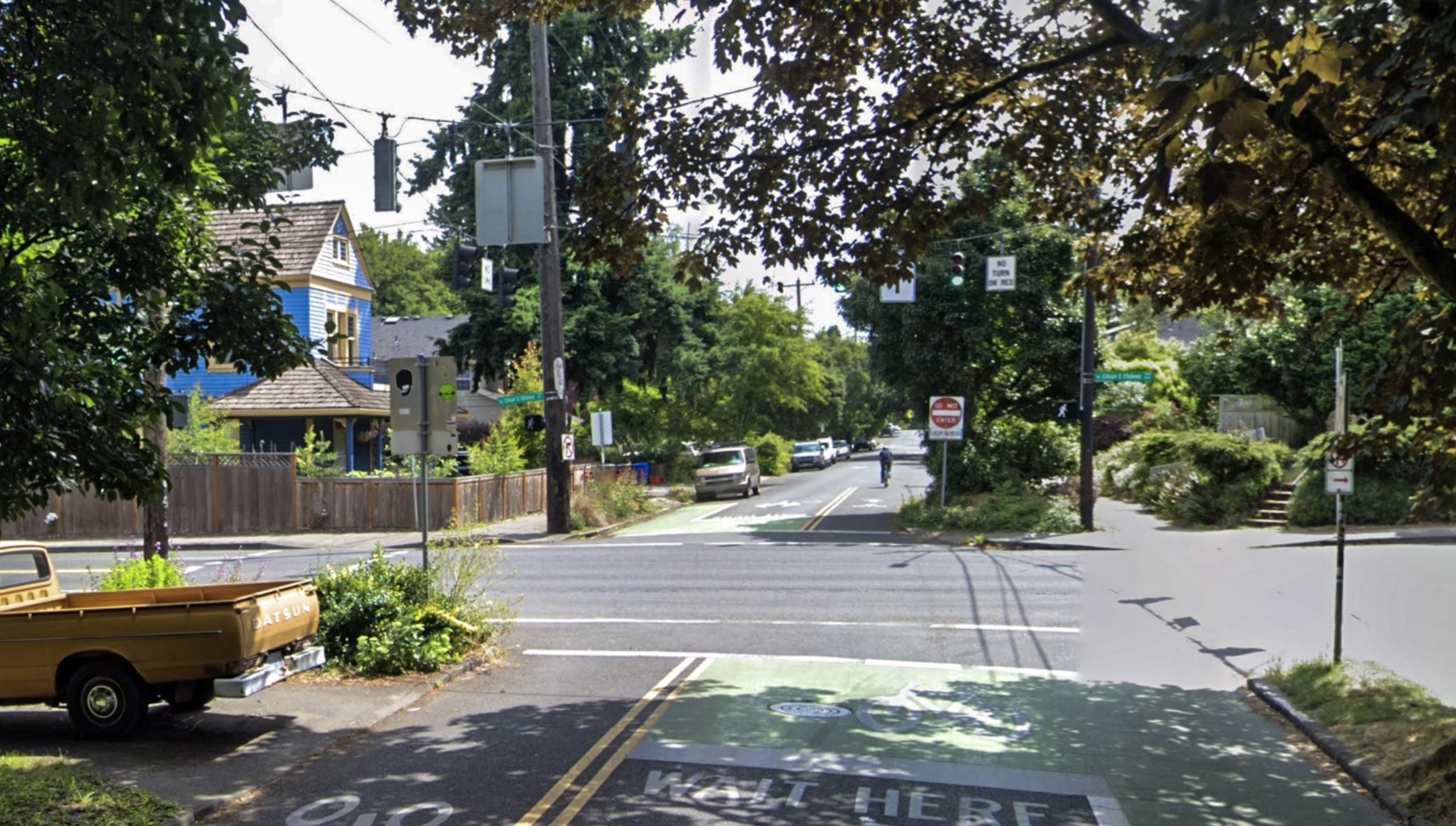
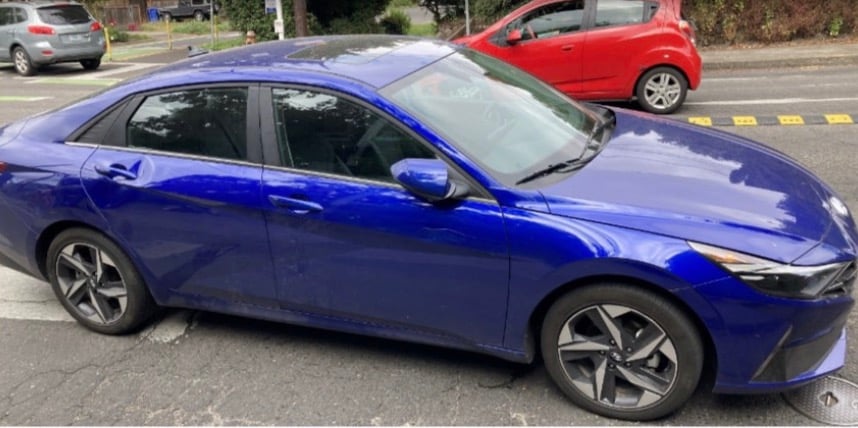
On June 27th, 2024, while biking eastbound on the Southeast Clinton Street neighborhood greenway, she crossed Cesar Chavez Blvd with a green light. As soon as she entered the intersection, a woman driving a blue Hyundai sedan southbound on Cesar Chavez slammed into her. The driver, then 21-year-old Sophie Bell, failed to stop at a red signal and didn’t even brake. A video (view it below) from a nearby resident shows Timmerman crumple to the ground on impact and begin wailing in pain. The collision caused multiple fractures to Timmerman’s ankle and several broken ribs.
“I decided to not cite Bell because she was remorseful and apologetic for hitting the cyclist.”
– Alexandru Martiniuc, PPB officer (from police report)

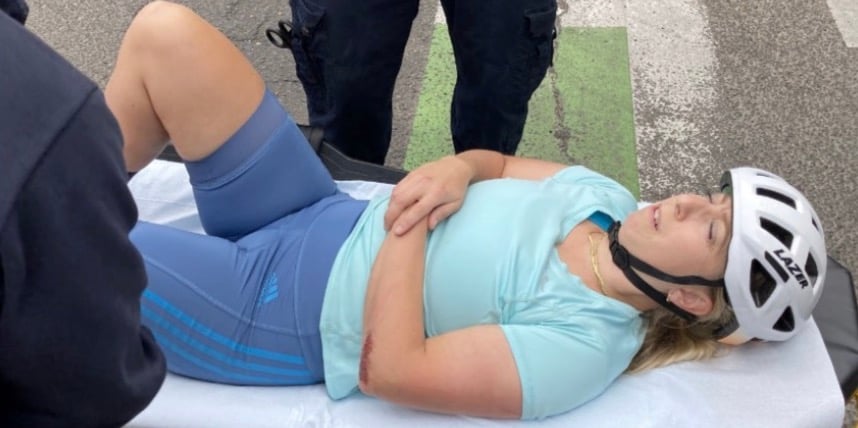
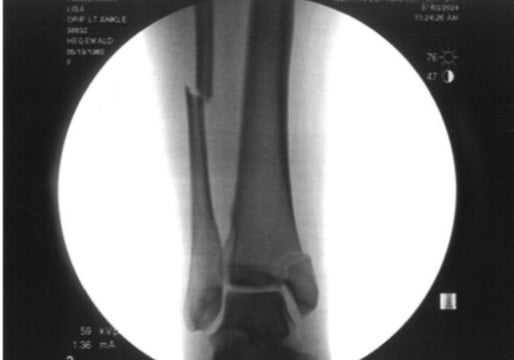
Timmerman, 42, endured two surgeries to repair bones and spent months in pain and physical therapy sessions. She expects early onset arthritis and ankle replacement surgery are in her future. “I was a very serious cyclist prior to the accident, riding about 6,000 miles a year,” she shared with me via email. “And while I’m back to cycling now, I’m doing only a fraction of what I did before.”
In some ways, Timmerman was lucky. It wasn’t a direct hit, and the car had a slim hood profile. What if Bell was driving a truck with a high hood? What if she’d been hit just a millisecond or two later? Those thoughts still haunt Timmerman; but her injuries weren’t the only troubling aspect of her ordeal.
“It was stunning to me how minimal the consequences were for the driver,” Timmerman shared with me.
According to the Portland Police Bureau report, a witness (a driver going the other direction who’d stopped at the signal) told the responding officer that the driver who hit Timmerman went through a red signal. A few days later, the officer was able to view video camera footage from a nearby porch. “I could see the pedestrian traffic signal in the video signaling eastbound traffic had the right of way/green light,” the report reads. “Timmerman entered the intersection. I saw a blue vehicle enter the intersection and sideswipe Timmerman.” Bell also admitted to the officer that she “thought her light was green.”

Three sources of very solid evidence proved that Bell had violated Oregon Revised Statute 811.135 – the careless driving law. That law states if a person commits a traffic violation that results in the serious injury (or death) of a “vulnerable user of a public way,” they can receive an enhanced sentence that includes completion of a traffic safety course and up to 200 hours of community service. If that sentencing is not met, they could also be subject to a fine of up to $12,500 and a one-year license suspension.
But despite Bell’s admission of guilt, a witness statement, and irrefutable video evidence, PPB Officer Alexandru Martiniuc declined to issue any citation at all. The reason: The driver felt bad and said sorry.
“After interviewing all involved parties and reviewing the camera footage, I determined the driver was at fault. Bell was inattentive and did not notice that her light was red,” Ofcr Martiniuc wrote in the report. “I decided to not cite Bell because she was remorseful and apologetic for hitting the cyclist.”
Chris Thomas of Portland-based law firm Thomas, Coon, Newton & Frost (a financial supporter of BikePortland) represented Timmerman in the case and told me in an interview this week, “the fact that the reaction and the apology and the sympathy would factor into the analysis at all is outrageous.” Thomas added that in his experience representing bicycle riders and walkers, failure to cite for obvious infractions “is not an isolated incident.”
“It would survive any standard of proof. There would be no issue for a police officer to prove this case in front of a traffic court judge.”
– Chris Thomas, lawyer
Calling this behavior from PPB officers a “widespread problem,” Thomas shared that, “It’s not as though this was a he-said/she-said. There’s a neutral witness, there’s video evidence. It would survive any standard of proof. There would be no issue for a police officer to prove this case in front of a traffic court judge.”
Thomas believes the decision to not issue a citation in a clear-cut case like this, “downplays the seriousness of careless operation of a vehicle and the consequences that you can cause by careless driving.” It’s a symptom of what Thomas feels is a “systemic, very pervasive ‘windshield bias‘ throughout our system.” Thomas has urged the Multnomah County District Attorney to consider stronger punishment for dangerous drivers and says elected officials who oversee the PPB need to step up and demand action.
“I’m not trying to ruin this person’s life – just to reinforce some accountability.”
– Lisa Timmerman
Asked to respond to my concern that what Ofcr Martiniuc wrote in the report could be perceived by some in the community as biased, PPB Public Information Officer Kevin Allen told me, “I cannot speak for the officer and I don’t have information about that individual case, but in most circumstances, policy and the law grants police officers the discretion to determine whether a citation (or arrest) is appropriate to the situation.” When I asked to speak directly to the officer in order to better understand their decision, Sgt. Allen said he’d ask for me. A few minutes later he replied: “The officer has nothing else to add beyond what is documented in the report.”
This circular unaccountability at PPB undermines their (already paper thin) public trust and calls into question the agency’s purported commitment to using enforcement as a way to improve road safety and change driver behavior. The fact that an officer would write “I decided to not cite Bell because she was remorseful and apologetic for hitting the cyclist,” shows how normalized and pervasive this sentiment is inside the PPB.
Compare Timmerman’s case with a crash that happened just one month ago. On November 10th the PPB issued a press release about a minor fender-bender between two drivers in Northeast Portland. The victim’s air bag was deployed, but they were not seriously injured, and the driver who caused the crash was not speeding or impaired. But for some reason, the driver was issued a citation for careless driving. The victim in that case was a Portland Police officer.
It doesn’t take an advocate or a lawyer to see how disturbing this is. 18 months after being hit, Timmerman herself still laments that the person who caused her so much pain faced no justice, and she worries Bell will do it again. “How do we have a Vision Zero policy but we can’t communicate the severity of the action to the driver when there is clear evidence they were at fault?” she wonders. “A citation seems like a minimal action/consequence. I’m not trying to ruin this person’s life – just to reinforce some accountability.”
It’s also not lost on Timmerman that this happened on Cesar Chavez Blvd, a road with a deadly history that a design that encourages dangerous driving. Safety activists will often say that good roadway design is self-enforcing. In the case with Cesar Chavez, the opposite is true. With its car-centric design, police enforcement of traffic laws is one of the only tools we have to keep drivers in check. Without it they will continue to run amok, leaving a trail of broken bodies and broken trust in its wake.
For Timmerman, the PPB’s intentional and selective lack of enforcement is another difficult layer to process. “I live in ground zero for the three fatalities in the past two years,” she shared with me. “Grey Wolfe was hit two blocks from my house. I heard it and saw the aftermath and it has been weighing heavily all week.”