
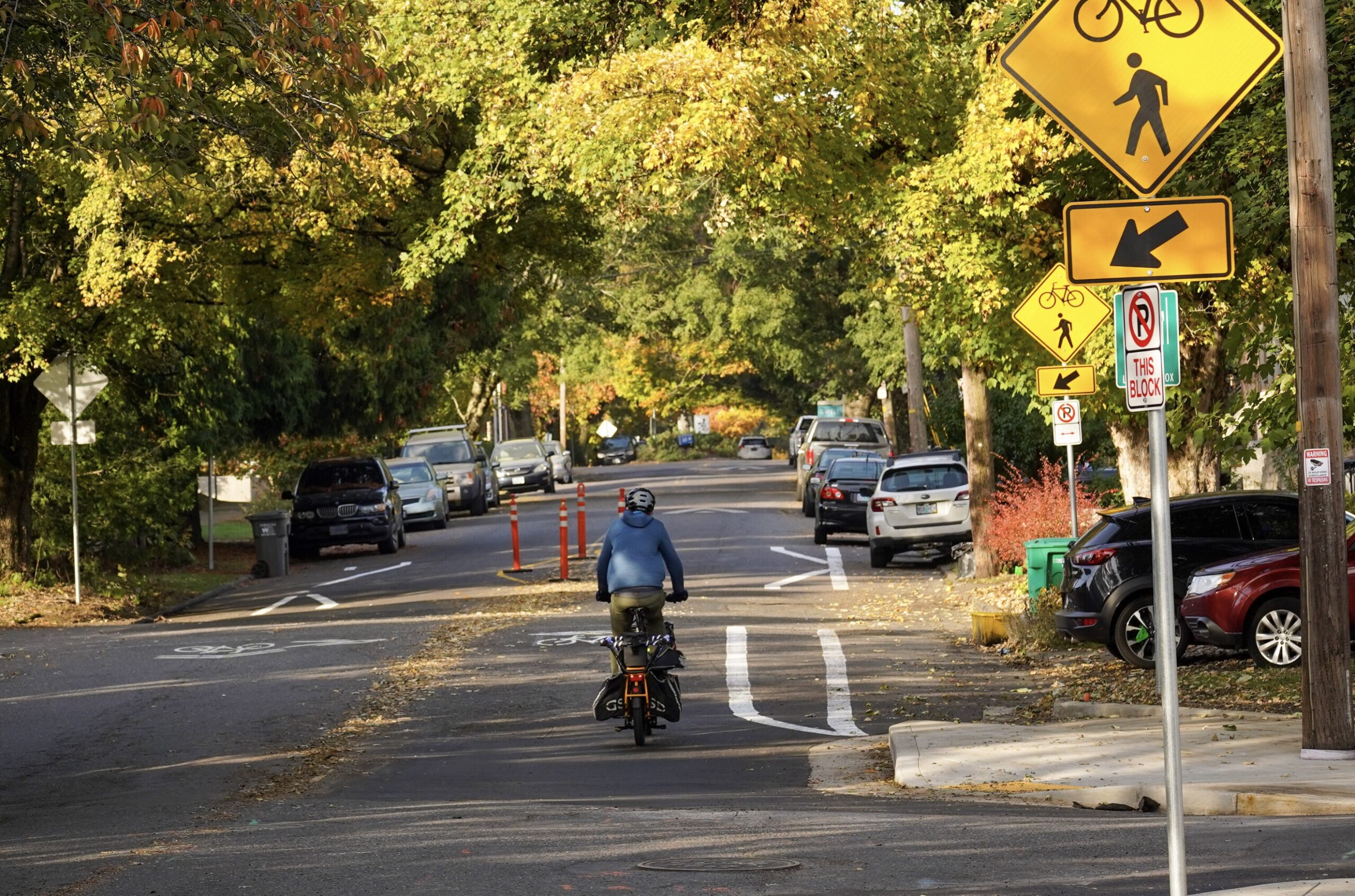
Written by Anders Hart, a NE 7th Avenue resident.
Portland’s bike network relies on neighborhood greenways, which PBOT defines as “low-traffic and low-speed streets where we give priority to people walking, bicycling, and rolling.” This approach works well enough, provided there are greenways connecting point A to point B. One of the most glaring gaps in the city’s greenway network is NE 7th Avenue, which connects North/Northeast Portland to Southeast via the Blumenauer Bridge across I-84. This corridor has a long history of city-led community engagement, which, while commendable, led to PBOT’s misguided 2019 decision to put a greenway on NE 9th Ave rather than the more logical choice of NE 7th Ave. With PBOT updating the 20-year Transportation System Plan (TSP) and changes proposed for Portland Public Schools (PPS) boundaries, now is the perfect time to revisit that decision and designate NE 7th as a neighborhood greenway.
I live on NE 7th, so this topic is personal for me. Having lived, biked, and walked in this neighborhood for several years, I’ve come to recognize how important this route is for north-south travel now that the Blumenauer Bridge is complete. I’ve also seen how often drivers aggressively pass people on bikes, routinely fail to stop for people crossing the street, and how much traffic can back up during rush hour. I’ve even been hit by a driver while biking on the street (luckily with only minor injuries). Seven crashes involving a cyclist and six involving a pedestrian have occurred on NE 7th between NE Broadway and NE Alberta between 2017 and 2024 per PBOT’s Vision Zero dashboard.
These conditions result from too many drivers using the street as a cut-through route. Traffic counts from December 2025 just south of NE Stanton St recorded 3,400 vehicles using NE 7th in one day. People biking along NE 7th have to contend with these vehicles in mixed traffic north of NE Tillamook St, while those on foot are forced to peek around parked cars when crossing traffic to destinations like Irving Park. Parallel bike routes are scarce, with the closest north-south greenways being NE Rodney Ave to the west and the NE 26th/NE 32nd Ave Greenway to the east, neither of which offer a way to cross I-84.
The clear solution is reducing the number of cars on NE 7th by installing diverters and making it a neighborhood greenway. This process would be relatively simple as NE 7th already has some existing traffic calming infrastructure in place, such as speed bumps and traffic circles. Additionally, MLK and NE 15th provide nearby parallel routes for vehicles, with frequent east-west cross streets providing access to homes and businesses.
As many BikePortland readers know, NE 7th almost became a greenway as part of PBOT’s Lloyd to Woodlawn project that concluded in 2022. You can read about that process in BikePortland’s excellent coverage here, here, here, and here. The short version of the story is that despite an initial strong showing of support for a greenway on NE 7th from the Street Trust and the King, Eliot, and Irvington neighborhood associations, PBOT chose NE 9th as the future greenway after hearing concerns about vehicle access and gentrification from some members of the Black community and other neighbors, some of whom started a petition in favor of putting the greenway on NE 9th. However, that petition only got 62 signatures, while a different petition in favor of putting the greenway on NE 7th got 972 signatures. While PBOT’s commitment to inclusivity in the planning process is admirable, I believe the Bureau overreacted to this pressure and scuttled a good project without considering the broader impacts.
The concerns raised about NE 7th, while sincere, are certainly not fatal flaws. Restricting vehicle access on NE 7th would have minimal effects on overall connectivity given the dense street grid and proximity of parallel vehicle routes on NE MLK and NE 15th. Additionally, research has shown that adding bicycle infrastructure or traffic calming measures has negligible effects on housing prices. Beyond that, NE 9th makes no sense as a potential greenway, as it is hillier, provides a less direct connection to the Blumenauer Bridge, and runs right into Irving Park. NE 7th is the obvious choice.

Furthermore, the demographics of the people walking, biking, and rolling on NE 7th have shifted since the Lloyd to Woodlawn project was completed. The ongoing surge in popularity of e-bikes, e-scooters, and other mobility devices has allowed many more Portlanders to get around car-free, and they frequently use NE 7th, with an estimated 1,020 daily cyclists using NE 7th near Irving Park in 2025, per PBOT counts. This group includes parents taking kids to daycare in cargo bikes, service workers using Biketown e-bikes or scooters, and even B-Line delivery workers. Even more people likely avoid the street due to the current suboptimal conditions. While a reasonable concern for equity led PBOT to reconsider plans for a greenway on NE 7th, that same concern should also apply to the Portlanders using NE 7th who can’t afford to drive, are unable to, or choose not to.
So why bring this topic up now? Two major planning efforts are underway that offer opportunities to designate NE 7th a greenway: the Portland Public Schools (PPS) “rightsizing” project and the Portland TSP update. The proposed PPS changes include moving grades 6-8 from Vernon to Harriet Tubman Middle School, and a greenway on NE 7th would offer a low-stress route for students traveling to and from Harriet Tubman. The ongoing TSP update also offers an ideal opportunity for PBOT to correct course. While the draft project list for the TSP currently includes the inefficient and misguided NE 9th Ave Greenway project (#40116), the Bureau is offering several opportunities to provide feedback, including through an online survey and in-person open houses. I encourage Portlanders who care about safe, livable streets to use these opportunities to join me in encouraging PBOT to make NE 7th Portland’s next neighborhood greenway.
Anders Hart lives, walks, drives, and bikes on NE 7th Avenue. He works as a transportation planner.