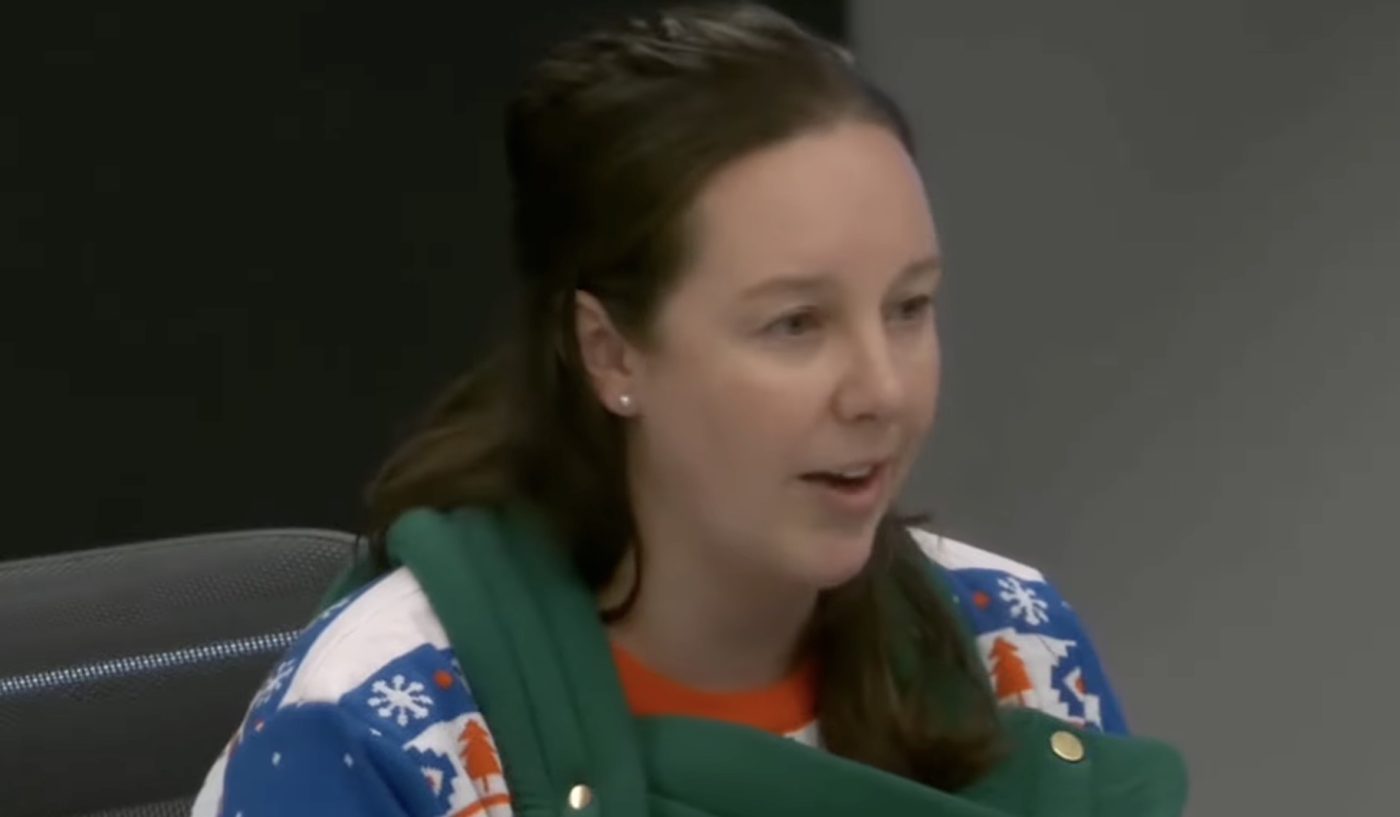

TriMet Board Member Tyler Frisbee speaking at Wednesday’s Trimet board meeting.
UPDATE, 12:30 on Sunday 12/14: Sorry for such a brief post folks. It was end of a long week and I barely finished this video before I had to quit and get to my son’s basketball game. I posted it in the car on the way to his game! Anyways, Judging from comments a lot of you figured out what it was about.
Quick context: Tyler Frisbee (longtime former policy advisory to U.S. Congressman Earl Blumenauer, former Deputy Direcrtor of Government Affairs and Policy Development at Metro, now Director of the Institute of Metropolitan Studies at PSU) weighed in on the 82nd Ave Transit Project at the TriMet Board Meeting on 12/10.
Below are her comments (which I’ve edited for brevity):
“We actually have two very different visions of 82nd that are finally clashing with each other in this moment. We literally had someone get up and say, ’82nd is a highway, stop treating it like it’s a neighborhood.’ And then we had people get up and say, ’82nd is my neighborhood. We’ve been asking for it to be a neighborhood street and serve the neighborhood for 30 years.’ That, to me, is the question, right? This is the moment: is 82nd a highway? Or is it a community? Is it a street that serves the community that it’s in?
And it is correct that it was built as a highway over 100 years ago. It is an incredibly different landscape and neighborhood than it was when it was built. And I would argue that the decision has actually already been made. It is no longer a highway. That [decision] was made with the transfer of 82nd to the City of Portland, and it was made when we started this project, right? You don’t run frequent service down a highway. If that is what we intend that road to be, then we shouldn’t be building sidewalks on it. We shouldn’t be building bus improvements on it. But in response to what we heard from the community, they’ve been organizing for that to be a different kind of street.
I understand people’s attachment to the way a road was built over 100 years ago, but I think there has been really clear discussion that that community looks really different now, particularly in the last 30 to 40 years, it has changed dramatically. And there have been a series of decisions that say we need to change the road to reflect the community and the landscape that it’s in now. And to me, the most ambitious transit project on our busiest bus line in the entire region that will only grow, right? That is a part of our city that is only growing, and more people are moving there, and we are seeing more transit need along that space. That is a very clear answer about where that community is going and what that community needs from us in the future. That does not disregard the fact that change is hard, and that does not disregard the fact that there are folks who have built up entire approaches to their business based on the way that street was.
But we are building a project that’s not meeting the next five years of need. We’re building a project that needs to meet the next 20,30, 40,50, years of need.
Big picture, I think that’s where we are. And you know, Michael [Kiser, TriMet Interim Director of Major Projects], I’ve heard you talk about being a community builder and a city builder — that is what this project needs to do. And some extent, actually, the community is built, right? They went ahead and built without the transportation service, without the transit service, and we’re just trying to catch up. [Bless you, baby. Good job (to her baby with her on the dais!)] This is where things get interesting, right? And it is where you can say, ‘You know, yes, I hear you have a concern around the Left turn lanes here. Here are different ways we can mitigate that. Let’s look at some of these options. Is it going to be perfect? No? Is your clientele going to change? Right?’ Each of those stores has an individual proportion in terms of who gets there by bus, who gets there walking, and who gets there by driving. That is going to change after this project, but our goal is that we are bringing enough new ridership there by the bus, and you know, PBOT is working to make it possible by foot, that they are actually seeing more folks visiting.
And that is my sort of second big picture comment. I have heard a lot from folks asking for we want more data on business impact. And my response has been, ‘You know what? When we look at BAT [Business Access & Transit] implementation across the country, much less internationally, it shows almost uniformly an increase in foot traffic and in support for the businesses that rely and depend on that foot traffic, and frankly, even businesses that are that think of themselves as car dependent, actually often see a much more significant increase in their foot traffic and folks coming off the bus that ends up being more than making up for any potential car loss.
What I have had said to me is, ‘Well, we don’t believe that,’ basically, or ‘It’s different here,’ and it is hard for me to then get to the next stage of a conversation, because it’s like, well, what are we going to turn around for you, that you’re going to believe if your answer is always just that data doesn’t meet my needs, that data is not what I want. When we look at the best data we have across the country, real life, BAT implementation and its impact on businesses, to me, it is very heartening. And what it says it’s a story of resiliency. It’s a story of these projects. They change the way that folks get there, but overall they’re bringing more folks to the door of your business.
So I guess I’m using this as a little bit of a soapbox to kind of push back, because I don’t know how to keep having the conversation of just like, ‘I don’t believe that.’ And I think the question that we have that we want to work with folks on is, ‘How can we help make this work so that it’s not about preserving the way that people get to you right now. It is about what does this look like in the future?’ What do your next 10, 20, 30 years as a business look like around 82nd because let me tell you, that community is changing, and you’re going to have folks getting there differently no matter what. And frankly, sometimes just having the same conversation six different times doesn’t actually change the conversation.
And so I would encourage us to think about how we can have the important conversations and the effective conversations with people that understand their needs and try to help find a good path forward. If they don’t want to participate in that, having that conversation six times is not useful, and so I want to find a way to work with all of our folks, with all the community folks who live along there and make sure everyone’s voice is heard, to find a way to meet needs and address needs when we can and acknowledge that this community has changed and is changing, and we need to meet that.”