
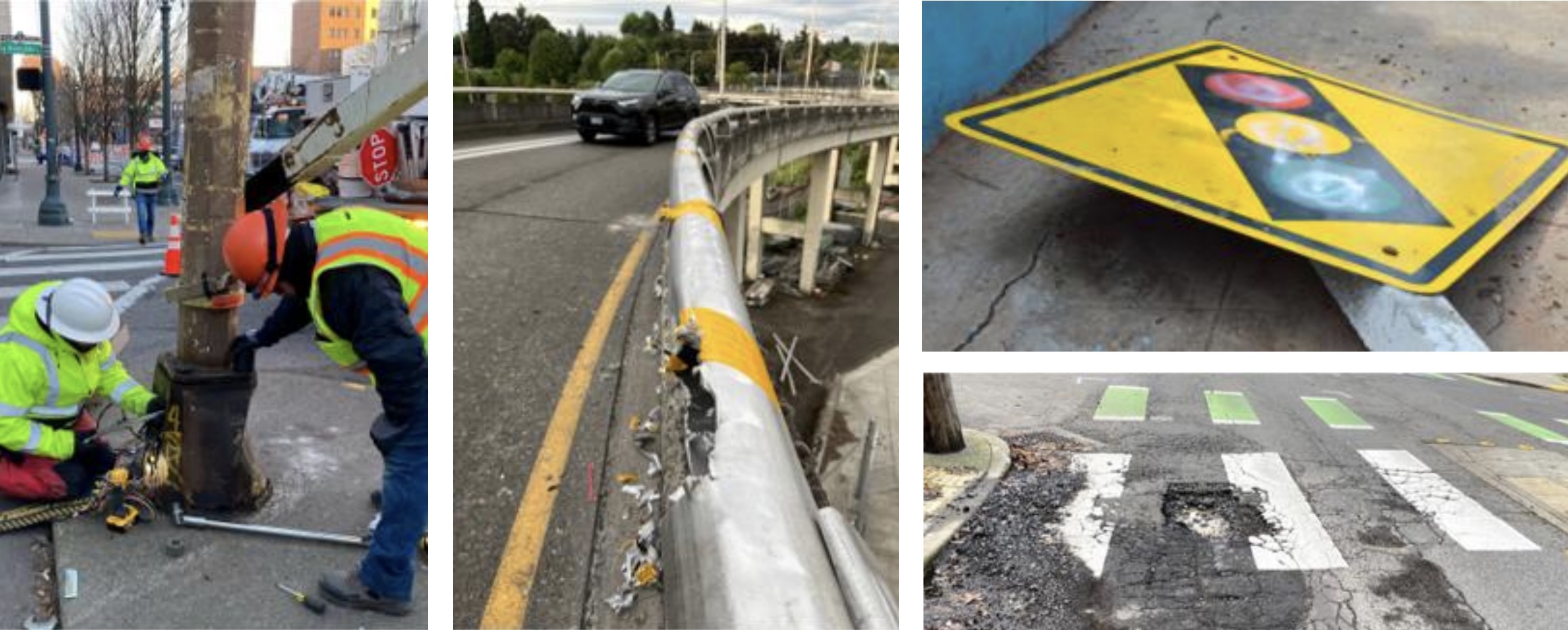
Looking to stem a financial crisis that’s been years in the making, the Portland City Council will host an important debate at meetings tomorrow (Wednesday, 4/15) that, if ultimately supported, would result in a significant increase to their annual revenue. On the agenda of the Committee of the Whole is an ordinance to adopt a transportation utility fee (TUF) and the regular City Council meeting will consider a resolution to adopt a street damage restoration fee (SDRF). If both fees were passed as currently proposed, they’d generate an estimated $69 million a year in new revenue.
To put that number into perspective, $69 million is about 40% of PBOT’s annual General Transportation Revenue. GTR is important because it’s discretionary — meaning the money is not obligated to specific projects or grant sources and PBOT can spend it however they see fit. This new funding would be very significant to PBOT given that just over 70% of its current budget is restricted.
The background
The TUF, which would be an additional line-item on Portlanders’ utility bills, could bring in about $47 million a year. The City’s current plan is to charge a flat rate of $12 per household, and $8.40 for folks who live in multifamily dwellings (a low-income discount program would also be created). The commercial rate would be 4.3% of the business owner’s utility bill. The SDRF would be charged to agencies and contractors who cut open city-owned streets to perform projects (these could be public agencies or private companies). In the past, PBOT would foot the bill to repair damaged pavement. The current plan is to add a $10.38 per square-foot charge to all “street opening permits” to account for the damages. The city estimates that would bring in about $22 million per year in new revenue.

Funds from the SDRF would be spent on damage done by the permit holder and the rest would go toward administration of the program. 75% of funds raised by the TUF would be spent on general maintenance and street preservation, including “those that support the City’s Vision Zero goals.”
Council members have already voiced strong support for both of these fees and there doesn’t appear to be strong, organized opposition to either of them (so far Councilor Dan Ryan is the only member to lodge a “no” vote). The only questions that remain appear to be how the fees might be tweaked around the edges.
The amendments
Given that the TUF ordinance language says how “no less than 75%” of the revenue must be spent, there’s likely to be spirited debate on Council about how to spend the remaining 25%. We already have two proposed amendments related to that issue.
District 3 Councilor Tiffany Koyama Lane wants the ordinance to state that no less than 25% of the revenue must be spent on, “activities that move us closer to our Vision Zero goals.” Koyama Lane’s amendment would also explicitly prohibit the money from being spent on “major roadway expansion.” She also wants to add language that would call out the Sidewalk Improvement and Paving Program (SIPP) as one of the eligible expenditures. SIPP was passed by Council in May 2025 as an unfunded mandate to build sidewalks in Districts 1 and 4.
This amendment makes sense for Koyama Lane, given that she’s positioned herself as Council’s Vision Zero champion. But keep in mind, the ordinance as written would already fund Vision Zero-related activities. The language says that at least 75% of the revenue must include, “maintenance activities that help the City achieve Vision Zero goals,” which includes, “bicycle and pedestrian facility maintenance.”
District 2 Councilor Sameer Kanal wants to strengthen the City’s commitment to a low-income discount. His amendment would force city leaders to work with the Public Works Service Area (of which PBOT is a part of) to provide a report on how to implement a TUF discount program and deliver to City Council before the end of this year.
District 4 Councilor Eric Zimmerman wants to make sure the TUF provides revenue directly to the SIPP program. Zimmerman’s amendment would add SIPP to Vision Zero as one of the investment areas that some of the maintenance projects align with when PBOT is considering how to spend the 75%. When it comes to the remaining 25%, Zimmerman wants the ordinance to dedicated half of it (12.5%) to the SIPP and the remaining half to go to Vision Zero.
District 4 Councilor Mitch Green has put forward a legislative concept — not an official amendment. Green’s proposal would create a two-part rate structure for the TUF: a fixed charge of $3 per billed account on the lot per month, plus a variable fee of $0.10 per 100 square-feet of utilized zoned land usage for each billable account per month. At the April 2nd meeting of the Committee of the Whole (where the TUF was last discussed), Green said he believes his idea would, “Align better with cost-causation principles” and that it, “sends a price signal to use our land more efficiently.” Green added that the proposal would also incentivize land owners to create more units within existing land, thus discouraging sprawl.
Note that Green’s proposal — which he referred to as, “quite elegant” and “really smart” — is not an amendment. That’s because he understands the urgency of the moment and wants the current proposal to pass as-is. At that April 2nd meeting he successfully passed an amendment that would allow Council to change the design of the fee (not the amount) at a later date. He wants his proposal to be carried forward in future discussions in hopes that after the existing fee passes, he can convince a majority of his colleagues to adopt his idea.
The politics
These new fees have more than enough support on City Council to pass. There will be some discussion tomorrow about relatively minor details of how the money is spent, but I don’t see a lot of disagreement among councilors. The TUF will be discussed in committee at 2:00 pm tomorrow and the SDRF resolution will be in front of full City Council at their 6:00 pm meeting later that same day.
If these fees pass, they’d go into effect January 1, 2027 and Council would have an opportunity to make adjustment every two years beginning in 2029.