

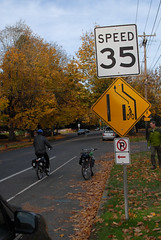
anything to slow people down.
(Photos © J. Maus)
Excessive speed. It’s a killer and it’s on the loose on streets throughout Portland.
It’s a problem and there are many ways to combat it. One of those is to reduce speed limits. But, as you’ll find out below, that’s far easier said than done.
Currently the Oregon Department of Transportation (ODOT) holds the power to set speed limits in our state. Even on local roads, where they don’t have jurisdiction in terms of maintenance or engineering, all speed change requests must go through ODOT. This process is a thorn in the side of our local Bureau of Transportation.
The head of PBOT, Portland Mayor Sam Adams wants to change that. Gaining control over speed limits is one of his top three priorities for improving traffic safety. In a letter to ODOT about the issue back in May, Adams said he’d like to “streamline” the “sometimes lengthy process” to alter speed limits on streets within city limits (he also told The Oregonian last night that the ODOT process is “ridiculous”).
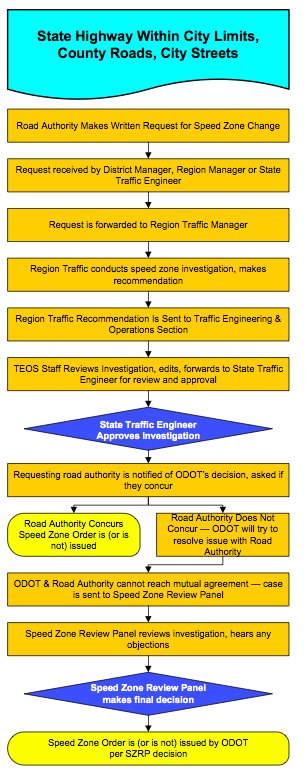
So, what exactly is that process? Why are Adams and others all up in arms about it? The graph below (created by ODOT) might give you an idea of why some think it could be streamlined:

In light of a spate of recent traffic collisions involving humans traveling at much different rates of speed, we heard from ODOT spokesman Michael Mason. Mason shared a link to ODOT’s Traffic-Roadway Section Speed Zoning Program website.
On that site, ODOT says that their speed zones are based on “careful” studies. They also address the fact that lowering speed limits might not solve the problem:
“Many people believe that lowering posted speeds will mean fewer accidents, but studies do not prove this. Unrealistically low speeds frustrate many drivers, resulting in numerous speeding violations and unsafe driving, actually causing more accidents. Some motorists may try to make up time by taking a shortcut through residential or other areas that are not suited to higher speeds and increased numbers of cars.”
If a city or county wants to have a speed changed, they make a request to ODOT for a review of the area in question. In a subsequent investigation, ODOT takes a look at factors like accident history, “roadside culture” (which I assume to mean the environmental context of the area), traffic volumes, width of the roadway, and so on.
A key part of any speed limit analysis is what’s known as the “85th percentile speed” (anyone who has worked with PBOT on neighborhood traffic safety issues has heard them mention this concept). The 85th percentile speed is the point at or below which 85 percent of the vehicles are traveling. According to ODOT, that speed is used “as an indication of the speed most drivers feel is reasonable and safe.”
Once ODOT completes their investigation, a detailed report is sent out. If the city or county agrees with ODOT, the new speed zone is established. If they don’t, the request goes to the Speed Zone Review Panel. That panel is filled with reps from the Oregon Transportation Safety Committee, the Oregon State Police, the Association of Oregon Counties, the League of Oregon Cities, and the Department of Transportation. They read ODOT’s recommendation and listen to testimony from local authorities before making a final decision.
Speed limits are just one piece of the puzzle with this problem. Speed limit changes don’t mean anything without enforcement. And, no matter what remedy we come up with, we’ll be fighting an uphill battle until there’s a complete shift in culture and behavior that human life is more important than arriving at a destination a few seconds earlier.