

A pioneering traffic design and engineering specialist who rode his bike to work every day and helped forge PDOT’s bike-friendly disposition, passed away on October 30th after a long bout with brain cancer.
Portland native Doug McCollum graduated from Portland State University in 1985, was hired by the Water Bureau one year later and then transferred to PDOT in 1986.
His daughter Caitlin works in the Transportation Options division at PDOT. In an email to me shortly after her dad passed away, she recalled,
“When I was in kindergarten and it was “parent career day” or something like that, he brought road signs. When I was older and explaining what he did for a living it was “he puts in speed bumps”, and later “bike lanes”.”
When news of McCollum’s passing became known, several colleagues were quick to share their glowing memories of the man and his work. From talking and emailing with several of them it also became clear that McCollum brought a bike-sensitive perspective to his work and that he was an early, and important, contributor to making Portland the most bike-centric big city in America.
“Doug was a wonderful person and traffic engineer who helped design many of Portland’s streets and intersections to make them safer and more hospitable for cyclists.”
— David Parisi
David Parisi, a planner and consultant, said McCollum was “extremely innovative” and a “wonderful person and traffic engineer who helped design many of Portland’s streets and intersections to make them safer and more hospitable for cyclists.”
Catherine Ciarlo, who led the BTA from 1998 to 2005 and is now on the Portland Planning Commission, worked with McCollum on several projects. She recalled how he was willing to find a solution to making room for bikes on NW Lovejoy when the streetcar was being built.
With the streetcar tracks being installed on an already narrow road, there was some talk of having no bike lanes at all. But according to Ciarlo, McCollum openly sought ideas and possible solutions. “I sent him a bunch of photos from the Netherlands and other places where they dealt with bike lanes and streetcar tracks and stops.”
The result was bike lanes on Lovejoy (which Ciarlo admits aren’t the best/safest but are better than nothing) that mount the sidewalk and go behind the streetcar stop.
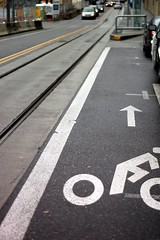
of bike lanes on NW Lovejoy.
McCollum was, “One of Portland’s pioneering engineers for bikes” according to Mia Birk. Birk is the former bike program manager for PDOT and worked closely with McCollum for six years. Birk told me that McCollum was one of the first bike-centric engineers in the country and that he “embraced bike transportation as part of his job.”
Birk credited McCollum’s open-minded approach to traffic engineering and said that he, “had no hesitation to put in bike lanes where they needed to go,” and that, “he had a view that bikes were simply another mode of traffic (not as common of an idea in the early 1990s as it is now).”
As testament to his thinking about integrating bike lanes into projects, Birk held up the example of SE 7th Ave. She recalled that in 1996 it was a four-lane street with on-street parking. When the street was slated for re-paving, Birk said she got a call from the maintenance bureau saying, “What should we do?”.
Birk called McCollum and said he needed to come up with a plan. His plan was to turn four lanes into three and add a bike lane. “In his opinion, that configuration would not just give dedicated space to bikes, it would also improve safety,” remembered Birk.
“He knew it would impact (motor vehicle) traffic flow but we needed to do it…and he took some heat for that decision, but he thought it was a right thing to do.”
In the end, Birk says safety on SE 7th improved and motor vehicle crashes decreased.
Birk also credited McCollum for the installation of bike lanes on NE Multnomah in front of the Rose Garden Arena (where the Blazers play). Birk recalled that arena plans called for no bike lanes on the street. That plan spurred the BTA to file a lawsuit to demand bike lanes.
Once McCollum got involved in the project, recalled Birk, he acknowledged that perhaps a mistake had been made in the plans and that bike lanes could be fit into the project; “He just thought it was the right thing to do.”
McCollum’s stance on the bike lanes, said Birk, “helped persuade some of the old-guard engineers at PDOT. Even though they weren’t bicyclists, Doug helped them realize that things were changing and they eventually agreed to install the bike lanes (and the BTA dropped the lawsuit).”