
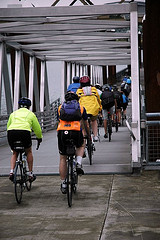

Eastbank Esplanade by bike.
(Photo © J. Maus)
Metro, is set to join Portland, Vancouver (WA), Hillsboro, Gresham, Tigard, Tualatin, and 30 other cities across the nation in an effort to document the number of people biking and walking on multi-use trails.
The counts are organized by the National Bicycle and Pedestrian Documentation Project and will take place at approximately 50 locations through the Portland-Vancouver metro region from today through September 14.
In a press release about the project, Metro Council president David Bragdon — who is set to embark on a trail study tour to Amsterdam and Copenhagen next month — said,
“The lack of region-wide trail user data has been identified by policy makers, planners and trail advocates as one of the greatest barriers to the development of more regional trails…
“I know that if we build them they will come, but some people need to see the data to understand why an interconnected trail system is such an important and timely investment for our future.”
Metro says the results of the trail count project will be used by planners around the country to “evaluate the cost effectiveness of trail investments, forecast demand for new trails, and track overall trends in trail use.”
Volunteers helping Metro with the counts will be busy at the following locations and times in the coming days:
- the East Bank Esplanade at the Steel Bridge – Tuesday (9/9) from 4 to 6 p.m.;
- Springwater On The Willamette at OMSI on Thursday (9/11) from 4 to 6 p.m., then again on Sunday (9/14) from 12 to 2 p.m.;
- The Waterfront Park path where it intersects the Morrison Street path on Tuesday (9/9) from 4 to 6 p.m.
Here is some background on the National Bicycle and Pedestrian Documentation Project:
–The National Bicycle and Pedestrian Documentation Project was initiated in 2003 by the Institute of Transportation Engineers (ITE) Pedestrian and Bicycle Council. ITE publishes a journal on vehicle counts known as the “ITE Trip Generation Manual,” which is used by transportation departments around the country to model roadway demand. Since no comparable document exists for bike and pedestrian trips, modelers lack data to accurately assess demand for non-motorized transportation infrastructure, such as trails.