
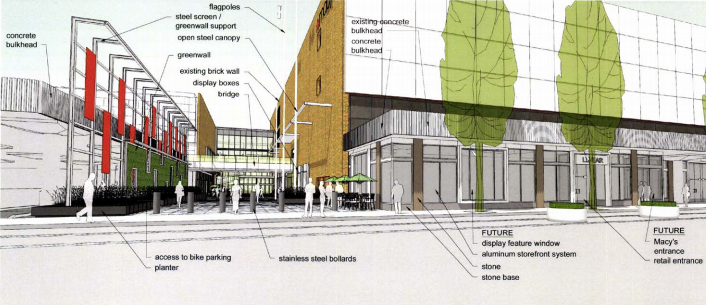
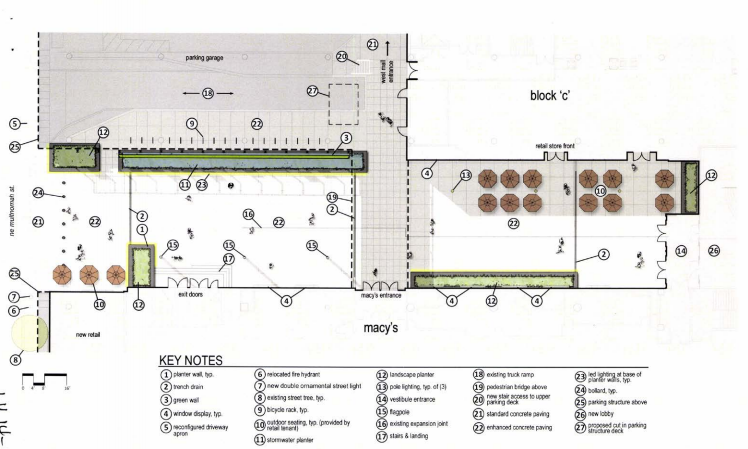
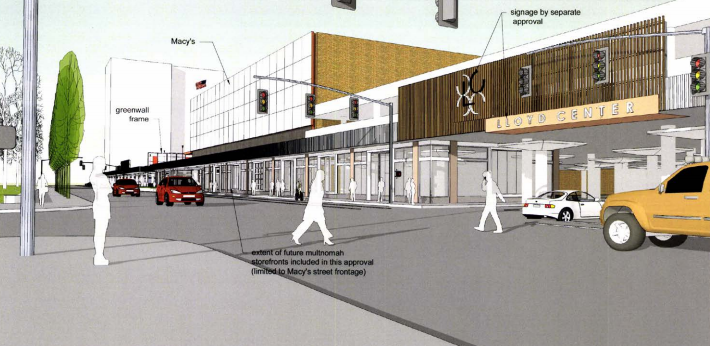
(Images: Waterleaf Architecture via City of Portland. Click to enlarge.)
After decades of keeping its shops (and Portland’s most famous skating rink) behind the bars of its parking garage, the Lloyd Center is planning a change.
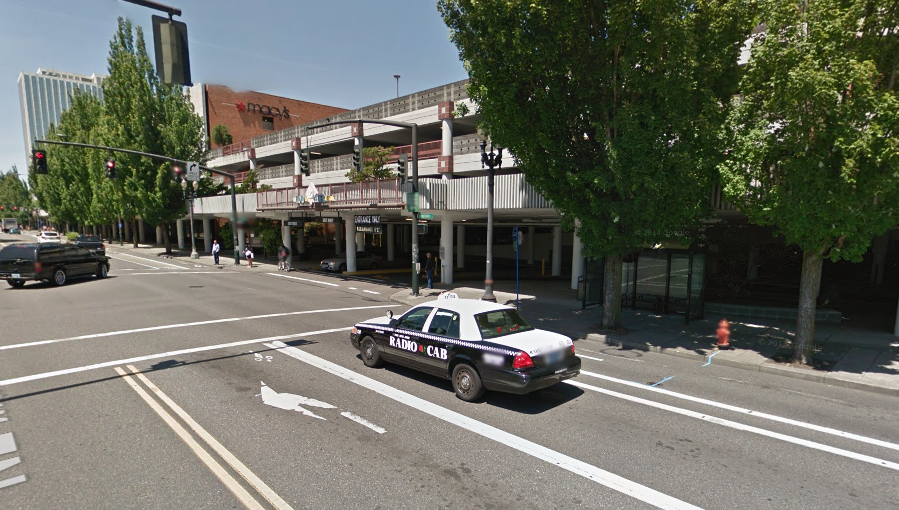
As we reported last winter, the new owners of the mall have planned a new “grand entrance” that will slice away part of the rarely crowded garage in order to welcome foot and bike traffic from Multnomah Street, Holladay Park and the Lloyd Center MAX station.
The city published the first detailed architectural renderings last week, part of preparations for a public hearing about the new design.
According to the documents, the new mall entrance would create a 10,825-square-foot plaza with stormwater and landscape planters, outdoor seating areas and a “green wall” screening the garage with covered bike parking just behind it.
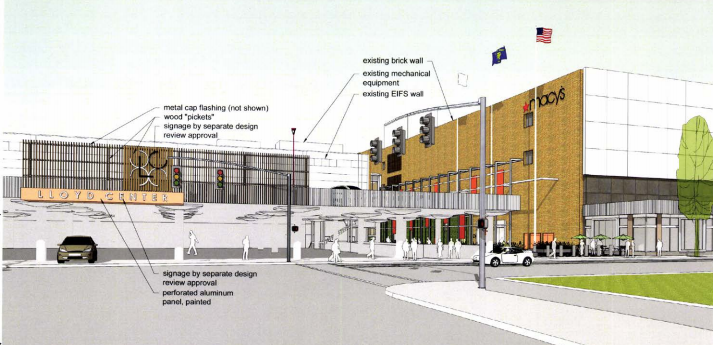
The mall also hopes to build a row of several aluminum storefronts stretching to the east of the entrance, turning the mostly dead row of pillars that currently faces Multnomah into sidewalk-facing retail.
The remodel is a change of course for Portland’s largest shopping mall, which was purchased for $148 million in June 2013 by Dallas-based Cypress Equities. A few months later, Nordstrom announced that it would close its anchor store. Malls are struggling across the country amid retail competition from Amazon and other discounters.
In that environment, Cypress’ investment in the Multnomah entrance seems to be a vote of confidence in the mall itself and in Multnomah Street, which was redesigned in 2012 to include protected bike lanes. Local property owners supported the redesign, saying it would calm auto traffic, make the street more pleasant to spend time on and lead to street retail development.
Advertisement

Last January, former city Transportation Director Tom Miller, who helped strike the deal to change Multnomah, said he believed redeveloping the area’s many surface parking lots could create “one of America’s truly great streets.”
In a tour of the nearby Hassalo on Eighth retail/apartment development on Monday, American Assets Trust CEO John Chamberlain cited the mall remodel as one of several reasons he was willing to bet on the rising appeal of the Lloyd District as a residential and street retail hub.
The rapidly advancing plans for the area are not unlike the “second downtown” that California oil millionaire Ralph Lloyd envisioned in 1923 when he bought the huge tracts of land north of Sullivan’s Gulch.
After Lloyd failed (despite extensive lobbying) to convince governments to kickstart his vision by moving their offices to his property, he and his children had decided to develop the biggest slice of their property as an innovative new use of urban real estate in the 1950s: a shopping mall.